Insurance and Ransomware

As ransomware becomes more common, I’m seeing more discussions about the ethics of paying the ransom. Here’s one more contribution to that issue: a research paper that the insurance industry is hurting more than it’s helping.

However, the most pressing challenge currently facing the industry is ransomware. Although it is a societal problem, cyber insurers have received considerable criticism for facilitating ransom payments to cybercriminals. These add fuel to the fire by incentivising cybercriminals’ engagement in ransomware operations and enabling existing operators to invest in and expand their capabilities. Growing losses from ransomware attacks have also emphasised that the current reality is not sustainable for insurers either.

To overcome these challenges and champion the positive effects of cyber insurance, this paper calls for a series of interventions from government and industry. Some in the industry favour allowing the market to mature on its own, but it will not be possible to rely on changing market forces alone. To date, the UK government has taken a light-touch approach to the cyber insurance industry. With the market undergoing changes amid growing losses, more coordinated action by government and regulators is necessary to help the industry reach its full potential.

The interventions recommended here are still relatively light, and reflect the fact that cyber insurance is only a potential incentive for managing societal cyber risk.They include: developing guidance for minimum security standards for underwriting; expanding data collection and data sharing; mandating cyber insurance for government suppliers; and creating a new collaborative approach between insurers and intelligence and law enforcement agencies around ransomware.

Finally, although a well-functioning cyber insurance industry could improve cyber security practices on a societal scale, it is not a silver bullet for the cyber security challenge. It is important to remember that the primary purpose of cyber insurance is not to improve cyber security, but to transfer residual risk. As such, it should be one of many tools that governments and businesses can draw on to manage cyber risk more effectively.

Basically, the insurance industry incents companies to do the cheapest mitigation possible. Often, that’s paying the ransom.

News article.

Premium Domain Names – transcom.uk
Transcom ISP – The UK’s Best Business ISP
DoubleCheck any website at doublecheck.uk

The Future of Mobile: Trends from Mobile World Congress 2021

Today we wrap up Mobile World Congress (MWC) 2021. Whether you joined online or attended the hybrid conference in person, one thing is certain: today’s groundbreaking technology is paving the way for our future connectivity. Fittingly, the theme of this year’s event was Connected Impact, representing the role mobile connectivity plays in an ever-changing world, where flexibility and adaptability are critical. Here are four of the key consumer takeaways from this year’s conference:   

1. 5G Is Connecting Our World  

COVID-19 truly put the power of online connectivity to the test. While 2020 was supposed to be the year of 5G connectivity, this was put on pause as the world faced social and financial uncertainty. Instead, the spotlight fell on legacy technologies to create a new normal for users. Consumers quickly had to figure out how to live their best lives online — from working from home to distance learning to digitally connecting with loved ones.  

To help foster online connectivity for all, 5G must step back into the spotlight. Although publicly available 5G networks have been around for two years, it is unlikely that many users see much of a difference between 5G and LTE. For users to feel the impact of 5G, mobile carriers must expand the frequencies at the low and high ends of the spectrum, which is where 5G networks operate.   

Qualcomm led the 5G announcements on Monday with the unveiling of its second-generation Qualcomm 5G RAN Platform for Small Cells (FSM200xx). This platform brings major enhancements to radio frequencies and is designed to take millimeter wave performance to more places: indoors, outdoors, and around the globe. According to Qualcomm, these advancements aim to facilitate greater mobile experiences and accelerate 5G performance and availability to users everywhere— thus reshaping opportunities for homes, hospitals, offices and more.  

2. New Wearables to Watch   

Technology and connectivity played a crucial role in our daily lives in 2020—and therefore, unsurprisingly, spending on health and wellness tech grew by 18.1%.  But now, we must ask ourselves what role technology will play post-lockdown.   

While they did not have a physical appearance at MWC this year, Samsung provided a sneak of their new wearables: they introduced the One UI Watch user experience, a new interface designed to make the Galaxy Watch and smartphone experience more deeply connected. Samsung also announced its expanded partnership with Google, promising to deliver better performance, longer battery life, and a larger ecosystem of apps to the Galaxy Watch. Although they did not unveil any hardware at MWC, Samsung did ensure that users can expect to see new devices like the Galaxy Z Fold 3 and the Galaxy Watch 4 at their Galaxy Unpacked event happening in July/August of 2021.  

3. A Welcomed Distraction: Tablets for Entertainment   

2020 also shone a bright light on the key role technology plays in the consumption and distribution of creative arts and entertainment. Lockdown put an even greater responsibility on streaming platforms — and the devices they are accessed on — to deliver content right to people’s homes. 

 To help meet entertainment consumption needs, Lenovo announced not one, not two, but five new Android tablets during MWC. Its largest tablet is the Yoga Tab 13, which features a built-in kickstand, 13-inch display with 2,160 x 1,350 resolution, up to 12 hours of battery life, and more. Lenovo is pitching this model as its “portable home cinema,” perfect for streaming on the go. It also unveiled the Yoga Tab 11 and the Tab P11 Plus, which are expected to be available in EMEA in July following the Yoga Tab 13’s June release date. For users hoping for a more compact, budget-friendly device, Lenovo also announced the Lenovo Tab M8 and the Lenovo Tab M7. Whichever model you select, one thing it certain — digital devices have and will continue to be instrumental in consumer entertainment.   

4. Mobile Security in a More Connected World  

These exciting announcements are a great representation of what the future holds for mobile technology and greater connectivity. The advancements in mobile connectivity have already made a positive impact on consumer lifestyles, but the rise in popularity of these devices has also caught the attention of cybercriminals looking to exploit consumers’ reliance on this technology.   

More time spent online interacting with various apps and services simultaneously increases your chance of exposure to cybersecurity risks and threats. Unsurprisingly, cybercriminals were quick to take advantage of the increase in connectivity throughout 2020. McAfee Labs saw an average of 375 new threats per minute and a surge of hackers exploiting the pandemic through COVID-19 themed phishing campaigns, malicious apps, malware and more. For users to continue to live a connected life, they will need to take greater care of their online safety and ensure that security is top-of-mind in any given situation. Taking these precautions will provide greater peace of mind in the new mobile-driven world.   

Stay Updated

To stay updated on all things McAfee and on top of the latest consumer and mobile security threats, follow @McAfee_Home  on Twitter, subscribe to our newsletter, listen to our podcast Hackable?, and ‘Like’ us on Facebook. 

The post The Future of Mobile: Trends from Mobile World Congress 2021 appeared first on McAfee Blogs.

Premium Domain Names – transcom.uk
Transcom ISP – The UK’s Best Business ISP
DoubleCheck any website at doublecheck.uk

Intuit to Share Payroll Data from 1.4M Small Businesses With Equifax

Financial services giant Intuit this week informed 1.4 million small businesses using its QuickBooks Online Payroll and Intuit Online Payroll products that their payroll information will be shared with big-three consumer credit bureau Equifax starting later this year unless customers opt out by the end of this month.

Intuit says the change is tied to an “exciting” and “free” new service that will let millions of small business employees get easy access to employment and income verification services when they wish to apply for a loan or line of credit.

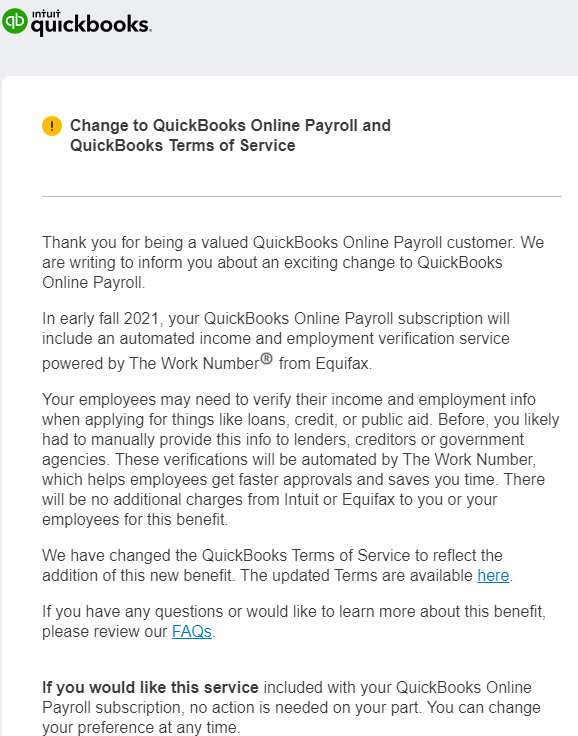
“In early fall 2021, your QuickBooks Online Payroll subscription will include an automated income and employment verification service powered by The Work Number from Equifax,” reads the Intuit email, which includes a link to the new Terms of Service. “Your employees may need to verify their income and employment info when applying for things like loans, credit, or public aid. Before, you likely had to manually provide this info to lenders, creditors or government agencies. These verifications will be automated by The Work Number, which helps employees get faster approvals and saves you time.”

An Intuit spokesperson clarified that the new service is not available through QuickBooks Online or to QuickBooks Online users as a whole. Intuit’s FAQ on the changes is here.

Equifax’s 2017 megabreach that exposed the personal and financial details of 145.5 million Americans may have shocked the public, but it did little to stop more than a million employers from continuing to sell Equifax their employee payroll data, Bloomberg found in late 2017.

“The workforce-solutions unit is now among Equifax’s fastest-growing businesses, contributing more than a fifth of the firm’s $3.1 billion of revenue last year,” wrote Jennifer Surane. “Using payroll data from government agencies and thousands of employers — including a vast majority of Fortune 500 companies — Equifax has cultivated a database of 300 million current and historic employment records, according to regulatory filings.”

QuickBooks Online user Anthony Citrano posted on Twitter about receiving the notice, noting that the upcoming changes had yet to receive any attention in the financial or larger media space.

“The way I read the terms, Equifax gets to proactively collect all payroll data just in case they need to share it later — similar to how they already handle credit reporting,” said Citrano, who is founder and CEO of Acquicent, a company that issues non-fungible tokens (NFTs). “And that feels like a disaster waiting to happen, especially given Equifax’s history.”

In selling payroll data to Equifax, Intuit will be joining some of the world’s largest payroll providers. For example, ADP — the largest payroll software provider in the United States — has long shared payroll data with Equifax.

But Citrano said this move by Intuit will incorporate a large number of fairly small businesses.

“ADP participates in some way already, but QuickBooks Online jumping on the bandwagon means a lot of employees of small to mid-sized businesses are going to be affected,” he said.

Why might small businesses want to think twice before entrusting Equifax with their payroll data? The answer is the company doesn’t have a great track record of protecting that information.

In the days following the 2017 breach at Equifax, KrebsOnSecurity pointed out that The Work Number made it a little too easy for anyone to learn your salary history. At the time, all you needed to view someone’s entire work and salary history was their Social Security number and date of birth. It didn’t help that for roughly half the U.S. population, both pieces of information were known to be in the possession of criminals behind the breach.

Equifax responded by taking down its Work Number website until it was able to include additional authentication requirements, saying anyone could opt out of Equifax revealing their salary history.

Equifax’s security improvements included the addition of four multiple-guess questions whose answers were based on publicly-available data. But these requirements were easily bypassed, as evidenced by a previous breach at Equifax’s employment division.

The Work Number is a user-paid verification of employment database created by TALX Corp., a data broker acquired by Equifax in 2007. Four months before the epic 2017 breach became public, KrebsOnSecurity broke the news that fraudsters who specialize in tax refund fraud had been successfully guessing the answers to those secret questions to reset TALX account PINs, which then let them view past W-2 tax forms for employees at many Fortune 500 companies.

Intuit says affected customers that do not want this new service included must update their preferences and opt-out by July 31, 2021. Otherwise, they will be automatically will be opted in. According to Intuit, customers can opt out by following these steps:

1. Sign in to QuickBooks Online Payroll.

2. Go to Payroll Settings.

3. In the Shared data section, select the pencil and uncheck the box.

4. Select Save.

Premium Domain Names – transcom.uk
Transcom ISP – The UK’s Best Business ISP
DoubleCheck any website at doublecheck.uk

We Infiltrated a Counterfeit Check Ring! Now What?

Imagine waking up each morning knowing the identities of thousands of people who are about to be mugged for thousands of dollars each. You know exactly when and where each of those muggings will take place, and you’ve shared this information in advance with the authorities each day for a year with no outward indication that they are doing anything about it. How frustrated would you be?
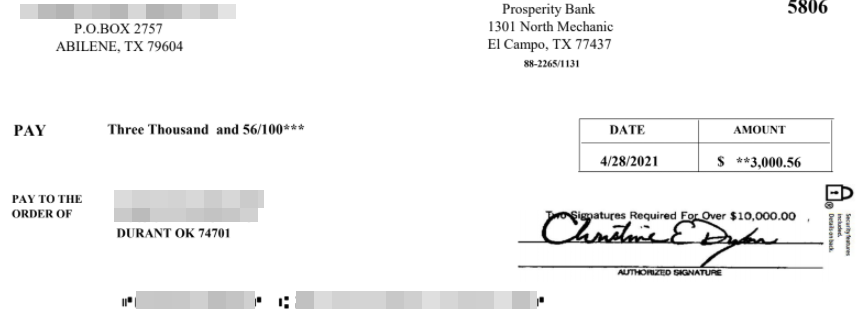
A counterfeit check image [redacted] that was intended for a person helping this fraud gang print and mail phony checks tied to a raft of email-based scams. One fraud-fighting group is intercepting hundreds to thousands of these per day.

Such is the curse of the fraud fighter known online by the handles “Brianna Ware” and “B. Ware” for short, a longtime member of a global group of volunteers who’ve infiltrated a cybercrime gang that disseminates counterfeit checks tied to a dizzying number of online scams.

For the past year, B. Ware has maintained contact with an insider from the criminal group that’s been sending daily lists of would-be victims who are to receive counterfeit checks printed using the real bank account information of legitimate companies.

“Some days we’re seeing thousands of counterfeit checks going out,” B. Ware said.

The scams used in connection with the fraudulent checks vary widely, from fake employment and “mystery shopper” schemes to those involving people who have been told they can get paid to cover their cars in advertisements (a.k.a. the “car wrap” scam).
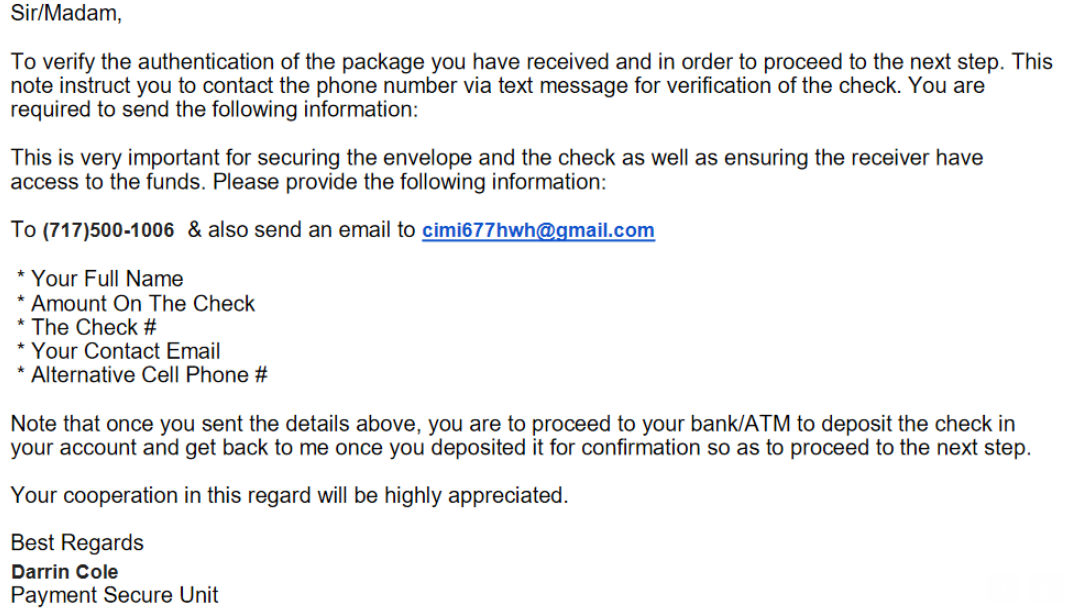
A form letter mailed out with a counterfeit check urges the recipient to text a phone number after the check has been deposited.

Most of the counterfeit checks being disseminated by this fraud group are in amounts ranging from $2,500 to $5,000. The crimes that the checks enable are known variously as “advanced fee” scams, in that they involve tricking people into making payments in anticipation of receiving something of greater value in return.

But in each scheme the goal is the same: Convince the recipient to deposit the check and then wire a portion of the amount somewhere else. A few days after the check is deposited, it gets invariably canceled by the organization whose bank account information was on the check. And then person who deposited the phony check is on the hook for the entire amount.

“Like the car wrap scam, where they send you a check for $5,000, and you agree to keep $1,000 for your first payment and send the rest back to them in exchange for the car wrap materials,” B. Ware said. “Usually the check includes a letter that says they want you to text a specific phone number to let them know you received the check. When you do that, they’ll start sending you instructions on how and where to send the money.”
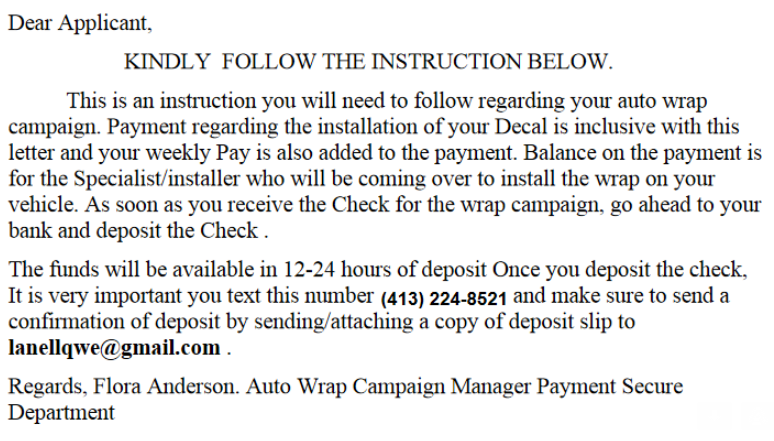
A typical confirmation letter that accompanies a counterfeit check for a car wrap scam.

Traditionally, these groups have asked recipients to transit money via wire transfer. But these days, B. Ware said, the same crooks are now asking people to forward the money via mobile applications like CashApp and Venmo.

B. Ware and other volunteer fraud fighters believe the fake checks gang is using people looped into phony employment schemes and wooed through online romance scams to print the counterfeit checks, and that other recruits are responsible for mailing them out each day.

“More often than not, the scammers creating the shipping labels will provide those to an unwitting accomplice, or the accomplice is told to log in to an account and print the labels,” B. Ware explained.

Often the counterfeit checks and labels forwarded by B. Ware’s informant come with notes attached indicating the type of scam with which they are associated.

“Sometimes they’re mystery shopper scams, and other times it’s overpayment for an item sold on Craigslist,” B. Ware said. “We don’t know how the scammers are getting the account and routing numbers for these checks, but they are drawn on real companies and always scan fine through a bank’s systems initially. The recipients can deposit them at any bank, but we try to get the checks to the banks when we can so they have a heads up.”

SHRINKING FROM THE FIREHOSE?

Roughly a year ago, B. Ware’s group started sharing its intelligence with fraud investigators at FedEx and the U.S. Postal Service — the primary delivery mechanisms for these counterfeit checks.
Both the USPS and FedEx have an interest in investigating because the fraudsters in this case are using stolen shipping labels paid for by companies who have no idea their FedEx or USPS accounts are being used for such purposes.

“In most cases, the name of the sender will be completely unrelated to what’s being sent,” B. Ware said. “For example, you’ll see a label for a letter to go out with a counterfeit check for a car wrap scam, and the sender on the shipping label will be something like XYZ Biological Resources.”

But B. Ware says a year later, there is little sign that anyone is interested in acting on the shared intelligence.

“It’s so much information that they really don’t want it anymore and they’re not doing anything about it,” B. Ware said of FedEx and the USPS. “It’s almost like they’re turning a blind eye. There are so many of these checks going out each day that instead of trying to drink from the firehouse, they’re just turning their heads.”

FedEx did not respond to requests for comment. The U.S. Postal Inspection Service responded with a statement saying it “does not comment publicly on its investigative procedures and operational protocols.”

ANY METHOD THAT WORKS

Ronnie Tokazowski is a threat researcher at Agari, a security firm that has closely tracked many of the groups behind these advanced fee schemes [KrebsOnSecurity interviewed Tokazowski in 2018 after he received a security industry award for his work in this area].

Tokazowski said it’s likely the group B. Ware has infiltrated is involved in a myriad other email fraud schemes, including so-called “business email compromise” (BEC) or “CEO scams,” in which the fraudsters impersonate executives at a company in the hopes of convincing someone at the firm to wire money for payment of a non-existent invoice. According to the FBI, BEC scams netted thieves nearly $2 billion in 2020 — far more than any other type of cybercrime.

In a report released in 2019 (PDF), Agari profiled a group it dubbed “Scattered Canary” that is operating principally out of West Africa and dabbles in a dizzying array of schemes, including BEC and romance scams, FEMA and SBA loans, unemployment insurance fraud, counterfeit checks and of course money laundering.
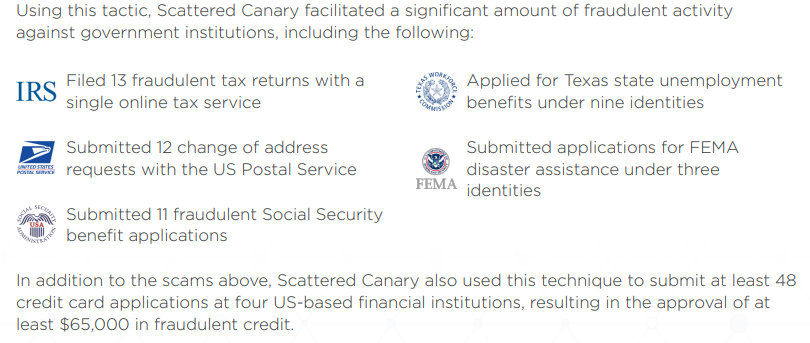
Image: Agari.

Tokazowski said he doesn’t know if the group B. Ware is watching has any affiliation with Scattered Canary. But he said his experience with Scattered Canary shows these groups tend to make money via any and all methods that reliably produce results.

“One of the things that came out of the Scattered Canary report was that the actors we saw doing BEC scams were the same actors doing the car wrap and various Craigslist scams involving fake checks,” he said. “The people doing this type of crime will have tutorials on how to run the scam, how to wire money out for unemployment fraud, how to target people on Craigslist, and so on. It’s very different from the way a Russian hacking group might go after one industry vertical or piece of software or focus on one or two types of fraud. They will follow any method they can that works.”

Tokazowski said he’s taken his share of flack from people on social media who say his focus on West African nations as the primary source of these advanced fee and BEC scams is somehow racist [KrebsOnSecurity experienced a similar response to the 2013 stories, Spy Service Exposes Nigerian ‘Yahoo Boys’, and ‘Yahoo Boys’ Have 419 Facebook Friends].

But Tokazowski maintains he has been one of the more vocal proponents of the idea that trying to fight these problems by arresting those involved is something of a Sisyphean task, and that it makes way more sense to focus on changing the economic realities in places like Nigeria, which has been a hotbed of advanced fee activity for decades.

Nigeria has the world’s second-highest unemployment rate — rising from 27.1 percent in 2019 to 33 percent in 2020, according to the National Bureau of Statistics. The nation also is among the world’s most corrupt, according to 2020 findings from Transparency International.

“Education is definitely one piece, as raising awareness is hands down the best way to get ahead of this,” Tokazowski said. “But we also need to think about ways to create more business opportunities there so that people who are doing this to put food on the table have more legitimate opportunities. Unfortunately, thanks to the level of corruption of government officials, there are a lot of cultural reasons that fighting this type of crime at the source is going to be difficult.”
Premium Domain Names – transcom.uk
Transcom ISP – The UK’s Best Business ISP
DoubleCheck any website at doublecheck.uk