Mollitiam Industries is the Newest Cyberweapons Arms Manufacturer

Wired is reporting on a company called Mollitiam Industries:

Marketing materials left exposed online by a third-party claim Mollitiam’s interception products, dubbed “Invisible Man” and “Night Crawler,” are capable of remotely accessing a target’s files, location, and covertly turning on a device’s camera and microphone. Its spyware is also said to be equipped with a keylogger, which means every keystroke made on an infected device — including passwords, search queries and messages sent via encrypted messaging apps — can be tracked and monitored.

To evade detection, the malware makes use of the company’s so-called “invisible low stealth technology” and its Android product is advertised as having “low data and battery consumption” to prevent people from suspecting their phone or tablet has been infected. Mollitiam is also currently marketing a tool that it claims enables “mass surveillance of digital profiles and identities” across social media and the dark web.

Premium Domain Names – transcom.uk
Transcom ISP – The UK’s Best Business ISP
DoubleCheck any website at doublecheck.uk

Watch Out for These 3 Online Job Scams

If you recently found yourself looking for a new job, you are far from alone. According to the Institute of Labor Economics, more Canadians were seeking new employment opportunities at the height of the pandemic than during the previous three recessions combined. Job hunters only used to have to worry about the clarity of their cover letters and impressing interviewers. Now, however, a new hurdle is in the mix in the race for a new job: online job scams. 

Here are three online job scams that you may encounter, plus a few tips on how to avoid and report them. 

1. Fake Job Ads

Fake job ads trick employment seekers into giving up their financial information. Fake job ads are more likely to appear on free sites, such as Craigslist, but they could be listed anywhere. So, no matter where you are searching, be wary that not everyone is looking for a talented individual such as yourself. They are on the hunt for sensitive personal details. 

When you are interviewing for jobs, legitimate employers are careful and intentioned about evaluating your fit for the job. For this reason, employers want to make sure they are not interviewing fake candidates, so they are likely going to want to meet you face-to-face or through a video chat. If an employer extends a job offer after a few email exchanges or an instant messenger job interview, request a more formal meeting. If they say that they would like to move fast and hire quickly, be concerned as no real employer would act that quickly. 

Guard your personal and financial information until you are 100% sure of the legitimacy of a job offer. Be on high alert if the “human resources representative” asks for your credit card or banking information to pay for training. Fake employers may also ask for your Social Insurance Number before extending a job offer letter. A great rule of thumb is to never share your SIN with anyone over the phone or over email. 

2. Phishing Emails

Between March and September 2020, 34% of Canadian respondents reported receiving a phishing message, according to a survey by Statistics CanadaPhishing emails often include malicious links that, when clicked, download malware to your device. Online job scams may not only attempt to steal your sensitive information, but they may also be phishing attempts to take over your personal devices. 

Some scammers using job offers as a guise might email people who never applied for a new opportunity. Be careful around these types of messages, urges the University of Calgary. Recruiters will most likely reach out and offer unsolicited interviews through social networking channels rather than email. Also, when you receive emails from people looking to hire you, take note of their email domain name. Is the email domain customized to the company’s name or is it a generic @gmail or @yahoo? Check the spelling of the email domain carefully too. Phishers are notoriously bad spellers and sometimes they use incorrect spelling of domain names to trick people into thinking they are the real company. 

3. Immigration Scams

Immigrating anywhere is a massive and stressful undertaking. Cybercriminals prey upon this stressful, major life event and target immigrants with enticing, but fake, job offers. The Government of Canada advises to never trust someone who says they can guarantee you a job in Canada. Also, keep an eye on the salary. Is it very high? Do your skills not completely align with the job description? Does the job seem very easy? Unfortunately, that may mean that the offer is too good to be true.  

How to Cover Your Bases

The best way to avoid falling for job scams is to know what you are looking for and to take your time when considering a new job. Check out these tips to outsmart scammers and keep your personal information and devices safe. 

1. Verify employers

Most job applications are submitted online, but if an employer is impressed by your resume, they will likely offer a screening call. When a human resources representative calls, make sure to note their name and ask for the website address of the company. Afterwards, search for the company online and the human resources representative who called you. They should show up together on a professional-looking website or a professional networking site. 

2. Read carefully

Inspect all correspondences you get from potential employers. Phishers often use language that inspires strong emotions and urges a speedy response. Strong emotions could include excitement or fear. If the email says you only have a few hours to respond or else the job will go to someone else, be skeptical. Accepting a job is a huge decision that you should be able to take at least a few days to think about. Read carefully, always hover over links to see where they redirect, and keep a level head when making decisions about your next career move. 

3. Report fraudulent activity

When you come across fraudulent activity, it is important that you report it to the correct authorities to stop it from happening to someone else. For immigration and online job scams, contact the Canadian Anti-Fraud Centre. 

4. Install security tools 

Phishers and job scammers may have gotten in contact with you with the aim of downloading malicious software on your computer. A comprehensive suite of security tools will protect you from viruses and malware that may have slipped past your eagle eye. McAfee Total Protection offers premium antivirus software, safe web browsing, and PC optimization. 

Stay Updated

To stay updated on all things McAfee and on top of the latest consumer and mobile security threats, follow @McAfee_Home on Twitter, subscribe to our newsletter, listen to our podcast Hackable?, and ‘Like’ us on Facebook.  

The post Watch Out for These 3 Online Job Scams appeared first on McAfee Blogs.

Premium Domain Names – transcom.uk
Transcom ISP – The UK’s Best Business ISP
DoubleCheck any website at doublecheck.uk

Restricting Supplier Choice Isn’t an Option to Enhance Digital Sovereignty

Digital sovereignty and strategic autonomy are phrases that are used almost daily in EU policy circles, loosely framed around the EU’s ability to carve out its own future in the digital sphere, rather than having its terms dictated from abroad. To achieve digital sovereignty in practice, having access to as broad a range of suppliers is key, not unnecessarily restricting the market.

Our ability to self-determine Europe’s digital future is at risk when we become reliant on one source, that much is clear, and has been demonstrated recently in the global supply shortage of microchips. All measures that reduce this dependency will benefit digital sovereignty, which in practice means expanding competition in the market to as many players as possible.

The means to get there are varied, and Europe is rightly seeking to build infrastructure, expand the pool of skilled experts and facilitate market entry. The EU and member states are also putting in place measures to eliminate obvious security risks in supply chains that demand an extra layer of vigilance, such as critical infrastructure, which is in the interest of national security.

But the notion that homegrown European solutions are automatically better than non-European ones – sometimes backed by measures that give European vendors and suppliers undue advantage, or which place additional hurdles for companies that handle customer data outside the EU – is misguided.

In the cybersecurity domain, in particular, limiting interoperability and vendor choice will only reduce Europe’s resilience against cyberattacks, which is a crucial element to ensuring Europe’s digital sovereignty and strategic autonomy. This is as true now as it always has been, in a sector innovating at break neck speed to meet the challenges set by our adversaries.

In this competitive market, best-in-class providers at the cutting edge of security are the ones that will make Europe more cyber-secure, irrespective of where they happen to have their headquarters or data centers.  Irrational decisions guided by protectionism should have no place in this debate. Indeed policies or practices requiring forced data localisation can often limit the benefits generated by scale and global reach, and negatively impact cyber security’s operational effectiveness.

A recent seminar organised by ECIS, the European Committee for Interoperable Systems, set out some clear principles that should guide Europe’s quest for digital sovereignty. Ensuring that the market operates as effectively as possible, supplier choice is as broad as possible, and interoperability and ability to switch suppliers is safeguarded, on the basis of clear standards, will be paramount.

That is not to say that all measures being considered are misguided. An industrial policy that improves Europe’s digital infrastructures will boost Europe’s supply of home-grown digital services and products. Countries also have legitimate reasons to safeguard their national security and are well within their rights to set criteria to this end. The real danger lies in confusing protectionism with digital sovereignty.

The post Restricting Supplier Choice Isn’t an Option to Enhance Digital Sovereignty appeared first on McAfee Blogs.

Premium Domain Names – transcom.uk
Transcom ISP – The UK’s Best Business ISP
DoubleCheck any website at doublecheck.uk

How Cyber Sleuths Cracked an ATM Shimmer Gang

In 2015, police departments worldwide started finding ATMs compromised with advanced new “shimming” devices made to steal data from chip card transactions. Authorities in the United States and abroad had seized many of these shimmers, but for years couldn’t decrypt the data on the devices. This is a story of ingenuity and happenstance, and how one former Secret Service agent helped crack a code that revealed the contours of a global organized crime ring.

Jeffrey Dant was a special agent at the U.S. Secret Service for 12 years until 2015. After that, Dant served as the global lead for the fraud fusion center at Citi, one of the largest financial institutions in the United States.

Not long after joining Citi, Dant heard from industry colleagues at a bank in Mexico who reported finding one of these shimming devices inside the card acceptance slot of a local ATM. As it happens, KrebsOnSecurity wrote about that particular shimmer back in August 2015.
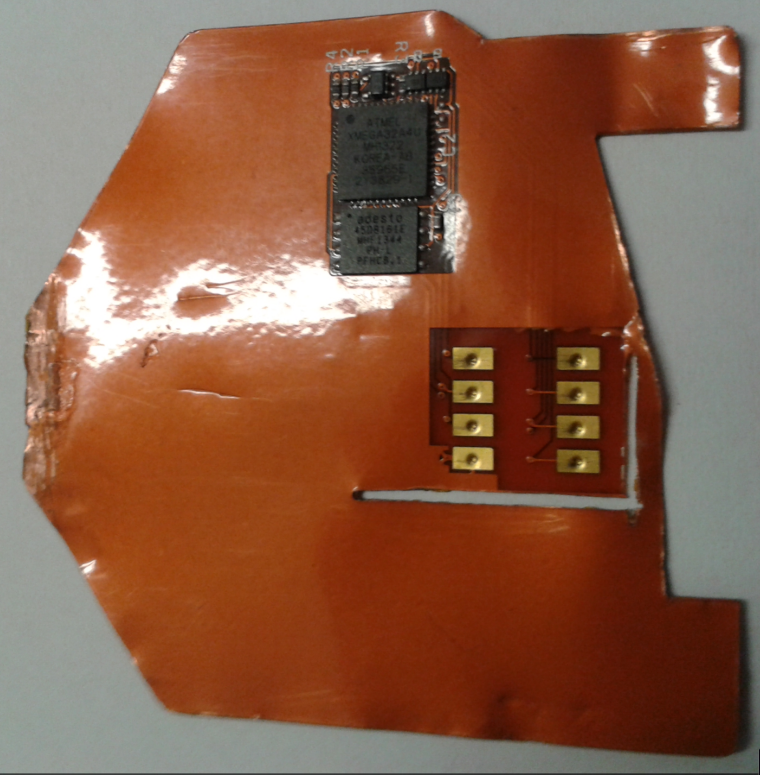
This card ‘shimming’ device is made to read chip-enabled cards and can be inserted directly into the ATM’s card acceptance slot.

The shimmers were an innovation that caused concern on multiple levels. For starters, chip-based payment cards were supposed to make it far more expensive and difficult for thieves to copy and clone. But these skimmers took advantage of weaknesses in the way many banks at the time implemented the new chip card standard.

Also, unlike traditional ATM skimmers that run on hidden cell phone batteries, the ATM shimmers found in Mexico did not require any external power source, and thus could remain in operation collecting card data until the device was removed.

When a chip card is inserted, a chip-capable ATM reads the data stored on the smart card by sending an electric current through the chip. Incredibly, these shimmers were able to siphon a small amount of that power (a few milliamps) to record any data transmitted by the card. When the ATM is no longer in use, the skimming device remains dormant, storing the stolen data in an encrypted format.

Dant and other investigators looking into the shimmers didn’t know at the time how the thieves who planted the devices went about gathering the stolen data. Traditional ATM skimmers are either retrieved manually, or they are programmed to transmit the stolen data wirelessly, such as via text message or Bluetooth.

But recall that these shimmers don’t have anywhere near the power needed to transmit data wirelessly, and the flexible shimmers themselves tend to rip apart when retrieved from the mouth of a compromised ATM. So how were the crooks collecting the loot?

“We didn’t know how they were getting the PINs at the time, either,” Dant recalled. “We found out later they were combining the skimmers with old school cameras hidden in fake overhead and side panels on the ATMs.”

Investigators wanted to look at the data stored on the shimmer, but it was encrypted. So they sent it to MasterCard’s forensics lab in the United Kingdom, and to the Secret Service.

“The Secret Service didn’t have any luck with it,” Dant said. “MasterCard in the U.K. was able to understand a little bit at a high level what it was doing, and they confirmed that it was powered by the chip. But the data dump from the shimmer was just encrypted gibberish.”

Organized crime gangs that specialize in deploying skimmers very often will encrypt stolen card data as a way to remove the possibility that any gang members might try to personally siphon and sell the card data in underground markets.

THE DOWNLOAD CARDS

Then in 2017, Dant got a lucky break: Investigators had found a shimming device inside an ATM in New York City, and that device appeared identical to the shimmers found in Mexico two years earlier.

“That was the first one that had showed up in the U.S. at that point,” Dant said.

The Citi team suspected that if they could work backwards from the card data that was known to have been recorded by the skimmers, they might be able to crack the encryption.

“We knew when the shimmer went into the ATM, thanks to closed-circuit television footage,” Dant said. “And we know when that shimmer was discovered. So between that time period of a couple of days, these are the cards that interacted with the skimmer, and so these card numbers are most likely on this device.”

Based off that hunch, MasterCard’s eggheads had success decoding the encrypted gibberish. But they already knew which payment cards had been compromised, so what did investigators stand to gain from breaking the encryption?

According to Dant, this is where things got interesting: They found that the same primary account number (unique 16 digits of the card) was present on the download card and on the shimmers from both New York City and Mexican ATMs.

Further research revealed that account number was tied to a payment card issued years prior by an Austrian bank to a customer who reported never receiving the card in the mail.

“So why is this Austrian bank card number on the download card and two different shimming devices in two different countries, years apart?” Dant said he wondered at the time.

He didn’t have to wait long for an answer. Soon enough, the NYPD brought a case against a group of Romanian men suspected of planting the same shimming devices in both the U.S. and Mexico. Search warrants served against the Romanian defendants turned up multiple copies of the shimmer they’d seized from the compromised ATMs.

“They found an entire ATM skimming lab that had different versions of that shimmer in untrimmed squares of sheet metal,” Dant said. “But what stood out the most was this unique device — the download card.”
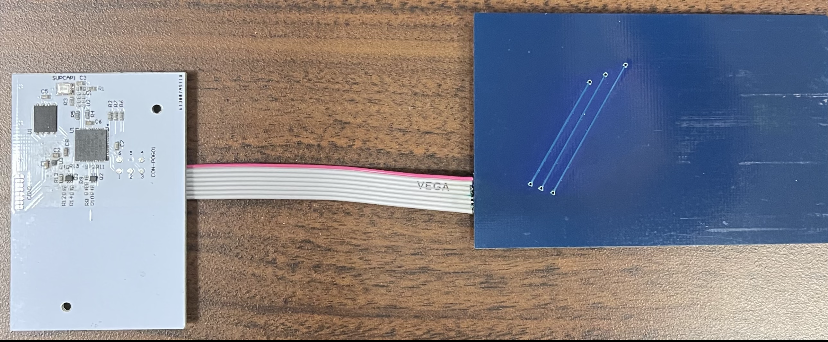
The download card (right, in blue) opens an encrypted session with the shimmer, and then transmits the stolen card data to the attached white plastic device. Image: KrebsOnSecurity.com.

The download card consisted of two pieces of plastic about the width of a debit card but a bit long longer. The blue plastic part — made to be inserted into a card reader — features the same contacts as a chip card. The blue plastic was attached via a ribbon cable to a white plastic card with a green LED and other electronic components.

Sticking the blue download card into a chip reader revealed the same Austrian card number seen on the shimming devices. It then became very clear what was happening.

“The download card was hard coded with chip card data on it, so that it could open up an encrypted session with the shimmer,” which also had the same card data, Dant said.
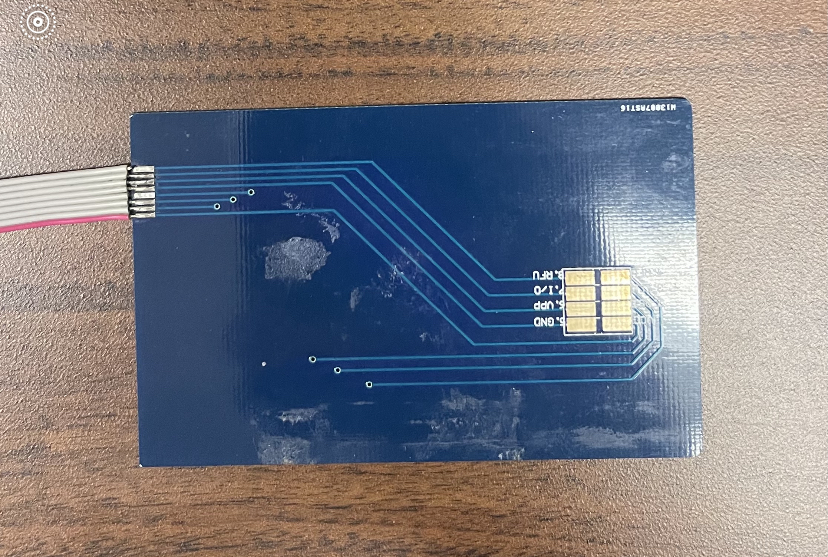
The download card, up close. Image: KrebsOnSecurity.com.

Once inserted into the mouth of ATM card acceptance slot that’s already been retrofitted with one of these shimmers, the download card causes an encrypted data exchange between it and the shimmer. Once that two-way handshake is confirmed, the white device lights up a green LED when the data transfer is complete.

THE MASTER KEY

Dant said when the Romanian crew mass-produced their shimming devices, they did so using the same stolen Austrian bank card number. What this meant was that now the Secret Service and Citi had a master key to discover the same shimming devices installed in other ATMs.

That’s because every time the gang compromised a new ATM, that Austrian account number would traverse the global payment card networks — telling them exactly which ATM had just been hacked.

“We gave that number to the card networks, and they were able to see all the places that card had been used on their networks before,” Dant said. “We also set things up so we got alerts anytime that card number popped up, and we started getting tons of alerts and finding these shimmers all over the world.”

For all their sleuthing, Dant and his colleagues never really saw shimming take off in the United States, at least nowhere near as prevalently as in Mexico, he said.

The problem was that many banks in Mexico and other parts of Latin America had not properly implemented the chip card standard, which meant thieves could use shimmed chip card data to make the equivalent of old magnetic stripe-based card transactions.

By the time the Romanian gang’s shimmers started showing up in New York City, the vast majority of U.S. banks had already properly implemented chip card processing in such a way that the same phony chip card transactions which sailed through Mexican banks would simply fail every time they were tried against U.S. institutions.

“It never took off in the U.S., but this kind of activity went on like wildfire for years in Mexico,” Dant said.

The other reason shimming never emerged as a major threat for U.S. financial institutions is that many ATMs have been upgraded over the past decade so that their card acceptance slots are far slimmer, Dant observed.

“That download card is thicker than a lot of debit cards, so a number of institutions were quick to replace the older card slots with newer hardware that reduced the height of a card slot so that you could maybe get a shimmer and a debit card, but definitely not a shimmer and one of these download cards,” he said.

Shortly after ATM shimmers started showing up at banks in Mexico, KrebsOnSecurity spent four days in Mexico tracing the activities of a Romanian organized crime gang that had very recently started its own ATM company there called Intacash.

Sources told KrebsOnSecurity that the Romanian gang also was paying technicians from competing ATM providers to retrofit cash machines with Bluetooth-based skimmers that hooked directly up to the electronics on the inside. Hooked up to the ATM’s internal power, those skimmers could collect card data indefinitely, and the data could be collected wirelessly with a smart phone.

Follow-up reporting last year by the Organized Crime and Corruption Reporting Project (OCCRP) found Intacash and its associates compromised more than 100 ATMs across Mexico using skimmers that were able to remain in place undetected for years. The OCCRP, which dubbed the Romanian group “The Riviera Maya Gang,” estimates the crime syndicate used cloned card data and stolen PINs to steal more than $1.2 billion from bank accounts of tourists visiting the region.

Last month, Mexican authorities arrested Florian “The Shark” Tudor, Intacash’s boss and the reputed ringleader of the Romanian skimming syndicate. Authorities charged that Tudor’s group also specialized in human trafficking, which allowed them to send gang members to compromise ATMs across the border in the United States.

Premium Domain Names – transcom.uk
Transcom ISP – The UK’s Best Business ISP
DoubleCheck any website at doublecheck.uk

How Cyber Safe is Your Drinking Water Supply?

Amid multiple recent reports of hackers breaking into and tampering with drinking water treatment systems comes a new industry survey with some sobering findings: A majority of the 52,000 separate drinking water systems in the United States still haven’t inventoried some or any of their information technology systems — a basic first step in protecting networks from cyberattacks.

The Water Sector Coordinating Council surveyed roughly 600 employees of water and wastewater treatment facilities nationwide, and found 37.9 percent of utilities have identified all IT-networked assets, with an additional 21.7 percent working toward that goal.

The Council found when it comes to IT systems tied to “operational technology” (OT) — systems responsible for monitoring and controlling the industrial operation of these utilities and their safety features — just 30.5 percent had identified all OT-networked assets, with an additional 22.5 percent working to do so.

“Identifying IT and OT assets is a critical first step in improving cybersecurity,” the report concluded. “An organization cannot protect what it cannot see.”

It’s also hard to see threats you’re not looking for: 67.9 percent of water systems reported no IT security incidents in the last 12 months, a somewhat unlikely scenario.

Michael Arceneaux, managing director of the WaterISAC — an industry group that tries to facilitate information sharing and the adoption of best practices among utilities in the water sector — said the survey shows much room for improvement and a need for support and resources.

“Threats are increasing, and the sector, EPA, CISA and USDA need to collaborate to help utilities prevent and recover from compromises,” Arceneaux said on Twitter.

While documenting each device that needs protection is a necessary first step, a number of recent cyberattacks on water treatment systems have been blamed on a failure to properly secure water treatment employee accounts that can be used for remote access.

In April, federal prosecutors unsealed an indictment against a 22-year-old from Kansas who’s accused of hacking into a public water system in 2019. The defendant in that case is a former employee of the water district he allegedly hacked.

In February, we learned that someone hacked into the water treatment plan in Oldsmar, Fla. and briefly increased the amount of sodium hydroxide (a.k.a. lye used to control acidity in the water) to 100 times the normal level. That incident stemmed from stolen or leaked employee credentials for TeamViewer, a popular program that lets users remotely control their computers.

In January, a hacker tried to poison a water treatment plant that served parts of the San Francisco Bay Area, reports Kevin Collier for NBCNews. The hacker in that case also had the username and password for a former employee’s TeamViewer account.

Image: WaterISAC.

Andrew Hildick-Smith is a consultant who served more than 15 years managing remote access systems for the Massachusetts Water Resources Authority. He said the percentage of companies that reported already having inventoried all of their IT systems is roughly equal to the number of larger water utilities (greater than 50,000 population) that recently had to certify to the Environmental Protection Agency (EPA) that they are compliant with the Water Infrastructure Act of 2018.

The water act gives utilities serving between 3,300 and 50,000 residents until the end of this month to complete a cybersecurity risk and resiliency assessment.

But Hildick-Smith said the vast majority of the nation’s water utilities — tens of thousands of them — serve fewer than 3,300 residents, and those utilities currently do not have to report to the EPA about their cybersecurity practices (or the lack thereof).

“A large number of utilities — probably close to 40,000 of them — are small enough that they haven’t been asked to do anything,” he said. “But some of those utilities are kind of doing cybersecurity based on self motivation rather than any requirement.”

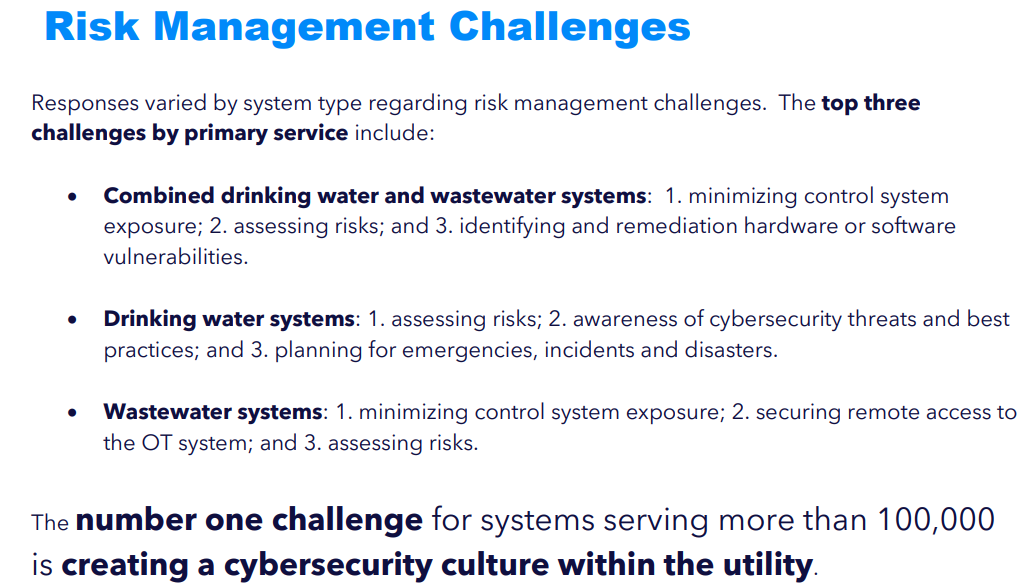
According to the water sector report, a great many of the nation’s water utilities are subject to economic disadvantages typical of rural and urban communities.

“Others do not have access to a cybersecurity workforce,” the report explains. “Operating in the background is that these utilities are struggling to maintain and replace infrastructure, maintain revenues while addressing issues of affordability, and comply with safe and clean water regulations.”

The report makes the case for federal funding of state and local systems to provide cybersecurity training, tools and services for those in charge of maintaining IT systems, noting that 38 percent of water systems allocate less than 1 percent of their annual budgets to cybersecurity.

As the recent hacking incidents above can attest, enabling some form of multi-factor authentication for remote access can blunt many of these attacks.

However, the sharing of remote access credentials among water sector employees may be a contributing factor in these recent incidents, since organizations that let multiple employees use the same account also are less likely to have any form of multi-factor enabled.

A copy of the report is available here (PDF).

Update, 6:25 p.m. ET: Clarified that the report was issued by the Water Sector Coordinating Council (not the WaterISAC).

Premium Domain Names – transcom.uk
Transcom ISP – The UK’s Best Business ISP
DoubleCheck any website at doublecheck.uk

French Teens on Trial for Cyber-bullying

French Teens on Trial for Cyber-bullying

France is trying more than a dozen teenagers in a new court set up in January specifically to hear cases concerning alleged online abuse and discrimination.

If convicted in the landmark two-day trial, the thirteen young people could be given suspended prison sentences of up to three years. 

The defendants are from a range of social and religious backgrounds. Charges levied against them include online harassment, making online death threats, and making online threats of rape. 

Some of the accused teenagers apologized for the comments they sent out into the digital world. Others denied being guilty of any crime. 

One defendant said his intentions when posting online had been to make people laugh and to attract more followers on social media. 

The trial is focused on comments made online two years ago by a then 16-year-old girl who has been identified publicly only by her first name, Mila.

Atheist Mila, who testified to the court, “I don’t like any religion,” used her Instagram and TikTok accounts to criticize Islam and the Quran. In France, freedom of expression is considered a fundamental right and blasphemy is not a crime.

Mila subsequently received more than 100,000 threatening messages, including death threats and rape threats, according to her lawyer, Richard Malka. She was also sent misogynist abuse and received hateful messages about her sexuality. 

The now 18-year-old Mila had to leave two schools over the abuse. She told the court she feels like she’s been “condemned to death” and cannot see a future for herself. 

Out of the thousands of abusive messages and comments, French police tracked down the 13 defendants currently on trial. 

One 22-year-old defendant identified only by his first name, Enzo, apologized to Mila in court for tweeting “you deserve to have your throat slit,” followed by a sexist epithet.

Another, known as Manfred, said he was “pretending to be a stalker to make people laugh” when he threatened to turn Mila into the next Samuel Paty. Paty was a teacher who was beheaded outside Paris in October after showing a class caricatures of the Prophet Muhammad.

“When I posted the tweet, I wasn’t thinking,” testified another defendant, 21-year-old university student Lauren, who tweeted about Mila: “Have her skull crushed, please.”

Premium Domain Names – transcom.uk
Transcom ISP – The UK’s Best Business ISP
DoubleCheck any website at doublecheck.uk

NIST Publishes Ransomware Guidance

NIST Publishes Ransomware Guidance

The National Institute of Standards and Technology (NIST) has published new draft guidance for organizations concerning ransomware attacks. 

The Cybersecurity Framework Profile for Ransomware Risk Management features advice on how to defend against the malware, what to do in the event of an attack, and how to recover from it. 

NIST’s Ransomware Profile can be used by organizations that have already adopted the NIST Cybersecurity Framework and wish to improve their risk postures. It can also help any organization seeking to implement a risk management framework that deals with ransomware threats. 

Included in the Ransomware Profile are steps that can be followed to identify and prioritize opportunities for improving their ransomware resistance. Users will learn how to prevent ransomware attacks and how to manage ransomware risk effectively. 

Basic measures mentioned in the guidance include keeping computers fully patched, using antivirus software, blocking access to known ransomware sites, and only permitting authorized apps to be used. 

Organizations are also advised to ensure scans are automatically conducted on emails and flash drives, to restrict the use of personally owned devices, to limit the use of accounts with administrative privileges, and to avoid the use of personal apps.

Another defensive tactic against ransomware that the guidance advocates is conducting security awareness training to educate employees about the dangers of opening files sent from unknown sources or clicking on links. 

NIST says planning ahead will help organizations that do succumb to ransomware to recover faster. It advises creating an incident recovery plan, implementing a comprehensive backup and restoration strategy, and maintaining an up-to-date list of internal and external ransomware attack contacts.

NIST intends for the new draft guidance to be used in conjunction with the NIST Cybersecurity Framework, other NIST guidance, and guidance issued by the Department of Homeland Security and the Federal Bureau of Investigation.

Those who wish to comment on the new draft Ransomware Profile have until July 9 to send their feedback to the Institute. A revised copy will then be released and a second commentary period held before a final document is published.

Premium Domain Names – transcom.uk
Transcom ISP – The UK’s Best Business ISP
DoubleCheck any website at doublecheck.uk