The Supreme Court Narrowed the CFAA

In a 6-3 ruling, the Supreme Court just narrowed the scope of the Computer Fraud and Abuse Act:

In a ruling delivered today, the court sided with Van Buren and overturned his 18-month conviction.

In a 37-page opinion written and delivered by Justice Amy Coney Barrett, the court explained that the “exceeds authorized access” language was, indeed, too broad.

Justice Barrett said the clause was effectively making criminals of most US citizens who ever used a work resource to perform unauthorized actions, such as updating a dating profile, checking sports scores, or paying bills at work.

What today’s ruling means is that the CFAA cannot be used to prosecute rogue employees who have legitimate access to work-related resources, which will need to be prosecuted under different charges.

The ruling does not apply to former employees accessing their old work systems because their access has been revoked and they’re not “authorized” to access those systems anymore.

More.

It’s a good ruling, and one that will benefit security researchers. But the confusing part is footnote 8:

For present purposes, we need not address whether this inquiry turns only on technological (or “code-based”) limitations on access, or instead also looks to limits contained in contracts or policies.

It seems to me that this is exactly what the ruling does address. The court overturned the conviction because the defendant was not limited by technology, but only by policies. So that footnote doesn’t make any sense.

I have written about this general issue before, in the context of adversarial machine learning research.

Premium Domain Names – transcom.uk
Transcom ISP – The UK’s Best Business ISP
DoubleCheck any website at doublecheck.uk

Justice Dept. Claws Back $2.3M Paid by Colonial Pipeline to Ransomware Gang

The U.S. Department of Justice said today it has recovered $2.3 million worth of Bitcoin that Colonial Pipeline paid to ransomware extortionists last month. The funds had been sent to DarkSide, a ransomware-as-a-service syndicate that disbanded after a May 14 farewell message to affiliates saying its Internet servers and cryptocurrency stash were seized by unknown law enforcement entities.

On May 7, the DarkSide ransomware gang sprang its attack against Colonial, which ultimately paid 75 Bitcoin (~$4.4 million) to its tormentors. The company said the attackers only hit its business IT networks — not its pipeline security and safety systems — but that it shut the pipeline down anyway as a precaution [several publications noted Colonial shut down its pipeline because its billing system was impacted, and it had no way to get paid].

On or around May 14, the DarkSide representative on several Russian-language cybercrime forums posted a message saying the group was calling it quits.

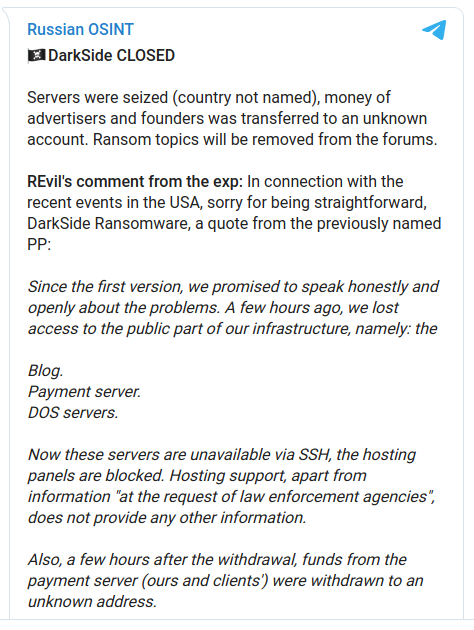
“Servers were seized, money of advertisers and founders was transferred to an unknown account,” read the farewell message. “Hosting support, apart from information ‘at the request of law enforcement agencies,’ does not provide any other information.”

A message from the DarkSide and REvil ransomware-as-a-service cybercrime affiliate programs.

Many security experts said they suspected DarkSide was just laying low for a while thanks to the heat from the Colonial attack, and that the group would re-emerge under a new banner in the coming months. And while that may be true, the seizure announced today by the DOJ certainly supports the DarkSide administrator’s claims that their closure was involuntary.

Security firms have suspected for months that the DarkSide gang shares some leadership with that of REvil, a.k.a. Sodinokibi, another ransomware-as-a-service platform that closed up shop in 2019 after bragging that it had extorted more than $2 billion from victims. That suspicion was solidified further when the REvil administrator added his comments to the announcement about DarkSide’s closure (see screenshot above).

First surfacing on Russian language hacking forums in August 2020, DarkSide is a ransomware-as-a-service platform that vetted cybercriminals can use to infect companies with ransomware and carry out negotiations and payments with victims. DarkSide says it targets only big companies, and forbids affiliates from dropping ransomware on organizations in several industries, including healthcare, funeral services, education, public sector and non-profits.

According to an analysis published May 18 by cryptocurrency security firm Elliptic, 47 cybercrime victims paid DarkSide a total of $90 million in Bitcoin, putting the average ransom payment of DarkSide victims at just shy of $2 million.

HOW DID THEY DO IT?

The DoJ’s announcement left open the question of how exactly it was able to recover a portion of the payment made by Colonial, which shut down its Houston to New England fuel pipeline for a week and prompted long lines, price hikes and gas shortages at filling stations across the nation.

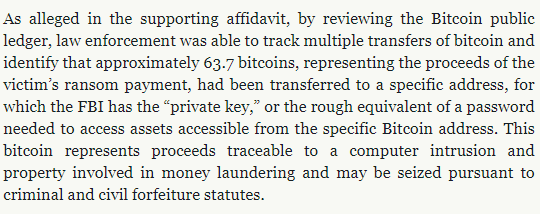
The DOJ said law enforcement was able to track multiple transfers of bitcoin and identify that approximately 63.7 bitcoins (~$3.77 million on May 8), “representing the proceeds of the victim’s ransom payment, had been transferred to a specific address, for which the FBI has the ‘private key,’ or the rough equivalent of a password needed to access assets accessible from the specific Bitcoin address.”

A passage from the DOJ’s press release today.

How it came to have that private key is the key question. Nicholas Weaver, a lecturer at the computer science department at University of California, Berkeley, said the most likely explanation is that law enforcements agent seized money from a specific DarkSide affiliate responsible for bringing the crime gang the initial access to Colonial’s systems.

“The ‘obtained the private key’ part of their statement is doing a lot of work,” Weaver said, point out that the amount the FBI recovered was less than the full amount Colonial paid.

“It is ONLY the Colonial Pipeline ransom, and it looks to be only the affiliate’s take.”

Experts at Elliptic came to the same conclusion.

“Any ransom payment made by a victim is then split between the affiliate and the developer,” writes Elliptic’s co-founder Tom Robinson. “In the case of the Colonial Pipeline ransom payment, 85% (63.75 BTC) went to the affiliate and 15% went to the DarkSide developer.”

The Biden administration is under increasing pressure to do something about the epidemic of ransomware attacks. In conjunction with today’s action, the DOJ called attention to the wins of its Ransomware and Digital Extortion Task Force, which have included successful prosecutions of crooks behind such threats as the Netwalker and SamSam ransomware strains.

The DOJ also released a June 3 memo from Deputy Attorney General Lisa O. Monaco instructing all federal prosecutors to adhere to new guidelines that seek centralize reporting about ransomware victims.

Having a central place for law enforcement and intelligence agencies to gather and act on ransomware threats was one of the key recommendations of a ransomware task force being led by some of the world’s top tech firms. In an 81-page report, the industry led task force called for an international coalition to combat ransomware criminals, and for a global network of investigation hubs. Their recommendations focus mainly on disrupting cybercriminal ransomware gangs by limiting their ability to get paid, and targeting the individuals and finances of the organized thieves behind these crimes.

Premium Domain Names – transcom.uk
Transcom ISP – The UK’s Best Business ISP
DoubleCheck any website at doublecheck.uk

Adventures in Contacting the Russian FSB

KrebsOnSecurity recently had occasion to contact the Russian Federal Security Service (FSB), the Russian equivalent of the U.S. Federal Bureau of Investigation (FBI). In the process of doing so, I encountered a small snag: The FSB’s website said in order to communicate with them securely, I needed to download and install an encryption and virtual private networking (VPN) appliance that is flagged by at least 20 antivirus products as malware.

The FSB headquarters at Lubyanka Square, Moscow. Image: Wikipedia.

The reason I contacted the FSB — one of the successor agencies to the Russian KGB — ironically enough had to do with security concerns raised by an infamous Russian hacker about the FSB’s own preferred method of being contacted.

KrebsOnSecurity was seeking comment from the FSB about a blog post published by Vladislav “BadB” Horohorin, a former international stolen credit card trafficker who served seven years in U.S. federal prison for his role in the theft of $9 million from RBS WorldPay in 2009. Horohorin, a citizen of Russia, Israel and Ukraine, is now back where he grew up in Ukraine, running a cybersecurity consulting business.
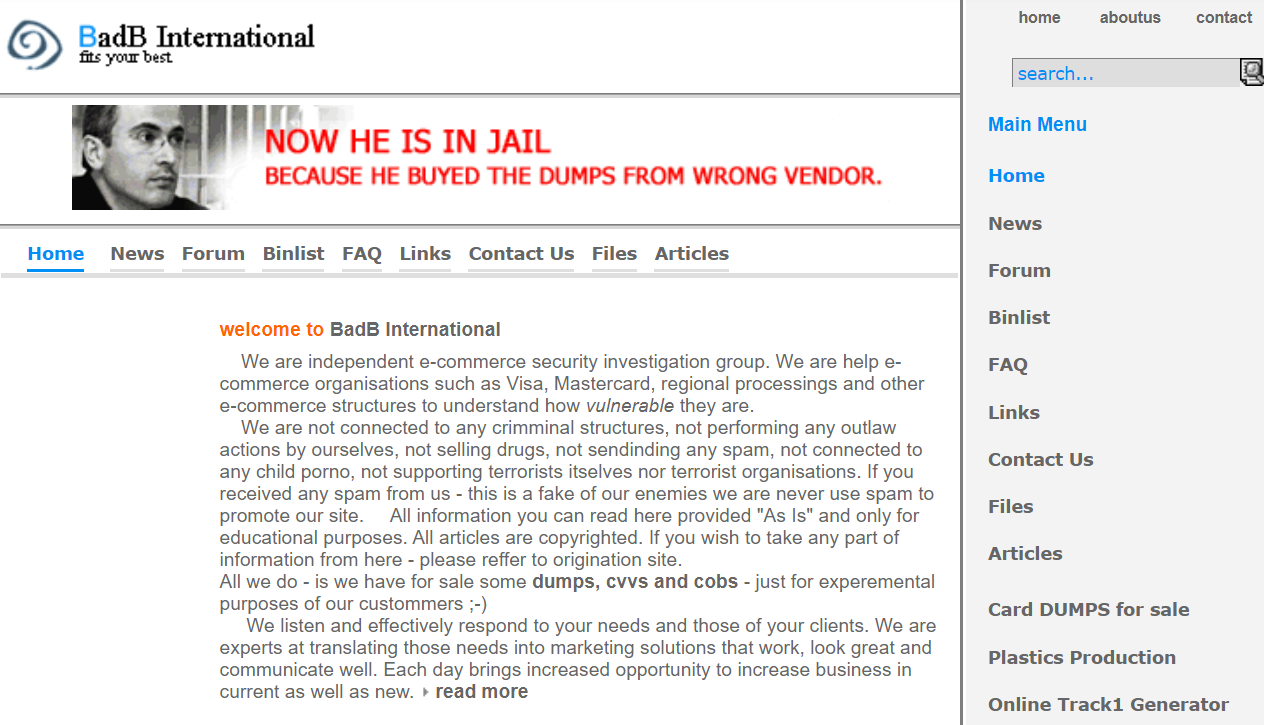
Horohorin’s BadB carding store, badb[.]biz, circa 2007. Image: Archive.org.

Visit the FSB’s website and you might notice its web address starts with http:// instead of https://, meaning the site is not using an encryption certificate. In practical terms, any information shared between the visitor and the website is sent in plain text and will be visible to anyone who has access to that traffic.

This appears to be the case regardless of which Russian government site you visit. According to Russian search giant Yandex, the laws of the Russian Federation demand that encrypted connections be installed according to the Russian GOST cryptographic algorithm.

That means those who have a reason to send encrypted communications to a Russian government organization — including ordinary things like making a payment for a government license or fine, or filing legal documents — need to first install CryptoPro, a Windows-only application that loads the GOST encryption libraries on a user’s computer.

But if you want to talk directly to the FSB over an encrypted connection, you can just install their own client, which bundles the CryptoPro code. Visit the FSB’s site and select the option to “transfer meaningful information to operational units,” and you’ll see a prompt to install a “random number generation” application that is needed before a specific contact form on the FSB’s website will load properly.

Mind you, I’m not suggesting anyone go do that: Horohorin pointed out that this random number generator was flagged by 20 different antivirus and security products as malicious.

“Think well before contacting the FSB for any questions or dealing with them, and if you nevertheless decide to do this, it is better to use a virtual machine,” Horohorin wrote. “And a spacesuit. And, preferably, while in another country.”
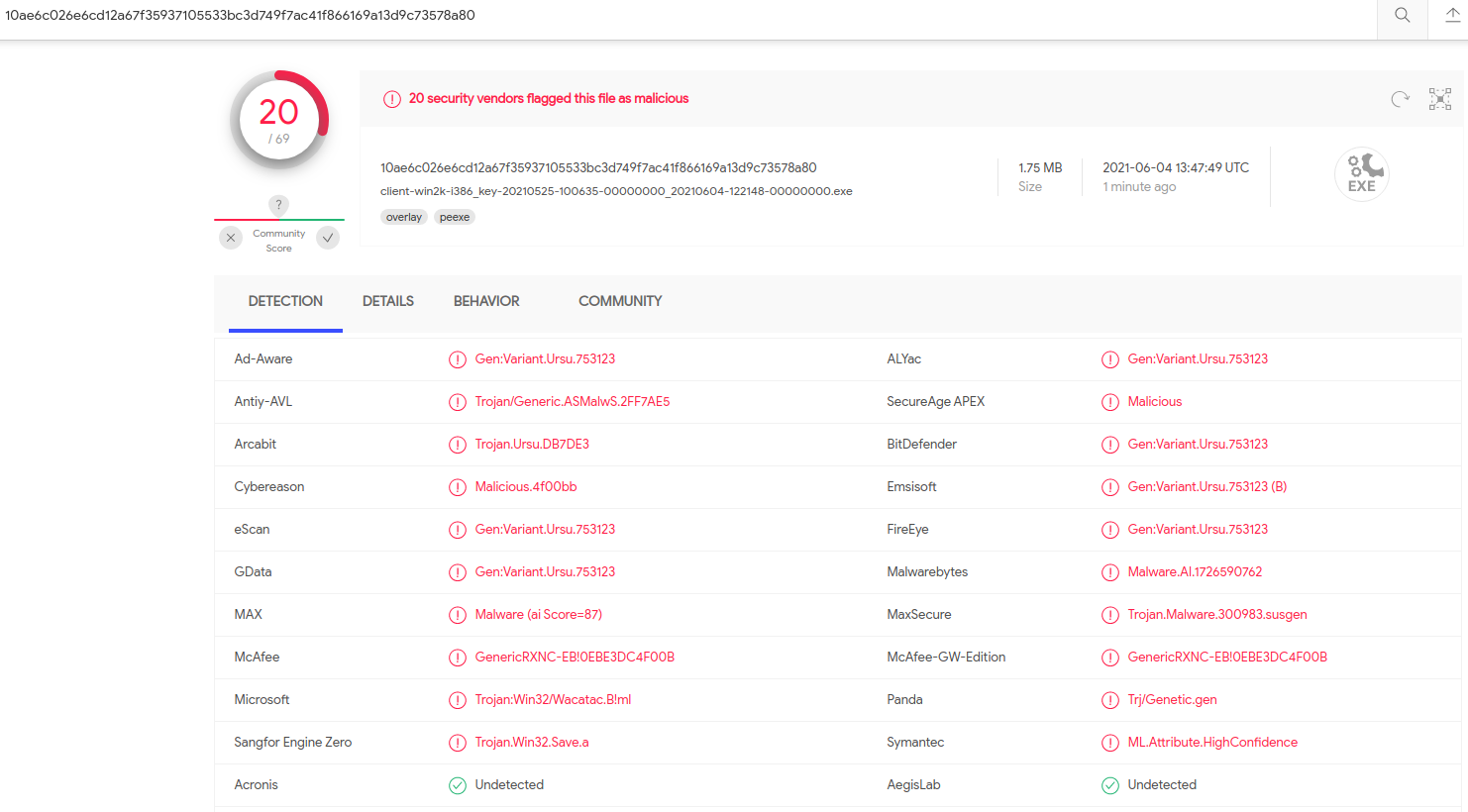
Antivirus product detections on the FSB’s VPN software. Image: VirusTotal.

It’s probably worth mentioning that the FSB is the same agency that’s been sanctioned for malicious cyber activity by the U.S. government on multiple occasions over the past five years. According to the most recent sanctions by the U.S. Treasury Department, the FSB is known for recruiting criminal hackers from underground forums and offering them legal cover for their actions.

“To bolster its malicious cyber operations, the FSB cultivates and co-opts criminal hackers, including the previously designated Evil Corp., enabling them to engage in disruptive ransomware attacks and phishing campaigns,” reads a Treasury assessment from April 2021.

While Horohorin seems convinced the FSB is disseminating malware, it is not unusual for a large number of security tools used by VirusTotal or other similar malware “sandbox” services to incorrectly flag safe files as bad or suspicious — an all-too-common condition known as a “false positive.”

Late last year I warned my followers on Twitter to put off installing updates for their Dell products until the company could explain why a bunch of its software drivers were being detected as malware by two dozen antivirus tools. Those all turned out to be false positives.

To really figure out what this FSB software was doing, I turned to Lance James, the founder of Unit221B, a New York City based cybersecurity firm. James said each download request generates a new executable program. That is because the uniqueness of the file itself is part of what makes the one-to-one encrypted connection possible.

“Essentially it is like a temporary, one-time-use VPN, using a separate key for each download” James said. “The executable is the handshake with you to exchange keys, as it stores the key for that session in the exe. It’s a terrible approach. But it’s what it is.”

James said the FSB’s program does not appear to be malware, at least in terms of the actions it takes on a user’s computer.

“There’s no sign of actual trojan activity here except the fact it self deletes,” James said. “It uses GOST encryption, and [the antivirus products] may be thinking that those properties look like ransomware.”

James says he suspects the antivirus false-positives were triggered by certain behaviors which could be construed as malware-like. The screenshot below — from VirusTotal — says some of the file’s contents align with detection rules made to find instances of ransomware.
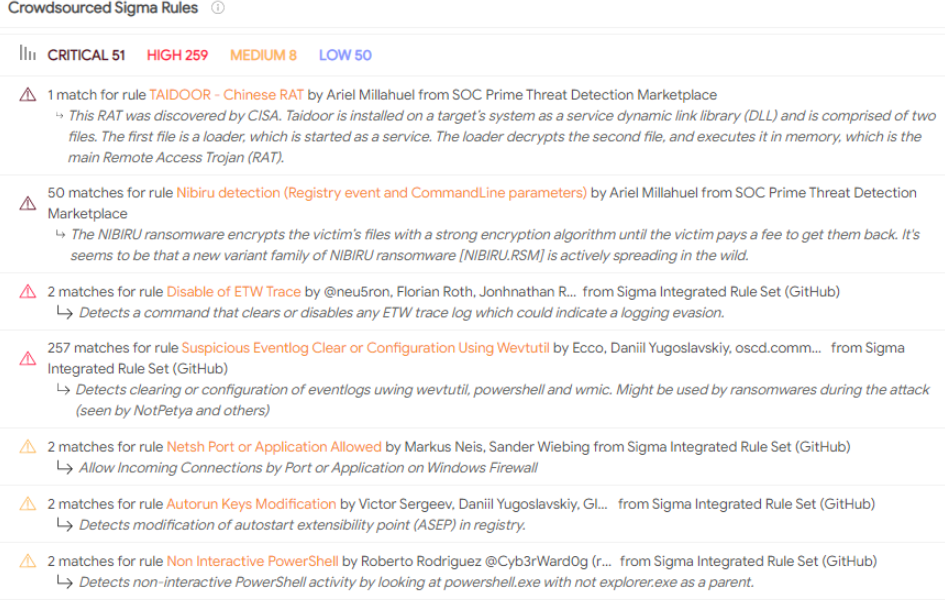
Some of the malware detection rules triggered by the FSB’s software. Source: VirusTotal.

Other detection rules tripped by this file include program routines that erase event logs from the user’s system — a behavior often seen in malware that is trying to hide its tracks.

On a hunch that just including the GOST encryption routine in a test program might be enough to trigger false positives in VirusTotal, James wrote and compiled a short program in C++ that invoked the GOST cipher but otherwise had no networking components. He then uploaded the file for scanning at VirusTotal.

Even though James’ test program did nothing untoward or malicious, it was flagged by six antivirus engines as potentially hostile. Symantec’s machine learning engine seemed particularly certain that James’ file might be bad, awarding it the threat name “ML.Attribute.HighConfidence” — the same designation it assigned to the FSB’s program.

KrebsOnSecurity installed the FSB’s software on a test computer using a separate VPN, and straight away it connected to an Internet address currently assigned to the FSB (213.24.76.xxx).

The program prompted me to click on various parts of the screen to generate randomness for an encryption key, and when that was done it left a small window which explained in Russian that the connection was established and that I should visit a specific link on the FSB’s site.
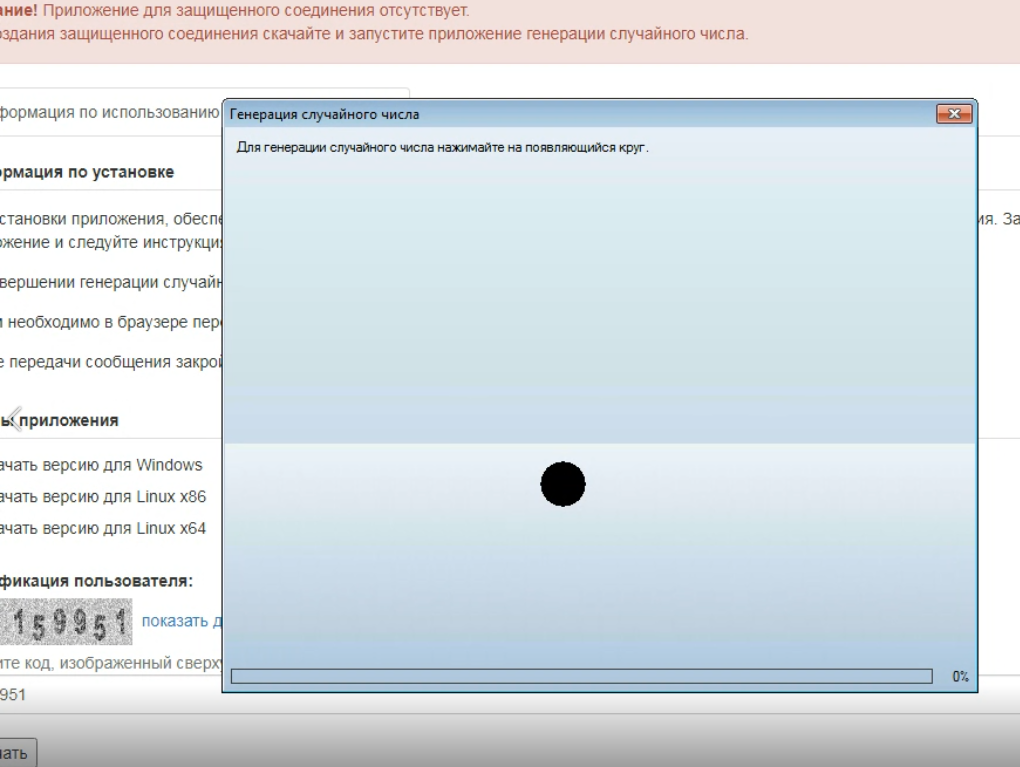
The FSB’s random number generator in action.

Doing so opened up a page where I could leave a message for the FSB. I asked them if they had any response to their program being broadly flagged as malware.
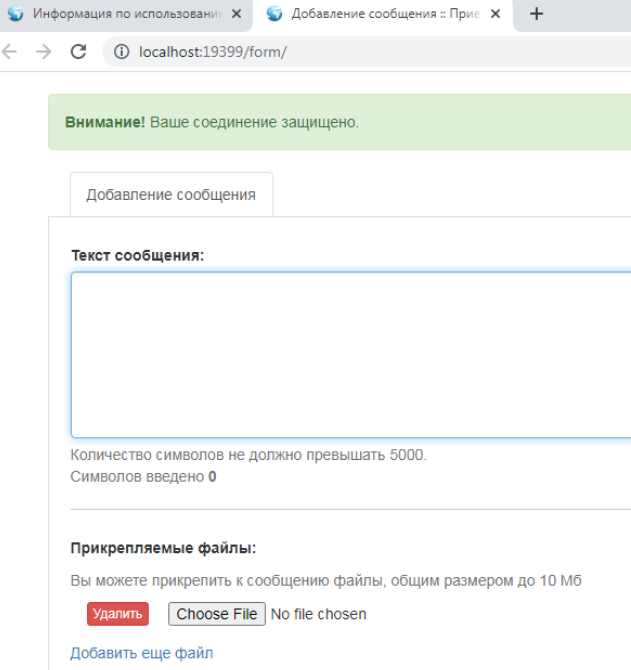
The contact form that ultimately appeared after installing the FSB’s software and clicking a specific link at fsb[.]ru.

After all the effort, I’m disappointed to report that I have not yet received a reply. Nor did I hear back from S-Terra CSP, the company that makes the VPN software offered by the FSB.

James said that given their position, he could see why many antivirus products might think it’s malware.

“Since they won’t use our crypto and we won’t use theirs,” James said. “It’s a great explanation on political weirdness with crypto.”

Still, James said, a number of things just don’t make sense about the way the FSB has chosen to deploy its one-time VPN software.

“The way they have set this up to suddenly trust a dynamically changing exe is still very concerning. Also, why would you send me a 256 random number generator seed in an exe when the computer has a perfectly valid and tested random number generator built in? You’re sending an exe to me with a key you decide over a non-secure environment. Why the fuck if you’re a top intelligence agency would you do that?”

Why indeed. I wonder how many people would share information about federal crimes with the FBI if the agency required everyone to install an executable file first — to say nothing of one that looks a lot like ransomware to antivirus firms?

After doing this research, I learned the FSB recently launched a website that is only reachable via Tor, software that protects users’ anonymity by bouncing their traffic between different servers and encrypting the traffic at every step of the way. Unlike the FSB’s clear web site, the agency’s Tor site does not ask visitors to download some dodgy software before contacting them.

“The application is running for a limited time to ensure your safety,” the instructions for the FSB’s random number generator assure, with just a gentle nudge of urgency. “Do not forget to close the application when finished.”

Yes, don’t forget that. Also, do not forget to incinerate your computer when finished.
Premium Domain Names – transcom.uk
Transcom ISP – The UK’s Best Business ISP
DoubleCheck any website at doublecheck.uk

US to Treat Ransomware Like Terrorism

US to Treat Ransomware Like Terrorism

A senior official at the United States Department of Justice (DOJ) has said that ransomware attacks in America are to be investigated with a similar urgency as incidences of terrorism.

The official told news agency Reuters that cyber-assaults using this particular type of malware are to be prioritized more highly now following a passel of ransomware attacks against entities in the US and elsewhere.

Ransomware victims in recent weeks have included the Colonial Pipeline, meat supplier JBS, the Steamship Authority of Massachusetts, and Fujifilm.

Reuters reports that internal DOJ guidance on ransomware was received by US attorney’s offices across the country on Thursday. Recipients were told that information regarding ransomware investigations in the field must be shared with a recently created task force based in Washington.

“It’s a specialized process to ensure we track all ransomware cases regardless of where it may be referred in this country, so you can make the connections between actors and work your way up to disrupt the whole chain,” said principal associate deputy attorney general at the Justice Department, John Carlin.

The Colonial attack is cited in the guidance as a prime example of the “growing threat that ransomware and digital extortion pose to the nation.”

It reportedly reads: “To ensure we can make necessary connections across national and global cases and investigations, and to allow us to develop a comprehensive picture of the national and economic security threats we face, we must enhance and centralize our internal tracking.”

The specialized process described by Carlin is typically used in cases of national security. Central notification will now be compulsory for investigations into counter anti-virus services, illicit online forums or marketplaces, cryptocurrency exchanges, bulletproof hosting services, botnets and online money laundering services.

“We’ve used this model around terrorism before but never with ransomware,” said Carlin. 

He added: “We really want to make sure prosecutors and criminal investigators report and are tracking … cryptocurrency exchanges, illicit online forums or marketplaces where people are selling hacking tools, network access credentials – going after the botnets that serve multiple purposes.”

FBI director Christopher Wray said that the agency is investigating around 100 kinds of ransomware, many of which are linked to criminal operators in Russia.

Premium Domain Names – transcom.uk
Transcom ISP – The UK’s Best Business ISP
DoubleCheck any website at doublecheck.uk

More US Kids Warned About Internet Than Unsafe Sex

More US Kids Warned About Internet Than Unsafe Sex

More American parents are warning their children about the dangers of going online than about the importance of sexual safety, according to new research.

A survey of over 1,000 parents in the United States conducted by InMyArea.com found that 89% of parents with children aged 12 or older have had an intentional talk about internet safety with their children. By contrast, only 66% of American parents with kids aged 12 or older had purposefully discussed sexual safety with their offspring.

Of those parents with kids aged 12+ who talked to their children about staying safe online, more than half (60%) had engaged in more than one discussion about the topic. By contrast, only 37% of parents with children aged 12 or older had talked to their children more than once about sexual safety.

The survey focused on parents with children aged between 6 and 17. Findings revealed that 82% of parents had talked to their kids about internet safety, with 51% having more than one intentional talk on the subject. 

The two most popular internet safety topics covered by parents were protecting personal information (81%) and stranger danger (79%). 

More than half of parents had discussed social media and mental health (53%) and cyber-bullying (51%) with their kids. 

Sex wasn’t the only issue to take a backseat behind the internet in discussions around safety. Researchers found that only 79% of parents with children aged 15 or older had talked to their kids about driving/vehicle safety. 

Of all the parents surveyed, outdoor/wilderness safety had been addressed by just 60%, and fire safety by just 69%. 

The survey found a discrepancy between parents’ views on age-restricted internet access and social media policies. 

“Most survey respondents believed their children should reach 14 to 15 years of age before having unsupervised access to social media,” said an InMyArea.com spokesperson. “Yet major platforms, including Facebook, Instagram, Snapchat, and Twitter, require users to be 13 before making an account.”

Results revealed parents’ leading internet concerns for their children as being targeted by a predator (67%), seeing sexually explicit content (65%) and seeing graphic or violent content (60%). More than half (56%) worried that their children would be cyber-bullied.

Premium Domain Names – transcom.uk
Transcom ISP – The UK’s Best Business ISP
DoubleCheck any website at doublecheck.uk

Biden Expands Trump’s Investment Ban on Chinese Firms

Biden Expands Trump’s Investment Ban on Chinese Firms

President Joe Biden’s latest executive order has expanded a ban on investing in Chinese companies with alleged links to defense or surveillance technology sectors that was introduced by former president Donald Trump.

The Trump administration issued an executive order on November 12, 2020, barring US entities from investing in a clutch of PRC companies including smartphone-maker Huawei, China Telecommunications Corp., China Unicom Ltd., and China Mobile Communications Group Co.

On Thursday, Biden signed an order blocking Americans from investing in 59 companies based in the People’s Republic of China, including leading microchip-maker Semiconductor Manufacturing International Corp. and the republic’s biggest server manufacturer, Inspur.

Defense companies that made it onto Biden’s list included Aviation Industry Corp. of China, Ltd., China North Industries Group Corp., China Aerospace Science and Industry Corporation Ltd., and China Shipbuilding Industry Co.

In 2019, Biden declared that the Chinese were “not bad folks” and that China, which has the world’s second largest economy, was “not competition for us.”

In the executive order signed yesterday, Biden wrote that “additional steps are necessary to address the national emergency declared in Executive Order 13959 of November 12, 2020 (Addressing the Threat From Securities Investments That Finance Communist Chinese Military Companies), including the threat posed by the military-industrial complex of the People’s Republic of China (PRC) and its involvement in military, intelligence, and security research and development programs, and weapons and related equipment production under the PRC’s Military-Civil Fusion strategy. 

“In addition, I find that the use of Chinese surveillance technology outside the PRC and the development or use of Chinese surveillance technology to facilitate repression or serious human rights abuse constitute unusual and extraordinary threats, which have their source in whole or substantial part outside the United States, to the national security, foreign policy, and economy of the United States, and I hereby expand the scope of the national emergency declared in Executive Order 13959 to address those threats.” 

The prohibitions will take effect on August 2, 2021. The US Treasury Department has said it will update the list of barred companies on a “rolling basis” and that they “fully expect” to add more companies to it in the months ahead.

Premium Domain Names – transcom.uk
Transcom ISP – The UK’s Best Business ISP
DoubleCheck any website at doublecheck.uk

CISOs Agree That Traditional Application Security Measures Don’t Work

CISOs Agree That Traditional Application Security Measures Don’t Work

Nearly three-quarters (71%) of CISOs aren’t confident that code in cloud-native architectures is free of vulnerabilities before it goes into production, according to new research from Dynatrace.

The software intelligence firm polled 700 global security chiefs in large enterprises with over 1,000 employees to better understand their concerns over microservices, containers, and Kubernetes in development.

Some 89% claimed their use had created dangerous application security blind spots.

These challenges appear to be compounded by time-to-market pressures and existing tools and processes not fit-for-purpose in the new cloud native era.

Over two-thirds (68%) of CISOs said the sheer volume of alerts coming through makes it difficult to prioritize. On average, their teams receive 2,169 flags about potential application security vulnerabilities each month, most of which are false positives, the research claimed.

Over a quarter (28%) said development teams sometimes bypass vulnerability checks to speed up delivery, while three-quarters (74%) said traditional scanning tools and other legacy security controls don’t work in today’s environments.

Bernd Greifeneder, founder and CTO of Dynatrace, argued that the growing use of cloud-native architectures had broken traditional approaches to app security.

“This research confirms what we’ve long anticipated: manual vulnerability scans and impact assessments are no longer able to keep up with the pace of change in today’s dynamic cloud environments and rapid innovation cycles,” he added.

“Risk assessment has become nearly impossible due to the growing number of internal and external service dependencies, runtime dynamics, continuous delivery, and polyglot software development, which uses an ever-growing number of third-party technologies. Already stretched teams are forced to choose between speed and security, exposing their organizations to unnecessary risk.”

Most CISOs questioned for the research agreed that more automation of deployment, configuration and management was needed.

“As organizations embrace DevSecOps, they also need to give their teams solutions that offer automatic, continuous, and real-time risk and impact analysis for every vulnerability, across both pre-production and production environments, and not based on point-in-time snapshots,” said Greifeneder.

Premium Domain Names – transcom.uk
Transcom ISP – The UK’s Best Business ISP
DoubleCheck any website at doublecheck.uk

Campaigners Request Meeting with Home Secretary as Part of Computer Misuse Act Review

Campaigners Request Meeting with Home Secretary as Part of Computer Misuse Act Review

Campaigners have written to the UK Home Secretary, Priti Patel, welcoming the announced review into the Computer Misuse Act (CMA) and requesting a meeting with her to discuss reform proposals.

The CyberUp Campaign and techUK penned the letter following a joint briefing call on Tuesday May 25 among industry representatives about the review, which Patel first announced in a speech during the CYBERUK 2021 virtual event last month. In her talk, she explained this is part of the UK government’s efforts to ensure law enforcement agencies are equipped with “the right tools and mechanisms to detect, disrupt, and deter our adversaries.”

The government has now opened a call for evidence from across the cybersecurity industry, which closes on June 8, 2021. This is requesting insights into the legislation, including whether current “protections in the CMA for legitimate cybersecurity activity provide adequate cover.”

Welcoming this development, the letter informed the Home Secretary that the CyberUp Campaign and techUK “share the desire to see a legal framework in the UK that is best able to assist UK law enforcement in defending the UK from an ever-evolving array of cyber threats, and that supports a thriving and internationally competitive UK cybersecurity industry.”

Many in the industry have long called for the act to be updated, observing that the cyber and technology landscape has changed substantially since it was first enacted in 1990.

In June 2020, a group of cybersecurity organizations coordinated by the CyberUp Campaign wrote an open letter to the UK Prime Minister Boris Johnson, emphasizing the need for the CMA to be updated. This letter stated: “In 1990, when the CMA became law, only 0.5% of the UK population used the internet, and the concept of cybersecurity and threat intelligence research did not yet exist. Now, 30 years on, the CMA is the central regime governing cybercrime in the UK despite being originally designed to protect telephone exchanges. This means that the CMA inadvertently criminalizes a large proportion of modern cyber-defense practices.”

Commenting on the latest developments, Ollie Whitehouse, CTO of NCC Group and spokesperson for the CyberUp Campaign said: “The goverment consultation represents a once-in-a-generation opportunity for the cyber sector to have our say on the badly out of date Computer Misuse Act, which has been around since the inception of the sector and increasingly acts as a barrier.”

Matt Evans, director at techUK, added: “Through the formal review of the Computer Misuse Act 1990, there is a real opportunity for the UK to future-proof key cybersecurity legislation, allowing industry and law enforcement to better work together to protect citizens and businesses alike.

“This is likely the start of a longer process and techUK will look to ensure that industry plays its role in exploring the potential options and challenges around reform, with a string view that through working towards sensible reforms that can also contribute to the UK’s international competitiveness and leadership in the cyber domain.

“techUK looks forward to engaging with the government throughout the review process on behalf of industry and additionally urges its relevant members to directly input into the Home Office.”

Premium Domain Names – transcom.uk
Transcom ISP – The UK’s Best Business ISP
DoubleCheck any website at doublecheck.uk

DNS Attacks on the Rise, Costing $1 Million Each

DNS Attacks on the Rise, Costing $1 Million Each

According to new research, cyber-attacks using DNS channels to steal data, DDoS victims, and deploy malware have grown in volume and cost throughout the pandemic.

EfficientIP’s 2021 Global DNS Threat Report was compiled by IDC from interviews with 1,114 organizations across the world about their experiences of last year.

It found that 87% of organizations suffered one or more DNS attack in 2020, up eight percentage points from 2019. On average, victims were hit 7.6 times at the cost of $950,000 per attack.

The most common forms of attack were DNS phishing (49%), DNS-based malware (38%), DDoS (29%), DNS hijacking (27%), DNS tunnelling for command and control (24%), zero-day bugs (23%) and cloud misconfiguration abuse (23%).

Phishing appears to have been particularly popular due to the large number of potentially at-risk remote workers.

These attacks frequently led to cloud service and in-house app downtime, compromised websites, brand damage, lost business and sensitive data theft, the report claimed.

Threat actors often use DNS as it is always on, with traffic whitelisted by most firewalls. That opens up opportunities to hide malware or stolen data in DNS channels, among other things.

However, given its ubiquity, DNS can also play an essential role in securing organizations — especially protecting remote workers and data and application traffic, EfficientIP said.

Half of those surveyed said they use DNS traffic analysis to detect compromised devices, and a quarter 27% send DNS traffic logs to SIEM platforms for analysis.

“While it is positive that companies want to use DNS to protect their increasingly remote workforces, organizations are continuing to suffer the costly impacts of DNS attacks,” said Romain Fouchereau, research manager for European security at IDC.

“As threat actors seek to diversify their toolkits, businesses must continue to be aware of the variety of threats posed, ensuring DNS security is a key priority to preventing these.”

Premium Domain Names – transcom.uk
Transcom ISP – The UK’s Best Business ISP
DoubleCheck any website at doublecheck.uk