McAfee Proactive Security Proves Effective in Recent MITRE ATT&CK™

McAfee Soars with Superior Protection Results   

Bottom Line: McAfee stopped the MITRE ATT&CK Evaluation Carbanak and FIN7 threats in their tracks within the first 15% of the major steps of the attack chain (on average), delivering on a critical security operations center (SOC) strategy: Stop the attack as early as possible.  

In April 2021, MITRE Engenuity released the results of the Carbanak and FIN7 evaluations that leveraged Tactics, Techniques, and Procedures (TTP’s) from the MITRE ATT&CK framework. McAfee and 28 other vendors tested the capabilities of our cybersecurity solutions across a wide range of attack vectors. These multi-stage simulated attacks leveraged a full range of known TTPs to execute the Carbanak and FIN7 attack campaigns. 

The Carbanak attack requires stealth and time. Threat actors count on operating undetected inside your infrastructure long enough to penetrate and own your crown jewel assets and information. They methodically step through complex custom TTPs to achieve their objectives. The sooner an attack can be detected and stopped, the lower the risk of a successful breach, damage to assets, and exfiltration of critical information.  

Shift left: Stopping Threats Before They Can Gain a Foothold 

McAfee displayed superior protection by blocking 100% across all 10 tests. On the other hand, several endpoint security providers failed to detect and block all threats. CrowdStrike, for example, was unable to block 30% of protection tests.  

Additionally, McAfee was able to block the attacks within the first 15% of attack steps on average across all testsOn the other hand, CrowdStrike allowed 50% of the attack chain steps on average to execute before blocking. The earlier in the attack chain that a threat is detected, the more likely it will be shut down before it causes damage. 

McAfee combines data and telemetry with comprehensive analytics-based detections that accelerate the pivot to defensive execution. This Time-Based Security metric determines if a blue team will have meaningful, timely, and actionable information. McAfee scores well on this metric by including specific references to MITRE Engenuity’s ATT&CK framework with centralized incident pivots to enriched telemetry, enabling faster detection, investigation, and reaction, and therefore lower exposure. Prioritizing Time-Based Security* (TBS) contributes to McAfee’s ability to block early and mitigate further damage. McAfee significantly outperformed CrowdStrike on the dimension of Time-Based Security.  

How did McAfee achieve this success in the evaluation and against such a sophisticated threat? 

Core to McAfee’s success is the alignment of products and capabilities around the ability to “shift left” in the attack cycle. Shifting left, or engaging as early as possible in the kill chain timeline, allows defenders to detect and stop an attack, minimize risk, and achieve these results at the lowest cost. 

For scenarios where threats are not blocked, McAfee provides extensive and actionable alerting and intelligence to ensure that responses and remediations are timely.  In the case of the MITRE Carbanak+FIN7 testing, McAfee demonstrated clear superiority over CrowdStrike in terms of Alert Actionability*. 

(For more information on Time-based Security and Alert Actionability, please review the following blog: SOC vs MITRE APT29 evaluation – Racing with Cozy Bear | McAfee Blogs)  

Defenders, Now is Your Time to Prevail Against Threat Actors 

Sophisticated adversaries surround us, and MITRE ATT&CK evaluations emulated their techniques and procedures. It’s time to let your teams know that with the right tools from McAfee and Shift Left best practices, intelligent defenders will prevail.  

Sneaky attackers traverse infrastructures and assets opportunistically and unpredictably. The complexity and variability in the attack chains associated with these threat actors make threats challenging to identify. McAfee will continue to evolve extended detection and response capabilities that go beyond the endpoint. The integration of these capabilities with solutions such as McAfee’s MVISION XDR enables the security operations team to benefit from unified visibility and control across the hybrid enterprise: endpoints, network, and the cloud.  

Most important is the integration of the ecosystem to fight and defeat attackers. McAfee MVISION XDR orchestrates both McAfee and non-McAfee security assets to deliver actionable cyber threat management and support both guided and automated investigations. 

As illustrated by the recent MITRE Carbanak+FIN7 protection tests, the industry recognizes the value of proactive capabilities to detect and block early, reducing reactive cyber defense efforts and damage. This dynamic enables your team to stop these sophisticated attacks earlier and more effectively. McAfee empowers your security operations teams to achieve faster and more effective results.  

To find out more about the MITRE ATT&CK Evaluation results, please reach out to sales@mcafee.com 


* These critical capabilities are defined by McAfee algorithms designed to maximize value to SOC and XDR needs.  Please see this McAfee MITRE blog for details on these algorithms 

Assessments of performance are McAfee’s and not those of MITRE Engenuity.  

MITRE Engenuity ATT&CK Evaluations are paid for by vendors and are intended to help vendors and end-users better understand a product’s capabilities in relation to MITRE’s publicly accessible ATT&CKⓇ framework. MITRE developed and maintains the ATT&CK knowledge base, which is based on real word reporting of adversary tactics and techniques. ATT&CK is freely available and is widely used by defenders in industry and government to find gaps in visibility, defensive tools, and processes as they evaluate and select options to improve their network defense. MITRE Engenuity makes the methodology and resulting data publicly available so other organizations may benefit and conduct their own analysis and interpretation. The evaluations do not provide rankings or endorsements.  


The post McAfee Proactive Security Proves Effective in Recent MITRE ATT&CK™ appeared first on McAfee Blogs.

Premium Domain Names – transcom.uk
Transcom ISP – The UK’s Best Business ISP
DoubleCheck any website at doublecheck.uk
Roaming Mantis Amplifies Smishing Campaign with OS-Specific Android Malware

The Roaming Mantis smishing campaign has been impersonating a logistics company to steal SMS messages and contact lists from Asian Android users since 2018. In the second half of 2020, the campaign improved its effectiveness by adopting dynamic DNS services and spreading messages with phishing URLs that infected victims with the fake Chrome application MoqHao.

Since January 2021, however, the McAfee Mobile Research team has established that Roaming Mantis has been targeting Japanese users with a new malware called SmsSpy. The malicious code infects Android users using one of two variants depending on the version of OS used by the targeted devices. This ability to download malicious payloads based on OS versions enables the attackers to successfully infect a much broader potential landscape of Android devices.

Smishing Technique

The phishing SMS message used is similar to that of recent campaigns, yet the phishing URL contains the term “post” in its composition.

Japanese message: I brought back your luggage because you were absent. please confirm. hxxps://post[.]cioaq[.]com


Fig: Smishing message impersonating a notification from a logistics company. (Source: Twitter)

Another smishing message pretends to be a Bitcoin operator and then directs the victim to a phishing site where the user is asked to verify an unauthorized login.

Japanese message: There is a possibility of abnormal login to your [bitFlyer] account. Please verify at the following URL: hxxps://bitfiye[.]com


Fig: Smishing message impersonating a notification from a bitcoin operator. (Source: Twitter)

During our investigation, we observed the phishing website hxxps://bitfiye[.]com redirect to hxxps://post.hygvv[.]com. The redirected URL contains the word “post” as well and follows the same format as the first screenshot. In this way, the actors behind the attack attempt to expand the variation of the SMS phishing campaign by redirecting from a domain that resembles a target company and service.

Malware Download

Characteristic of the malware distribution platform, different malware is distributed depending on the Android OS version that accessed the phishing page. On Android OS 10 or later, the fake Google Play app will be downloaded. On Android 9 or earlier devices, the fake Chrome app will be downloaded.

Japanese message in the dialog: “Please update to the latest version of Chrome for better security.”

Fig: Fake Chrome application for download (Android OS 9 or less)


Japanese message in the dialog: “[Important] Please update to the latest version of Google Play for better security!”


Fig: Fake Google Play app for download (Android OS 10 or above)

Because the malicious program code needs to be changed with each major Android OS upgrade, the malware author appears to cover more devices by distributing malware that detects the OS, rather than attempting to cover a smaller set with just one type of malware

Technical Behaviors

The main purpose of this malware is to steal phone numbers and SMS messages from infected devices. After it runs, the malware pretends to be a Chrome or Google Play app that then requests the default messaging application to read the victim’s contacts and SMS messages. It pretends to be a security service by Google Play on the latest Android device. Additionally, it can also masquerade as a security service on the latest Android devices. Examples of both are seen below.

Japanese message: “At first startup, a dialog requesting permissions is displayed. If you do not accept it, the app may not be able to start, or its functions may be restricted.”


Fig: Default messaging app request by fake Chrome app


Japanese message: “Secure Internet Security. Your device is protected. Virus and Spyware protection, Anti-phishing protection and Spam mail protection are all checked.”

Fig: Default messaging app request by fake Google Play app

After hiding its icon, the malware establishes a WebSocket connection for communication with the attacker’s command and control (C2) server in the background. The default destination address is embedded in the malware code. It further has link information to update the C2 server location in the event it is needed. Thus, if no default server is detected, or if no response is received from the default server, the C2 server location will be obtained from the update link.

The MoqHao family hides C2 server locations in the user profile page of a blog service, yet some samples of this new family use a Chinese online document service to hide C2 locations. Below is an example of new C2 server locations from an online document:

Fig: C2 server location described in online document

As part of the handshake process, the malware sends the Android OS version, phone number, device model, internet connection type (4G/Wi-Fi), and unique device ID on the infected device to the C2 server.

Then it listens for commands from the C2 server. The sample we analyzed supported the commands below with the intention of stealing phone numbers in Contacts and SMS messages.

Command String Description
通讯录 Send whole contact book to server
收件箱 Send all SMS messages to server
拦截短信&open Start <Delete SMS message>
拦截短信&close Stop <Delete SMS message>
发短信& Command data contains SMS message and destination number, send them via infected device

Table: Remote commands via WebSocket

Conclusion

We believe that the ongoing smishing campaign targeting Asian countries is using different mobile malware such as MoqHao, SpyAgent, and FakeSpy. Based on our research, the new type of malware discovered this time uses a modified infrastructure and payloads. We believe that there could be several groups in the cyber criminals and each group is developing their attack infrastructures and malware separately. Or it could be the work of another group who took advantage of previously successful cyber-attacks.

McAfee Mobile Security detects this threat as Android/SmsSpy and alerts mobile users if it is present and further protects them from any data loss. For more information about McAfee Mobile Security, visit https://www.mcafeemobilesecurity.com.

Appendix – IoC

C2 Servers:

  • 168[.]126[.]149[.]28:7777
  • 165[.]3[.]93[.]6:7777
  • 103[.]85[.]25[.]165:7777

Update Links:

  • r10zhzzfvj[.]feishu.cn/docs/doccnKS75QdvobjDJ3Mh9RlXtMe
  • 0204[.]info
  • 0130one[.]info
  • 210302[.]top
  • 210302bei[.]top

Phishing Domains:

Domain Registration Date
post.jpostp.com 2021-03-15
manag.top 2021-03-11
post.niceng.top 2021-03-08
post.hygvv.com 2021-03-04
post.cepod.xyz 2021-03-04
post.jposc.com 2021-02-08
post.ckerr.site 2021-02-06
post.vioiff.com 2021-02-05
post.cioaq.com 2021-02-04
post.tpliv.com 2021-02-03
posk.vkiiu.com 2021-02-01
sagawae.kijjh.com 2021-02-01
post.viofrr.com 2021-01-31
posk.ficds.com 2021-01-30
sagawae.ceklf.com 2021-01-30
post.giioor.com 2021-01-30
post.rdkke.com 2021-01-29
post.japqn.com 2021-01-29
post.thocv.com 2021-01-28
post.xkdee.com 2021-01-27
post.sagvwa.com 2021-01-25
post.aiuebc.com 2021-01-24
post.postkp.com 2021-01-23
post.solomsn.com 2021-01-22
post.civrr.com 2021-01-21
post.jappnve.com 2021-01-19
sp.vvsscv.com 2021-01-16
ps.vjiir.com 2021-01-15
post.jpaeo.com 2021-01-12
t.aeomt.com 2021-01-2


Sample Hash information:

Hash Package name Fake Application
EA30098FF2DD1D097093CE705D1E4324C8DF385E7B227C1A771882CABEE18362 com.gmr.keep Chrome
29FCD54D592A67621C558A115705AD81DAFBD7B022631F25C3BAAE954DB4464B com.gmr.keep Google Play
9BEAD1455BFA9AC0E2F9ECD7EDEBFDC82A4004FCED0D338E38F094C3CE39BCBA com.mr.keep Google Play
D33AB5EC095ED76EE984D065977893FDBCC12E9D9262FA0E5BC868BAD73ED060 com.mrc.keep Chrome
8F8C29CC4AED04CA6AB21C3C44CCA190A6023CE3273EDB566E915FE703F9E18E com.hhz.keeping Chrome
21B958E800DB511D2A0997C4C94E6F0113FC4A8C383C73617ABCF1F76B81E2FD com.hhz.keeping Google Play
7728EF0D45A337427578AAB4C205386CE8EE5A604141669652169BA2FBA23B30 com.hz.keep3 Chrome
056A2341C0051ACBF4315EC5A6EEDD1E4EAB90039A6C336CC7E8646C9873B91A com.hz.keep3 Google Play
054FA5F5AD43B6D6966CDBF4F2547EDC364DDD3D062CD029242554240A139FDB com.hz.keep2 Google Play
DD40BC920484A9AD1EEBE52FB7CD09148AA6C1E7DBC3EB55F278763BAF308B5C com.hz.keep2 Chrome
FC0AAE153726B7E0A401BD07C91B949E8480BAA0E0CD607439ED01ABA1F4EC1A com.hz.keep1 Google Play
711D7FA96DFFBAEECEF12E75CE671C86103B536004997572ECC71C1AEB73DEF6 com.hz.keep1 Chrome
FE916D1B94F89EC308A2D58B50C304F7E242D3A3BCD2D7CCC704F300F218295F com.hz.keep1 Google Play
3AA764651236DFBBADB28516E1DCB5011B1D51992CB248A9BF9487B72B920D4C com.hz.keep1 Chrome
F1456B50A236E8E42CA99A41C1C87C8ED4CC27EB79374FF530BAE91565970995 com.hz.keep Google Play
77390D07D16E6C9D179C806C83D2C196A992A9A619A773C4D49E1F1557824E00 com.hz.keep Chrome
49634208F5FB8BCFC541DA923EBC73D7670C74C525A93B147E28D535F4A07BF8 com.hz.keep Chrome
B5C45054109152F9FE76BEE6CBBF4D8931AE79079E7246AA2141F37A6A81CBA3 com.hz.keep Google Play
85E5DBEA695A28C3BA99DA628116157D53564EF9CE14F57477B5E3095EED5726 com.hz.keep Chrome
53A5DD64A639BF42E174E348FEA4517282C384DD6F840EE7DC8F655B4601D245 com.hz.keep Google Play
80B44D23B70BA3D0333E904B7DDDF7E19007EFEB98E3B158BBC33CDA6E55B7CB com.hz.keep Chrome
797CEDF6E0C5BC1C02B4F03E109449B320830F5ECE0AA6D194AD69E0FE6F3E96 com.hz.keep Chrome
691687CB16A64760227DCF6AECFE0477D5D983B638AFF2718F7E3A927EE2A82C com.hz.keep Google Play
C88C3682337F7380F59DBEE5A0ED3FA7D5779DFEA04903AAB835C959DA3DCD47 com.hz.keep Google Play


The post Roaming Mantis Amplifies Smishing Campaign with OS-Specific Android Malware appeared first on McAfee Blogs.

Premium Domain Names – transcom.uk
Transcom ISP – The UK’s Best Business ISP
DoubleCheck any website at doublecheck.uk

Malicious Office 365 Apps Are the Ultimate Insiders

Phishers targeting Microsoft Office 365 users increasingly are turning to specialized links that take users to their organization’s own email login page. After a user logs in, the link prompts them to install a malicious but innocuously-named app that gives the attacker persistent, password-free access to any of the user’s emails and files, both of which are then plundered to launch malware and phishing scams against others.

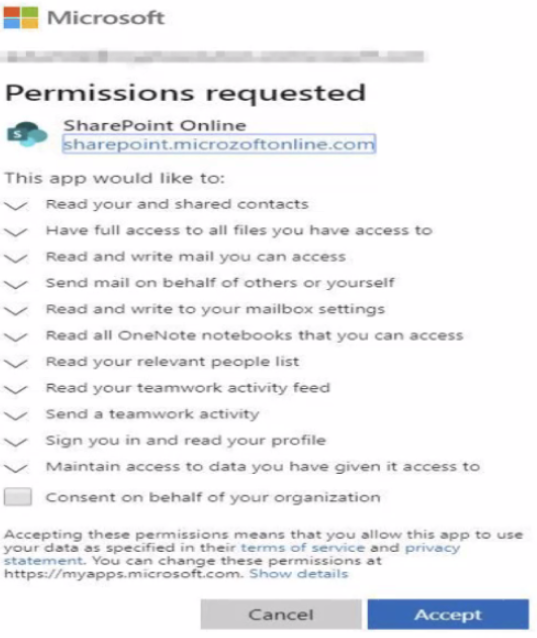
These attacks begin with an emailed link that when clicked loads not a phishing site but the user’s actual Office 365 login page — whether that be at microsoft.com or their employer’s domain. After logging in, the user might see a prompt that looks something like this:

These malicious apps allow attackers to bypass multi-factor authentication, because they are approved by the user after that user has already logged in. Also, the apps will persist in a user’s Office 365 account indefinitely until removed, and will survive even after an account password reset.

This week, messaging security vendor Proofpoint published some new data on the rise of these malicious Office 365 apps, noting that a high percentage of Office users will fall for this scheme [full disclosure: Proofpoint is an advertiser on this website].

Ryan Kalember, Proofpoint’s executive vice president of cybersecurity strategy, said 55 percent of the company’s customers have faced these malicious app attacks at one point or another.

“Of those who got attacked, about 22 percent — or one in five — were successfully compromised,” Kalember said.

Kalember said Microsoft last year sought to limit the spread of these malicious Office apps by creating an app publisher verification system, which requires the publisher to be a valid Microsoft Partner Network member.

That approval process is cumbersome for attackers, so they’ve devised a simple work around. “Now, they’re compromising accounts in credible tenants first,” Proofpoint explains. “Then, they’re creating, hosting and spreading cloud malware from within.”

The attackers responsible for deploying these malicious Office apps aren’t after passwords, and in this scenario they can’t even see them. Rather, they’re hoping that after logging in users will click yes to a approve the installation of a malicious but innocuously-named app into their Office365 account.

Kalember said the crooks behind these malicious apps typically use any compromised email accounts to conduct “business email compromise” or BEC fraud, which involves spoofing an email from someone in authority at an organization and requesting the payment of a fictitious invoice. Other uses have included the sending of malware-laced emails from the victim’s email account.

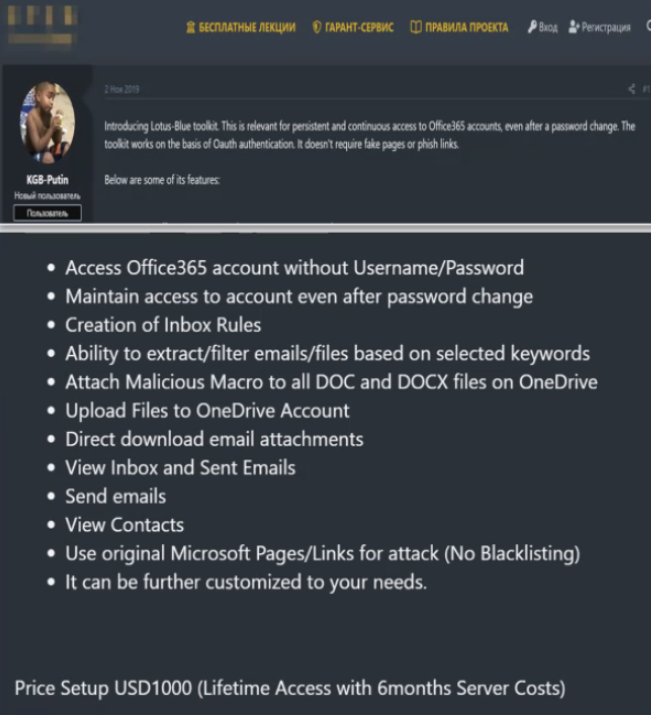
Last year, Proofpoint wrote about a service in the cybercriminal underground where customers could access various Office 365 accounts without a username or password. The service also advertised the ability to extract and filter emails and files based on selected keywords, as well as attach malicious macros to all documents in a user’s Microsoft OneDrive.

A cybercriminal service advertising the sale of access to hacked Office365 accounts. Image: Proofpoint.

“You don’t need a botnet if you have Office 365, and you don’t need malware if you have these [malicious] apps,” Kalember said. “It’s just easier, and it’s a good way to bypass multi-factor authentication.”

KrebsOnSecurity first warned about this trend in January 2020. That story cited Microsoft saying that while organizations running Office 365 could enable a setting to restrict users from installing apps, doing so was a “drastic step” that “severely impairs your users’ ability to be productive with third-party applications.”

Since then, Microsoft added a policy that allows Office 365 administrators to block users from consenting to an application from a non-verified publisher. Also, applications published after November 8, 2020, are coupled with a consent screen warning in case the publisher is not verified, and the tenant policy allows the consent.

Microsoft’s instructions for detecting and removing illicit consent grants in Office 365 are here.

Proofpoint says O365 administrators should limit or block which non-administrators can create applications, and enable Microsoft’s verified publisher policy — as a majority of cloud malware is still coming from Office 365 tenants that are not part of Microsoft’s partner network. Experts say it’s also important to ensure you have security logging turned on so that alerts are generated when employees are introducing new software into your infrastructure.

Premium Domain Names – transcom.uk
Transcom ISP – The UK’s Best Business ISP
DoubleCheck any website at doublecheck.uk

Fake Vaccine Domain Seized

Fake Vaccine Domain Seized

A fraudulent website impersonating a biotechnology company to allegedly steal data has been seized by the United States Attorney’s Office for the District of Maryland.

“Freevaccinecovax.org” purported to be the domain name of a company that was developing a vaccine for COVID-19. However, the site was allegedly set up to collect the personal information of visitors and use it for nefarious purposes.

According to the affidavit filed in support of the seizure, the apparently fraudulent website “freevaccinecovax.org” was discovered by the Homeland Security Investigations Cyber Crimes Center (“C3”) and the Homeland Security Investigations Intellectual Property Rights Center (“IPRC”).

A domain analysis conducted by HSI revealed that the domain name was created on April 27, 2021, using an IP address located in Strasbourg, Germany. The registrant country was listed as Russia.

The creators of the fake site used the real trademarked logos for Pfizer, the World Health Organization (WHO), and the United Nations High Commissioner for Refugees (UNHCR) on the homepage to make the domain appear authentic. 

The seizure of the domain name was announced by Acting United States Attorney for the District of Maryland Jonathan Lenzner and Special Agent in Charge James Mancuso of Homeland Security Investigations, Baltimore.

Mancuso said the HSI wants the public to understand that “all a bad guy needs to defraud thousands of Americans in search of COVID-19 information is the ability to create a website combined with malicious intent.”

The site is the latest in a string of fraudulent websites seeking to capitalize on the outbreak of coronavirus that have been seized by the Maryland US Attorney’s Office. The Office said the data collected by the site could potentially have been used to commit fraud, to deploy malware, or to carry out phishing attacks. 

“This is the ninth fraudulent website seeking to illegally profit from the COVID-19 pandemic that we have seized,” said Lenzner. 

“Members of the public should not provide personal information or click on links in unsolicited e-mails and should remember that the COVID-19 vaccine is not for sale.”

The federal government is providing the vaccine free of charge to people living in the United States.

Premium Domain Names – transcom.uk
Transcom ISP – The UK’s Best Business ISP
DoubleCheck any website at doublecheck.uk

Virgin Active SA Suffers Cyber-Attack

Virgin Active SA Suffers Cyber-Attack

The South African arm of fitness group Virgin Active has been targeted by “sophisticated cyber-criminals.”

The company took all its computer systems offline after being targeted by cyber-criminals on Thursday. Late on Friday, Virgin Active warned clients of the attack by posting a message on its website.

“Virgin Active South Africa became aware of a cyberattack yesterday and our security teams immediately started working with cybersecurity experts to carefully contain, manage and investigate the cyber event,” the message read.

The company’s 136 health clubs remain open while Virgin Active IT staff work behind the scenes to determine the nature and extent of the attack. With computer systems down, the fitness facilities are operating on a “first come, first served” basis. 

Virgin Active is yet to reveal what kind of attack it was subjected to; however, the company said that no data had been removed by unauthorized third parties.

“While we take the necessary steps to protect data, we have been targeted by sophisticated cybercriminals,” said Virgin Active.

“As a precautionary measure, we have taken all systems offline while we resolve this. Our clubs are operating as normal and we sincerely apologize for any inconvenience while we address this event.” 

The company said that it had notified South Africa’s Information Regulator “as a precaution” and is working with law enforcement to bring about a return to normal operations.

In an FAQ published online, Virgin Active emphasized that the attack was not the result of sloppy security practices.

“We have passed security audits and all our data is protected. In addition, all financial and banking data has been encrypted,” stated the company.

Addressing what if any data had been compromised, Virgin Active said: “All our customer data is protected and, at this point in time, we are not aware of any data expropriation. As a precautionary measure, we have taken all systems offline while we work to resolve this.”

The company added that they were still “unsure as to the extent of the cyberattack” as “an investigation being done by forensic experts” remained ongoing.

Premium Domain Names – transcom.uk
Transcom ISP – The UK’s Best Business ISP
DoubleCheck any website at doublecheck.uk

Third Parties Caused Data Breaches at 51% of Organizations

Third Parties Caused Data Breaches at 51% of Organizations

Remote access is becoming an organization’s weakest attack surface, according to new research published today by the Ponemon Institute and third-party remote access provider SecureLink.

The new report, titled “A Crisis in Third-party Remote Access Security,” reveals a disparity between an organization’s perceived third-party access security threat and the protective measures it puts in place. 

Researchers found that organizations are exposing their networks to non-compliance and security risks by not taking action to reduce third-party access risk. 

Nearly half (44%) of organizations were found to have experienced a security breach within the last 12 months. Of those organization, three-quarters (74%) said that the breach had occurred because too much privileged access had been given to third parties.

Researchers found that organizations are not doing the necessary security checks before sharing data access with third parties. Just over half (51%) of organizations said they had not been assessing the security and privacy practices of all third parties before granting them access to sensitive and confidential information. 

“Providing remote access to third parties without implementing the appropriate security safeguards is almost guaranteeing a security incident and a data breach involving sensitive and confidential information,” said Dr. Larry Ponemon, chairman and founder of the Ponemon Institute. 

“It is important that organizations assess the security and privacy practices of the third parties that have access to their networks and ensure that they have just enough access to perform their designated responsibilities and nothing more.”

Other key findings were that 54% of organizations do not have a comprehensive inventory of all third parties with access to their network, and 65% of organizations have not identified the third parties with access to their organization’s most sensitive data.

“The findings in this report showcase the lack of security, management, and accountability that’s needed to adequately secure third-party remote access, which is very worrying,” commented Joe Devine, CEO of SecureLink. 

“While recent high-profile breaches have done a good job of highlighting the serious risks of unsecure vendor relationships, there is still a lot of work to be done to shift organizations’ mindset when it comes to protecting not only their data, but their customer and partner data too.”

Premium Domain Names – transcom.uk
Transcom ISP – The UK’s Best Business ISP
DoubleCheck any website at doublecheck.uk
UK Cyber Security Association Officially Opens for Membership

UK Cyber Security Association Officially Opens for Membership

The UK Cyber Security Association has officially launched and is open for membership, it has been announced.

The body is designed to provide a community for anyone working in, or who has an interest in, the sector, helping promote best practices and information sharing both in the UK and internationally. It also aims to work alongside government, trade bodies, and cybersecurity groups to share information and initiatives.

Membership has now opened for individuals and organizations actively working in the cybersecurity industry. Those who join will be given access to an online portal and forum to engage with other members and the chance to participate in a program of events and training sessions, among other benefits.

First started in 2019 by industry expert Lisa Ventura, the UK Cyber Security Association has been in an expressions of interests phase until now. So far, it has undertaken project work and campaigns in areas such as growing neurodiversity and women in cybersecurity, addressing the cyber-skills gap, and helping individuals and small businesses stay secure online during the COVID-19 pandemic.

Commenting on the launch, Ventura, CEO & founder of the UK Cyber Security Association, said: “In 2019 I spotted a gap for a membership/trade association in cybersecurity and the UK Cyber Security Association was born. Since then, it has been in an expressions of interest phase which has exceeded all my expectations and we are now fully open for membership. Cybercrime has grown exponentially in recent years, especially during the global pandemic, and it has never been more important for individuals and organizations to take their cybersecurity seriously.

“Our aim is to be a caring and sharing membership organization in cybersecurity with a primary focus on delivering value to our members. We are delighted with the response to the idea of a membership association for cybersecurity and look forward to welcoming and helping our members as the association grows and develops.”

The announcement has come shortly after another industry body, the UK Cyber Security Council, was launched as an independent body last month. The council is responsible for boosting professional standards and career prospects for those working in cybersecurity.

Premium Domain Names – transcom.uk
Transcom ISP – The UK’s Best Business ISP
DoubleCheck any website at doublecheck.uk

Scripps Health Knocked Offline by Ransomware

Scripps Health Knocked Offline by Ransomware

A leading Californian healthcare provider has been hit by a cyber-attack forcing the postponement of some patient appointments and a reversion back to offline processes.

Non-profit Scripps Health posted several updates to Twitter over the weekend, claiming that an incident detected on Saturday forced it to suspend access to some applications, including MyScripps and scripps.org.

“While our information technology applications are offline, patient care continues to be delivered safely and effectively at our facilities, utilizing established back-up processes, including offline documentation methods,” it continued.

“Some patient appointments scheduled for today and Monday, May 3, will need to be postponed as a result of this. We are working on how best to notify these patients about the need to reschedule.”

The San Diego-headquartered provider said that outpatient urgent care centers and Scripps HealthExpress locations and emergency departments remain open for patient care, and tried to reassure patients that its “physicians and employees are well-trained and thoroughly prepared to respond to this sort of situation.”

Local reports confirmed ransomware as the cause of the attack, adding that patients with life-threatening conditions would be diverted from the group’s hospitals where possible.

Scripps is reported to generate revenues of around $3 billion annually and treats an estimated 700,000 patients each year.

Unfortunately, the healthcare sector continues to be a major target for threat actors who see the pandemic as a perfect opportunity to turn up the heat on hospitals for their own gain.

Cyber-attacks on global healthcare organizations (HCOs) surged by more than double the rate of those targeting other sectors at the end of 2020, with ransomware the primary cause, according to Check Point.

In the meantime, Scripps Health said it was working hard to restore systems.

“Our technical teams and vendor partners are working around the clock to resolve these issues as quickly as possible. We have notified law enforcement and the appropriate governmental organizations,” it added.

Premium Domain Names – transcom.uk
Transcom ISP – The UK’s Best Business ISP
DoubleCheck any website at doublecheck.uk

Pulse Secure Patches Critical Zero-Day Flaw

Pulse Secure Patches Critical Zero-Day Flaw

Pulse Secure has patched a critical zero-day vulnerability that was being exploited by multiple APT groups to target US defense companies, among other entities.

The security update fixes CVE-2021-22893, a critical authentication bypass vulnerability in the Pulse Connect Secure VPN product which has a CVSS score of 10.0.

It was being exploited in combination with bugs from 2019 and 2020, patched by the vendor but not applied by some organizations, to bypass multi-factor authentication on the product. This allowed attackers to deploy webshells for persistence and perform surveillance activities.

Mandiant said at the time that it had tracked 12 malware families to the exploitation of the vulnerability, and at least one state-sponsored attack group, APT5.

Reports of these attacks first started to appear around two weeks ago, with both the US Cybersecurity and Infrastructure Security Agency (CISA) and the UK’s National Cyber Security Centre (NCSC) issuing warnings to organizations.

Phil Richards, CSO or Pulse Secure’s parent company Ivanti, argued that the firm was making “significant investments” to improve its security posture, including enhancements to its application development processes.

“The Pulse Secure team has worked closely with CISA as well as leading forensic experts and industry groups, including Mandiant/FireEye and Stroz Friedberg, among others, to investigate and respond quickly to malicious activity that was identified on a very limited number of customer systems,” he added.

“The Pulse team took swift action to provide mitigations directly to the limited number of impacted customers that remediates the risk to their system, and we are pleased to be able to deliver a security patch in such short order to address the vulnerability.”

Richards also encouraged Pulse Secure customers to take advantage of an integrity checker tool to see if they’ve been impacted by the threat.

Premium Domain Names – transcom.uk
Transcom ISP – The UK’s Best Business ISP
DoubleCheck any website at doublecheck.uk

Suspected Iranian Ransomware Group Targets Israeli Firms

Suspected Iranian Ransomware Group Targets Israeli Firms

Suspected Iranian hackers have reportedly hit multiple Israeli companies with ransomware, in a new campaign of attacks.

A group describing itself as ‘N3tw0rm’ (Networm) on Sunday added the logo of H&M Israel to their naming and shaming website, just three days after another local firm, Veritas Logistics, was hit.

Networm is threatening to publish 110GB of data stolen from the fashion retailer and 9GB from transport firm Veritas, including information on customers, invoices, employees and possibly payment data, according to Haaretz.

The group reportedly demanded 3 Bitcoin ($168,000) from Veritas Logistics to delete the data.

A local cybersecurity firm that Haaretz spoke to claimed it was providing incident response for three Israeli companies that had recently been hit by ransomware. There are suspicions an unnamed non-profit may also have been targeted in the ongoing campaign.

The Networm group has been linked to ‘Pay2Key’ — an Iranian cyber-attack group that hit scores of Israeli firms at the end of last year in what some commentators described as an ideological rather than financially motivated operation.

If that’s true, the attackers have no intention of releasing the stolen information but instead want to undermine the status of Israel as a pre-eminent cyber power, the report claimed.

In fact, it’s not uncommon for ransomware threat actors to hold onto some or all of the data they’ve stolen. A Sophos report out last week claimed that although a third (32%) of victim organizations now elect to pay, only 8% got all their data back last year and 29% didn’t manage to grab more than half of what they lost.

Premium Domain Names – transcom.uk
Transcom ISP – The UK’s Best Business ISP
DoubleCheck any website at doublecheck.uk