Space Command to Launch Dedicated Cyber Center

Space Command to Launch Dedicated Cyber Center

The United States is to launch a dedicated joint cyber center to promote integration between US Space Command and US Cyber Command.

News of the center was shared by the commander of US Cyber Command, General James Dickinson, during a 2022 fiscal budget hearing with US Strategic Command and Space Command last week. 

“We are standing up a joint cyber center within the command as we speak,” said Dickinson.

Detailing what else was in the works for space and cyber, the general added: “I also have, as a result of the command standing up, I’ve got five service components provided by each of the services to the combatant command with two of those—my Navy component as well as my Marines component—who are dual hatted.”

In prepared testimony on the fiscal year 2022 priorities and posture of Space Command, Dickinson warned of security threats coming from the east. 

The general noted China’s desire “to use space to supplant the US as a global economic and military leader” and said that Russia is seeking “to degrade US space capabilities in order to prevail in future conflicts.” 

He said: “Both countries reorganized their militaries to develop deeper competency in technical military fields such as electronic warfare, cyberspace and space operation.”

Dickinson said that Russia and China were developing and testing anti-satellite weapon systems to achieve their national security goals. 

“China is developing a broad complement of jamming and cyberspace capabilities, directed energy weapons, on-orbit capabilities, and ground-based antisatellite missiles that can achieve a range of effects,” said Dickinson.

Other countries flagged by the general for their cyberspace and counter-space activities were Iran and North Korea. 

“Iran and North Korea continue to advance their own counter-space threats through cyberattacks, jamming and electronic warfare,” said Dickinson, before noting that North Korea’s technology “to evolve and mature their cyberattack capabilities” continues to improve. 

The general emphasized the need for the United States to maintain “a robust cybersecurity environment that secures our intellectual and technological advantage from cradle to grave” to achieve its space goals.

He named cybersecurity as one of the critical areas that the country must keep funding.

Premium Domain Names – transcom.uk
Transcom ISP – The UK’s Best Business ISP
DoubleCheck any website at doublecheck.uk

E-commerce Fraud to Exceed $20 Billion in 2021

E-commerce Fraud to Exceed $20 Billion in 2021

E-commerce fraud is set to spike 18% from 2020-2021 to top $20 billion globally this year, according to the latest research from Juniper Research.

The value of online losses will grow from around $17.5 billion in 2020 as scammers continue to target the growing number of internet shoppers forced online by the pandemic.

According to the new report, Online Payment Fraud: Emerging Threats, Segment Analysis & Market Forecasts 2021-2025 Market Research, merchants are increasingly on the back foot when it comes to mitigating online fraud.

It calls out AI-powered behavioral biometrics as an important step forward in technological innovation which could help these businesses fight back without adding extra customer friction to the purchasing journey.

Such tools can work away in the background to identify each user by the unique way they type, use their mouse, fill in web forms or carry out other tasks. That would limit the number of transactions that must be flagged for manual review or extra authentication checks.

Clear messaging around the need for these extra checks is also important to help manage customer expectations at the online check out, Juniper Research said.

“While the need for security is greater than ever, the competitive e-commerce environment means merchants will need to ensure that extra security checks are justified to the user, or they risk higher cart abandonment rates,” warned co-author, Susan Morrow.

New Strong Customer Authentication (SCA) requirements deferred because of COVID-19 will finally come into force in the UK this September, adding to the burden on merchants. Those who haven’t planned the transition could end up being forced to add extra authentication checks.

Juniper Research claimed that China would be the largest market for e-commerce fraud in the world, accounting for over 40% of global losses in 2025, at over $12 billion. It warned merchants there to invest in advanced solutions now to protect their slim operating margins.

Premium Domain Names – transcom.uk
Transcom ISP – The UK’s Best Business ISP
DoubleCheck any website at doublecheck.uk

Cyber Ninjas Forges on With Controversial Arizona Election Recount

Cyber Ninjas Forges on With Controversial Arizona Election Recount

Republicans in Arizona still smarting after Joe Biden’s win there have hired a little-known cybersecurity consultancy to perform an election ‘audit’ in the state’s most populous county, according to reports.

Florida-based Cyber Ninjas has no previous experience in managing election recounts and is run by a man who has shared conspiracy theories online about the supposed illegitimacy of the US election results last November, according to The Guardian.

The report cited Doug Logan as claiming his personal views are irrelevant because the audit itself will be run transparently via streamed video. However, journalists are reportedly banned from observing the count, and there are question marks over who the financial backers of the project are.

The $150,000 put up by the Republican-dominated state senate was reportedly added to by funds raised from the right-wing One America News Network, which went direct to Cyber Ninjas.

Logan has also refused to commit to bipartisan counting teams, only that they would be comprised of members of law enforcement, the military and retirees.

The manual recount for Maricopa county began last Friday and there are also plans to go door-to-door to ask people how they voted in certain precincts. Ballot paper fibers will be scanned to look for fakes and both the voting machines and the data they generated will apparently be reviewed.

However, question marks are already being raised over the way the ‘review’ is being handled.

Experts cited by The Guardian claimed that paper counts tend to be error-prone and questioned a lack of transparency around how voter intent would be decided.

There have already been pre- and post-election checks of the voting machines in Maricopa county and a check of a representative sample of ballots. Two separate audit firms reported no issues with the voting software or counting equipment used.

Premium Domain Names – transcom.uk
Transcom ISP – The UK’s Best Business ISP
DoubleCheck any website at doublecheck.uk

US Drilling Giant Gyrodata Reveals Employee Data Breach

US Drilling Giant Gyrodata Reveals Employee Data Breach

A major oil drilling specialist has admitted it suffered a ransomware attack which may have led to the compromise of data belonging to current and former employees.

Houston-based Gyrodata claims to be one of the world’s leading suppliers of technology and services designed to extract hydrocarbons from the earth.

However, late last week it published a statement revealing the security incident, which was discovered on February 21.

There’s no information on whether the ransomware itself caused any disruption to the firm, but it did admit the potential impact on employees’ personal and financial data.

“Gyrodata’s investigation determined that the unauthorized actor gained access to certain systems and related data within the Gyrodata environment at various times from approximately January 16, 2021 to February 22, 2021,” it said.

“The data potentially obtained by the unauthorized actor may have contained personal information of current and former Gyrodata employees, including names, addresses, dates of birth, driver’s license numbers, Social Security numbers, passport numbers, W-2 tax forms, and information related to health plan enrolment.”

As of last Thursday, the firm has been contacting affected individuals by post, and has set-up a dedicated call center to deal with the potential fallout. Gyrodata is estimated to have around 1000 employees worldwide, including in offices in Scotland and Malaysia.

“Individuals whose personal information may have been involved should remain vigilant for incidents of fraud or identity theft by reviewing account statements and free credit reports for any unauthorized activity,” the statement continued.

“It is recommended that you review any statements that you receive from your health insurer or healthcare providers. If you see services that you did not receive, please contact the insurer or provider immediately. As a precaution, Gyrodata is also offering individuals whose Social Security number or driver’s license number may have been involved complementary credit monitoring and identity protection services.”

Premium Domain Names – transcom.uk
Transcom ISP – The UK’s Best Business ISP
DoubleCheck any website at doublecheck.uk

When AIs Start Hacking

If you don’t have enough to worry about already, consider a world where AIs are hackers.

Hacking is as old as humanity. We are creative problem solvers. We exploit loopholes, manipulate systems, and strive for more influence, power, and wealth. To date, hacking has exclusively been a human activity. Not for long.

As I lay out in a report I just published, artificial intelligence will eventually find vulnerabilities in all sorts of social, economic, and political systems, and then exploit them at unprecedented speed, scale, and scope. After hacking humanity, AI systems will then hack other AI systems, and humans will be little more than collateral damage.

Okay, maybe this is a bit of hyperbole, but it requires no far-future science fiction technology. I’m not postulating an AI “singularity,” where the AI-learning feedback loop becomes so fast that it outstrips human understanding. I’m not assuming intelligent androids. I’m not assuming evil intent. Most of these hacks don’t even require major research breakthroughs in AI. They’re already happening. As AI gets more sophisticated, though, we often won’t even know it’s happening.

AIs don’t solve problems like humans do. They look at more types of solutions than us. They’ll go down complex paths that we haven’t considered. This can be an issue because of something called the explainability problem. Modern AI systems are essentially black boxes. Data goes in one end, and an answer comes out the other. It can be impossible to understand how the system reached its conclusion, even if you’re a programmer looking at the code.

In 2015, a research group fed an AI system called Deep Patient health and medical data from some 700,000 people, and tested whether it could predict diseases. It could, but Deep Patient provides no explanation for the basis of a diagnosis, and the researchers have no idea how it comes to its conclusions. A doctor either can either trust or ignore the computer, but that trust will remain blind.

While researchers are working on AI that can explain itself, there seems to be a trade-off between capability and explainability. Explanations are a cognitive shorthand used by humans, suited for the way humans make decisions. Forcing an AI to produce explanations might be an additional constraint that could affect the quality of its decisions. For now, AI is becoming more and more opaque and less explainable.

Separately, AIs can engage in something called reward hacking. Because AIs don’t solve problems in the same way people do, they will invariably stumble on solutions we humans might never have anticipated­ — and some will subvert the intent of the system. That’s because AIs don’t think in terms of the implications, context, norms, and values we humans share and take for granted. This reward hacking involves achieving a goal but in a way the AI’s designers neither wanted nor intended.

Take a soccer simulation where an AI figured out that if it kicked the ball out of bounds, the goalie would have to throw the ball in and leave the goal undefended. Or another simulation, where an AI figured out that instead of running, it could make itself tall enough to cross a distant finish line by falling over it. Or the robot vacuum cleaner that instead of learning to not bump into things, it learned to drive backwards, where there were no sensors telling it it was bumping into things. If there are problems, inconsistencies, or loopholes in the rules, and if those properties lead to an acceptable solution as defined by the rules, then AIs will find these hacks.

We learned about this hacking problem as children with the story of King Midas. When the god Dionysus grants him a wish, Midas asks that everything he touches turns to gold. He ends up starving and miserable when his food, drink, and daughter all turn to gold. It’s a specification problem: Midas programmed the wrong goal into the system.

Genies are very precise about the wording of wishes, and can be maliciously pedantic. We know this, but there’s still no way to outsmart the genie. Whatever you wish for, he will always be able to grant it in a way you wish he hadn’t. He will hack your wish. Goals and desires are always underspecified in human language and thought. We never describe all the options, or include all the applicable caveats, exceptions, and provisos. Any goal we specify will necessarily be incomplete.

While humans most often implicitly understand context and usually act in good faith, we can’t completely specify goals to an AI. And AIs won’t be able to completely understand context.

In 2015, Volkswagen was caught cheating on emissions control tests. This wasn’t AI — human engineers programmed a regular computer to cheat — but it illustrates the problem. They programmed their engine to detect emissions control testing, and to behave differently. Their cheat remained undetected for years.

If I asked you to design a car’s engine control software to maximize performance while still passing emissions control tests, you wouldn’t design the software to cheat without understanding that you were cheating. This simply isn’t true for an AI. It will think “out of the box” simply because it won’t have a conception of the box. It won’t understand that the Volkswagen solution harms others, undermines the intent of the emissions control tests, and is breaking the law. Unless the programmers specify the goal of not behaving differently when being tested, an AI might come up with the same hack. The programmers will be satisfied, the accountants ecstatic. And because of the explainability problem, no one will realize what the AI did. And yes, knowing the Volkswagen story, we can explicitly set the goal to avoid that particular hack. But the lesson of the genie is that there will always be unanticipated hacks.

How realistic is AI hacking in the real world? The feasibility of an AI inventing a new hack depends a lot on the specific system being modeled. For an AI to even start on optimizing a problem, let alone hacking a completely novel solution, all of the rules of the environment must be formalized in a way the computer can understand. Goals — known in AI as objective functions — need to be established. And the AI needs some sort of feedback on how well it’s doing so that it can improve.

Sometimes this is simple. In chess, the rules, objective, and feedback — did you win or lose? — are all precisely specified. And there’s no context to know outside of those things that would muddy the waters. This is why most of the current examples of goal and reward hacking come from simulated environments. These are artificial and constrained, with all of the rules specified to the AI. The inherent ambiguity in most other systems ends up being a near-term security defense against AI hacking.

Where this gets interesting are systems that are well specified and almost entirely digital. Think about systems of governance like the tax code: a series of algorithms, with inputs and outputs. Think about financial systems, which are more or less algorithmically tractable.

We can imagine equipping an AI with all of the world’s laws and regulations, plus all the world’s financial information in real time, plus anything else we think might be relevant; and then giving it the goal of “maximum profit.” My guess is that this isn’t very far off, and that the result will be all sorts of novel hacks.

But advances in AI are discontinuous and counterintuitive. Things that seem easy turn out to be hard, and things that seem hard turn out to be easy. We don’t know until the breakthrough occurs.

When AIs start hacking, everything will change. They won’t be constrained in the same ways, or have the same limits, as people. They’ll change hacking’s speed, scale, and scope, at rates and magnitudes we’re not ready for. AI text generation bots, for example, will be replicated in the millions across social media. They will be able to engage on issues around the clock, sending billions of messages, and overwhelm any actual online discussions among humans. What we will see as boisterous political debate will be bots arguing with other bots. They’ll artificially influence what we think is normal, what we think others think.

The increasing scope of AI systems also makes hacks more dangerous. AIs are already making important decisions about our lives, decisions we used to believe were the exclusive purview of humans: Who gets parole, receives bank loans, gets into college, or gets a job. As AI systems get more capable, society will cede more — and more important — decisions to them. Hacks of these systems will become more damaging.

What if you fed an AI the entire US tax code? Or, in the case of a multinational corporation, the entire world’s tax codes? Will it figure out, without being told, that it’s smart to incorporate in Delaware and register your ship in Panama? How many loopholes will it find that we don’t already know about? Dozens? Thousands? We have no idea.

While we have societal systems that deal with hacks, those were developed when hackers were humans, and reflect human speed, scale, and scope. The IRS cannot deal with dozens — let alone thousands — of newly discovered tax loopholes. An AI that discovers unanticipated but legal hacks of financial systems could upend our markets faster than we could recover.

As I discuss in my report, while hacks can be used by attackers to exploit systems, they can also be used by defenders to patch and secure systems. So in the long run, AI hackers will favor the defense because our software, tax code, financial systems, and so on can be patched before they’re deployed. Of course, the transition period is dangerous because of all the legacy rules that will be hacked. There, our solution has to be resilience.

We need to build resilient governing structures that can quickly and effectively respond to the hacks. It won’t do any good if it takes years to update the tax code, or if a legislative hack becomes so entrenched that it can’t be patched for political reasons. This is a hard problem of modern governance. It also isn’t a substantially different problem than building governing structures that can operate at the speed and complexity of the information age.

What I’ve been describing is the interplay between human and computer systems, and the risks inherent when the computers start doing the part of humans. This, too, is a more general problem than AI hackers. It’s also one that technologists and futurists are writing about. And while it’s easy to let technology lead us into the future, we’re much better off if we as a society decide what technology’s role in our future should be.

This is all something we need to figure out now, before these AIs come online and start hacking our world.

This essay previously appeared on Wired.com

Premium Domain Names – transcom.uk
Transcom ISP – The UK’s Best Business ISP
DoubleCheck any website at doublecheck.uk

You Don’t Have to Give Up Your Crown Jewels in Hopes of Better Cloud Security

If you’re like me, you love a good heist film. Movies like The Italian Job, Inception, and Ocean’s 11 are riveting, but outside of cinema these types of heists don’t really happen anymore, right? Think again. In 2019, the Green Vault Museum in Dresden, Germany reported a jewel burglary worthy of its own film.

On November 25, 2019 at 4am, the Berlin Clan Network started a fire that destroyed the museum’s power box, disabling some of the alarm systems. The clan then cut through iron bars and broke into the vault. Security camera footage published online shows two suspects entering the room with flashlights, across a black-and-white-tiled floor. After grabbing 37 sets of stolen jewelry in a couple of minutes, the thieves exited through the same window, replacing the bars in order to delay detection. Then they fled in a car which was later found torched.[1]

Since then, there’s been numerous police raids and a couple of arrests, but an international manhunt is still underway and none of the stolen jewels have been recovered. What’s worse is that the museum didn’t insure the jewelry, resulting in a $1.2 billion-dollar loss. Again, this is a story ripe for Hollywood.

Although we may not read about jewelry heists like this one every day, we do see daily headlines about security breaches resulting in companies losing their own crown jewels – customer data. In fact, the concept of protecting crown jewels is so well known in the cybersecurity industry, that MITRE has created a process called Crown Jewels Analysis (CJA), which helps organizations identify the most important cyber assets and create mitigation processes for protecting those assets.[2] Today exposed sensitive data has become synonymous with cloud storage breaches and there is no shortage of victims.

To be fair all of these breaches have a common factor – the human element in charge of managing cloud storage misconfigured or didn’t enable the correct settings. However, at the same time we can’t always blame people when security fails. If robbers can so easily access multiple crown jewels again and again, you can’t keep blaming the security guards. Something is wrong with the system.

Some of the most well-versed cloud native companies like Netflix, Twilio, and Uber have suffered security breaches with sensitive data stored in cloud storage.[3] This has gotten to the point that in 2020, the Verizon Data Breach Report listed Errors as the second highest cause for data breaches due “in large part, associated with internet-exposed storage.”[4]

So why is securing cloud storage services so hard? Why do so many different companies struggle with this concept? As we’ve talked to our customers and asked what makes protecting sensitive data in the cloud so challenging, many simply don’t know if they had sensitive data in the cloud or struggle with handling the countless permissions and available overrides for each service.[5] Most of them have taken the approach that someone – whether that be an internal employee, a third-party contractor, or a technology partner – will eventually fail in setting the right permissions for their data, and they need a solution that will continuously check for sensitive data and prevent it from being accessed regardless of the location or service-level permissions.

Enter in Cloud Native Application Protection Platform (CNAPP). Last month our new CNAPP service dedicated to securing hybrid cloud infrastructure and cloud native applications became generally available. One of the core pillars behind CNAPP is Apps & Data – meaning that along with Cloud Security Posture Management (CSPM) and Cloud Workload Protection Platform (CWPP), CNAPP provides a cohesive Data Loss Prevention (DLP) service.

Figure 1: CNAPP Pillars

Typically, the way security vendors perform DLP scans for cloud storage is by copying down customer data to their platform. They do this because in order to scan for sensitive data, the vendor needs access to your data from a platform that can run their DLP engine. However, this solution presents some challenges:

  • Costs – copying down storage objects means customers incur charges for every bit of data that goes across the wire which include but aren’t limited to requests charges, egress charges, and data transfer charges. For some customers these charges are significant enough where they have to pick and choose which objects to scan instead of protecting their entire data store in the cloud.
  • Operational burden – customers who aren’t comfortable sending the data over the public internet have to create tunnels or direct connections to vendor solutions. This means additional overhead, architectural changes, and sometimes backhauling large amounts of data across those connections.
  • Defeats the Purpose of DLP – this was a lesson learned from our MVISION Cloud DLP scanning; for some customers performing DLP scans over network connections was convenient but for other customers it was a huge security risk. Essentially, these solutions require customers to hand over their crown jewels in order to determine if that data has the crown jewels. Ultimately, we arrived at the conclusion that data should be local, but DLP policies should be global.

This is where we came up with the concept of in-tenant DLP scanning. In-tenant DLP scanning works by launching a small software stack inside the customers’ AWS, Azure, or GCP account. The stack is a headless, microservice (called a Micro Point of Presence or Micro PoP) that pushes out workload protection policies to compute and storage services. The Micro PoP connects to the CNAPP console for management purposes but allows customers to perform local DLP scans within each virtual network segment using direct access. No customer data ever leaves the customers’ tenant.

Figure 2: In-tenant DLP Scanning

Customers can also choose to connect multiple virtual network segments to a single Micro PoP using services like AWS PrivateLink if they want to consolidate DLP scans for multiple S3 buckets. There’s no capacity limit or license limitation to how many Micro PoPs customers can deploy. CNAPP supports in-tenant DLP scanning for Amazon S3, Azure Blob, and GCP storage today with on-prem storage coming soon. Lastly, customers don’t have to pick and choose only one deployment model – they can use our traditional DLP scans (called API scans) over network connections or select our in-tenant DLP scans for more sensitive workloads.

In-tenant DLP scanning is just one of the many innovate features we’ve launched with CNAPP. I invite you to check out the solution for yourself. Visit https://mcafee.com/CNAPP for more information or request a demo at https://mcafee.com/demo. We’d love to get your feedback and see how MVISION CNAPP can help your company stay out of the headlines and make sure your crown jewels are right where they should be.


Disclaimer: this blog post contains information on products, services and/or processes in development. All information provided here is subject to change without notice at McAfee’s sole discretion. Contact your McAfee representative to obtain the latest forecast, schedule, specifications, and roadmaps.

[1] https://www.dw.com/en/germanys-heist-that-shocked-the-museum-world-the-green-vault-theft/a-55702898

[2] https://www.mitre.org/publications/systems-engineering-guide/enterprise-engineering/systems-engineering-for-mission-assurance/crown-jewels-analysis

[3] https://www.darkreading.com/cloud/twilio-security-incident-shows-danger-of-misconfigured-s3-buckets/d/d-id/1338447

[4] https://enterprise.verizon.com/resources/reports/dbir/

[5] https://www.upguard.com/blog/s3-security-is-flawed-by-design

The post You Don’t Have to Give Up Your Crown Jewels in Hopes of Better Cloud Security appeared first on McAfee Blogs.

Premium Domain Names – transcom.uk
Transcom ISP – The UK’s Best Business ISP
DoubleCheck any website at doublecheck.uk

Experian’s Credit Freeze Security is Still a Joke

In 2017, KrebsOnSecurity showed how easy it is for identity thieves to undo a consumer’s request to freeze their credit file at Experian, one of the big three consumer credit bureaus in the United States.  Last week, KrebsOnSecurity heard from a reader who had his freeze thawed without authorization through Experian’s website, and it reminded me of how truly broken authentication and security remains in the credit bureau space.

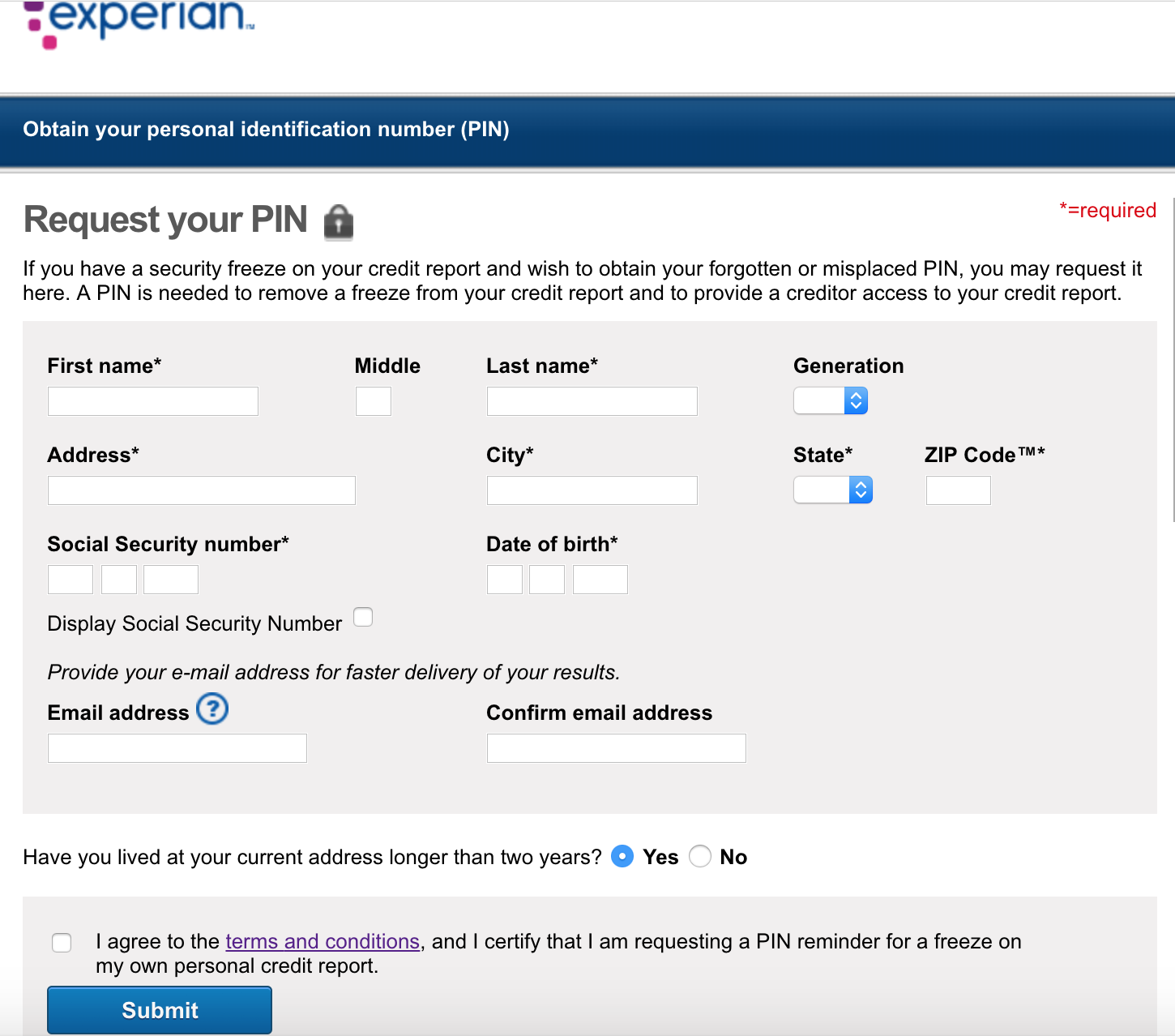
Experian’s page for retrieving someone’s credit freeze PIN requires little more information than has already been leaked by big-three bureau Equifax and a myriad other breaches.

Dune Thomas is a software engineer from Sacramento, Calif. who put a freeze on his credit files last year at Experian, Equifax and TransUnion after thieves tried to open multiple new payment accounts in his name using an address in Washington state that was tied to a vacant home for sale.

But the crooks were persistent: Earlier this month, someone unfroze Thomas’ account at Experian and promptly applied for new lines of credit in his name, again using the same Washington street address. Thomas said he only learned about the activity because he’d taken advantage of a free credit monitoring service offered by his credit card company.

Thomas said after several days on the phone with Experian, a company representative acknowledged that someone had used the “request your PIN” feature on Experian’s site to obtain his PIN and then unfreeze his file.

Thomas said he and a friend both walked through the process of recovering their freeze PIN at Experian, and were surprised to find that just one of the five multiple-guess questions they were asked after entering their address, Social Security Number and date of birth had anything to do with information only the credit bureau might know.

KrebsOnSecurity stepped through the same process and found similar results. The first question asked about a new mortgage I supposedly took out in 2019 (I didn’t), and the answer was none of the above. The answer to the second question also was none of the above.

The next two questions were useless for authentication purposes because they’d already been asked and answered; one was “which of the following is the last four digits of your SSN,” and the other was “I was born within a year or on the year of the date below.” Only one question mattered and was relevant to my credit history (it concerned the last four digits of a checking account number).

The best part about this lax authentication process is that one can enter any email address to retrieve the PIN — it doesn’t need to be tied to an existing account at Experian. Also, when the PIN is retrieved, Experian doesn’t bother notifying any other email addresses already on file for that consumer.

Finally, your basic consumer (read: free) account at Experian does not give users the option to enable any sort of multi-factor authentication that might help stymie some of these PIN retrieval attacks on credit freezes.

Unless, that is, you subscribe to Experian’s heavily-marketed and confusingly-worded “CreditLock” service, which charges between $14.99 and $24.99 a month for the ability to “lock and unlock your file easily and quickly, without delaying the application process.” CreditLock users can both enable multifactor authentication and get alerts when someone tries to access their account.

Thomas said he’s furious that Experian only provides added account security for consumers who pay for monthly plans.

“Experian had the ability to give people way better protection through added authentication of some kind, but instead they don’t because they can charge $25 a month for it,” Thomas said. “They’re allowing this huge security gap so they can make a profit. And this has been going on for at least four years.”

Experian has not yet responded to requests for comment.

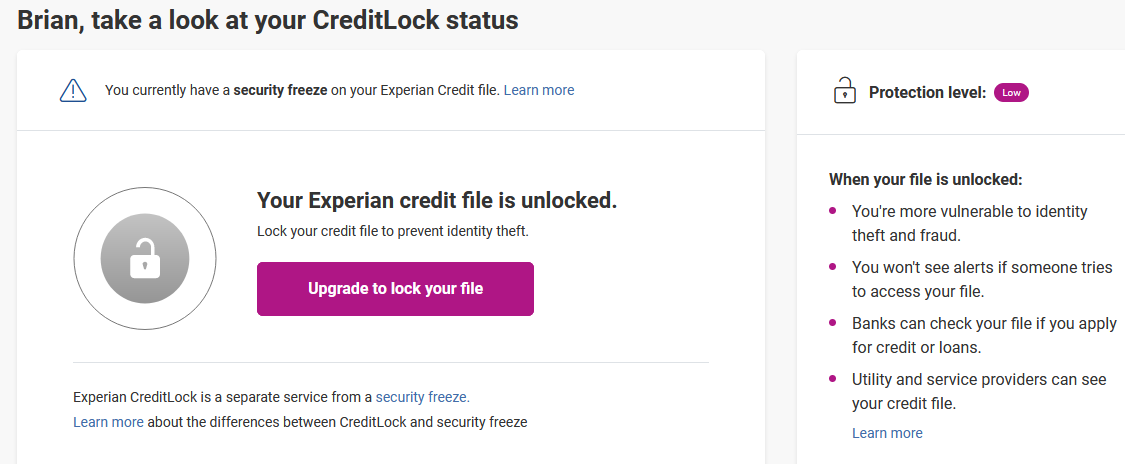
When a consumer with a freeze logs in to Experian’s site, they are immediately directed to a message for one of Experian’s paid services, such as its CreditLock service. The message I saw upon logging in confirmed that while I had a freeze in place with Experian, my current “protection level” was “low” because my credit file was unlocked.

“When your file is unlocked, you’re more vulnerable to identity theft and fraud,” Experian warns, untruthfully. “You won’t see alerts if someone tries to access your file. Banks can check your file if you apply for credit or loans. Utility and service providers can see your credit file.”

Experian says my security is low because while I have a freeze in place, I haven’t bought into their questionable “lock service.”

Sounds scary, right? The thing is — except for the part about not seeing alerts — none of the above statement is true if you already have a freeze on your file. A security freeze essentially blocks any potential creditors from being able to view your credit file, unless you affirmatively unfreeze or thaw your file beforehand.

With a freeze in place on your credit file, ID thieves can apply for credit in your name all they want, but they will not succeed in getting new lines of credit in your name because few if any creditors will extend that credit without first being able to gauge how risky it is to loan to you (i.e., view your credit file). It is now free to freeze your credit in all U.S. states and territories.

Experian, like the other consumer credit bureaus, uses their intentionally confusing “lock” terminology to frighten consumers into paying for monthly subscription services. A key selling point for these lock services is they can be a faster way to let creditors peek at your file when you wish to apply for new credit. That may or may not be true in practice, but consider why it’s so important for Experian to get consumers to sign up for their lock programs.

The real reason is that Experian makes money every time someone makes a credit inquiry in your name, and it does not want to do anything to hinder those inquiries. Signing up for a lock service lets Experian continue selling credit report information to a variety of third parties. According to Experian’s FAQ, when locked your Experian credit file remains accessible to a host of companies, including:

-Potential employers or insurance companies

-Collection agencies acting on behalf of companies you may owe

-Companies providing pre-screened credit card offers

-Companies that have an existing credit relationship with you (this is true for frozen files also)

-Personalized offers from Experian, if you choose to receive them

It is annoying that Experian can get away with offering additional account security only to people who pay the company a hefty sum each month to sell their information. It’s also amazing that this sloppy security I wrote about back in 2017 is still just as prevalent in 2021.

But Experian is hardly alone. In 2019, I wrote about how Equifax’s new MyEquifax site made it simple for thieves to lift an existing credit freeze at Equifax and bypass the PIN if they were armed with just your name, Social Security number and birthday.

Also in 2019, identity thieves were able to get a copy of my credit report from TransUnion after successfully guessing the answers to multiple-guess questions like the ones Experian asks. I only found out after hearing from a detective in Washington state, who informed me that a copy of the report was found on a removable drive seized from a local man who was arrested on suspicion of being part of an ID theft gang.

TransUnion investigated and found it was indeed at fault for giving my credit report to ID thieves, but that on the bright side its systems blocked another fraudulent attempt at getting my report in 2020.

“In our investigation, we determined that a similar attempt to fraudulently obtain your report occurred in April 2020, and was successfully blocked by enhanced controls TransUnion has implemented since last year,” the company said. “TransUnion deploys a multi-layered security program to combat the ongoing and increasing threat of fraud, cyber-attacks and malicious activity.  In today’s dynamic threat environment, TransUnion is constantly enhancing and refining our controls to address the latest security threats, while still allowing consumers access to their information.”

For more information on credit freezes (also called a “security freezes”), how to request one, and other tips on preventing identity fraud, check out this story.

If you haven’t done so lately, it might be a good time to order a free copy of your credit report from annualcreditreport.com. This service entitles each consumer one free copy of their credit report annually from each of the three credit bureaus — either all at once or spread out over the year.

Premium Domain Names – transcom.uk
Transcom ISP – The UK’s Best Business ISP
DoubleCheck any website at doublecheck.uk