Premium Domain Names – transcom.uk
Transcom ISP – The UK’s Best Business ISP
DoubleCheck any website at doublecheck.uk
Author: admin
Malware Loader Abuses Google SEO to Expand Payload Delivery
Premium Domain Names – transcom.uk
Transcom ISP – The UK’s Best Business ISP
DoubleCheck any website at doublecheck.uk
Firewall Vendor Patches Critical Auth Bypass Flaw
Premium Domain Names – transcom.uk
Transcom ISP – The UK’s Best Business ISP
DoubleCheck any website at doublecheck.uk
National Security Risks of Late-Stage Capitalism
Early in 2020, cyberspace attackers apparently working for the Russian government compromised a piece of widely used network management software made by a company called SolarWinds. The hack gave the attackers access to the computer networks of some 18,000 of SolarWinds’s customers, including US government agencies such as the Homeland Security Department and State Department, American nuclear research labs, government contractors, IT companies and nongovernmental agencies around the world.
It was a huge attack, with major implications for US national security. The Senate Intelligence Committee is scheduled to hold a hearing on the breach on Tuesday. Who is at fault?
The US government deserves considerable blame, of course, for its inadequate cyberdefense. But to see the problem only as a technical shortcoming is to miss the bigger picture. The modern market economy, which aggressively rewards corporations for short-term profits and aggressive cost-cutting, is also part of the problem: Its incentive structure all but ensures that successful tech companies will end up selling insecure products and services.
Like all for-profit corporations, SolarWinds aims to increase shareholder value by minimizing costs and maximizing profit. The company is owned in large part by Silver Lake and Thoma Bravo, private-equity firms known for extreme cost-cutting.
SolarWinds certainly seems to have underspent on security. The company outsourced much of its software engineering to cheaper programmers overseas, even though that typically increases the risk of security vulnerabilities. For a while, in 2019, the update server’s password for SolarWinds’s network management software was reported to be “solarwinds123.” Russian hackers were able to breach SolarWinds’s own email system and lurk there for months. Chinese hackers appear to have exploited a separate vulnerability in the company’s products to break into US government computers. A cybersecurity adviser for the company said that he quit after his recommendations to strengthen security were ignored.
There is no good reason to underspend on security other than to save money — especially when your clients include government agencies around the world and when the technology experts that you pay to advise you are telling you to do more.
As the economics writer Matt Stoller has suggested, cybersecurity is a natural area for a technology company to cut costs because its customers won’t notice unless they are hacked – and if they are, they will have already paid for the product. In other words, the risk of a cyberattack can be transferred to the customers. Doesn’t this strategy jeopardize the possibility of long-term, repeat customers? Sure, there’s a danger there – but investors are so focused on short-term gains that they’re too often willing to take that risk.
The market loves to reward corporations for risk-taking when those risks are largely borne by other parties, like taxpayers. This is known as “privatizing profits and socializing losses.” Standard examples include companies that are deemed “too big to fail,” which means that society as a whole pays for their bad luck or poor business decisions. When national security is compromised by high-flying technology companies that fob off cybersecurity risks onto their customers, something similar is at work.
Similar misaligned incentives affect your everyday cybersecurity, too. Your smartphone is vulnerable to something called SIM-swap fraud because phone companies want to make it easy for you to frequently get a new phone — and they know that the cost of fraud is largely borne by customers. Data brokers and credit bureaus that collect, use, and sell your personal data don’t spend a lot of money securing it because it’s your problem if someone hacks them and steals it. Social media companies too easily let hate speech and misinformation flourish on their platforms because it’s expensive and complicated to remove it, and they don’t suffer the immediate costs – indeed, they tend to profit from user engagement regardless of its nature.
There are two problems to solve. The first is information asymmetry: buyers can’t adequately judge the security of software products or company practices. The second is a perverse incentive structure: the market encourages companies to make decisions in their private interest, even if that imperils the broader interests of society. Together these two problems result in companies that save money by taking on greater risk and then pass off that risk to the rest of us, as individuals and as a nation.
The only way to force companies to provide safety and security features for customers and users is with government intervention. Companies need to pay the true costs of their insecurities, through a combination of laws, regulations, and legal liability. Governments routinely legislate safety — pollution standards, automobile seat belts, lead-free gasoline, food service regulations. We need to do the same with cybersecurity: the federal government should set minimum security standards for software and software development.
In today’s underregulated markets, it’s just too easy for software companies like SolarWinds to save money by skimping on security and to hope for the best. That’s a rational decision in today’s free-market world, and the only way to change that is to change the economic incentives.
This essay previously appeared in the New York Times.
Premium Domain Names – transcom.uk
Transcom ISP – The UK’s Best Business ISP
DoubleCheck any website at doublecheck.uk
Is Your Browser Extension a Botnet Backdoor?
A company that rents out access to more than 10 million Web browsers so that clients can hide their true Internet addresses has built its network by paying browser extension makers to quietly include its code in their creations. This story examines the lopsided economics of extension development, and why installing an extension can be such a risky proposition.

Singapore-based Infatica[.]io is part of a growing industry of shadowy firms trying to woo developers who maintain popular browser extensions — desktop and mobile device software add-ons available for download from Apple, Google, Microsoft and Mozilla designed to add functionality or customization to one’s browsing experience.
Some of these extensions have garnered hundreds of thousands or even millions of users. But here’s the rub: As an extension’s user base grows, maintaining them with software updates and responding to user support requests tends to take up an inordinate amount of the author’s time. Yet extension authors have few options for earning financial compensation for their work.
So when a company comes along and offers to buy the extension — or pay the author to silently include some extra code — that proposal is frequently too good to pass up.
For its part, Infatica seeks out authors with extensions that have at least 50,000 users. An extension maker who agrees to incorporate Infatica’s computer code can earn anywhere from $15 to $45 each month for every 1,000 active users.
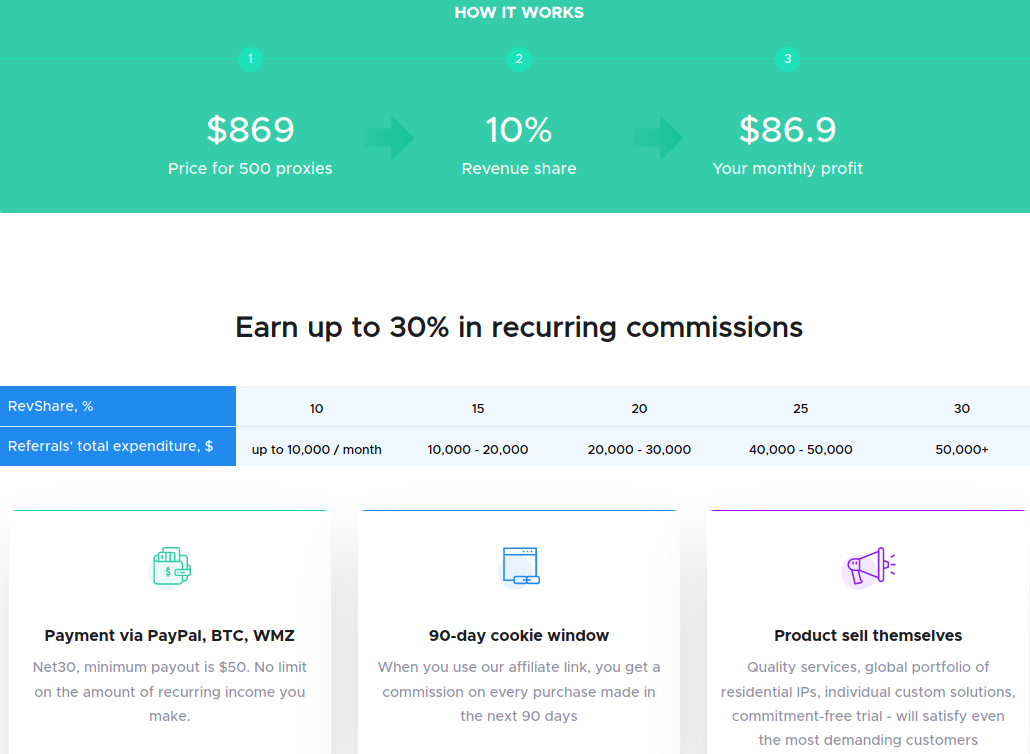
An Infatica graphic explaining the potential benefits for extension owners.
Infatica’s code then uses the browser of anyone who has that extension installed to route Web traffic for the company’s customers, including marketers or anyone able to afford its hefty monthly subscription charges.
The end result is when Infatica customers browse to a web site, that site thinks the traffic is coming from the Internet address tied to the extension user, not the customer’s.
Infatica prices its service based on the volume of web traffic a customer is seeking to anonymize, from $360 a month for 40 gigabytes all the way to $20,000 a month for 10,000 gigabytes of data traffic pushed through millions of residential computers.
THE ECONOMICS OF EXTENSIONS
Hao Nguyen is the developer behind ModHeader, an extension used by more than 400,000 people to test the functionality of websites by making it easier for users to modify the data shared with those sites. When Nguyen found himself spending increasing amounts of his time and money supporting the extension, he tried including ads in the program to help offset costs.
ModHeader users protested loudly against the change, and Nguyen removed the ads — which he said weren’t making him much money anyway.
“I had spent at least 10 years building this thing and had no luck monetizing it,” he told KrebsOnSecurity.
Nguyen said he ignored multiple requests from different companies offering to pay him to insert their code, mainly because the code gave those firms the ability to inject whatever they wanted into his program (and onto his users’ devices) at any time.
Then came Infatica, whose code was fairly straightforward by comparison, he said. It restricted the company to routing web requests through his users’ browsers, and did not try to access more sensitive components of the user’s browser experience, such as stored passwords and cookies, or viewing the user’s screen.
More importantly, the deal would net him at least $1,500 a month, and possibly quite a bit more.
“I gave Infatica a try but within a few days I got a lot of negative user reviews,” he said. “They didn’t like that the extension might be using their browser as a proxy for going to not so good places like porn sites.”
Again he relented, and removed the Infatica code.
A TARGET-RICH ENVIRONMENT
These days, Nguyen is focusing more of his time on chrome-stats.com, which provides detailed information on more than 150,000 extensions. The service is free for limited use, but subscribers who pay a monthly fee can get access to more resources, such as older extension versions and details about their code components.
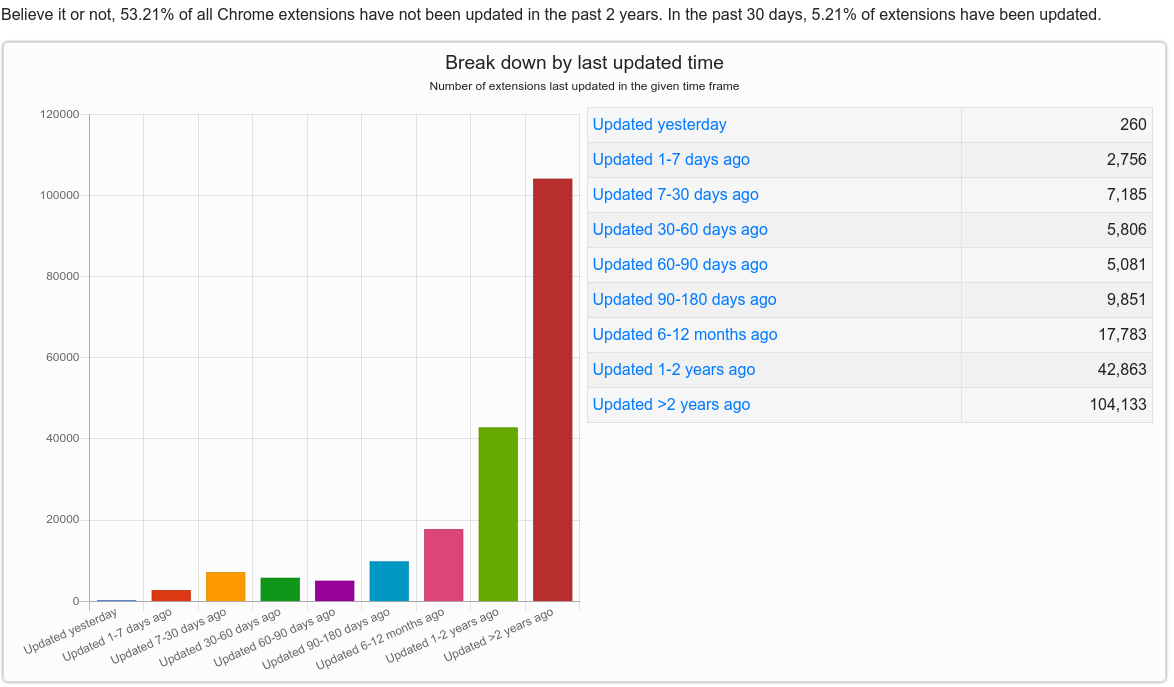
According to chrome-stats.com, the majority of extensions — more than 100,000 of them — are effectively abandoned by their authors, or haven’t been updated in more than two years. In other words, there a great many developers who are likely to be open to someone else buying up their creation and their user base.
The vast majority of extensions are free, although a handful that have attracted a large and loyal enough following have been able to charge for their creations or for subscription services tied to the extension. But last year, Google announced it was shutting down paid Chrome extensions offered on its Chrome Web Store.
Nguyen said this will only exacerbate the problem of frustrated developers turning to offers from dodgy marketing firms.
“It’s a really tough marketplace for extension developers to be able to monetize and get reward for maintaining their extensions,” he said. “There are tons of small developers who haven’t been able to do anything with their extensions. That’s why some of them will go into shady integration or sell the extension for some money and just be done with it.”
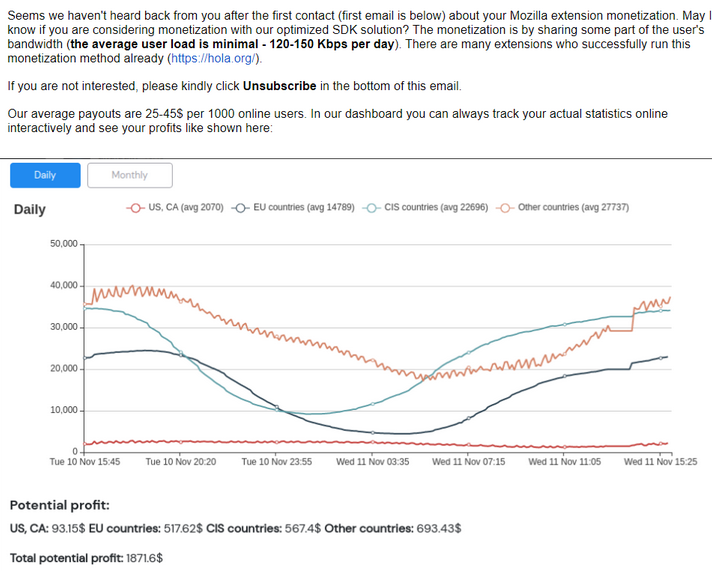
A solicitation sent by Infatica to the developer of the SponsorBlock extension. Image: sponsor.ajay.app
WHO IS INFATICA?
It is unclear how many extensions currently incorporate Infatica’s code. KrebsOnSecurity searched for extensions that invoke several domains tied to Infatica’s Web proxy service (e.g., extendbalanc[.]org, ipv4v6[.]info). This research was conducted using Nguyen’s site and crxcavator.io, a similar extension research site owned by networking giant Cisco Systems.
Those searches revealed that Infatica’s code has been associated with at least three dozen extensions over the past few years, including several that had more than 100,000 users. One of those is Video Downloader Plus, which at one point claimed nearly 1.4 million active users.
The founder and director of Infatica — a resident of Biysk, Russia named Vladimir Fomenko — did not respond to multiple requests for comment.

Infatica founder Vladimir M. Fomenko.
Fomenko is the sole director of the iNinja VPN, another service that obfuscates the true Internet address of its more than 400,000 users. It stands to reason that iNinja VPN also is not only offering its customers a way to obfuscate their Internet address, but is actively using those same systems to route traffic for other customers: A Chrome browser plugin and ad blocker by the same name whose code includes Infatica’s “extenbalanc” domain has 400,000 users.
That would put Infatica in line with the activities of another major controversial VPN/proxy provider: Luminati, a.k.a. “HolaVPN.” In 2015, security researchers discovered that users of the HolaVPN browser extension were being used to funnel Web traffic for other people. Indeed, in the screenshot above, Infatica’s marketing team can be seen comparing its business model to that of HolaVPN.
Fomenko has appeared in two previous KrebsOnSecurity stories; both concerned King Servers (a.k.a. “Hosting Solution Ltd.“), a hosting company he has operated for years which caters mostly to adult websites.
In 2016, hackers suspected of working for Russian state security services compromised databases for election systems in Arizona and Illinois. Six of the eight Internet addresses identified by the FBI as sources of the attack traced back to King Servers. In an interview with The New York Times several months later, Fomenko flatly denied having any ties to the hacking.
According to the Russian daily Novaya Gazeta, revelations about the 2016 hacking incident’s ties to King Servers led to treason charges against Sergey Mikhaylov, the former deputy chief of Russia’s top anti-cybercrime unit.
Russian authorities charged that Mikhaylov had tipped off the FBI to information about Fomenko and King Servers. In 2019, Mikhaylov was convicted and sentenced to 22 years in a penal colony.
BE SPARING IN TRUSTING EXTENSIONS
Browser extensions — however useful or fun they may seem when you install them — typically have a great deal of power and can effectively read and/or write all data in your browsing sessions. The powers granted to each extension are roughly spelled out in its “manifest,” basically a description of what it will be able to access once you incorporate it into your browser.
According to Nguyen’s chrome-stats.com, about a third of all extensions for Chrome — by far the most widely-used Web browser — require no special permissions. But the remainder require the user to place a good deal of trust in the extension’s author. For example, approximately 30 percent can view all of your data on all or specific websites, or index your open tabs and browsing activity.
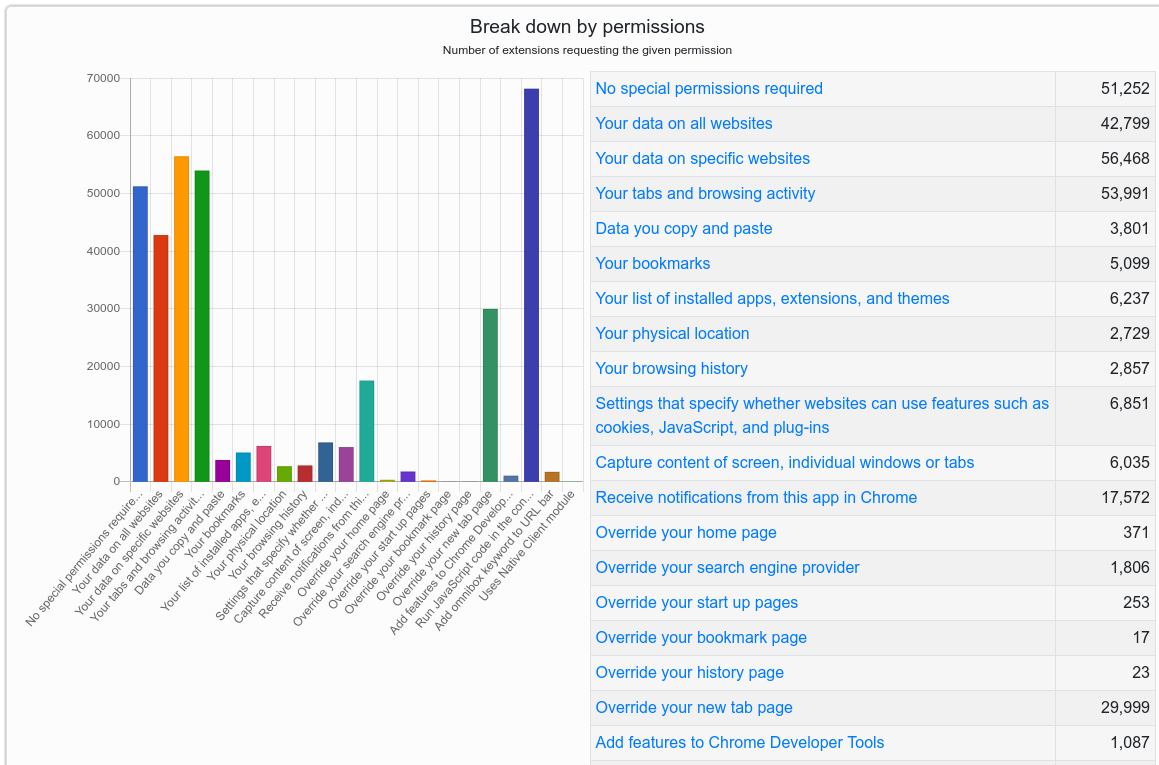
More than 68,000 Chrome extensions allow the execution of arbitrary code in the context of webpages, effectively allowing the extension to alter the appearance and functionality of specific sites.
I hope it’s obvious by this point, but readers should be extremely cautious about installing extensions — sticking mainly to those that are actively supported and respond to user concerns.
Personally, I do not make much use of browser extensions. In almost every case I’ve considered installing one I’ve been sufficiently spooked by the permissions requested that I ultimately decided it wasn’t worth the risk, given that any extension can go rogue at the whims of its author.
If you’re the type of person who uses multiple extensions, it may be wise to adopt a risk-based approach going forward. Given the high stakes that typically come with installing an extension, consider carefully whether having the extension is truly worth it. This applies equally to plug-ins designed for Web site content management systems like WordPress and Joomla.
Do not agree to update an extension if it suddenly requests more permissions than a previous version. This should be a giant red flag that something is not right. If this happens with an extension you trust, you’d be well advised to remove it entirely.
Also, never download and install an extension just because some Web site says you need it to view some type of content. Doing so is almost always a high-risk proposition. Here, Rule #1 from KrebsOnSecurity’s Three Rules of Online Safety comes into play: “If you didn’t go looking for it, don’t install it.” Finally, in the event you do wish to install something, make sure you’re getting it directly from the entity that produced the software.
Google Chrome users can see any extensions they have installed by clicking the three dots to the right of the address bar, selecting “More tools” in the resulting drop-down menu, then “Extensions.” In Firefox, click the three horizontal bars next to the address bar and select “Add-ons,” then click the “Extensions” link on the resulting page to view any installed extensions.

Premium Domain Names – transcom.uk
Transcom ISP – The UK’s Best Business ISP
DoubleCheck any website at doublecheck.uk
Supporting the Women Hit Hardest by the Pandemic
Only 57% of women in the U.S. are working or looking for work right now—the lowest rate since 1988.
That telling data point is just one of several that illustrate a stark contrast in these stark times: of the millions who’ve seen their employment affected by the pandemic, women have been hardest hit.
According to the U.S. Bureau of Labor Statistics (BLS), some 2.3 million women left the workforce between the start of the pandemic and January 2021. Meanwhile, the BLS statistic for the number of men who left the U.S. workforce in that same period was 1.8 million. With International Women’s Day here, it’s time we ask ourselves how we can stem this inordinately sized tide of hard-working and talented women from leaving the workforce.
Job losses during the pandemic impact women disproportionately greater than men
A broader BLS statistic provides a further perspective: a total of 4,637,000 payroll jobs for women have been lost in total since the pandemic began in the U.S. alone. That ranges from executive roles, jobs in retail, and educators, to work in public service and more. Of those jobs lost, about one third of women aged 25-44 cited that childcare was the reason for that unemployment.
Combine that with the fact that globally women carry out at least two and a half times more unpaid household and care work than men, and a global gender pay gap of 23%, it’s easy to see why millions of women have simply dropped out of the workforce to manage children and home schooling—even in the instances where employment is available.
Not that this should surprise us. For example, just a few years before the pandemic, research showed that few Americans wanted to revert to the traditional roles of women at home and men in the workplace. However, when push came to shove, the Pew Research showed that women most often made compromises when needs at home conflicted with work. And now we’ve seen that sentiment come home to roost. On a massive scale.
Put plainly, when the pandemic pushed, women’s working lives predominantly went over the edge.
Supporting women working remotely during the pandemic
Within these facts and figures, I’d like to focus on the women who are working remotely while caring for their families, whether that’s their children, elders in their lives, or even a mix of both. What can we do, as employers, leaders, and co-workers in our businesses to better support them?
As early as June, Forbes reported that women were reducing their working hours at a rate four to five times greater than men, ostensibly to manage a household where everything from daycare, school, elder care, and work all take place under the same roof. The article went on to cite ripple-effect concerns in the wake of such reductions like the tendency to pursue less-demanding work, greater vulnerability to layoffs, and reduced likelihood for promotion. In fact, one study conducted in the U.S. last summer found that 34% of men with children at home say they’ve received a promotion while working remotely, while only 9% of women with children at home say the same.
In an interview with the BBC, Melinda Gates, the Co-Chair of the Bill and Melinda Gates Foundation, stated her views on the situation succinctly: “I hope Covid-19 forces us to confront how unsustainable the current arrangement is—and how much we all miss out on when women’s responsibilities at home limit their ability to contribute beyond it. The solutions lie with governments, employers, and families committed to doing things more equitably.” I agree. This is a problem for us to solve together.
How employers and leaders can help
As for the role of employers and leaders in the solution, some thinking presented in The Harvard Business Review caught my eye. The article, “3 Ways Companies Can Retain Working Moms Right Now” focuses on what employers can do to better support the women in their workforce. The three ingredients the authors propose are:
- Provide certainty and clarity, wherever possible.
- Right size job expectations.
- And continue the empathy.
If we think about the stressors we all face, this simple recipe actually reveals some depth. It takes knowing, and engaging with, employees perhaps more greatly than before. One sentence in the conclusion struck me in particular:
“It is no longer an option for managers to pretend that their employees do not have lives outside of their jobs, as these evaporated boundaries between home and work are not going away anytime soon.”
I see this every practically every day when I meet with my team. I’m sure you’ve seen it as well. With our laptop cameras on for sometimes hours a day, we’ve all caught glimpses into our coworker’s lives outside the office, seen that 7am meeting rescheduled for 8am to accommodate a busy breakfast rush with the family, or even kiddos pop into the frame during a call to say “hi.” What we may not see is just how much of a struggle that could be for some in the long haul.
Enter again those notions of providing certainty and clarity, rightsizing job expectations, and showing empathy. While not the end-all-be-all answers, they provide a starting point. As employers and leaders, if we can minimize the x-factors, adapt the workloads, and show compassion as we navigate the road to recovery, we can retain employees—and at least mitigate some of the stressors that are pushing women out of their jobs and careers during this pandemic. Exceptional employers and leaders have always done this. And now, in exceptional times, I believe it must become the norm.
How you as a friend and co-worker can help
Likewise, for co-workers, it’s absolutely okay to check in with people on your team, your vendors, your clients, and other people in your network and simply ask how they’re doing. I’ve had many meetings where we informally go around the horn and talk about what’s going on outside of work. The shared experience of working remotely has a way of creating new norms, and perhaps starting a meeting with an informal check-in way on occasion is one of them.
This is an opportunity to listen, simply so someone can feel better by being heard, and so that we can pinpoint places where we can come in and offer some support.
Some challenges women are facing are beyond our capacity to help firsthand, yet we can identify them when we see them. If you or someone you know is struggling, here are a few resources in the U.S. that can help:
Mental health resources for women
The Office on Women’s Health, part of the U.S. Department of Health & Human services, offers a wealth of resources on its website, along with a help line that can provide further resources as well.
The National Institute of Mental Health has an extended list of articles, resources, and links to services that can provide immediate help for people who are struggling to cope or who are in crisis.
Legal resources for women
A Better Balance is a nonprofit legal advocacy group that “uses the power of the law to advance justice for workers, so they can care for themselves and their loved ones without jeopardizing their economic security.” They offer a confidential help line that can provide people with information about their workplace rights.
The National Women’s Law Center offers complementary legal consultations and with questions about accessing paid sick leave and paid leave to care for a child whose school or childcare provider is closed because of COVID-19.
Stemming the tide together
As women leave the workforce worldwide, we’ve seen organizations lose precious talent, and we’ve seen women sacrifice their livelihoods and career paths. As such, the pandemic has exacted hard and human costs, ones that have fallen on women in outsized ways.
A problem of this scope is one for us to solve collectively. Apart from the bigger, broader solutions that may be forthcoming, as the employers and co-workers of women, there’s something we can do right now: reach out, listen, and act. These days call for more empathy and adaptation than ever before, particularly for the hard-working women who are doing it all—and then some.
Stay Updated
To stay updated on all things McAfee and on top of the latest consumer and mobile security threats, follow @McAfee_Home on Twitter, subscribe to our email, listen to our podcast Hackable?, and ‘Like’ us on Facebook.
The post Supporting the Women Hit Hardest by the Pandemic appeared first on McAfee Blogs.
Premium Domain Names – transcom.uk
Transcom ISP – The UK’s Best Business ISP
DoubleCheck any website at doublecheck.uk
6 Steps to Help Your Family Restore Digital Balance in Stressful Times
Editor’s Note: This is part II in a series on helping families protect their mental and digital health in times of chronic stress. The content is not intended to be a substitute for professional advice or treatment.
Over the past year of remote life, technology has become both a lifeline and a life sucker. We’ve witnessed technology author amazing moments of human connection impossible just a few decades ago. At the same time, we’ve also seen isolation and disconnection quietly settle in alongside those wins.
As discussed in our last blog, studies now confirm living under ongoing pandemic stress has triggered a growing mental health crisis across age groups. While experts debate the degree technology contributes to that crisis, all agree the increase in digital connection over the past decade has diminished important forms of human connection considered essential to mental health.
How much is too much?
While device use has spiked during the pandemic, the rise in tech dependence is nothing new. Our digital immersion over time has generated terms such as “phubbing,” aka phone snubbing, now known as looking at your phone over the person in front of you. It’s also why doctors now treat excessive online gaming a legitimate addiction. We also know that social media companies intentionally design apps to keep us logging on, tagging, scrolling, and, most importantly sharing our data.
With more parents and kids now working and learning from home — which has only amplified time online — successfully balancing our tech feels even more impossible.
A big struggle for many parents continues to be: How much tech is too much and how can we strike a healthy balance?
The answer to that question will look different for every family. And frankly, the answer continues to evolve almost daily. The more we know, the more we can respond and recalibrate (as well as equip our kids) to move toward that healthy balance. Here are just a few of the best practices to inspire you forward.
6 Steps to Help Restore Digital Balance
Start over right now. Sure, you should start establishing digital habits when your kids are young. But, life. Things happen. Pandemics hit. Rules go out the window. So, start right now, right here, knowing better and doing better. Consider parental controls that will help you set healthy screen limits for kids (and yourself) and monitor the content coming into your home.
Do it together. A healthy digital balance is an all-in, family huddle, team endeavor kind of thing. No edicts or mandates tend to work here. Explain the “why” behind needed changes to your digital routines and the physical, social, and emotional reasons why balance is so important.
Separate home and work. Because so many parents are working from home, the temptation to overwork is very real. Home and work life can easily fuse together. This fusion makes it impossible to model a balanced digital life for your kids. Consider drawing thick lines between work and home. A few ideas: Maintain a separate office in the home. At close of business, shut off all devices. Create media free zones for your family after 5 p.m. such as the dinner table, homework time, friend time, and family time.
Just say “no” to notifications. Pause to examine: What unacceptable digital distractions have I accepted? Are things like email, push notifications, and alerts on my phone interrupting important conversations and time with friends and family? Flip those switches.
Ask yourself what’s missing. Technology isn’t “bad” and a lot of the time we spend online is either essential to our livelihood or a healthy social life (this especially applies tweens, teens, and young adults). Even so, when we step over that line of healthy digital behavior, do we have the courage to ask ourselves what healthy activity am I sacrificing right now? Have I put an important relationship on the back burner? Do I have an important deadline I’m ignoring? Have I let a hobby, sport, or physical exercise go? Have I sidelined outdoor activities for screen time? All of these are important, honest questions to ask yourself (and post to your kids) to move closer to a healthy digital balance.
Put technology in its place. Stop to evaluate the role you’ve given technology in your life personally and in your home. Do you need to dust off your tech ground rules? Consider putting screens down when others are talking, being intentional about making eye contact, and listening in a way that requires your full attention. Make family mealtimes, outings, and game nights phone free.
Balance increases over time and establishing smarter, healthier family habits is a marathon, not a sprint. Every step is big so celebrate your milestones and give yourself grace to make this not-so-easy trek back to a balanced digital life. As Nike says about getting physically fit, we can say about getting back our digital, “No one has ever regretted it.”
The post 6 Steps to Help Your Family Restore Digital Balance in Stressful Times appeared first on McAfee Blogs.
Premium Domain Names – transcom.uk
Transcom ISP – The UK’s Best Business ISP
DoubleCheck any website at doublecheck.uk
USA Third Most Affected by Stalkerware

New research by cybersecurity company Kaspersky has found that Russia, Brazil, and the United States of America were the countries most affected by stalkerware last year.
A new report, “The State of Stalkerware 2020,” that was released today found that 53,870 Kaspersky users were affected globally by malicious surveillance software in 2020.
Russia had the most affected users for the second year running, with 12,389 victims. With 6,523 victims, Brazil moved up from third place in 2019 to become the second most impacted country in 2020.
The USA, which was the fourth most impacted country in 2019, moved up to third place with 4,745. India, which held the number two spot in 2019, was a close fourth in 2020 with 4,627 victims.
Other countries that made it into the top ten were Mexico, Germany, Iran, Italy, the United Kingdom, and Saudi Arabia.
The total number of victims globally in 2020 fell by 13,630 compared to 2019. Researchers noted a rise in the number of victims in the second half of 2020 when lockdown restrictions put in place by many countries around the world to slow the spread of COVID-19 were lifted.
“We see the number of users affected by stalkerware has remained high and we detect new samples every day,” said Victor Chebyshev, research development team lead at Kaspersky.
With more than 8,100 users affected globally, Nidb was the most used stalkerware sample in 2020. This sample is used to sell a number of different stalkerware products such as iSpyoo, TheTruthSpy, and Copy9.
The Coalition Against Stalkerware warns that this malicious software, which enables a remote user to monitor activities on another user’s device, “may facilitate intimate partner surveillance, harassment, abuse, stalking, and/or violence.”
“It’s important to remember that there is somebody’s real life story behind all these numbers, and sometimes there is a silent call for help. Therefore, we are sharing our part of the picture, with the community working to end the use of stalkerware in order to have a better understanding of the issue,” said Chebyshev.
“It is clear that we all need to share what we are finding so we can further improve detection and protection for the benefit of those affected by cyberviolence.”
Premium Domain Names – transcom.uk
Transcom ISP – The UK’s Best Business ISP
DoubleCheck any website at doublecheck.uk
Atos Acquires Two Cybersecurity Companies

French multinational information technology services and consulting company Atos has completed the acquisition of two cybersecurity companies.
On February 24, the self-styled decarbonization services and products pioneer announced the successful acquisition of Motiv ICT Security. Founded in 1998, Motiv is the largest independent Managed Security Services (MSS) provider in the Netherlands.
In a statement released Wednesday, Atos said that the deal would reinforce its position as the third worldwide MSS provider “by strengthening the Group’s local capabilities and bringing its recent investment in the Managed Detection and Response (MDR) platform, AIsaac, to Dutch customers.”
From the deal, Atos is set to gain Motiv’s independently certified Security Operations Center (SOC), more than 180 highly skilled cybersecurity experts, and the Motiv Academy, which fast-tracks new talent into SOC operational deployment.
“We are excited with this important next step for Motiv, our employees and our customers,” said Aksel Dorèl, CEO of Motiv.
“By joining forces with Atos, we accelerate on our mission to support the secure digital transformation of our customers, unlocking the full potential of Atos’ global cyber security service and capabilities to our customers.”
On February 23, Atos completed the acquisition of In Fidem, a Canada-based cybersecurity consulting firm with expertise in digital identity, cloud security, digital forensics, risk management, cyber-breach response, and security operations.
“We’re excited to unite our expertise with that of In Fidem and see many synergies between our teams and business approach,” said Pierre Barnabé, senior executive vice president, head of big data & cybersecurity at Atos.
Founded in 2005 and headquartered in Montreal with offices in Quebec City and Ottawa, In Fidem will bring its network of more than 100 highly skilled specialists to the Atos cybersecurity team.
“Atos understands our aim to support our clients with multi-disciplinary teams,” said Matthieu Chouinard, CEO of In Fidem.
“They share our corporate vision which is centered on the return of our clients’ security investment and trust. By combining our forces, we will enhance our services to our customers.”
Terms of the two deals were not disclosed. They follow the recent cybersecurity acquisitions by Atos of Paladion, digital.security, and SEC Consult.
Premium Domain Names – transcom.uk
Transcom ISP – The UK’s Best Business ISP
DoubleCheck any website at doublecheck.uk
FBI Investigating Michigan School District Hack

The Federal Bureau of Investigation and Michigan State Police are investigating a cyber-attack on a Michigan school district.
District administrators at Saginaw Township Community Schools began experiencing IT issues on Sunday following what is believed to have been a ransomware attack on the district’s computer network.
Investigators are in contact with the cyber-criminals behind the attack. It is not yet clear how the threat actors gained access to the network.
“They are communicating almost daily with the hackers to figure out what exactly they want,” said district superintendent Bruce Martin.
WNEM reported that Martin sent an email out to parents in which he stated that malware had been used to encrypt files and lock users out of them. The cyber-thieves behind the attack had then demanded ransom money from the school in exchange for a decryption key.
Sunday’s attack did not prevent the school from being able to educate students via remote learning and in-person classes in the days that followed.
“I think that sent a message that we can overcome this,” said Martin.
However, the attack has had an impact on how lessons have been taught.
“A lot of teachers went ‘old school,’ with books and paper and pencil,” said Martin, who then went on to acknowledge, “It could have been a whole lot worse, but it certainly has been disruptive in an already disruptive year.”
Martin said on February 25 that the district’s computer systems have now mostly been restored. Investigators are still working to discover the full impact of the cyber-attack and are yet to determine if any personal data was compromised.
Matt McLalin of the Michigan State Police Cyber Command Center said that paying a ransom to cyber-attackers was not a good move.
“You pay them the money, they are just going to use that money to continue to make new malware and infect others,” he told ABC News.
Offering advice on how to minimize the impact of a ransomware attack, McLalin said: “Keep good back-ups, obviously, good, regular back-ups where you are regularly backing up your data and keep them off-line.”
Premium Domain Names – transcom.uk
Transcom ISP – The UK’s Best Business ISP
DoubleCheck any website at doublecheck.uk