How $100M in Jobless Claims Went to Inmates

The U.S. Labor Department’s inspector general said this week that roughly $100 million in fraudulent unemployment insurance claims were paid in 2020 to criminals who are already in jail. That’s a tiny share of the estimated tens of billions of dollars in jobless benefits states have given to identity thieves in the past year. To help reverse that trend, many states are now turning to a little-known private company called ID.me. This post examines some of what that company is seeing in its efforts to stymie unemployment fraud.
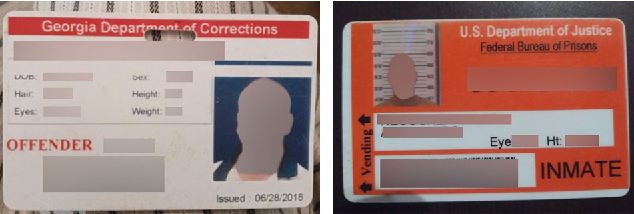
These prisoners tried to apply for jobless benefits. Personal information from the inmate IDs has been redacted. Image: ID.me

A new report (PDF) from the Labor Department’s Office of Inspector General (OIG) found that from March through October of 2020, some $3.5 billion in fraudulent jobless benefits — nearly two-thirds of the phony claims it reviewed — was paid out to individuals with Social Security numbers filed in multiple states. Almost $100 million went to more than 13,000 ineligible people who are currently in prison.

The OIG acknowledges that the total losses from all states is likely to be tens of billions of dollars. Indeed, just one state — California — disclosed last month that hackers, identity thieves and overseas criminal rings stole more than $11 billion in jobless benefits from the state last year. That’s roughly 10 percent of all claims.

Bloomberg Law reports that in response to a flood of jobless claims that exploit the lack of information sharing among states, the Labor Dept. urged the states to use a federally funded hub designed to share applicant data and detect fraudulent claims filed in more than one state. But as the OIG report notes, participation in the hub is voluntary, and so far only 32 of 54 state or territory workforce agencies in the U.S. are using it.

Much of this fraud exploits weak authentication methods used by states that have long sought to verify applicants using static, widely available information such as Social Security numbers and birthdays. Many states also lacked the ability to tell when multiple payments were going to the same bank accounts.

To make matters worse, as the Coronavirus pandemic took hold a number of states dramatically pared back the amount of information required to successfully request a jobless benefits claim.

77,000 NEW (AB)USERS EACH DAY

In response, 15 states have now allied with McLean, Va.-based ID.me to shore up their authentication efforts, with six more states under contract to use the service in the coming months. That’s a minor coup for a company launched in 2010 with the goal of helping e-commerce sites validate the identities of customers for the purposes of granting discounts for veterans, teachers, students, nurses and first responders.

ID.me says it now has more than 36 million people signed up for accounts, with roughly 77,000 new users signing up each day. Naturally, a big part of that growth has come from unemployed people seeking jobless benefits.

To screen out fraudsters, ID.me requires applicants to supply a great deal more information than previously requested by the states, such as images of their driver’s license or other government-issued ID, copies of utility or insurance bills, and details about their mobile phone service.

When an applicant doesn’t have one or more of the above — or if something about their application triggers potential fraud flags — ID.me may require a recorded, live video chat with the person applying for benefits.

This has led to some fairly amusing attempts to circumvent their verification processes, said ID.me founder and CEO Blake Hall. For example, it’s not uncommon for applicants appearing in the company’s video chat to don disguises. The Halloween mask worn by the applicant pictured below is just one example.

Image: ID.me

Hall said the company’s service is blocking a significant amount of “first party” fraud — someone using their own identity to file in multiple states where they aren’t eligible — as well as “third-party” fraud, where people are tricked into giving away identity data that thieves then use to apply for benefits.

“There’s literally every form of attack, from nation states and organized crime to prisoners,” Hall said. “It’s like the D-Day of fraud, this is Omaha Beach we’re on right now. The amount of fraud we are fighting is truly staggering.”

According to ID.me, a major driver of phony jobless claims comes from social engineering, where people have given away personal data in response to romance or sweepstakes scams, or after applying for what they thought was a legitimate work-from-home job.

“A lot of this is targeting the elderly,” Hall said. “We’ve seen [videos] of people in nursing homes, where folks off camera are speaking for them and holding up documents.”

“We had one video where the person applying said, ‘I’m here for the prize money,’” Hall continued. “Another elderly victim started weeping when they realized they weren’t getting a job and were the victim of a job scam. In general though, the job scam stuff hits younger people harder and the romance and prize money stuff hits elderly people harder.”

Many other phony claims are filed by people who’ve been approached by fraudsters promising them a cut of any unemployment claims granted in their names.

“That person is told to just claim that they had their identity stolen when and if law enforcement ever shows up,” Hall said.

REACTIONS FROM THE UNDERGROUND

Fraudsters involved in filing jobless benefit claims have definitely taken notice of ID.me’s efforts. Shortly after the company began working with California in December 2020, ID.me came under a series of denial-of-service (DDoS) attacks aimed at knocking the service offline.

“We have blocked at least five sustained, large-scale DDoS attacks originating from Nigeria trying to take our service down because we are blocking their fraud,” Hall said.

In May 2020, KrebsOnSecurity examined postings to several Telegram chat channels dedicated to selling services that help people fraudulently apply for jobless benefits. These days, some of the most frequent posts on those channels advertise the sale of various “methods” or tips about how to bypass ID.me protections.
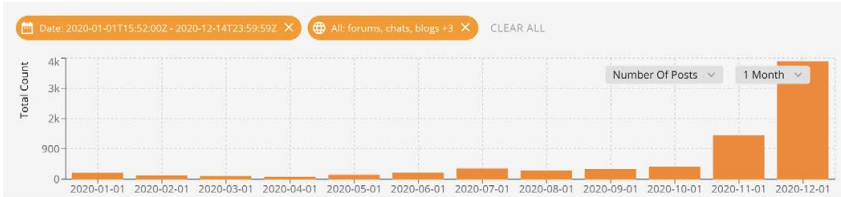
Mentions of id.me in cybercrime forums, Telegram channels throughout 2020. Source: Flashpoint-intel.com

Asked about the efficacy of those methods, Hall said while his service can’t stop all phony jobless claims, it can ensure that a single scammer can only file one fraudulent application.

“I’d say in this space it’s not about being perfect, but about being better,” he said.

That’s something of an understatement in an era when being able to limit each scammer to a single fraudulent claim can be considered progress. But Hall says one of the reasons we’re in this mess is that the states have for too long relied on data broker firms that sell authentication services based on static data that is far too easy for fraudsters to steal, buy or trick people into giving away.

“There’s been a real shift in the market from data-centric identity verification to verifying through something you have and something you are, like a phone or face or ID,” he said. “And those aren’t in the provenance of the incumbents, the data-centric brokers. When there have been so many data breaches that the toothpaste is basically out of the tube, you need a full orchestration platform.”

A BETTER MOUSETRAP?

Collecting and storing so much personal data on tens of millions of Americans can make one an attractive target for hackers and ID thieves. Hall says ID.me is certified against the NIST 800-63-3 digital identity guidelines, employs multiple layers of security, and fully segregates static consumer data tied to a validated identity from a token used to represent that identity.

“We take a defense-in-depth approach, with partitioned networks, and use very sophisticated encryption scheme so that when and if there is a breach, this stuff is firewalled,” he said. “You’d have to compromise the tokens at scale and not just the database. We encrypt all that stuff down to the file level with keys that rotate and expire every 24 hours. And once we’ve verified you we don’t need that data about you on an ongoing basis.”

With such a high percentage of jobless claims now being filed by identity thieves, many states have instituted new fraud filters that ended up rejecting or delaying millions of legitimate claims.

Jim Patterson, a Republican assemblyman from California, held a news conference in December charging that ID.me’s system “continually glitches and rejects legitimate forms of identification, forcing applicants to go through the manual verification process which takes months.”

ID.me says roughly eight users will pass through its automated self-serve flow for every one user who needs to use the video chat method to verify their identity.

“The majority of legitimate claimants pass our automated, self-serve identity verification process in less than five minutes,” Hall said. “For individuals who fail this process, we are the only company in the United States that offers a secure, video chat based method of identity verification to ensure that all users are able to prove their identity online.”

Hall says his company also exceeds the industry standard in terms of validating the identities of people with little or no credit history.

“If you just rely on credit bureaus or data brokers for this, it means anyone who doesn’t have a credit history doesn’t get through,” he said. “And that tends to have a disproportionate affect on those more likely to be less affluent, such as minority communities.”

Premium Domain Names – transcom.uk
Transcom ISP – The UK’s Best Business ISP
DoubleCheck any website at doublecheck.uk


CrowdStrike Slams Microsoft Over SolarWinds Hack

CrowdStrike Slams Microsoft Over SolarWinds Hack

The United States Senate’s select committee on intelligence met yesterday to hear evidence from tech executives regarding the historic hack on Texas-based company SolarWinds

Government agencies issued emergency directives in December after cybersecurity company FireEye detected a supply-chain attack trojanizing SolarWinds’ Orion business software updates to distribute malware.

Using SolarWinds and Microsoft programs, hackers believed to have been working for Russia attacked nine federal agencies and around 100 American companies.

The committee heard that both the scale and sophistication of the attack were greater than had been previously thought. Microsoft president Brad Smith said the attack “was the largest and most sophisticated sort of operation that we have seen” and that he believed it was the work of “at least 1,000 very skilled, very capable engineers.”

The true impact of the attack may never be gauged as victims are only required by law to disclose cyber-attacks that expose individuals’ private data. 

During the attack, hackers were able to read Microsoft’s source code for how its programs authenticate users and then manipulate those programs to access new areas inside victims’ networks. 

Smith said that this had been made possible not through any errors on Microsoft’s part, but as the result of customers’ configuration mistakes and other errors that meant “the keys to the safe and the car were left out in the open.”

CrowdStrike‘s chief executive George Kurtz said the hackers were able to exploit Microsoft’s overly complicated and “antiquated” architecture. 

“The threat actor took advantage of systemic weaknesses in the Windows authentication architecture, allowing it to move laterally within the network” and reach the cloud environment while bypassing multifactor authentication, said Kurtz. 

To increase national cybersecurity, Smith called for companies to improve information-sharing about cyber-attacks. Kurtz called for Microsoft to fix issues existing in Active Directory and Azure.

He said: “Should Microsoft address the authentication architecture limitations around Active Directory and Azure Active Directory, or shift to a different methodology entirely, a considerable threat vector would be completely eliminated from one of the world’s most widely used authentication platforms.”

Senator Mark Warner pointed out that 30% of the victims did not have Orion software installed and that they were attacked via other methods. Mandiant CEO Kevin Mandia said that the main attack tactic deployed by hackers was password spray—trying common or reused passwords against accounts en masse.

Premium Domain Names – transcom.uk
Transcom ISP – The UK’s Best Business ISP
DoubleCheck any website at doublecheck.uk

Infosecurity Europe 2021 Postponed with New Event Dates TBA

Infosecurity Europe 2021 Postponed with New Event Dates TBA

Europe’s leading information security event Infosecurity Europe, originally scheduled for June 8-10 2021 at London Olympia, will now take place at a later date in the year, organizer Reed Exhibitions has announced. This is due to the current situation regarding the COVID-19 pandemic.

A statement from Reed Exhibitions outlined: “Following the UK Prime Minister’s announcement on the gradual lifting of COVID-19 restrictions in England we are now working closely with our partners and venue to obtain suitable new dates in 2021 and we will announce them as soon as we possibly can.

“In the meantime, we want to ensure we keep the conversation going within our community and will be providing a program of virtual content on June 8-10. More information will be available on the Infosecurity Europe website soon.

“We thank everyone involved for their continued support and patience in these unprecedented circumstances. Our thoughts are with all those affected by Coronavirus,” Reed Exhibitions added.

Queries regarding Infosecurity Europe 2021 can be directed to the event’s customer support team at infosecurity.helpline@reedexpo.co.uk or by calling +44 (0)20 8271 2130.

Premium Domain Names – transcom.uk
Transcom ISP – The UK’s Best Business ISP
DoubleCheck any website at doublecheck.uk

Former Power Company Boss to Admit Wire Fraud

Former Power Company Boss to Admit Wire Fraud

The former CEO of a regulated electric and natural gas public utility in South Carolina is due to plead guilty today in federal court to conspiracy to commit mail and wire fraud.

Kevin B. Marsh is the ex-CEO of SCANA Corporation and former chairman of its board of directors. The Cayce-based company, which was the only Fortune 500 company in South Carolina, merged with Dominion Energy in January 2019 after an incident known as the Nukegate scandal caused its stock price to tumble.

The scandal arose after the company and its subsidiary SCE&G allegedly defrauded investors by making false and misleading statements about the Virgil C. Summer nuclear expansion project.

Under the project, SCANA and SCE&G collectively invested $9bn into the construction of two nuclear reactors in Fairfield County from 2008 to 2017. Construction began in 2013 but was ultimately abandoned after delays and errors drove the cost up to $25bn.

To pay for the construction, the companies used a state law that allows utilities to raise consumers’ electricity rates. Ratepayers continued to pay increased rates for the expansion despite its termination.

In February 2020, the Securities and Exchange Commission filed a complaint alleging that SCANA, SCE&G, Kevin Marsh, and former executive vice president Stephen Byrne misled investors by claiming that the nuclear construction project would qualify the company for more than $1bn in tax credits when in reality the project was far behind schedule and therefore unlikely to qualify for the tax credits.  

Without admitting or denying the allegations, in December 2020 SCANA and SCE&G agreed to a permanent injunction and to pay $112.5m in disgorgement plus prejudgment interest. SCANA also agreed to pay a $25m penalty. 

“Shareholders were deceived by SCANA and robbed of millions upon millions of dollars,” said US Attorney Peter McCoy. “I am hopeful that, along with the criminal charges brought forward by our office, this multimillion dollar civil fine and penalty shows that no person or organization is above the law.”

Byrne pled guilty in federal court in July 2020 to conspiracy to commit mail and wire fraud under a plea agreement requiring him to cooperate with law enforcement officials. 

Premium Domain Names – transcom.uk
Transcom ISP – The UK’s Best Business ISP
DoubleCheck any website at doublecheck.uk

Poor Remote Working Behaviors and Procedures Putting Orgs at Risk

Poor Remote Working Behaviors and Procedures Putting Orgs at Risk

One-fifth of remote workers in the UK recycle their work email or password to log into consumer websites and apps, such as online shopping and even dating, increasing the risk of their corporate credentials being stolen. This is according to Ivanti’s Secure Consumer Cyber Report, which surveyed 1000 UK home workers about their cybersecurity behaviors.

The research revealed that poor cybersecurity practices by home workers are prevalent, which is putting organizations at greater risk of cyber-attacks. Over a third (39.93%) of those surveyed said they were allowed to use personal devices, such as laptops, smartphones, tablets or smartwatches to access company applications and networks. Despite this, nearly half (47.87) admitted they have not set up two-factor authentication for smart devices in their homes.

The report also indicated that organizations have not sufficiently adapted their security procedures to a remote working model, nearly a year since the start of the COVID-19 pandemic. Around one-third of UK consumers claimed their organization does not require them to use a secure access tool, such as a VPN, while roughly a quarter of US and UK remote workers surveyed said that their employer does not require them to update their password every six months or use a one-time password generator.

Nigel Seddon, VP EMEA West at Ivanti, commented: “The poor security hygiene and shortfalls in enterprise security emphasized by the report are creating a perfect storm for cyber-criminals looking to take advantage of consumers working from home. By reusing passwords and failing to implement corporate workspace segregation policies and multi-factor authentication, businesses are increasing their risk of falling victim to credential stuffing attacks.

“Given that there has been a recent increase in the number of data breaches targeting consumer-based companies and online communities, it is very likely that enterprise email and passwords are already exposed on the dark web. Companies across all industries must implement a zero-trust model to ensure that entities accessing corporate information, applications or networks are valid and not using stolen credentials.”

Premium Domain Names – transcom.uk
Transcom ISP – The UK’s Best Business ISP
DoubleCheck any website at doublecheck.uk

Medical Data of 500,000 French Residents Leaked Online

Medical Data of 500,000 French Residents Leaked Online

Sensitive medical data belonging to nearly half a million French people has been stolen and leaked online, according to a joint investigation by news source Libération and French cybersecurity blog Zataz.

The exposed data, which can be accessed from multiple sites, includes names, phone numbers, and postal addresses of 491,840 individuals. In some cases, it is accompanied by identifying information including Social Security number, birth date, blood type, GP, health insurance provider, medical treatments, HIV status, and pregnancy test results. 

Libération found that the data was stolen from around 30 different medical laboratories located mainly in France’s northwestern quarter. The news source said that the leaked information corresponds to samples taken between 2015 and October 2020, a period during which the laboratories were all using a particular type of medical administrative software published by the Dedalus Healthcare Systems Group.

“We are not certain that the sole reason for this incident was Dedalus software,” Dedalus COO Didier Neyrat told international news agency Agence France-Presse (AFP).

“We have set up a crisis cell group as we are taking this seriously, and we will work in partnership with our clients to understand what has happened.”

In an interview with AFP, Zataz journalist Damien Bancal said: “You can already find the files in seven different places online.”

He added that the stolen data had been in the possession of a number of malicious hackers who had intended to sell it on Telegram. However, one of them went rogue and leaked the information following a disagreement within the group. 

Bancal suspects that the information that was leaked is not the only stolen data that has fallen into the hands of the hackers.

“500,000 data points is already huge, and we have no reason to doubt that the hackers have many more in their possession,” he said.

The security incident comes after an announcement by France’s Ministry of Health that the data of 50,000 doctors and medical staff in France was being sold online in a cybercrime forum. Among the information exposed in this attack were usernames and passwords.

Sensitive medical data belonging to nearly half a million French people has been stolen and leaked online according to a joint investigation by news source Libération and French cyber-security blog Zataz.

The exposed data, which can be accessed from multiple sites, includes names, phone numbers and postal addresses of 491,840 individuals. In some cases, it is accompanied by identifying information including social security number, birth date, blood type, GP, health insurance provider, medical treatments, HIV status and pregnancy test results. 

Libération found that the data was stolen from around 30 different medical laboratories located mainly in France’s north-western quarter. The news source said that the leaked information corresponds to samples taken between 2015 and October 2020, a period during which the laboratories were all using a particular type of medical administrative software published by the Dedalus Healthcare Systems Group.

“We are not certain that the sole reason for this incident was Dedalus software,” Dedalus COO Didier Neyrat told international news agency Agence France-Presse (AFP).

“We have set up a crisis cell group as we are taking this seriously, and we will work in partnership with our clients to understand what has happened.”

In an interview with AFP, Zatav journalist Damien Bancal said: “You can already find the files in seven different places online.”

He added that the stolen data had been in the possession of a number of malicious hackers who had intended to sell it on Telegram. However, one of them went rogue and leaked the information following a disagreement among the group. 

Bancal suspects that the information that was leaked is not the only stolen data that has fallen into the hands of the hackers.

“500,000 data points is already huge, and we have no reason to doubt that the hackers have many more in their possession,” he said.

The security incident comes after an announcement by France’s Ministry of Health that the data of 50,000 doctors and medical staff in France was being sold online in a cybercrime forum. Among the information exposed in this attack was usernames and passwords.

Premium Domain Names – transcom.uk
Transcom ISP – The UK’s Best Business ISP
DoubleCheck any website at doublecheck.uk

IT Security Firm Kaseya Acquires SOC Platform RocketCyber

IT Security Firm Kaseya Acquires SOC Platform RocketCyber

Kaseya, a provider of IT and security management solutions for managed service providers (MSPs) and small- to medium-sized businesses (SMBs), has announced the acquisition of managed security operations center (SOC) platform RocketCyber.

RocketCyber will continue to operate as an independent business within Kaseya, led by CEO and co-founder, Carl Banzhof, in Dallas, Texas. Kaseya’s new SOCs will be located in Dallas, Texas, Miami, Florida and Dublin, Ireland, the company confirmed.

“The addition of RocketCyber makes Kaseya IT Complete the only integrated platform in the market to deliver managed SOC, automated internal threat detection, credential monitoring, anti-phishing and more for a truly comprehensive, end-to-end cybersecurity suite that tackles all of today’s modern day threats,” said Fred Voccola, CEO, Kaseya. “With this acquisition, we’ve doubled down on our security investments to provide our customers with access to experts who can continuously monitor their IT environments without the cost and complexity of disparate tools.”

New integrations to the Kaseya IT Complete platform as a result of the deal will allow Kaseya customers to gain several benefits including rapidly deployed managed SOC, security analyst and incident ticket support.

RocketCyber is the culmination of our combined 50-plus years of experience in creating intrusion detection, vulnerability, risk and compliance technologies,” explained Banzhof. “In the end, Kaseya was the clear choice for us with its rich security platform. Now that our products are deeply integrated, MSPs and SMBs can protect themselves against all attack vectors and sleep soundly at night.”

Premium Domain Names – transcom.uk
Transcom ISP – The UK’s Best Business ISP
DoubleCheck any website at doublecheck.uk

Bill Bozeman Appointed to Netwatch Group’s Executive Board

Bill Bozeman Appointed to Netwatch Group’s Executive Board

Netwatch Group has announced the appointment of Bill Bozeman, CPP, to its executive board. The security group, which is comprised of NMC, CalAtlantic and Netwatch, will now receive advice and insights from Bozeman’s 40+ years in the sector to help it meet its corporate objectives in 2021 and beyond.

Bozeman is a world renowned security professional, recognized with numerous industry awards throughout his distinguished career. This includes the George Lippert memorial award, the Paul Marcus award and the Security Legend Award. In addition, he is a member of the Security Integration Hall of Fame and has been recognized as one of the 25 most influential security executives.

Most recently, Bozeman served as president and CEO of the security system integration cooperative PSA Security Network for over 20 years. Prior to this, he has led multiple security organizations, including Delta Audio-Visual Security, Dictograph Alarm Systems Inc. and Pinkerton Systems Integration.  

Kurt Takahashi, recently appointed CEO for Netwatch Group, said: “Bill Bozeman is one of the security industry’s most accomplished and knowledgeable professionals. We are thrilled that he will be joining our team, and look forward to working together with him.”

Matt Barnette will replace Bozeman as CEO at PSA, with responsibilities shifting over the next four months. Barnette joins the cooperative from HID Global, where he was vice-president of their North American Business Unit, and has 30 years of experience in the security sector.

Commenting on his new role, Bozeman said: “It has been an honor to serve this industry as the leader of PSA for so many years, and I am grateful to have had that opportunity. Matt Barnette is the perfect choice to fill that role now, as I move ahead to the next exciting chapter, working together with Netwatch Group.”

Premium Domain Names – transcom.uk
Transcom ISP – The UK’s Best Business ISP
DoubleCheck any website at doublecheck.uk

Legal Firm Leaks 15,000 Cases Via the Cloud

Legal Firm Leaks 15,000 Cases Via the Cloud

A legal advisory company has inadvertently exposed data on 15,000 cases involving people killed or injured in traffic accidents after a cloud misconfiguration.

Researchers at reviews site WizCase found the AWS S3 bucket containing 55,000 documents wide open. It required no authorization to view the 20GB trove, meaning anyone with the URL could have accessed highly sensitive personal information, the firm claimed.

WizCase traced the data back to İnova Yönetim, a Turkish actuarial consultancy which analyzes data to help calculate insurance risk and premiums.

After contacting the firm on October 1 2020, and AWS five days later, WizCase noted the server was secured on October 12, although no response was received from the consultancy.

For each of the 15,000 court cases, the researchers found personally identifiable information (PII) on the victim including name, national ID number, marital status and birth date, alongside insurance and accident details.

Some documents exposed even more details of witnesses, complainants and other parties, including detailed information on accidents, vehicle registration numbers, breathalyzer test results, descriptions of injuries and much more.

The data apparently related to cases between the start of 2018 and the end of summer 2020.

Those exposed in the privacy snafu may be at risk of scammers following up with highly convincing phishing emails or phone calls (vishing) designed to trick them into handing over more personal and financial information.

“With some social engineering, bad actors or criminals could contact a [mobile] operator, masquerading as the victim, and verify all kinds of verification questions operators would ask to clone a SIM card,” WizCase argued.

“After having access to victims’ phone calls and SMS messages, bad actors could then try to do the same operation with clients’ insurance and bank.”

Cyber-criminals could also use the data to try and bribe officials and blackmail or threaten individuals, it claimed.

Premium Domain Names – transcom.uk
Transcom ISP – The UK’s Best Business ISP
DoubleCheck any website at doublecheck.uk

Ransomware Attacks Double Against Global Universities

Ransomware Attacks Double Against Global Universities

Global ransomware attacks against universities doubled year-on-year in 2020 as the pandemic forced massive changes to higher education, according to BlueVoyant.

The security vendor’s latest Cybersecurity in Higher Education report is compiled from an analysis of 2702 universities across 43 countries, covering the period January 2019 to September 2020.

It found that ransomware was the number one threat last year, with attacks increasing 100% and average pay-outs totalling nearly $450,000.

Many universities have been forced to switch to remote teaching/learning during the COVID-19 crisis, increasing their exposure to certain threats, BlueVoyant claimed.

The surge in ransomware could partly be explained by the fact that over a fifth (22%) of all analyzed universities and colleges had open or unsecured remote desktop ports (RDPs). What’s more, two-thirds (66%) lacked protocols like SPF, DKIM and DMARC to help guard against phishing.

These tend to be the top two vectors for ransomware.

After ransomware, data breaches were the number two threat event for the sector over the reporting period, accounting for half of all events in 2019. Over a third of these were linked to learning tools and associated apps like Zoom, Chegg and ProctorU.

According to BlueVoyant, credential lists linked to university users are “massively trafficked” on the dark web, and password management is poor, with reuse and simple credentials common.

There’s also a major threat from state-backed data thieves: the report recorded 200 such attacks in the past two years but argued that there were likely many more.

“This is an industry that has had to rapidly pivot to online learning, changing standard methods of learning, practically overnight. The education sector is also under huge financial and regulatory pressure,” argued BlueVoyant CEO, Jim Rosenthal.

“Threat actors know that there are vulnerabilities to be exploited and they are taking advantage of these vulnerabilities at every opportunity, making it imperative for universities to adopt a solid cybersecurity threat posture to ensure that the wealth of sensitive data is properly defended against adversaries.”

Premium Domain Names – transcom.uk
Transcom ISP – The UK’s Best Business ISP
DoubleCheck any website at doublecheck.uk