Web Credit Card Skimmer Steals Data from Another Credit Card Skimmer

MalwareBytes is reporting a weird software credit card skimmer. It harvests credit card data stolen by another, different skimmer:

Even though spotting multiple card skimmer scripts on the same online shop is not unheard of, this one stood out due to its highly specialized nature.

“The threat actors devised a version of their script that is aware of sites already injected with a Magento 1 skimmer,” Malwarebytes’ Head of Threat Intelligence Jérôme Segura explains in a report shared in advance with Bleeping Computer.

“That second skimmer will simply harvest credit card details from the already existing fake form injected by the previous attackers.”

Premium Domain Names – transcom.uk
Transcom ISP – The UK’s Best Business ISP
DoubleCheck any website at doublecheck.uk

Microsoft Patch Tuesday, February 2021 Edition

Microsoft today rolled out updates to plug at least 56 security holes in its Windows operating systems and other software. One of the bugs is already being actively exploited, and six of them were publicized prior to today, potentially giving attackers a head start in figuring out how to exploit the flaws.

Nine of the 56 vulnerabilities earned Microsoft’s most urgent “critical” rating, meaning malware or miscreants could use them to seize remote control over unpatched systems with little or no help from users.

The flaw being exploited in the wild already — CVE-2021-1732 — affects Windows 10, Server 2016 and later editions. It received a slightly less dire “important” rating and mainly because it is a vulnerability that lets an attacker increase their authority and control on a device, which means the attacker needs to already have access to the target system.

Two of the other bugs that were disclosed prior to this week are critical and reside in Microsoft’s .NET Framework, a component required by many third-party applications (most Windows users will have some version of .NET installed).

Windows 10 users should note that while the operating system installs all monthly patch roll-ups in one go, that rollup does not typically include .NET updates, which are installed on their own. So when you’ve backed up your system and installed this month’s patches, you may want to check Windows Update again to see if there are any .NET updates pending.

A key concern for enterprises is another critical bug in the DNS server on Windows Server 2008 through 2019 versions that could be used to remotely install software of the attacker’s choice. CVE-2021-24078 earned a CVSS Score of 9.8, which is about as dangerous as they come.

Recorded Future says this vulnerability can be exploited remotely by getting a vulnerable DNS server to query for a domain it has not seen before (e.g. by sending a phishing email with a link to a new domain or even with images embedded that call out to a new domain). Kevin Breen of Immersive Labs notes that CVE-2021-24078 could let an attacker steal loads of data by altering the destination for an organization’s web traffic — such as pointing internal appliances or Outlook email access at a malicious server.

Windows Server users also should be aware that Microsoft this month is enforcing the second round of security improvements as part of a two-phase update to address CVE-2020-1472, a severe vulnerability that first saw active exploitation back in September 2020.

The vulnerability, dubbed “Zerologon,” is a bug in the core “Netlogon” component of Windows Server devices. The flaw lets an unauthenticated attacker gain administrative access to a Windows domain controller and run any application at will. A domain controller is a server that responds to security authentication requests in a Windows environment, and a compromised domain controller can give attackers the keys to the kingdom inside a corporate network.

Microsoft’s initial patch for CVE-2020-1472 fixed the flaw on Windows Server systems, but did nothing to stop unsupported or third-party devices from talking to domain controllers using the insecure Netlogon communications method. Microsoft said it chose this two-step approach “to ensure vendors of non-compliant implementations can provide customers with updates.” With this month’s patches, Microsoft will begin rejecting insecure Netlogon attempts from non-Windows devices.

A couple of other, non-Windows security updates are worth mentioning. Adobe today released updates to fix at least 50 security holes in a range of products, including Photoshop and Reader. The Acrobat/Reader update tackles a critical zero-day flaw that Adobe says is actively being exploited in the wild against Windows users, so if you have Adobe Acrobat or Reader installed, please make sure these programs are kept up to date.

There is also a zero-day flaw in Google’s Chrome Web browser (CVE-2021-21148) that is seeing active attacks. Chrome downloads security updates automatically, but users still need to restart the browser for the updates to fully take effect. If you’re a Chrome user and notice a red “update” prompt to the right of the address bar, it’s time to save your work and restart the browser.

Standard reminder: While staying up-to-date on Windows patches is a must, it’s important to make sure you’re updating only after you’ve backed up your important data and files. A reliable backup means you’re less likely to pull your hair out when the odd buggy patch causes problems booting the system.

So do yourself a favor and backup your files before installing any patches. Windows 10 even has some built-in tools to help you do that, either on a per-file/folder basis or by making a complete and bootable copy of your hard drive all at once.

Keep in mind that Windows 10 by default will automatically download and install updates on its own schedule. If you wish to ensure Windows has been set to pause updating so you can back up your files and/or system before the operating system decides to reboot and install patches, see this guide.

And as always, if you experience glitches or problems installing any of these patches this month, please consider leaving a comment about it below; there’s a better-than-even chance other readers have experienced the same and may chime in here with some helpful tips.

Premium Domain Names – transcom.uk
Transcom ISP – The UK’s Best Business ISP
DoubleCheck any website at doublecheck.uk

Arrest, Raids Tied to ‘U-Admin’ Phishing Kit

Cyber cops in Ukraine carried out an arrest and several raids last week in connection with the author of a U-Admin, a software package used to administer what’s being called “one of the world’s largest phishing services.” The operation was carried out in coordination with the FBI and authorities in Australia, which was particularly hard hit by phishing scams perpetrated by U-Admin customers.
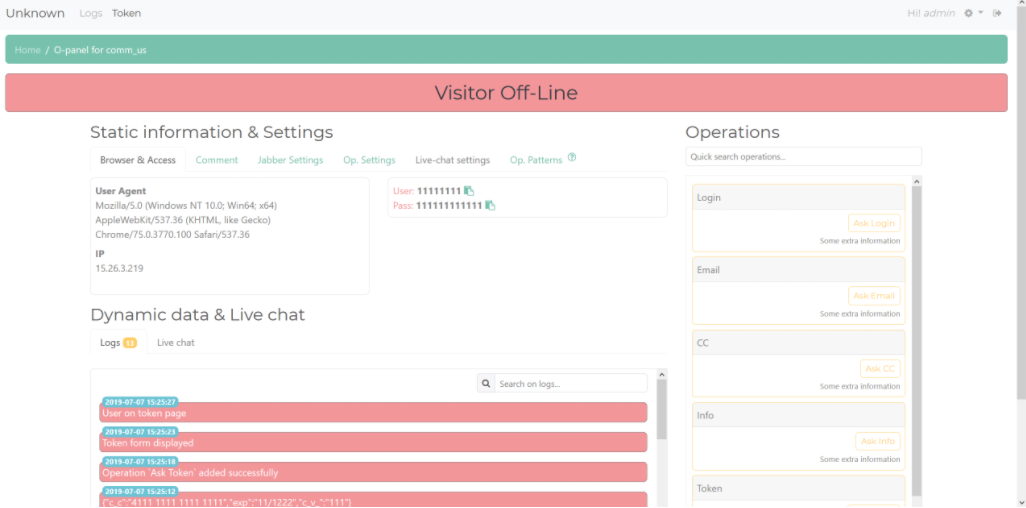
The U-Admin phishing panel interface. Image: fr3d.hk/blog

The Ukrainian attorney general’s office said it worked with the nation’s police force to identify a 39-year-old man from the Ternopil region who developed a phishing package and special administrative panel for the product.

“According to the analysis of foreign law enforcement agencies, more than 50% of all phishing attacks in 2019 in Australia were carried out thanks to the development of the Ternopil hacker,” the attorney general’s office said, noting that investigators had identified hundreds of U-Admin customers.

Brad Marden, superintendent of cybercrime operations for the Australian Federal Police (AFP), said their investigation into who was behind U-Admin began in late 2018, after Australian citizens began getting deluged with phishing attacks via mobile text messages that leveraged the software.

“It was rampant,” Marden said, noting that the AFP identified the suspect and referred the case to the Ukrainians for prosecution. “At one stage in 2019 we had a couple of hundred SMS phishing campaigns tied to just this particular actor. Pretty much every Australian received a half dozen of these phishing attempts.”

U-Admin, a.k.a. “Universal Admin,” is crimeware platform that first surfaced in 2016. U-Admin was sold by an individual who used the hacker handle “Kaktys” on multiple cybercrime forums.

According to this comprehensive breakdown of the phishing toolkit, the U-Admin control panel isn’t sold on its own, but rather it is included when customers contact the developer and purchase a set of phishing pages designed to mimic a specific brand — such as a bank website or social media platform.

Cybersecurity threat intelligence firm Intel 471 describes U-Admin as an information stealing framework that uses several plug-ins in one location to help users pilfer victim credentials more efficiently. Those plug-ins include a phishing page generator, a victim tracker, and even a component to help manage money mules (for automatic transfers from victim accounts to people who were hired in advance to receive and launder stolen funds).

Perhaps the biggest selling point for U-Admin is a module that helps phishers intercept multi-factor authentication codes. This core functionality is what’s known as a “web inject,” because it allows phishers to dynamically interact with victims in real-time by injecting content into the phishing page that prompts the victim to enter additional information. The video below, produced by the U-Admin developer, shows a few examples (click to enlarge).
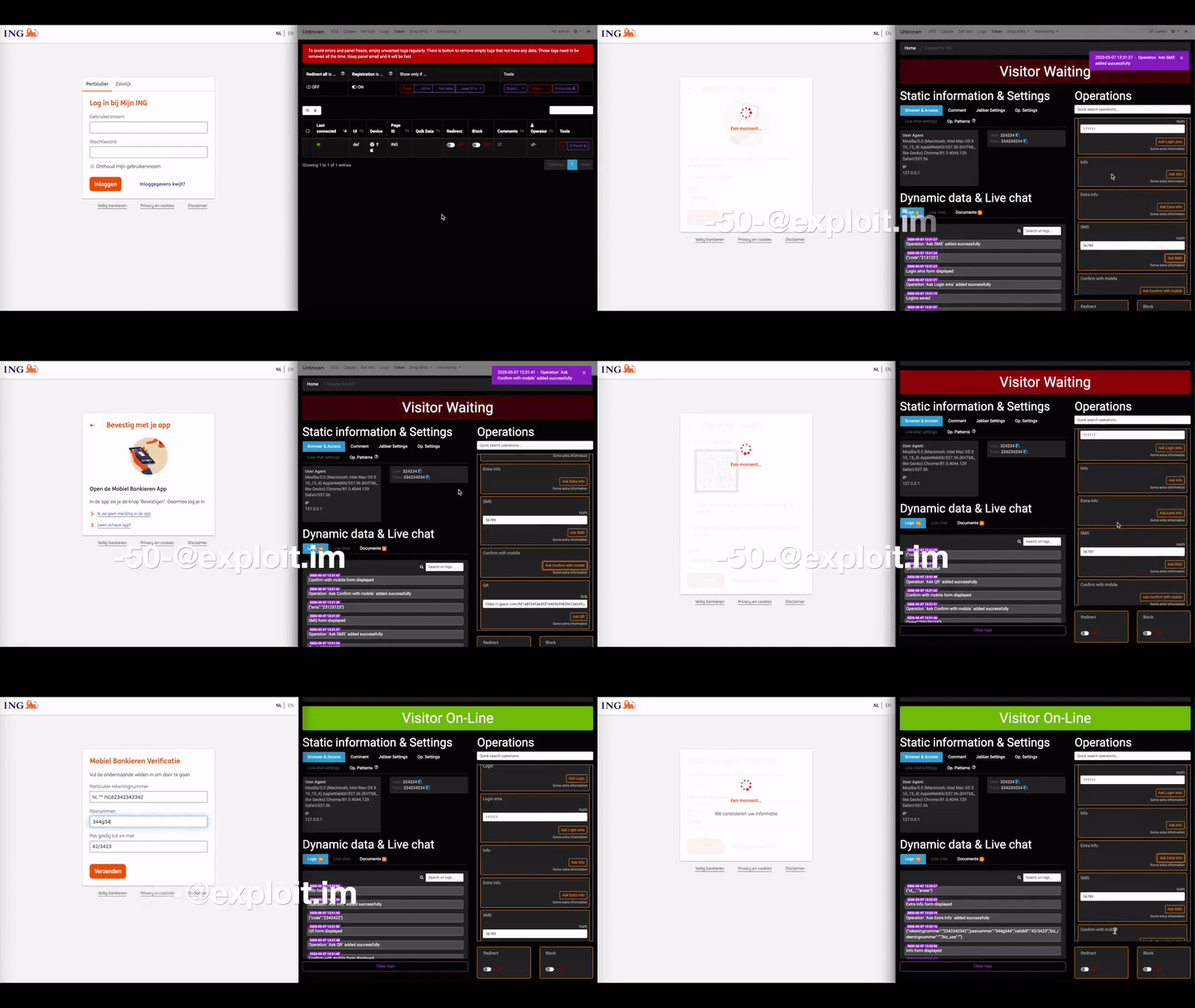
A demonstration video showing the real-time web injection capabilities of the U-Admin phishing kit. Credit: blog.bushidotoken.net

There are multiple recent reports that U-Admin has been used in conjunction with malware — particularly Qakbot (a.k.a. Qbot) — to harvest one-time codes needed for multi-factor authentication.

“Paired with [U-Admin’s 2FA harvesting functionality], a threat actor can remotely connect to the Qakbot-infected device, enter the stolen credentials plus the 2FA token, and begin initiating transactions,” explains this Nov. 2020 blog post on an ongoing Qakbot campaign that was first documented three months earlier by Check Point Research.

In the days following the Ukrainian law enforcement action, several U-Admin customers on the forums where Kaktys was most active began discussing whether the product was still safe to use following the administrator’s arrest.

The AFP’s Marden hinted that the suspicions raised by U-Admin’s customer base might be warranted.

“I wouldn’t be unhappy with the crooks continuing to use that piece of kit, without saying anything more on that front,” Marden said.

While Kaktys’s customers may be primarily concerned about the risks of using a product supported by a guy who just got busted, perhaps they should be more worried about other crooks [or perhaps the victim banks themselves] moving in on their turf: It appears the U-Admin package being sold in the underground has long included a weakness that could allow anyone to view or alter data that was phished with the help of this kit.

The security flaw was briefly alluded to in a 2018 writeup on U-Admin by the SANS Internet Storm Center.

“Looking at the professionality of the code, the layout and the functionality I’m giving this control panel 3 out of 5 stars,” joked SANS guest author Remco Verhoef. “We wanted to give them 4 stars, but we gave one star less because of an SQL injection vulnerability” [link added].

That vulnerability was documented in more detail at exploit archive Packet Storm Security in March 2020 and indexed by Check Point Software in May 2020, suggesting it still persists in current versions of the product.

The best advice to sidestep phishing scams is to avoid clicking on links that arrive unbidden in emails, text messages and other mediums. This advice is the same whether you’re using a mobile or desktop device. In fact, this phishing framework specialized in lures specifically designed to be loaded on mobile devices.

Most phishing scams invoke a temporal element that warns of dire consequences should you fail to respond or act quickly. If you’re unsure whether the message is legitimate, take a deep breath and visit the site or service in question manually — ideally, using a browser bookmark so as to avoid potential typosquatting sites.

Further reading:

uAdmin Show & Tell
Gathering Intelligence on the Qakbot banking Trojan
Premium Domain Names – transcom.uk
Transcom ISP – The UK’s Best Business ISP
DoubleCheck any website at doublecheck.uk

Paralegal’s Pal Admits Outing Witnesses

Paralegal’s Pal Admits Outing Witnesses

A woman from Iowa has admitted obtaining confidential information about a drug-trafficking operation from her paralegal friend and then releasing it on social media.

Rachel Manna, of West Des Moines, pleaded guilty on February 4 to using a former Department of Justice contractor’s government computer to access government records and to obtain sensitive, non-public law enforcement information.

In the spring of 2018, 33-year-old Manna asked her friend Danielle Taff to access details about certain defendants in a criminal investigation and prosecution. 

At the time, 37-year-old Ankeny resident Taff was employed as a contractor paralegal by the US Attorney’s Office for the Southern District of Iowa. She was assigned to the office’s Civil Division, where she worked exclusively on matters related to civil forfeiture. Taff’s job did not require nor authorize her to access files and information related to the district’s investigation and prosecution of criminal cases. 

Nevertheless, Taff agreed to Manna’s request, and on or about May 16, 2018, the paralegal used her US Department of Justice computer to access criminal files stored on the district’s shared electronic data storage drive. Among the information illegally accessed by Taff were reports of law enforcement interviews with at least two individuals who had cooperated with the district in a drug-trafficking investigation.

Taff used her cell phone to photograph around 30 sensitive, non-public documents related to that drug-trafficking investigation. She then shared the photographs with Manna. 

“As a result, in October 2018, other individuals posted those photographs to a Facebook group dedicated to outing ‘snitches,’ or law enforcement cooperators, in the Des Moines region,” stated the Department of Justice.  

The photographs taken by Taff and subsequently posted on Facebook identified at least two people who had cooperated in the drug-trafficking investigation by name and other personal identifiers.

On November 6, 2020, Taff pleaded guilty to one count of fraud and related activity in connection with computers before US District Judge Stephanie Rose of the Southern District of Iowa. 

Taff is scheduled to be sentenced on March 9. Sentencing for Manna is due to take place on June 4.

Premium Domain Names – transcom.uk
Transcom ISP – The UK’s Best Business ISP
DoubleCheck any website at doublecheck.uk

Law Firm Data Breach Impacts UPMC Patients

Law Firm Data Breach Impacts UPMC Patients

A cyber-attack on a Pennsylvania law firm has potentially exposed the personal health information (PHI) of more than 36,000 patients of University of Pittsburgh Medical Center (UPMC).

Law firm Charles J. Hilton & Associates P.C. (CJH), which provides legal services to UPMC, discovered suspicious activity in its employee email system in June 2020. An investigation determined that hackers had gained access to several employee email accounts between April 1, 2020, and June 25, 2020.

In December 2020, UPMC received a breach notification report from CJH confirming that whoever hacked into the email accounts may have accessed patient data. CJH is now in the process of writing to all the patients who may have been affected.

Patient information compromised in the attack consisted of data used by CJH to provide its contracted billing-related legal services to UPMC.

Exposed data includes names, dates of birth, Social Security numbers, bank or financial account numbers, driver’s license numbers, state identification card numbers, electronic signatures, medical record numbers, patient account numbers, patient control numbers, visit numbers, and trip numbers.

Hackers were also able to access Medicare or Medicaid identification numbers, individual health insurance or subscriber numbers, group health insurance or subscriber numbers, medical benefits and entitlement information, disability access and accommodation, and information related to occupational health, diagnosis, symptoms, treatment, prescriptions or medications, drug tests, billing or claims, and/or disability.

“After a lengthy investigation by computer forensics specialists, CJH confirmed to UPMC in December that some of UPMC’s patient information may have been accessed in this breach,” stated UPMC in a notice posted February 5. 

“While there is no evidence that this data was misused, CJH and UPMC are alerting affected patients through personal letters and public notification.” 

Complimentary credit monitoring and identity-theft protection services are being offered by CJH to patients whose data was compromised. The company has also set up a hotline for people to call with their concerns. 

UPMC and CJH are encouraging potentially impacted individuals to review account statements, credit reports, and explanation of benefits forms for suspicious activity and to report any suspicious activity immediately to their insurance company, health care provider, or financial institution.

Premium Domain Names – transcom.uk
Transcom ISP – The UK’s Best Business ISP
DoubleCheck any website at doublecheck.uk

Emsisoft Suffers System Breach

Emsisoft Suffers System Breach

The founder of New Zealand cybersecurity company Emsisoft has issued an apology over a configuration error that led to a system data breach. 

News that one of the company’s test systems had been compromised was shared on February 3 by Emsisoft founder and managing director Christian Mairoll. 

In a security incident that Mairoll wrote “should not have happened,” a database containing log records generated by Emsisoft products and services was made accessible to unauthorized third parties. 

Mairoll revealed that the database was accessible between January 18, 2021, and February 3 and that at least one individual had accessed some of its records in an automated attack.  

“The attack profile indicates that this was an automated attack and not specifically targeted at Emsisoft. Also, our traffic logs indicate that only parts of the affected database were accessed and not the entire database,” wrote Mairoll in a February 4 incident update.  

“However, due to technical limitations it’s impossible to determine exactly which data rows were accessed.”

In response to the attack, the company took the impacted system offline and started a complete forensic analysis of the incident. The investigation revealed that 14 customer email addresses associated with seven different organizations were among the data impacted by the breach.

“The stolen data in question consists of technical logs produced by our endpoint protection software during normal usage, such as update protocols, and generally does not contain any personal information like passwords, password hashes, user account names, billing information, addresses, or anything similar,” wrote Mairoll.

“However, as part of the investigation, we noticed that 14 customer email addresses were part of the scan logs due to detections of malicious emails stored in the users’ email clients.”

Customers whose email addresses were in the stolen logs have been contacted by Emsisoft. Since the incident, the company has voiced a commitment to perform all future tests and benchmarks in an isolated environment without internet access and with artificially generated data only.

“We understand the importance of our role as guardians of your information and online safety and will continue to work every day to re-earn your trust,” said Mairoll.  

Premium Domain Names – transcom.uk
Transcom ISP – The UK’s Best Business ISP
DoubleCheck any website at doublecheck.uk

Remote Desktop Protocol Attacks Surge by 768%

Remote Desktop Protocol Attacks Surge by 768%

Remote desktop protocol (RDP) attacks increase by 768% between Q1 and Q4 last year, fuelled by the shift to remote working, according to ESET’s Q4 2020 Threat Report.

However, a slower rate of growth was observed in the final quarter of the year, indicating that organizations have enhanced their security for remote users.

Another key finding from the report was a rise in COVID-19-themed email threats in Q4, with the vaccine rollout particularly heavily targeted. Compared with Q3, vaccine mentions in malicious emails were up by 50%, highlighting the strong lures this topic offers. These include business proposals in vaccine development, offers on ultra-low-temperature freezers and vaccine-related conspiracy theories. ESET expects cyber-criminals to continue leveraging this issue via email attacks throughout the coming year.

ESET also highlighted the global disruption campaign it took part in against one of the largest and longest-lived botnets, TrickBot. This led to 94% of TrickBot’s servers being taken down in a single week. Jean-Ian Boutin, head of threat research at ESET, commented: “There was a sharp decline in TrickBot’s activities following the disruption operation late last year. We are continuously monitoring the TrickBot botnet, and the level of activity remains very low to this day.”

In addition, the cybersecurity firm revealed research findings about a number of supply chain attacks during Q4, which are especially relevant given the SolarWinds attack that took place in December 2020. These include a previously unknown APT group called XDSpy, a Lazarus attack in South Korea and a Mongolian supply chain attack named Operation StealthyTrident.

Boutin added: “RDP security is not to be underestimated especially due to ransomware, which is commonly deployed through RDP exploits, and, with its increasingly aggressive tactics, poses a great risk to both private and public sectors. As the security of remote work gradually improves, the boom in attacks exploiting RDP is expected to slow down – we already saw some signs of this in Q4.”

Premium Domain Names – transcom.uk
Transcom ISP – The UK’s Best Business ISP
DoubleCheck any website at doublecheck.uk