Financial Regulator Hit by 240,000 Malicious Emails in Q4 2020

Financial Regulator Hit by 240,000 Malicious Emails in Q4 2020

The UK’s financial regulator was bombarded with nearly a quarter of a million malicious emails in the final quarter of 2020, FOI data has revealed, highlighting the continuous pressure high-profile organizations are under to protect their assets.

Litigation firm Griffin Law filed the FOI request with powerful London-based body the Financial Conduct Authority (FCA).

It revealed that the FCA was hit with 238,711 malicious and unsolicited emails over the final three months of 2020, averaging out at around 80,000 per month.

November saw the highest volume (84,723), followed by October (81,799) and December (72,288). The vast majority were classified as spam, with over 2400 containing malware including Trojans, spyware and worms, according to the report.

The good news is that the FCA blocked all of these malicious emails sent its way, although the real threat is not from mass automated campaigns but more highly targeted spear-phishing attempts.

Tessian CEO, Tim Sadler, argued that phishing remains a major security problem today because it’s easier to hack a human than it is to target software.

“Cyber-criminals, undoubtedly, want to get hold of the huge amounts of valuable and sensitive information that FCA staff have access to, and they have nothing but time on their hands to figure out how to get it,” he added.

“It just takes a bit of research, one convincing message or one cleverly worded email, and a distracted employee to successfully trick or manipulate someone into sharing company data or handing over account credentials.”

The regulator is far from faultless when it comes to cybersecurity: like many organizations, human error has been its undoing in the past.

Back in February 2020 it apologized after accidentally posting personal information including names, addresses and telephone numbers of some individuals who had lodged complaints against the authority.

Ironically, the data leak occurred as part of its response to an FOI request.

Premium Domain Names – transcom.uk
Transcom ISP – The UK’s Best Business ISP
DoubleCheck any website at doublecheck.uk

Government Security Supplier Suffers Double Breach

Government Security Supplier Suffers Double Breach

A French cybersecurity company with government clients revealed this week that an unauthorized third party has stolen customer data and some of its source code.

Airbus subsidiary Stormshield counts the French government among its public sector client list. It claimed that attackers targeted a customer portal used by customers and partners to manage support tickets.

“Personal data and technical exchanges associated with certain accounts may have been consulted. We immediately alerted the account owners on the portal and we notified the French authorities. As a precaution, the passwords of all accounts were reset and we applied additional measures to the portal in order to reinforce its security,” it explained in a statement.

“All the support tickets and technical exchanges in the accounts concerned have been reviewed and the results have been communicated to the customers. At the same time, we have also applied similar preventive measures to the Stormshield Institute portal, used for the management of our training courses.”

Alongside the customer breach, the cybersecurity vendor claimed that attackers had also managed to lift some source code related to its Stormshield Network Security (SNS) product, although there are no signs that the code had been modified or any products in production compromised.

“Our teams are mobilized to ensure the best security of our customers’ infrastructures. Thus, as an additional precautionary measure, we have anticipated the replacement of the trusted certificate that signs and ensures the integrity of the SNS releases and updates,” it added.

“New updates have been made available to customers and partners so that their products can work with this new certificate.”

Security experts suggested the attack may have ben state-sponsored, continuing a spate of recent raids on cybersecurity companies.

“Given this was an attack on a government security system and hackers inspected source code, it does not appear to be your typical data thieves looking for low-hanging fruit. The attack could have well been state-sponsored,” argued Paul Bischoff, privacy advocate at Comparitech.com.

“All cyber-attacks are concerning, but those against cybersecurity companies are particularly worrying. This attack will no doubt damage Stormshield’s reputation and future prospects, but time will tell if the French government actually decides to replace Stormshield or stick with it.”

Premium Domain Names – transcom.uk
Transcom ISP – The UK’s Best Business ISP
DoubleCheck any website at doublecheck.uk

Friday Squid Blogging: Live Giant Squid Found in Japan

A giant squid was found alive in the port of Izumo, Japan. Not a lot of news, just this Twitter thread (with a couple of videos).

If confirmed, I believe this will be the THIRD time EVER a giant squid was filmed alive!

As usual, you can also use this squid post to talk about the security stories in the news that I haven’t covered.

Read my blog posting guidelines here.

Premium Domain Names – transcom.uk
Transcom ISP – The UK’s Best Business ISP
DoubleCheck any website at doublecheck.uk

Presidential Cybersecurity and Pelotons

President Biden wants his Peloton in the White House. For those who have missed the hype, it’s an Internet-connected stationary bicycle. It has a screen, a camera, and a microphone. You can take live classes online, work out with your friends, or join the exercise social network. And all of that is a security risk, especially if you are the president of the United States.

Any computer brings with it the risk of hacking. This is true of our computers and phones, and it’s also true about all of the Internet-of-Things devices that are increasingly part of our lives. These large and small appliances, cars, medical devices, toys and — yes — exercise machines are all computers at their core, and they’re all just as vulnerable. Presidents face special risks when it comes to the IoT, but Biden has the NSA to help him handle them.

Not everyone is so lucky, and the rest of us need something more structural.

US presidents have long tussled with their security advisers over tech. The NSA often customizes devices, but that means eliminating features. In 2010, President Barack Obama complained that his presidential BlackBerry device was “no fun” because only ten people were allowed to contact him on it. In 2013, security prevented him from getting an iPhone. When he finally got an upgrade to his BlackBerry in 2016, he complained that his new “secure” phone couldn’t take pictures, send texts, or play music. His “hardened” iPad to read daily intelligence briefings was presumably similarly handicapped. We don’t know what the NSA did to these devices, but they certainly modified the software and physically removed the cameras and microphones — and possibly the wireless Internet connection.

President Donald Trump resisted efforts to secure his phones. We don’t know the details, only that they were regularly replaced, with the government effectively treating them as burner phones.

The risks are serious. We know that the Russians and the Chinese were eavesdropping on Trump’s phones. Hackers can remotely turn on microphones and cameras, listening in on conversations. They can grab copies of any documents on the device. They can also use those devices to further infiltrate government networks, maybe even jumping onto classified networks that the devices connect to. If the devices have physical capabilities, those can be hacked as well. In 2007, the wireless features of Vice President Richard B. Cheney’s pacemaker were disabled out of fears that it could be hacked to assassinate him. In 1999, the NSA banned Furbies from its offices, mistakenly believing that they could listen and learn.

Physically removing features and components works, but the results are increasingly unacceptable. The NSA could take Biden’s Peloton and rip out the camera, microphone, and Internet connection, and that would make it secure — but then it would just be a normal (albeit expensive) stationary bike. Maybe Biden wouldn’t accept that, and he’d demand that the NSA do even more work to customize and secure the Peloton part of the bicycle. Maybe Biden’s security agents could isolate his Peloton in a specially shielded room where it couldn’t infect other computers, and warn him not to discuss national security in its presence.

This might work, but it certainly doesn’t scale. As president, Biden can direct substantial resources to solving his cybersecurity problems. The real issue is what everyone else should do. The president of the United States is a singular espionage target, but so are members of his staff and other administration officials.

Members of Congress are targets, as are governors and mayors, police officers and judges, CEOs and directors of human rights organizations, nuclear power plant operators, and election officials. All of these people have smartphones, tablets, and laptops. Many have Internet-connected cars and appliances, vacuums, bikes, and doorbells. Every one of those devices is a potential security risk, and all of those people are potential national security targets. But none of those people will get their Internet-connected devices customized by the NSA.

That is the real cybersecurity issue. Internet connectivity brings with it features we like. In our cars, it means real-time navigation, entertainment options, automatic diagnostics, and more. In a Peloton, it means everything that makes it more than a stationary bike. In a pacemaker, it means continuous monitoring by your doctor — and possibly your life saved as a result. In an iPhone or iPad, it means…well, everything. We can search for older, non-networked versions of some of these devices, or the NSA can disable connectivity for the privileged few of us. But the result is the same: in Obama’s words, “no fun.”

And unconnected options are increasingly hard to find. In 2016, I tried to find a new car that didn’t come with Internet connectivity, but I had to give up: there were no options to omit that in the class of car I wanted. Similarly, it’s getting harder to find major appliances without a wireless connection. As the price of connectivity continues to drop, more and more things will only be available Internet-enabled.

Internet security is national security — not because the president is personally vulnerable but because we are all part of a single network. Depending on who we are and what we do, we will make different trade-offs between security and fun. But we all deserve better options.

Regulations that force manufacturers to provide better security for all of us are the only way to do that. We need minimum security standards for computers of all kinds. We need transparency laws that give all of us, from the president on down, sufficient information to make our own security trade-offs. And we need liability laws that hold companies liable when they misrepresent the security of their products and services.

I’m not worried about Biden. He and his staff will figure out how to balance his exercise needs with the national security needs of the country. Sometimes the solutions are weirdly customized, such as the anti-eavesdropping tent that Obama used while traveling. I am much more worried about the political activists, journalists, human rights workers, and oppressed minorities around the world who don’t have the money or expertise to secure their technology, or the information that would give them the ability to make informed decisions on which technologies to choose.

This essay previously appeared in the Washington Post.

Premium Domain Names – transcom.uk
Transcom ISP – The UK’s Best Business ISP
DoubleCheck any website at doublecheck.uk

Facebook, Instagram, TikTok and Twitter Target Resellers of Hacked Accounts

Facebook, Instagram, TikTok, and Twitter this week all took steps to crack down on users involved in trafficking hijacked user accounts across their platforms. The coordinated action seized hundreds of accounts the companies say have played a major role in facilitating the trade and often lucrative resale of compromised, highly sought-after usernames.
At the center of the account ban wave are some of the most active members of OGUsers, a forum that caters to thousands of people selling access to hijacked social media and other online accounts.

Particularly prized by this community are short usernames, which can often be resold for thousands of dollars to those looking to claim a choice vanity name.

Facebook told KrebsOnSecurity it seized hundreds of accounts — mainly on Instagram — that have been stolen from legitimate users through a variety of intimidation and harassment tactics, including hacking, coercion, extortion, sextortion, SIM swapping, and swatting.

THE MIDDLEMEN

Facebook said it targeted a number of accounts tied to key sellers on OGUsers, as well as those who advertise the ability to broker stolen account sales.

Like most cybercrime forums, OGUsers is overrun with shady characters who are there mainly to rip off other members. As a result, some of the most popular denizens of the community are those who’ve earned a reputation as trusted “middlemen.”

These core members offer escrow services that – in exchange for a cut of the total transaction cost (usually five percent) — will hold the buyer’s funds until he is satisfied that the seller has delivered the credentials and any email account access needed to control the hijacked social media account.

For example, one of the most active accounts targeted in this week’s social network crackdown is the Instagram profileTrusted,” self-described as “top-tier professional middleman/escrow since 2014.”

Trusted’s profile included several screenshots of his OGUsers persona, “Beam,” who warns members about an uptick in the number of new OGUsers profiles impersonating him and other middlemen on the forum. Beam currently has more reputation points or “vouches” than almost anyone on the forum, save for perhaps the current and former site administrators.
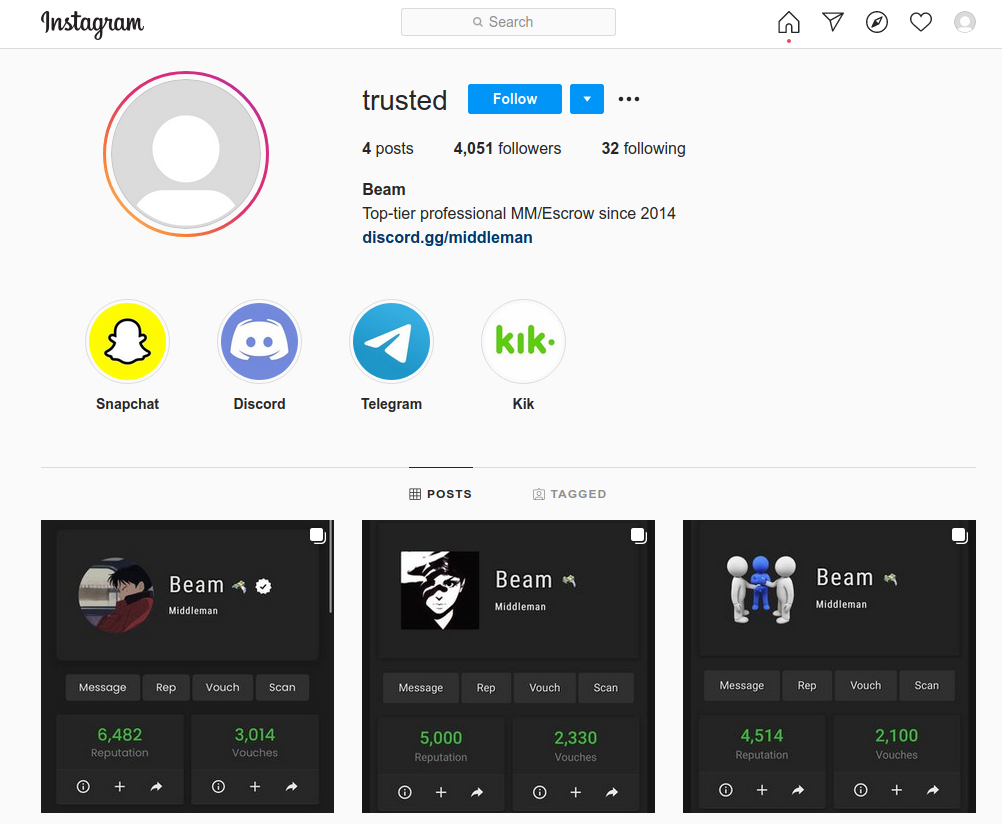
The now-banned Instagram account for the middleman @trusted/beam.

Helpfully, OGUsers has been hacked multiple times over the years, and its database of user details and private messages posted on competing crime forums. Those databases show Beam was just the 12th user account created on OGUsers back in 2014.

In his posts, Beam says he has brokered well north of 10,000 transactions. Indeed, the leaked OGUsers databases — which include private messages on the forum prior to June 2020 — offer a small window into the overall value of the hijacked social media account industry.

In each of Beam’s direct messages to other members who hired him as a middleman he would include the address of the bitcoin wallet to which the buyer was to send the funds. Just two of the bitcoin wallets Beam used for middlemanning over the past of couple of years recorded in excess of 6,700 transactions totaling more than 243 bitcoins — or roughly $8.5 million by today’s valuation (~$35,000 per coin)Beam would have earned roughly $425,000 in commissions on those sales.

Beam, a Canadian whose real name is Noah Hawkins, declined to be interviewed when contacted earlier this week. But his “Trusted” account on Instagram was taken down by Facebook today, as were “@Killer,” — a personal Instagram account he used under the nickname “noah/beam.” Beam’s Twitter account — @NH — has been deactivated by Twitter; it was hacked and stolen from its original owner back in 2014.

Reached for comment, Twitter confirmed that it worked in tandem with Facebook to seize accounts tied to top members of OGUsers, citing its platform manipulation and spam policy. Twitter said its investigation into the people behind these accounts is ongoing.

TikTok confirmed it also took action to target accounts tied to top OGUusers members, although it declined to say how many accounts were reclaimed.

“As part of our ongoing work to find and stop inauthentic behavior, we recently reclaimed a number of TikTok usernames that were being used for account squatting,” TikTok said in a written statement. “We will continue to focus on staying ahead of the ever-evolving tactics of bad actors, including cooperating with third parties and others in the industry.”

‘SOCIAL MEDIA SPECIALISTS’

Other key middlemen who’ve brokered thousands more social media account transactions via OGUsers that were part of this week’s ban wave included Farzad (OGUser #81), who used the Instagram accounts @middleman and @frzd; and @rl, a.k.a. “Amp,” a major middleman and account seller on OGUusers.

Naturally, the top middlemen in the OGUsers community get much of their business from sellers of compromised social media and online gaming accounts, and these two groups tend to cross-promote one another. Among the top seller accounts targeted in the ban wave was the Instagram account belonging to Ryan Zanelli (@zanelli), a 22-year-old self-described “social media marketing specialist” from Melbourne, Australia.
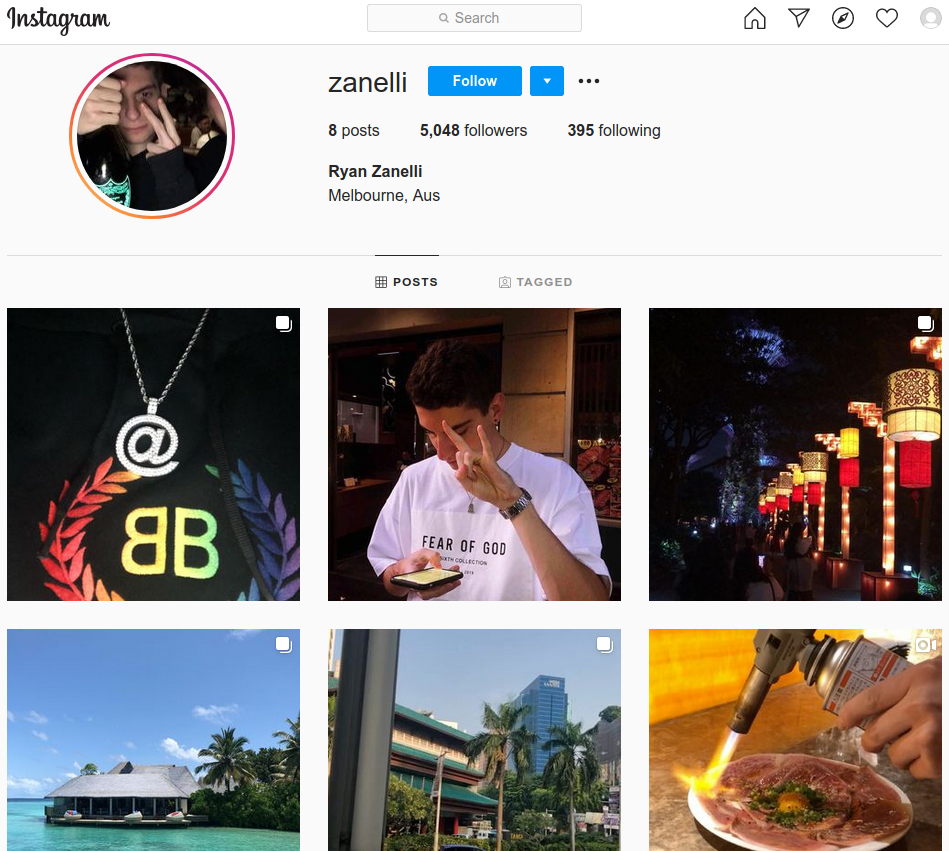
The leaked OGusers databases suggest Zanelli is better known to the OGusers community as “Verdict,” the fifth profile created on the forum and a longtime administrator of the site.

Reached via Telegram, Zanelli acknowledged he was an administrator of OGUsers, but denied being involved in anything illegal.

“I’m an early adaptor to the forum yes just like other countless members, and no social media property I sell is hacked or has been obtained through illegitimate means,” he said. “If you want the truth, I don’t even own any of the stock, I just resell off of people who do.”

This is not the first time Instagram has come for his accounts: As documented in this story in The Atlantic, some of his accounts totaling more than 1 million followers were axed in late 2018 when the platform took down 500 usernames that were stolen, resold, and used for posting memes.

“This is my full-time income, so it’s very detrimental to my livelihood,” Zanelli told The Atlantic, which identified him only by his first name. “I was trying to eat dinner and socialize with my family, but knowing behind the scenes everything I’ve built, my entire net worth, was just gone before my eyes.”

Another top seller account targeted in the ban wave was the Instagram account @h4ck, whose Telegram sales channel also advertises various services to get certain accounts banned and unbanned from differed platforms, including Snapchat and Instagram.
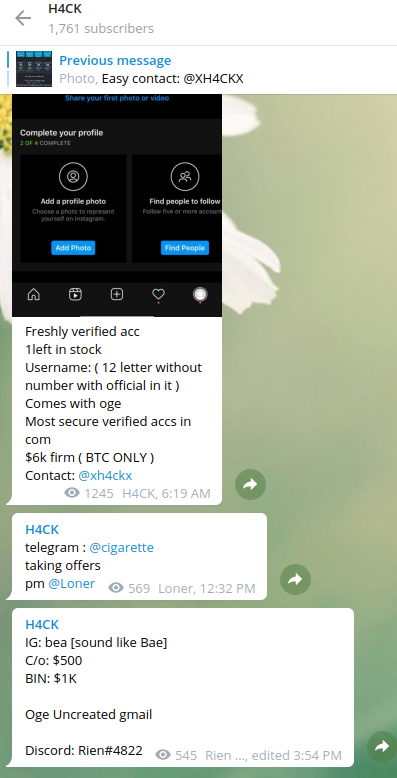
Snippets from the Telegram sales channel for @h4ck, one of the Instagram handles seized by Facebook today.

Facebook said while this is hardly the first time it has reclaimed accounts associated with hijackers, it is the first time it has done so publicly. The company says it has no illusions that this latest enforcement action is going to put a stop to the rampant problem of account hijacking for resale, but views the effort as part of an ongoing strategy to drive up costs for account traffickers, and to educate potential account buyers about the damage inflicted on people whose accounts are hijacked.

In recognition of the scale of the problem, Instagram today rolled out a new feature called “Recently Deleted,” which seeks to help victims undo the damage wrought by an account takeover.

“We know hackers sometimes delete content when they gain access to an account, and until now people had no way of easily getting their photos and videos back,” Instagram explained in a blog post. “Starting today, we will ask people to first verify that they are the rightful account holders when permanently deleting or restoring content from Recently Deleted.”

Facebook wasn’t exaggerating about the hijacking community’s use of extortion and other serious threats to gain control over highly prized usernames. I wish I could get back the many hours spent reading private messages from the OGUsers community, but it is certainly not uncommon for targets to be threatened with swatting attacks, or to have their deeply personal and/or financial information posted publicly online unless they relinquish control over a desired account.

WHAT YOU CAN DO

Any accounts that you value should be secured with a unique and strong password, as well the most robust form of multi-factor authentication available. Usually, this is a mobile app that generates a one-time code, but some sites like Twitter and Facebook now support even more robust options — such as physical security keys.

Whenever possible, avoid opting to receive the second factor via text message or automated phone calls, as these methods are prone to compromise via SIM swapping — a crime that is prevalent among people engaged in stealing social media accounts. SIM swapping involves convincing mobile phone company employees to transfer ownership of the target’s phone number to a device the attackers control.

These precautions are even more important for any email accounts you may have. Sign up with any service online, and it will almost certainly require you to supply an email address. In nearly all cases, the person who is in control of that address can reset the password of any associated services or accounts –merely by requesting a password reset email. Unfortunately, many email providers still let users reset their account passwords by having a link sent via text to the phone number on file for the account.

Most online services require users to supply a mobile phone number when setting up the account, but do not require the number to remain associated with the account after it is established. I advise readers to remove their phone numbers from accounts wherever possible, and to take advantage of a mobile app to generate any one-time codes for multifactor authentication.
Premium Domain Names – transcom.uk
Transcom ISP – The UK’s Best Business ISP
DoubleCheck any website at doublecheck.uk