One of the proposed bills would set up a $5m fund to help small towns upgrade their systems and bolster their security.
Premium Domain Names – transcom.uk
Transcom ISP – The UK’s Best Business ISP
DoubleCheck any website at doublecheck.uk
Premium Domain Names – transcom.uk
Transcom ISP – The UK’s Best Business ISP
DoubleCheck any website at doublecheck.uk
Premium Domain Names – transcom.uk
Transcom ISP – The UK’s Best Business ISP
DoubleCheck any website at doublecheck.uk
Premium Domain Names – transcom.uk
Transcom ISP – The UK’s Best Business ISP
DoubleCheck any website at doublecheck.uk
Premium Domain Names – transcom.uk
Transcom ISP – The UK’s Best Business ISP
DoubleCheck any website at doublecheck.uk
Premium Domain Names – transcom.uk
Transcom ISP – The UK’s Best Business ISP
DoubleCheck any website at doublecheck.uk
Premium Domain Names – transcom.uk
Transcom ISP – The UK’s Best Business ISP
DoubleCheck any website at doublecheck.uk
Communities across the United States are starting to ban facial recognition technologies. In May of last year, San Francisco banned facial recognition; the neighboring city of Oakland soon followed, as did Somerville and Brookline in Massachusetts (a statewide ban may follow). In December, San Diego suspended a facial recognition program in advance of a new statewide law, which declared it illegal, coming into effect. Forty major music festivals pledged not to use the technology, and activists are calling for a nationwide ban. Many Democratic presidential candidates support at least a partial ban on the technology.
These efforts are well-intentioned, but facial recognition bans are the wrong way to fight against modern surveillance. Focusing on one particular identification method misconstrues the nature of the surveillance society we’re in the process of building. Ubiquitous mass surveillance is increasingly the norm. In countries like China, a surveillance infrastructure is being built by the government for social control. In countries like the United States, it’s being built by corporations in order to influence our buying behavior, and is incidentally used by the government.
In all cases, modern mass surveillance has three broad components: identification, correlation and discrimination. Let’s take them in turn.
Facial recognition is a technology that can be used to identify people without their knowledge or consent. It relies on the prevalence of cameras, which are becoming both more powerful and smaller, and machine learning technologies that can match the output of these cameras with images from a database of existing photos.
But that’s just one identification technology among many. People can be identified at a distance by their heartbeat or by their gait, using a laser-based system. Cameras are so good that they can read fingerprints and iris patterns from meters away. And even without any of these technologies, we can always be identified because our smartphones broadcast unique numbers called MAC addresses. Other things identify us as well: our phone numbers, our credit card numbers, the license plates on our cars. China, for example, uses multiple identification technologies to support its surveillance state.
Once we are identified, the data about who we are and what we are doing can be correlated with other data collected at other times. This might be movement data, which can be used to “follow” us as we move throughout our day. It can be purchasing data, Internet browsing data, or data about who we talk to via email or text. It might be data about our income, ethnicity, lifestyle, profession and interests. There is an entire industry of data brokers who make a living analyzing and augmenting data about who we are – using surveillance data collected by all sorts of companies and then sold without our knowledge or consent.
There is a huge – and almost entirely unregulated – data broker industry in the United States that trades on our information. This is how large Internet companies like Google and Facebook make their money. It’s not just that they know who we are, it’s that they correlate what they know about us to create profiles about who we are and what our interests are. This is why many companies buy license plate data from states. It’s also why companies like Google are buying health records, and part of the reason Google bought the company Fitbit, along with all of its data.
The whole purpose of this process is for companies – and governments – to treat individuals differently. We are shown different ads on the Internet and receive different offers for credit cards. Smart billboards display different advertisements based on who we are. In the future, we might be treated differently when we walk into a store, just as we currently are when we visit websites.
The point is that it doesn’t matter which technology is used to identify people. That there currently is no comprehensive database of heartbeats or gaits doesn’t make the technologies that gather them any less effective. And most of the time, it doesn’t matter if identification isn’t tied to a real name. What’s important is that we can be consistently identified over time. We might be completely anonymous in a system that uses unique cookies to track us as we browse the Internet, but the same process of correlation and discrimination still occurs. It’s the same with faces; we can be tracked as we move around a store or shopping mall, even if that tracking isn’t tied to a specific name. And that anonymity is fragile: If we ever order something online with a credit card, or purchase something with a credit card in a store, then suddenly our real names are attached to what was anonymous tracking information.
Regulating this system means addressing all three steps of the process. A ban on facial recognition won’t make any difference if, in response, surveillance systems switch to identifying people by smartphone MAC addresses. The problem is that we are being identified without our knowledge or consent, and society needs rules about when that is permissible.
Similarly, we need rules about how our data can be combined with other data, and then bought and sold without our knowledge or consent. The data broker industry is almost entirely unregulated; there’s only one law – passed in Vermont in 2018 – that requires data brokers to register and explain in broad terms what kind of data they collect. The large Internet surveillance companies like Facebook and Google collect dossiers on us are more detailed than those of any police state of the previous century. Reasonable laws would prevent the worst of their abuses.
Finally, we need better rules about when and how it is permissible for companies to discriminate. Discrimination based on protected characteristics like race and gender is already illegal, but those rules are ineffectual against the current technologies of surveillance and control. When people can be identified and their data correlated at a speed and scale previously unseen, we need new rules.
Today, facial recognition technologies are receiving the brunt of the tech backlash, but focusing on them misses the point. We need to have a serious conversation about all the technologies of identification, correlation and discrimination, and decide how much we as a society want to be spied on by governments and corporations — and what sorts of influence we want them to have over our lives.
This essay previously appeared in the New York Times.
EDITED TO ADD: Rereading this post-publication, I see that it comes off as overly critical of those who are doing activism in this space. Writing the piece, I wasn’t thinking about political tactics. I was thinking about the technologies that support surveillance capitalism, and law enforcement’s usage of that corporate platform. Of course it makes sense to focus on face recognition in the short term. It’s something that’s easy to explain, viscerally creepy, and obviously actionable. It also makes sense to focus specifically on law enforcement’s use of the technology; there are clear civil and constitutional rights issues. The fact that law enforcement is so deeply involved in the technology’s marketing feels wrong. And the technology is currently being deployed in Hong Kong against political protesters. It’s why the issue has momentum, and why we’ve gotten the small wins we’ve had. (The EU is considering a five-year ban on face recognition technologies.) Those wins build momentum, which lead to more wins. I should have been kinder to those in the trenches.
If you want to help, sign the petition from Public Voice calling on a moratorium on facial recognition technology for mass surveillance. Or write to your US congressperson and demand similar action. There’s more information from EFF and EPIC.
Premium Domain Names – transcom.uk
Transcom ISP – The UK’s Best Business ISP
DoubleCheck any website at doublecheck.uk
This year:
King County voters will be able to use their name and birthdate to log in to a Web portal through the Internet browser on their phones, says Bryan Finney, the CEO of Democracy Live, the Seattle-based voting company providing the technology.
Once voters have completed their ballots, they must verify their submissions and then submit a signature on the touch screen of their device.
Finney says election officials in Washington are adept at signature verification because the state votes entirely by mail. That will be the way people are caught if they log in to the system under false pretenses and try to vote as someone else.
The King County elections office plans to print out the ballots submitted electronically by voters whose signatures match and count the papers alongside the votes submitted through traditional routes.
While advocates say this creates an auditable paper trail, many security experts say that because the ballots cross the Internet before they are printed, any subsequent audits on them would be moot. If a cyberattack occurred, an audit could essentially require double-checking ballots that may already have been altered, says Buell.
Of course it’s not an auditable paper trail. There’s a reason why security experts use the phrase “voter-verifiable paper ballots.” A centralized printout of a received Internet message is not voter verifiable.
Another news article.
Premium Domain Names – transcom.uk
Transcom ISP – The UK’s Best Business ISP
DoubleCheck any website at doublecheck.uk
Aleksei Burkov, an ultra-connected Russian hacker once described as “an asset of supreme importance” to Moscow, has pleaded guilty in a U.S. court to running a site that sold stolen payment card data and to administering a highly secretive crime forum that counted among its members some of the most elite Russian cybercrooks.
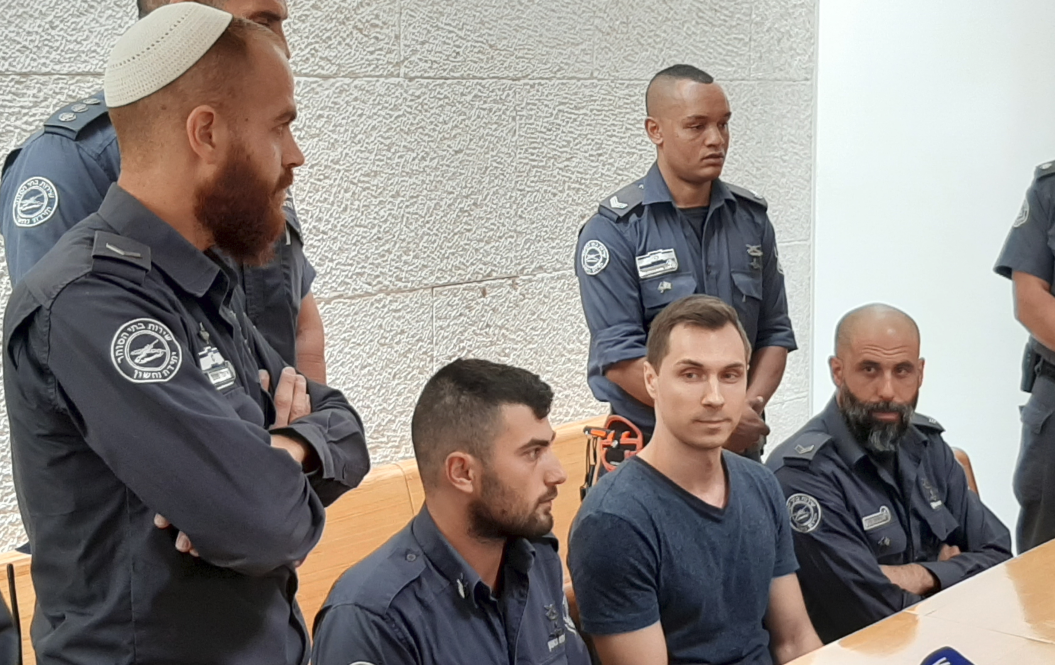
Aleksei Burkov, seated second from right, attends a hearing in Jerusalem in 2015. Andrei Shirokov / Tass via Getty Images.
Burkov, 29, admitted to running CardPlanet, a site that sold more than 150,000 stolen credit card accounts, and to being the founder and administrator of DirectConnection — a closely guarded underground community that attracted some of the world’s most-wanted Russian hackers. He pleaded guilty last week in a Virginia court to access device fraud and conspiracy to commit computer intrusion, identity theft, wire fraud and money laundering.
As KrebsOnSecurity noted in a November 2019 profile of Burkov’s hacker nickname ‘k0pa,’ “a deep dive into the various pseudonyms allegedly used by Burkov suggests this individual may be one of the most connected and skilled malicious hackers ever apprehended by U.S. authorities, and that the Russian government is probably concerned that he simply knows too much.”
Membership in the DirectConnection fraud forum was heavily restricted. New members had to be native Russian speakers, provide a $5,000 deposit, and be vouched for by three existing crime forum members. Also, members needed to have a special encryption certificate installed in their Web browser before the forum’s login page would even load.
DirectConnection was something of a Who’s Who of major cybercriminals, and many of its most well-known members have likewise been extradited to and prosecuted by the United States. Those include Sergey “Fly” Vovnenko, who was sentenced to 41 months in prison for operating a botnet and stealing login and payment card data. Vovnenko also served as administrator of his own cybercrime forum, which he used in 2013 to carry out a plan to have Yours Truly framed for heroin possession.
As noted in last year’s profile of Burkov, an early and important member of DirectConnection was a hacker who went by the moniker “aqua” and ran the banking sub-forum on Burkov’s site. In December 2019, the FBI offered a $5 million bounty leading to the arrest and conviction of aqua, who’s been identified as Maksim Viktorovich Yakubets. The Justice Department says Yakubets/aqua ran a transnational cybercrime organization called “Evil Corp.” that stole roughly $100 million from victims.
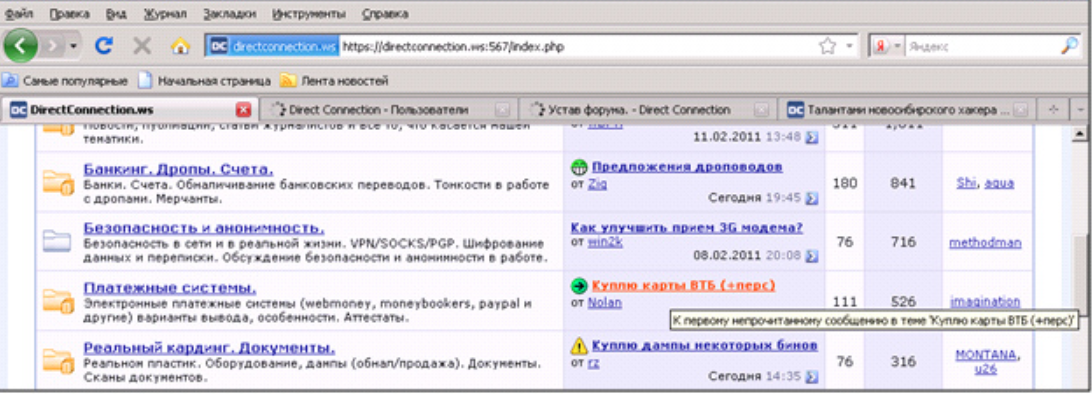
In this 2011 screenshot of DirectConnection, we can see the nickname of “aqua,” who ran the “banking” sub-forum on DirectConecttion. Aqua, a.k.a. Maksim V. Yakubets of Russia, now has a $5 million bounty on his head from the FBI.
According to a statement of facts in Burkov’s case, the author of the infamous SpyEye banking trojan — Aleksandr “Gribodemon” Panin — was personally vouched for by Burkov. Panin was sentenced in 2016 to more than nine years in prison.
Other top DirectConnection members include convicted credit card fraudsters Vladislav “Badb” Horohorin and Sergey “zo0mer” Kozerev, as well as the infamous spammer and botnet master Peter “Severa” Levashov.
Burkov was arrested in 2015 on an international warrant while he was visiting Israel, and over the ensuing four years the Russian government aggressively sought to keep him from being extradited to the United States. When Israeli authorities turned down requests to send him back to Russia — supposedly to face separate hacking charges there — the Russians then imprisoned a young Israeli woman on trumped-up drug charges in a bid to trade prisoners.
As the news outlet Haaretz reported in October, Naama Issachar was arrested while changing planes in Russia on her way home from a yoga course in India. Russian police said they found approximately 10 grams of marijuana in Issachar’s bag. Issachar denied smuggling drugs, saying she had not sought to enter Russia during her layover and had no access to her luggage during her brief stay in the Russian airport.
Haaretz noted that the Russian government pressed Israel to exchange Burkov for Issachar. When Israel’s supreme court cleared the way for Burkov’s extradition to the United States, Issachar was found guilty of drug smuggling and sentenced to 7.5 years in jail.
But according to a story today in The Times of Israel, the Kremlin has signaled that Russian President Vladimir Putin may make a decision “in the near future,” on a possible pardon for Issachar, whose mother reportedly met with Putin while the Russian leader was visiting Israel last week.
Burkov currently is scheduled to be sentenced on May 8. He faces a maximum sentence of 15 years in prison.
Premium Domain Names – transcom.uk
Transcom ISP – The UK’s Best Business ISP
DoubleCheck any website at doublecheck.uk
A Russian man has pleaded guilty to running an illegal online marketplace that sold stolen payment card credentials to criminals, who used them to make over $20m in fraudulent purchases.
Before a United States court, Aleksei Burkov admitted operating the Cardplanet website, which sold card data acquired through illegal computer intrusions. Many of the cards offered for sale belonged to United States citizens, with the result that over $20m in fraudulent purchases were made on American credit cards.
According to the Associated Press, prosecutors said Burkov offered a money-back guarantee to his customers if a stolen card number no longer worked.
The 29-year-old also pleaded guilty to running a second website that served as an invite-only club where elite cyber-criminals could advertise stolen goods and criminal services.
Items for sale on the site included personal identifying information, malicious software, and money laundering and hacking services.
“To obtain membership in Burkov’s cybercrime forum, prospective members needed three existing members to ‘vouch’ for their good reputation among cybercriminals and to provide a sum of money, normally $5,000, as insurance,” said the Eastern District of Virginia US Attorney’s Office.
“These measures were designed to keep law enforcement from accessing Burkov’s cybercrime forum and to ensure that members of the forum honored any deals made while conducting business on the forum.”
Burkov was arrested at Ben-Gurion Airport near Tel Aviv in December 2015, and in 2017, an Israeli district court approved his extradition to the United States. Burkov was finally extradited to the United States from Israel on November 11, 2019, after appeals to the Israeli Supreme Court and the Israeli High Court of Justice were denied.
In front of Senior US District Judge T.S. Ellis, III, Burkov pleaded guilty to access device fraud and conspiracy to commit computer intrusion, identity theft, wire and access device fraud, and money laundering.
Burkov faces a maximum sentence of fifteen years in prison when sentenced on May 8.
Russian officials objected to Burkov’s extradition from Israel. According to the Associated Press, Israeli officials have suggested Russia sought Burkov’s release by offering an exchange for Naama Issachar, a 26-year-old Israeli woman who received a seven-year prison sentence in Moscow for drug-related charges.
Premium Domain Names – transcom.uk
Transcom ISP – The UK’s Best Business ISP
DoubleCheck any website at doublecheck.uk