Trojaned Windows Installer Targets Ukraine

Mandiant is reporting on a trojaned Windows installer that targets Ukrainian users. The installer was left on various torrent sites, presumably ensnaring people downloading pirated copies of the operating system:

Mandiant uncovered a socially engineered supply chain operation focused on Ukrainian government entities that leveraged trojanized ISO files masquerading as legitimate Windows 10 Operating System installers. The trojanized ISOs were hosted on Ukrainian- and Russian-language torrent file sharing sites. Upon installation of the compromised software, the malware gathers information on the compromised system and exfiltrates it. At a subset of victims, additional tools are deployed to enable further intelligence gathering. In some instances, we discovered additional payloads that were likely deployed following initial reconnaissance including the STOWAWAY, BEACON, and SPAREPART backdoors.

One obvious solution would be for Microsoft to give the Ukrainians Windows licenses, so they don’t have to get their software from sketchy torrent sites.

—————
Free Secure Email – Transcom Sigma
Boost Inflight Internet
Transcom Hosting
Transcom Premium Domains

The Equifax Breach Settlement Offer is Real, For Now

Millions of people likely just received an email or snail mail notice saying they’re eligible to claim a class action payment in connection with the 2017 megabreach at consumer credit bureau Equifax. Given the high volume of reader inquiries about this, it seemed worth pointing out that while this particular offer is legit (if paltry), scammers are likely to soon capitalize on public attention to the settlement money.

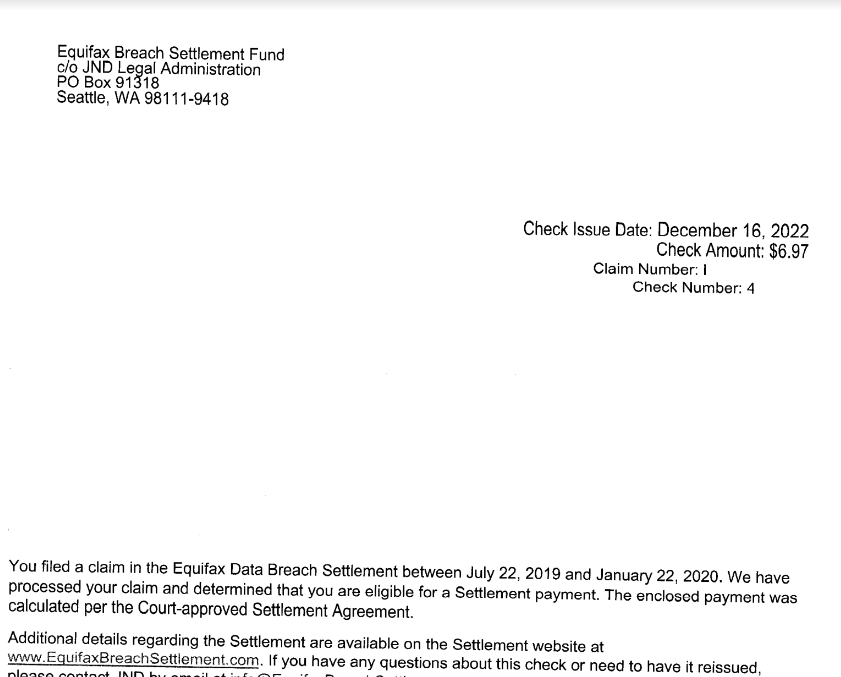
One reader’s copy of their Equifax Breach Settlement letter. They received a check for $6.97.

In 2017, Equifax disclosed a massive, extended data breach that led to the theft of Social Security Numbers, dates of birth, addresses and other personal information on nearly 150 million people. Following a public breach response perhaps best described as a giant dumpster fire, the big-three consumer credit reporting bureau was quickly hit with nearly two dozen class-action lawsuits.

In exchange for resolving all outstanding class action claims against it, Equifax in 2019 agreed to a settlement that includes up to $425 million to help people affected by the breach.

Affected consumers were eligible to apply for at least three years of credit monitoring via all three major bureaus simultaneously, including Equifax, Experian and TransUnion. Or, if you didn’t want to take advantage of the credit monitoring offers, you could opt for a cash payment of up to $125.

The settlement also offered reimbursement for the time you may have spent remedying identity theft or misuse of your personal information caused by the breach, or purchasing credit monitoring or credit reports. This was capped at 20 total hours at $25 per hour ($500), with total cash reimbursement payments not to exceed $20,000 per consumer.

Those who did file a claim probably started receiving emails or other communications earlier this year from the Equifax Breach Settlement Fund, which has been messaging class participants about methods of collecting their payments.

How much each recipient receives appears to vary quite a bit, but probably most people will have earned a payment on the smaller end of that $125 scale — like less than $10. Those who received higher amounts likely spent more time documenting actual losses and/or explaining how the breach affected them personally.

So far this week, KrebsOnSecurity has received at least 20 messages from readers seeking more information about these notices. Some readers shared copies of letters they got in the mail along with a paper check from the Equifax Breach Settlement Fund (see screenshot above).

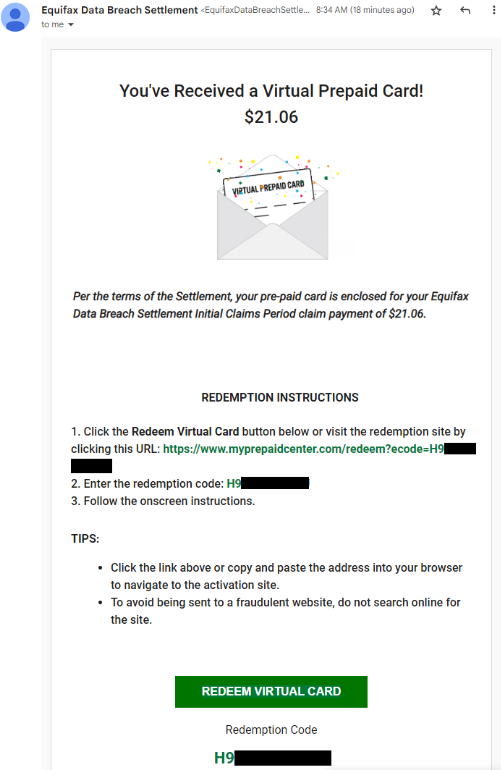
Others said they got emails from the Equifax Breach Settlement domain that looked like an animated greeting card offering instructions on how to redeem a virtual prepaid card.

If you received one of these settlement emails and are wary about clicking the included links (good for you, by the way), copy the redemption code and paste it into the search box at myprepaidcenter.com/redeem. Successfully completing the card application requires accepting a prepaid MasterCard agreement (PDF).

The website for the settlement — equifaxbreachsettlement.com — also includes a lookup tool that lets visitors check whether they were affected by the breach; it requires your last name and the last six digits of your Social Security Number.

But be aware that phishers and other scammers are likely to take advantage of increased public awareness of the payouts to snooker people. Tim Helming, security evangelist at DomainTools.com, today flagged several new domains that mimic the name of the real Equifax Breach Settlement website and do not appear to be defensively registered by Equifax, including equifaxbreechsettlement[.]com, equifaxbreachsettlementbreach[.]com, and equifaxsettlements[.]co.

In February 2020, the U.S. Justice Department indicted four Chinese officers of the People’s Liberation Army (PLA) for perpetrating the 2017 Equifax hack. DOJ officials said the four men were responsible for carrying out the largest theft of sensitive personal information by state-sponsored hackers ever recorded.

Equifax surpassed Wall Street’s expectations in its most recent quarterly earnings: The company reported revenues of $1.24 billion for the quarter ending September 2022.

Of course, most of those earnings come from Equifax’s continued legal ability to buy and sell eye-popping amounts of financial and personal data on U.S. consumers. As one of the three major credit bureaus, Equifax collects and packages information about your credit, salary, and employment history. It tracks how many credit cards you have, how much money you owe, and how you pay your bills. Each company creates a credit report about you, and then sells this report to businesses who are deciding whether to give you credit.

Americans currently have no legal right to opt out of this data collection and trade. But you can and also should freeze your credit, which by the way can make your credit profile less profitable for companies like Equifax — because they make money every time some potential creditor wants a peek inside your financial life. Also, it’s probably a good idea to freeze the credit of your children and/or dependents as well. It’s free on both counts.

—————
Free Secure Email – Transcom Sigma
Boost Inflight Internet
Transcom Hosting
Transcom Premium Domains

The Smart Home Security Guide

The smarts behind a smart home come from you. At least when it comes to keeping it more private and secure. 

Without question, smart home devices have truly stormed the marketplace. We’ve gone from a handful of relatively straightforward things like connected lights, outlets, and cameras to a wide range of fully connected household appliances like refrigerators, stoves, and laundry machines. You can even water your garden with smart devices, which check for soil moisture, weather reports, and for what you’re watering. 

Further new technologies like the Matter protocol aim to make them all work more reliably and easily—with a new networking standard that allows different devices from different platforms to work together. Something they couldn’t do before and something that likely kept people from adding to their connected home because of compatibility issues. No more. 

It’s exciting, as it should be. Yet the security and privacy measures for these devices hasn’t quite kept up with all this rapid development and expansion. Not across the board, anyway. Security isn’t always built into these devices. In some cases, it’s so poorly handled that it makes some devices prone to attack. 

However, you can absolutely enjoy a smart home and all the comforts and conveniences that come along with it. Safely. Just a little extra effort from you makes it possible. And you don’t need to be any kind of whiz to pull it off.  

Why security for your smart appliances and smart devices counts 

For starters, the old security adage holds true for smart homes and devices: “If it’s connected, it must be protected.” Any connected device can provide a hacker with an inroad to your home network and the data and devices on it. So even that seemingly innocent smart wall outlet that you use to run your living room lamps could be a target.  

In fact, we’ve seen instances where a little outlet created a big security issue, such as one report where an unsecure plug used poor factory passwords and didn’t use secure encryption to communicate with the household router. The result—hackers could obtain login credentials to a victim’s entire home network. 

Another old security adage is that your home network is only as secure as your weakest device. In the above case, that was a poorly designed smart outlet—at least from a security standpoint. 

Now consider a highly connected smart home with a dozen or so smart devices. Maybe some of those have great security built in and are backed by manufacturers that update them regularly for ongoing security. And maybe some of those other devices, not so much. Again, just one poorly secured device in that mix could jeopardize your connected things, along with the data you keep on them. 

Privacy for smart appliances and smart devices counts too 

On the topic of data, we often talk about privacy policies and how they’re not all created equal. Depending on the app, device, and operating system—along with any settings you have control over too—may determine what information a company collects, keeps, and shares about you and your usage. Moreover, it may determine what they or other third parties might do with that data as well. 

Put simply, not every company treats your personal data the same way. Some may sell it to data brokers for profit or share it with third parties like insurance companies, government agencies, law enforcement, and others according to findings published by some industry groups. 

Still others may not sell that data, yet they will share it with third parties for analysis or use it to fuel their own advertising campaigns or advertising platforms they own. And of course, there are others who collect and analyze the bare minimum and keep that data to themselves. 

Consider once more that smart home filled with a dozen or so smart devices. That likely means several different data privacy policies are in play as well, each handing the data created by that home in different ways. And in ways that you may or may not be fully aware of, given that privacy policies are often notoriously long reads, sometimes filled with legalese.  

Without question, privacy is another consideration for your smart home. 

You have more control over your smart home security and privacy than you might think 

You can do plenty of things that can make your smart devices more private and more secure than they were when they came out of the box. And as mentioned above, the steps are all rather straightforward. Our Smart Home Security Guide lays it out for you. 

It’s part of the McAfee Security Guide Series, and in it you’ll get a closer look at how you can protect a smart wall outlet, along with that smart coffeemaker, door lock, refrigerator and more. It covers the basics of protection, how to shop for more private and secure smart devices, plus a section that talks specifically about smart speakers and protecting your privacy while using them. 

In all, our Smart Home Security Guide is here to help. The truth is that security isn’t always included with smart home devices. Not right out of the box anyway. Just like with your computers, smartphones, and other devices, the best security relies on you. With a handful of steps, you can enjoy your smart home with confidence. 

The post The Smart Home Security Guide appeared first on McAfee Blog.
—————
Free Secure Email – Transcom Sigma
Boost Inflight Internet
Transcom Hosting
Transcom Premium Domains

How to Surrender to a Drone

The Ukrainian army has released an instructional video explaining how Russian soldiers should surrender to a drone:

“Seeing the drone in the field of view, make eye contact with it,” the video instructs. Soldiers should then raise their arms and signal they’re ready to follow.

After that the drone will move up and down a few meters, before heading off at walking pace in the direction of the nearest representatives of Ukraine’s army, it says.

The video also warns that the drone’s battery may run low, in which case it will head back to base and the soldiers should stay put and await a fresh one.

That one, too, should be met with eye contact and arms raised, it says.

Incredible.

—————
Free Secure Email – Transcom Sigma
Boost Inflight Internet
Transcom Hosting
Transcom Premium Domains