The Medibank Data Breach – Steps You Can Take to Protect Yourself

Hackers have posted another batch of stolen health records on the dark web—following a breach that could potentially affect nearly 8 million Australian Medibank customers, along with nearly 2 million more international customers. 

The records were stolen in October’s reported breach at Medibank, one of Australia’s largest private health insurance providers. Given Australia’s population of almost 26 million people, close to a third of the population could find themselves affected.  

The hackers subsequently issued ransomware demands with the threat of releasing the records. With their demands unmet, the hackers then started posting the records in batches, the first on November 8th and the latest dropping on November 14th. 

According to Medibank, the records and information could include diagnoses, a list of conditions, and further information such as: 

“[P]ersonal data such as names, addresses, dates of birth, phone numbers, email addresses, Medicare numbers for AHM customers (not expiry dates), in some cases passport numbers for our international students (not expiry dates), and some health claims data.” 

Medibank continues to keep its customers up to date on the latest developments on its website and further states they will contact customers, via email and post, to clarify what has been stolen and what has been published on the dark web.  

What should I do if I think my information was caught up in the Medibank breach? 

Any time a data breach occurs, it means that your personal information could end up in the hands of a bad actor. In the case of Medibank, the hackers posted the stolen information on the dark web, which unfortunately means that the likelihood of a potential scammer or thief obtaining this information is a near certainty. 

In light of this, there are a few steps you can take to protect yourself in the aftermath of a data breach, which involves a combination of preventative steps and some monitoring on your part. 

Report unauthorised use of your information or accounts immediately 

Home Affairs Minister Clare O’Neil called for Australians to “Contact Services Australia if you believe there has been unauthorised activity in your Medicare account.” Further, Australians can take the following additional steps to protect themselves in the wake of identity theft. 

Keep an eye out for phishing attacks 

With some personal information in hand, bad actors may seek out more. They may follow up a breach with rounds of phishing attacks that direct you to bogus sites designed to steal your personal information—either by tricking you into providing it or by stealing it without your knowledge. So as it’s always wise to keep a skeptical eye open for unsolicited messages that ask you for information in some form or other, often in ways that urge or pressure you into acting. Always look out for phishing attacks, particularly after breaches. 

If you are contacted by Medibank, make certain the communication is legitimate. Bad actors may pose as Medibank to steal personal information. Do not click on links sent in emails, texts, or messages. Instead, go straight to the Medibank website or contact them by phone directly. 

Change your passwords and use a password manager 

While it does not appear that login information was affected, a password update is still a strong security move. Strong and unique passwords are best, which means never reusing your passwords across different sites and platforms. Using a password manager will help you keep on top of it all, while also storing your passwords securely. Moreover, changing your passwords regularly can reduce your risk in the event of a data breach. Namely, a breached password is no good to a hacker if you’ve changed it. 

Enable two-factor authentication 

While a strong and unique password is a good first line of defense, enabling two-factor authentication across your accounts will help your cause by providing an added layer of security. It’s increasingly common to see nowadays, where banks and all manner of online services will only allow access to your accounts after you’ve provided a one-time passcode sent to your email or smartphone. If your accounts support two-factor authentication, enable it. 

Consider using identity monitoring 

An identity monitoring service can monitor everything from email addresses to credit cards, bank account numbers and phone numbers for signs of breaches so you can take action to secure your accounts before they’re used for identity theft. Personal information harvested from data breaches can end up on dark web marketplaces where it’s bought by other bad actors so they can launch their own attacks. McAfee’s identity monitoring service helps you keep an eye on your personal info and provides alerts if your data is found, averaging 10 months ahead of similar services. 

Check your credit and consider a credit freeze 

When personal information gets released, there’s a chance that a hacker, scammer, or thief will put it to use. This may include committing fraud, where they draw funds from existing accounts, and theft, where they create new accounts in your name. This may include identity theft, where someone pretends to be you, generally to gain access to more information or services, and may escalate to identity fraud, where funds are stolen from your account. 

Another step that customers can take is to place a credit freeze on their credit reports with the major credit agencies in Australia— Equifax, illion, and Experian. This will help prevent bad actors from opening new lines of credit or take out loans in your name by “freezing” your credit report so that potential creditors cannot pull it for reference. Terms of freezing a credit report will vary, so check with each agency for details. 

Consider using comprehensive online protection 

A complete suite of online protection software can offer layers of extra security. Identity thieves generally focus on easy targets to save time. Elevated security across the majority of your data can make you a far more difficult target. In addition to more private and secure time online with a VPN, identity monitoring, and password management, this includes web browser protection that can block malicious and suspicious links that could lead you down the road to malware or a phishing scam—which antivirus protection can’t do alone. Additionally, McAfee offers support from a licensed recovery pro who can help you restore your credit, just in case. 

Should I replace my driver’s licence? 

Per Medibank, some victims of the breach may have had their driver’s licence number exposed. Given that a licence number is such a unique piece of personally identifiable information, anyone notified by Medibank that theirs may have been affected should strongly consider changing them. The process for replacing a licence document will vary depending on your state or territory.  

The recent Optus breach of September 2022 saw some states and territories propose making exceptions to the rules for attack victims, so look to your local government for guidance.  

The Medibank data breach – you have ways to protect yourself 

Not all data breaches make the news. Businesses and organizations, large and small, have all fallen victim to them, and with regularity. The measures you can take here are measures you can take even if you don’t believe you were caught up in the Medibank breach.  

However, you have every reason to act now rather than wait for additional news. Staying on top of our credit and identity has always been important, but given all the devices, apps, and accounts we keep these days leaves us more exposed than ever, which makes protection a must.  

The post The Medibank Data Breach – Steps You Can Take to Protect Yourself appeared first on McAfee Blog.

—————
Free Secure Email – Transcom Sigma
Boost Inflight Internet
Transcom Hosting
Transcom Premium Domains

Microsoft’s Edge over Popups (and Google Chrome)

Following up on our previous blog, How to Stop the Popups, McAfee Labs saw a sharp decrease in the number of deceptive push notifications reported by McAfee consumers running Microsoft’s Edge browser on Windows.

Such browser-delivered push messages appear as toaster pop-ups in the tray above the system clock and are meant to trick users into taking various actions, such as installing software, purchasing a subscription, or providing personal information.

example of a deceptive push notification

Upon further investigation, this major drop seems to be associated with a change in the behavior of the Edge browser with two notable improvements over older versions.

First, when users visit websites known to deliver deceptive push notifications, Edge blocks authorization prompts that could trick users into opting-in to receive popups:

Second, when unwanted popups do occur, it is now easier than ever to disable them, on a per-site basis.  Users can simply click the three dots (…) on the right of the notification and choose to “Turn off all notifications for” the domain responsible for the popup.

This is a great improvement over the previous experience of having to manually navigate browser settings to achieve the desired result.

Earlier this year, 9TO5Google reported a Chrome code change may be indicative of a similar crack down by Google on nefarious popups.

One can hope Google will follow Microsoft’s example to improve browser security and usability.

The post Microsoft’s Edge over Popups (and Google Chrome) appeared first on McAfee Blog.

—————
Free Secure Email – Transcom Sigma
Boost Inflight Internet
Transcom Hosting
Transcom Premium Domains

Top Zeus Botnet Suspect “Tank” Arrested in Geneva

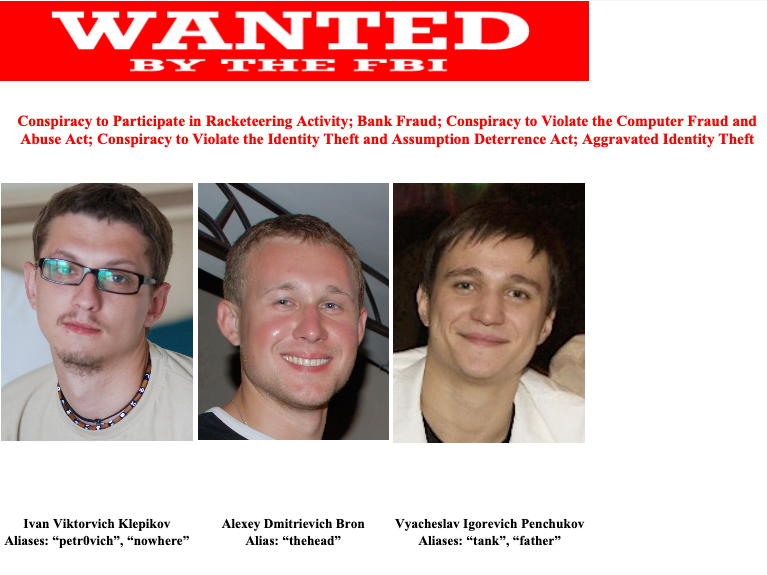
Vyacheslav “Tank” Penchukov, the accused 40-year-old Ukrainian leader of a prolific cybercriminal group that stole tens of millions of dollars from small to mid-sized businesses in the United States and Europe, has been arrested in Switzerland, according to multiple sources.

Wanted Ukrainian cybercrime suspect Vyacheslav “Tank” Penchukov (right) was arrested in Geneva, Switzerland. Tank was the day-to-day manager of a cybercriminal group that stole tens of millions of dollars from small to mid-sized businesses.

Penchukov was named in a 2014 indictment by the U.S. Department of Justice as a top figure in the JabberZeus Crew, a small but potent cybercriminal collective from Ukraine and Russia that attacked victim companies with a powerful, custom-made version of the Zeus banking trojan.

The U.S. Federal Bureau of Investigation (FBI) declined to comment for this story. But according to multiple sources, Penchukov was arrested in Geneva, Switzerland roughly three weeks ago as he was traveling to meet up with his wife there.

Penchukov is from Donetsk, a traditionally Russia-leaning region in Eastern Ukraine that was recently annexed by Russia. In his hometown, Penchukov was a well-known deejay (“DJ Slava Rich“) who enjoyed being seen riding around in his high-end BMWs and Porsches. More recently, Penchukov has been investing quite a bit in local businesses.

The JabberZeus crew’s name is derived from the malware they used, which was configured to send them a Jabber instant message each time a new victim entered a one-time password code into a phishing page mimicking their bank. The JabberZeus gang targeted mostly small to mid-sized businesses, and they were an early pioneer of so-called “man-in-the-browser” attacks, malware that can silently siphon any data that victims submit via a web-based form.

Once inside a victim company’s bank accounts, the crooks would modify the firm’s payroll to add dozens of “money mules,” people recruited through work-at-home schemes to handle bank transfers. The mules in turn would forward any stolen payroll deposits — minus their commissions — via wire transfer overseas.

Tank, a.k.a. “DJ Slava Rich,” seen here performing as a DJ in Ukraine in an undated photo from social media.

The JabberZeus malware was custom-made for the crime group by the alleged author of the Zeus trojan — Evgeniy Mikhailovich Bogachev, a top Russian cybercriminal with a $3 million bounty on his head from the FBI. Bogachev is accused of running the Gameover Zeus botnet, a massive crime machine of 500,000 to 1 million infected PCs that was used for large DDoS attacks and for spreading Cryptolocker — a peer-to-peer ransomware threat that was years ahead of its time.

Investigators knew Bogachev and JabberZeus were linked because for many years they were reading the private Jabber chats between and among members of the JabberZeus crew, and Bogachev’s monitored aliases were in semi-regular contact with the group about updates to the malware.

Gary Warner, director of research in computer forensics at the University of Alabama at Birmingham, noted in his blog from 2014 that Tank told co-conspirators in a JabberZeus chat on July 22, 2009 that his daughter, Miloslava, had been born and gave her birth weight.

“A search of Ukrainian birth records only showed one girl named Miloslava with that birth weight born on that day,” Warner wrote. This was enough to positively identify Tank as Penchukov, Warner said.

Ultimately, Penchukov’s political connections helped him evade prosecution by Ukrainian cybercrime investigators for many years. The late son of former Ukrainian President Victor Yanukovych (Victor Yanukovych Jr.) would serve as godfather to Tank’s daughter Miloslava. Through his connections to the Yanukovych family, Tank was able to establish contact with key insiders in top tiers of the Ukrainian government, including law enforcement.

Sources briefed on the investigation into Penchukov said that in 2010 — at a time when the Security Service of Ukraine (SBU) was preparing to serve search warrants on Tank and his crew — Tank received a tip that the SBU was coming to raid his home. That warning gave Tank ample time to destroy important evidence against the group, and to avoid being home when the raids happened. Those sources also said Tank used his contacts to have the investigation into his crew moved to a different unit that was headed by his corrupt SBU contact.

Writing for Technology Review, Patrick Howell O’Neil recounted how SBU agents in 2010 were trailing Tank around the city, watching closely as he moved between nightclubs and his apartment.

“In early October, the Ukrainian surveillance team said they’d lost him,” he wrote. “The Americans were unhappy, and a little surprised. But they were also resigned to what they saw as the realities of working in Ukraine. The country had a notorious corruption problem. The running joke was that it was easy to find the SBU’s anticorruption unit—just look for the parking lot full of BMWs.”

AUTHOR’S NOTE/BACKGROUND

I first encountered Tank and the JabberZeus crew roughly 14 years ago as a reporter for The Washington Post, after a trusted source confided that he’d secretly gained access to the group’s private Jabber conversations.

From reading those discussions each day, it became clear Tank was nominally in charge of the Ukrainian crew, and that he spent much of his time overseeing the activities of the money mule recruiters — which were an integral part of their victim cashout scheme.

It was soon discovered that the phony corporate websites the money mule recruiters used to manage new hires had a security weakness that allowed anyone who signed up at the portal to view messages for every other user. A scraping tool was built to harvest these money mule recruitment messages, and at the height of the JabberZeus gang’s activity in 2010 that scraper was monitoring messages on close to a dozen different money mule recruitment sites, each managing hundreds of “employees.”

Each mule was given busy work or menial tasks for a few days or weeks prior to being asked to handle money transfers. I believe this was an effort to weed out unreliable money mules. After all, those who showed up late for work tended to cost the crooks a lot of money, as the victim’s bank would usually try to reverse any transfers that hadn’t already been withdrawn by the mules.

When it came time to transfer stolen funds, the recruiters would send a message through the fake company website saying something like: “Good morning [mule name here]. Our client — XYZ Corp. — is sending you some money today. Please visit your bank now and withdraw this payment in cash, and then wire the funds in equal payments — minus your commission — to these three individuals in Eastern Europe.”

Only, in every case the company mentioned as the “client” was in fact a small business whose payroll accounts they’d already hacked into.

So, each day for several years my morning routine went as follows: Make a pot of coffee; shuffle over to the computer and view the messages Tank and his co-conspirators had sent to their money mules over the previous 12-24 hours; look up the victim company names in Google; pick up the phone to warn each that they were in the process of being robbed by the Russian Cyber Mob.

My spiel on all of these calls was more or less the same: “You probably have no idea who I am, but here’s all my contact info and what I do. Your payroll accounts have been hacked, and you’re about to lose a great deal of money. You should contact your bank immediately and have them put a hold on any pending transfers before it’s too late. Feel free to call me back afterwards if you want more information about how I know all this, but for now please just call or visit your bank.”

In many instances, my call would come in just minutes or hours before an unauthorized payroll batch was processed by the victim company’s bank, and some of those notifications prevented what otherwise would have been enormous losses — often several times the amount of the organization’s normal weekly payroll. At some point I stopped counting how many tens of thousands of dollars those calls saved victims, but over several years it was probably in the millions.

Just as often, the victim company would suspect that I was somehow involved in the robbery, and soon after alerting them I would receive a call from an FBI agent or from a police officer in the victim’s hometown. Those were always interesting conversations.

Collectively, these notifications to victims led to dozens of stories over several years about small businesses battling their financial institutions to recover their losses. I never wrote about a single victim that wasn’t okay with my calling attention to their plight and to the sophistication of the threat facing other companies.

This incessant meddling on my part very much aggravated Tank, who on more than one occasion expressed mystification as to how I knew so much about their operations and victims. Here’s a snippet from one of their Jabber chats in 2009, after I’d written a story for The Washington Post about their efforts to steal $415,000 from the coffers of Bullitt County, Kentucky. In the chat below, “lucky12345” is the Zeus author Bogachev:

tank: Are you there?
tank: This is what they damn wrote about me.
tank: http://voices.washingtonpost.com/securityfix/2009/07/an_odyssey_of_fraud_part_ii.html#more
tank: I’ll take a quick look at history
tank: Originator: BULLITT COUNTY FISCAL Company: Bullitt County Fiscal Court
tank: Well, you got [it] from that cash-in.
lucky12345: From 200K?
tank: Well, they are not the right amounts and the cash out from that account was shitty.
tank: Levak was written there.
tank: Because now the entire USA knows about Zeus.
tank: 😀
lucky12345: It’s fucked.

On Dec. 13, 2009, one of Tank’s top money mule recruiters — a crook who used the pseudonym “Jim Rogers” — told his boss something I hadn’t shared beyond a few trusted confidants at that point: That The Washington Post had eliminated my job in the process of merging the newspaper’s Web site (where I worked at the time) with the dead tree edition.

jim_rogers: There is a rumor that our favorite (Brian) didn’t get his contract extension at Washington Post. We are giddily awaiting confirmation 🙂 Good news expected exactly by the New Year! Besides us no one reads his column 🙂
tank: Mr. Fucking Brian Fucking Kerbs!

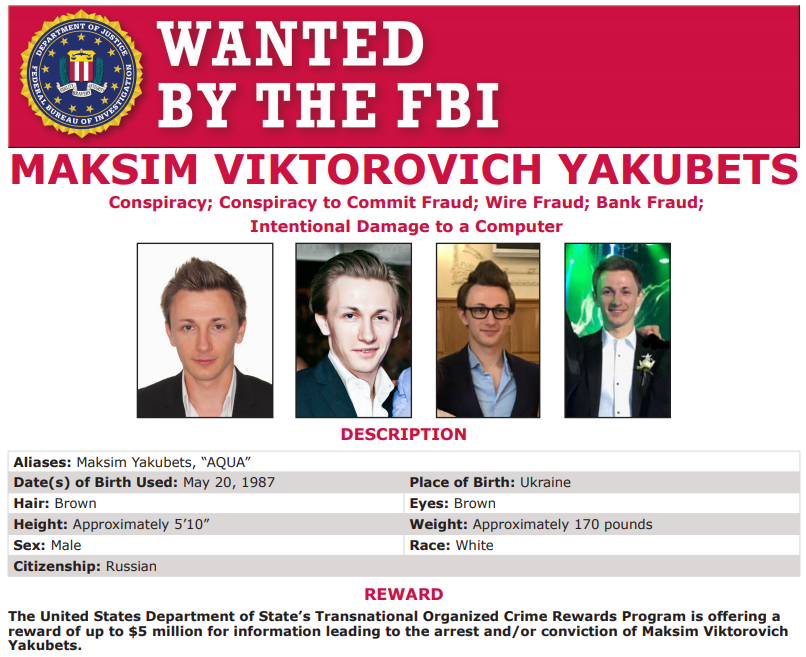
Another member of the JabberZeus crew — Ukrainian-born Maksim “Aqua” Yakubets — also is currently wanted by the FBI, which is offering a $5 million reward for information leading to his arrest and conviction.

Alleged “Evil Corp” bigwig Maksim “Aqua” Yakubets. Image: FBI

—————
Free Secure Email – Transcom Sigma
Boost Inflight Internet
Transcom Hosting
Transcom Premium Domains