What are the factors behind this stark rise, and how can the skills gap be closed?
—————
Free Secure Email – Transcom Sigma
Boost Inflight Internet
Transcom Hosting
Transcom Premium Domains
—————
Free Secure Email – Transcom Sigma
Boost Inflight Internet
Transcom Hosting
Transcom Premium Domains
—————
Free Secure Email – Transcom Sigma
Boost Inflight Internet
Transcom Hosting
Transcom Premium Domains
—————
Free Secure Email – Transcom Sigma
Boost Inflight Internet
Transcom Hosting
Transcom Premium Domains
—————
Free Secure Email – Transcom Sigma
Boost Inflight Internet
Transcom Hosting
Transcom Premium Domains
—————
Free Secure Email – Transcom Sigma
Boost Inflight Internet
Transcom Hosting
Transcom Premium Domains
—————
Free Secure Email – Transcom Sigma
Boost Inflight Internet
Transcom Hosting
Transcom Premium Domains
Long and interesting interview with Signal’s new president, Meredith Whittaker:
WhatsApp uses the Signal encryption protocol to provide encryption for its messages. That was absolutely a visionary choice that Brian and his team led back in the day - and big props to them for doing that. But you can’t just look at that and then stop at message protection. WhatsApp does not protect metadata the way that Signal does. Signal knows nothing about who you are. It doesn’t have your profile information and it has introduced group encryption protections. We don’t know who you are talking to or who is in the membership of a group. It has gone above and beyond to minimize the collection of metadata.
WhatsApp, on the other hand, collects the information about your profile, your profile photo, who is talking to whom, who is a group member. That is powerful metadata. It is particularly powerful—and this is where we have to back out into a structural argument for a company to collect the data that is also owned by Meta/Facebook. Facebook has a huge amount, just unspeakable volumes, of intimate information about billions of people across the globe.
It is not trivial to point out that WhatsApp metadata could easily be joined with Facebook data, and that it could easily reveal extremely intimate information about people. The choice to remove or enhance the encryption protocols is still in the hands of Facebook. We have to look structurally at what that organization is, who actually has control over these decisions, and at some of these details that often do not get discussed when we talk about message encryption overall.
I am a fan of Signal and I use it every day. The one feature I want, which WhatsApp has and Signal does not, is the ability to easily export a chat to a text file.
—————
Free Secure Email – Transcom Sigma
Boost Inflight Internet
Transcom Hosting
Transcom Premium Domains
Authored by SangRyol Ryu
Cybercriminals are always after illegal advertising revenue. As we have previously reported, we have seen many mobile malwares masquerading as a useful tool or utility, and automatically crawling ads in the background. Recently the McAfee Mobile Research Team has identified new Clicker malware that sneaked into Google Play. In total 16 applications that were previously on Google Play have been confirmed to have the malicious payload with an assumed 20 million installations.
McAfee security researchers notified Google and all of the identified apps are no longer available on Google Play. Users are also protected by Google Play Protect, which blocks these apps on Android. McAfee Mobile Security products detect this threat as Android/Clicker and protect you from malware. For more information, to get fully protected, visit McAfee Mobile Security.
The malicious code was found on useful utility applications like Flashlight (Torch), QR readers, Camara, Unit converters, and Task managers:
Once the application is opened, it downloads its remote configuration by executing an HTTP request. After the configuration is downloaded, it registers the FCM (Firebase Cloud Messaging) listener to receive push messages. At first glance, it seems like well-made android software. However, it is hiding ad fraud features behind, armed with remote configuration and FCM techniques.
| Attribute name | Known meaning of the value |
| FCMDelay | Initial start hours after first installation |
| adButton | Visivility of a button of Advertisement |
| adMob | AdMob unit ID |
| adMobBanner | AdMob unit ID |
| casOn | Whether CAS library works or not |
| facebookAd | FaceBook Ad ID |
| fbAdRatio | Ratio of FB AD |
| googleAdRatio | Ratio of AdMob |
| is | Decide BootService to run or not |
| urlOpen | to open popup or not when starts PowerService |
| popUrl | URL for PowerService |
| popUpDelay | Delay time for PowerService |
| liveUrl | URL for livecheck service |
| pbeKey | Key for making unique string |
| playButtonList | URL for other service |
| reviewPopupDialog | ‘y’ it shows review dialog |
| tickDelay | Delay time for TickService |
| tickEnable | Value of TickService enabled |
| tickRandomMax | Value of TickService random delay |
| tickRandomMin | Value of TickService random delay |
| tickType | Set the type of TickService |
| updateNotiVersion | Value for showing update activity |
The FCM message has various types of information and that includes which function to call and its parameters. The picture below shows some of FCM message history:
When an FCM message receives and meets some condition, the latent function starts working. Mainly, it is visiting websites which are delivered by FCM message and browsing them successively in the background while mimicking user’s behavior. This may cause heavy network traffic and consume power without user awareness during the time it generates profit for the threat actor behind this malware. In the picture below there is an example of the network traffic generated to get the information required to generate fake clicks and the websites visited without user’s consent or interaction:
So far, we have identified two pieces of code related to this threat. One is “com.click.cas” library which focuses on the automated clicking functionality while “com.liveposting” library works as an agent and runs hidden adware services:
Depending on the version of the applications, some have both libraries working together while other applications only have “com.liveposting” library. The malware is using installation time, random delay and user presence to avoid the users from noticing these malicious acts. The malicious behavior won’t start if the installation time is within an hour and during the time the user is using the device, probably to stay under the radar and avoid being detected right away:
Clicker malware targets illicit advertising revenue and can disrupt the mobile advertising ecosystem. Malicious behavior is cleverly hidden from detection. Malicious actions such as retrieving crawl URL information via FCM messages start in the background after a certain period of time and are not visible to the user.
McAfee Mobile Security detects and removes malicious applications like this one that may run in the background without user’s knowledge. Also, we recommend having a security software installed and activated so you will be notified of any mobile threats present on your device in a timely manner. Once you remove this and other malicious applications, you can expect an extended battery time and you will notice reduced mobile data usage while ensuring that your sensitive and personal data is protected from this and other types of threats.
liveposting[.]net
sideup[.]co[.]kr
msideup[.]co[.]kr
post-blog[.]com
pangclick[.]com
modooalba[.]net
| SHA256 | Package name | Name | Downloaded |
| a84d51b9d7ae675c38e260b293498db071b1dfb08400b4f65ae51bcda94b253e | com.hantor.CozyCamera | High-Speed Camera | 10,000,000+ |
| 00c0164d787db2ad6ff4eeebbc0752fcd773e7bf016ea74886da3eeceaefcf76 | com.james.SmartTaskManager | Smart Task Manager | 5,000,000+ |
| b675404c7e835febe7c6c703b238fb23d67e9bd0df1af0d6d2ff5ddf35923fb3 | kr.caramel.flash_plus | Flashlight+ | 1,000,000+ |
| 65794d45aa5c486029593a2d12580746582b47f0725f2f002f0f9c4fd1faf92c | com.smh.memocalendar | 달력메모장 | 1,000,000+ |
| 82723816760f762b18179f3c500c70f210bbad712b0a6dfbfba8d0d77753db8d | com.joysoft.wordBook | K-Dictionary | 1,000,000+ |
| b252f742b8b7ba2fa7a7aa78206271747bcf046817a553e82bd999dc580beabb | com.kmshack.BusanBus | BusanBus | 1,000,000+ |
| a2447364d1338b73a6272ba8028e2524a8f54897ad5495521e4fab9c0fd4df6d | com.candlencom.candleprotest | Flashlight+ | 500,000+ |
| a3f484c7aad0c49e50f52d24d3456298e01cd51595c693e0545a7c6c42e460a6 | com.movinapp.quicknote | Quick Note | 500,000+ |
| a8a744c6aa9443bd5e00f81a504efad3b76841bbb33c40933c2d72423d5da19c | com.smartwho.SmartCurrencyConverter | Currency Converter | 500,000+ |
| 809752e24aa08f74fce52368c05b082fe2198a291b4c765669b2266105a33c94 | com.joysoft.barcode | Joycode | 100,000+ |
| 262ad45c077902d603d88d3f6a44fced9905df501e529adc8f57a1358b454040 | com.joysoft.ezdica | EzDica | 100,000+ |
| 1caf0f6ca01dd36ba44c9e53879238cb46ebb525cb91f7e6c34275c4490b86d7 | com.schedulezero.instapp | Instagram Profile Downloader | 100,000+ |
| 78351c605cfd02e1e5066834755d5a57505ce69ca7d5a1995db5f7d5e47c9da1 | com.meek.tingboard | Ez Notes | 100,000+ |
| 4dd39479dd98124fd126d5abac9d0a751bd942b541b4df40cb70088c3f3d49f8 | com.candlencom.flashlite | 손전등 | 1,000+ |
| 309db11c2977988a1961f8a8dbfc892cf668d7a4c2b52d45d77862adbb1fd3eb | com.doubleline.calcul | 계산기 | 100+ |
| bf1d8ce2deda2e598ee808ded71c3b804704ab6262ab8e2f2e20e6c89c1b3143 | com.dev.imagevault | Flashlight+ | 100+ |
The post New Malicious Clicker found in apps installed by 20M+ users appeared first on McAfee Blog.
—————
Free Secure Email – Transcom Sigma
Boost Inflight Internet
Transcom Hosting
Transcom Premium Domains
On October 10, 2022, there were 576,562 LinkedIn accounts that listed their current employer as Apple Inc. The next day, half of those profiles no longer existed. A similarly dramatic drop in the number of LinkedIn profiles claiming employment at Amazon comes as LinkedIn is struggling to combat a significant uptick in the creation of fake employee accounts that pair AI-generated profile photos with text lifted from legitimate users.
Jay Pinho is a developer who is working on a product that tracks company data, including hiring. Pinho has been using LinkedIn to monitor daily employee headcounts at several dozen large organizations, and last week he noticed that two of them had far fewer people claiming to work for them than they did just 24 hours previously.
Pinho’s screenshot below shows the daily count of employees as displayed on Amazon’s LinkedIn homepage. Pinho said his scraper shows that the number of LinkedIn profiles claiming current roles at Amazon fell from roughly 1.25 million to 838,601 in just one day, a 33 percent drop:
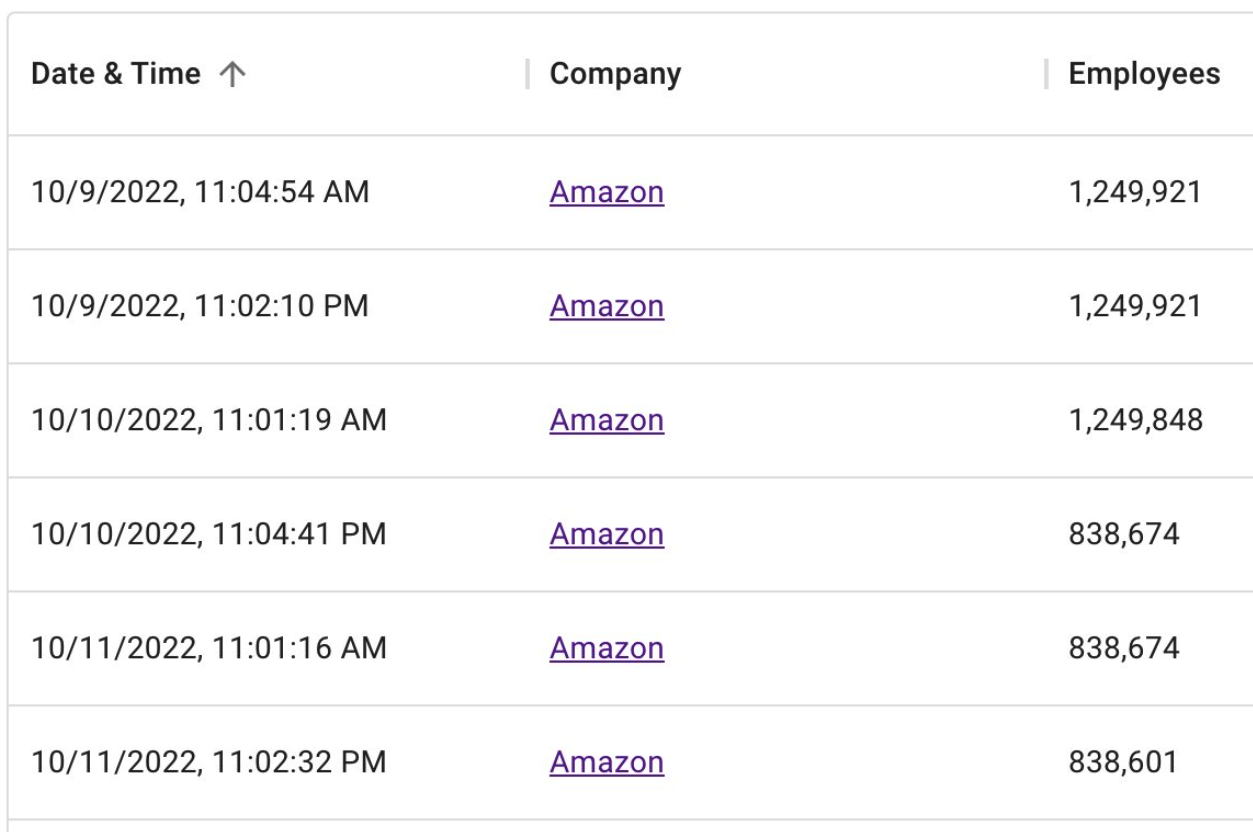
The number of LinkedIn profiles claiming current positions at Amazon fell 33 percent overnight. Image: twitter.com/jaypinho
As stated above, the number of LinkedIn profiles that claimed to work at Apple fell by approximately 50 percent on Oct. 10, according to Pinho’s analysis:
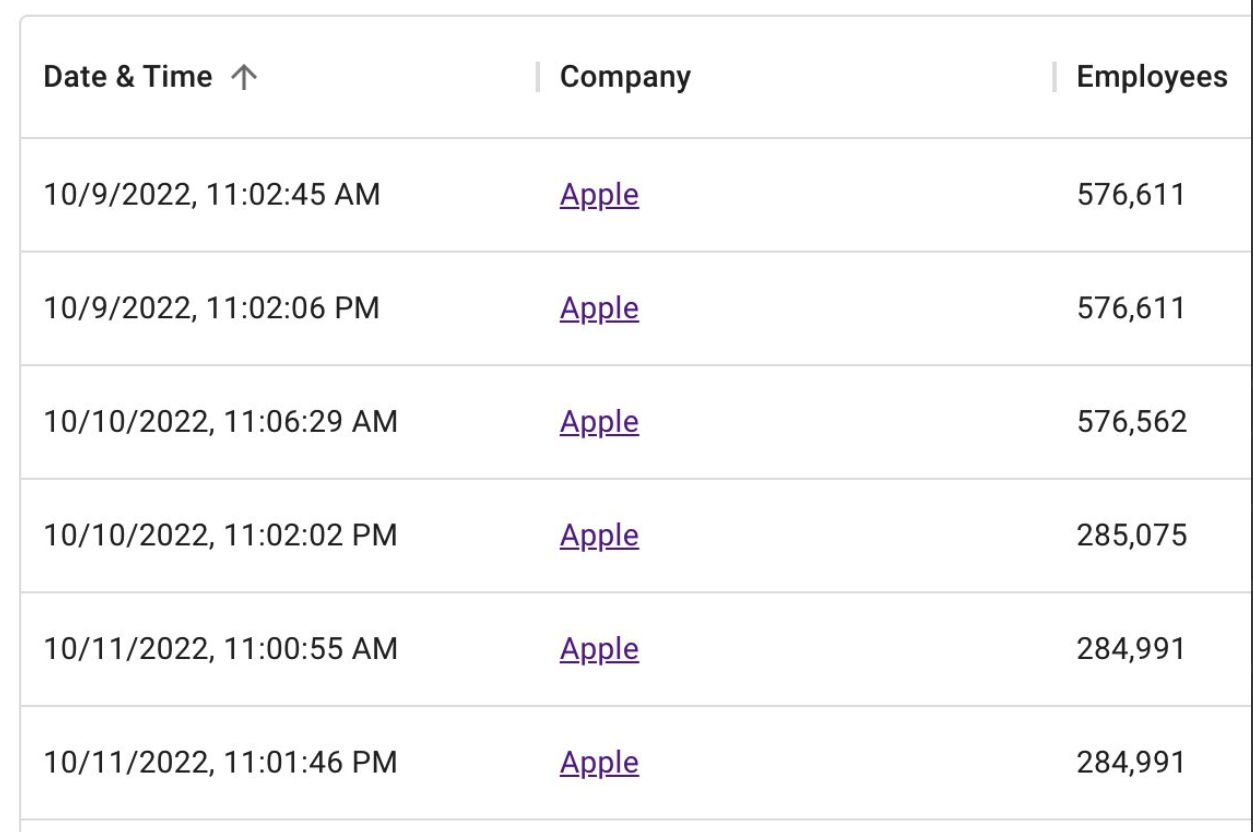
Image: twitter.com/jaypinho
Neither Amazon or Apple responded to requests for comment. LinkedIn declined to answer questions about the account purges, saying only that the company is constantly working to keep the platform free of fake accounts. In June, LinkedIn acknowledged it was seeing a rise in fraudulent activity happening on the platform.
KrebsOnSecurity hired Menlo Park, Calif.-based SignalHire to check Pinho’s numbers. SignalHire keeps track of active and former profiles on LinkedIn, and during the Oct 9-11 timeframe SignalHire said it saw somewhat smaller but still unprecedented drops in active profiles tied to Amazon and Apple.
“The drop in the percentage of 7-10 percent [of all profiles], as it happened [during] this time, is not something that happened before,” SignalHire’s Anastacia Brown told KrebsOnSecurity.
Brown said the normal daily variation in profile numbers for these companies is plus or minus one percent.
“That’s definitely the first huge drop that happened throughout the time we’ve collected the profiles,” she said.
In late September 2022, KrebsOnSecurity warned about the proliferation of fake LinkedIn profiles for Chief Information Security Officer (CISO) roles at some of the world’s largest corporations. A follow-up story on Oct. 5 showed how the phony profile problem has affected virtually all executive roles at corporations, and how these fake profiles are creating an identity crisis for the businesses networking site and the companies that rely on it to hire and screen prospective employees.
A day after that second story ran, KrebsOnSecurity heard from a recruiter who noticed the number of LinkedIn profiles that claimed virtually any role in network security had dropped seven percent overnight. LinkedIn declined to comment about that earlier account purge, saying only that, “We’re constantly working at taking down fake accounts.”
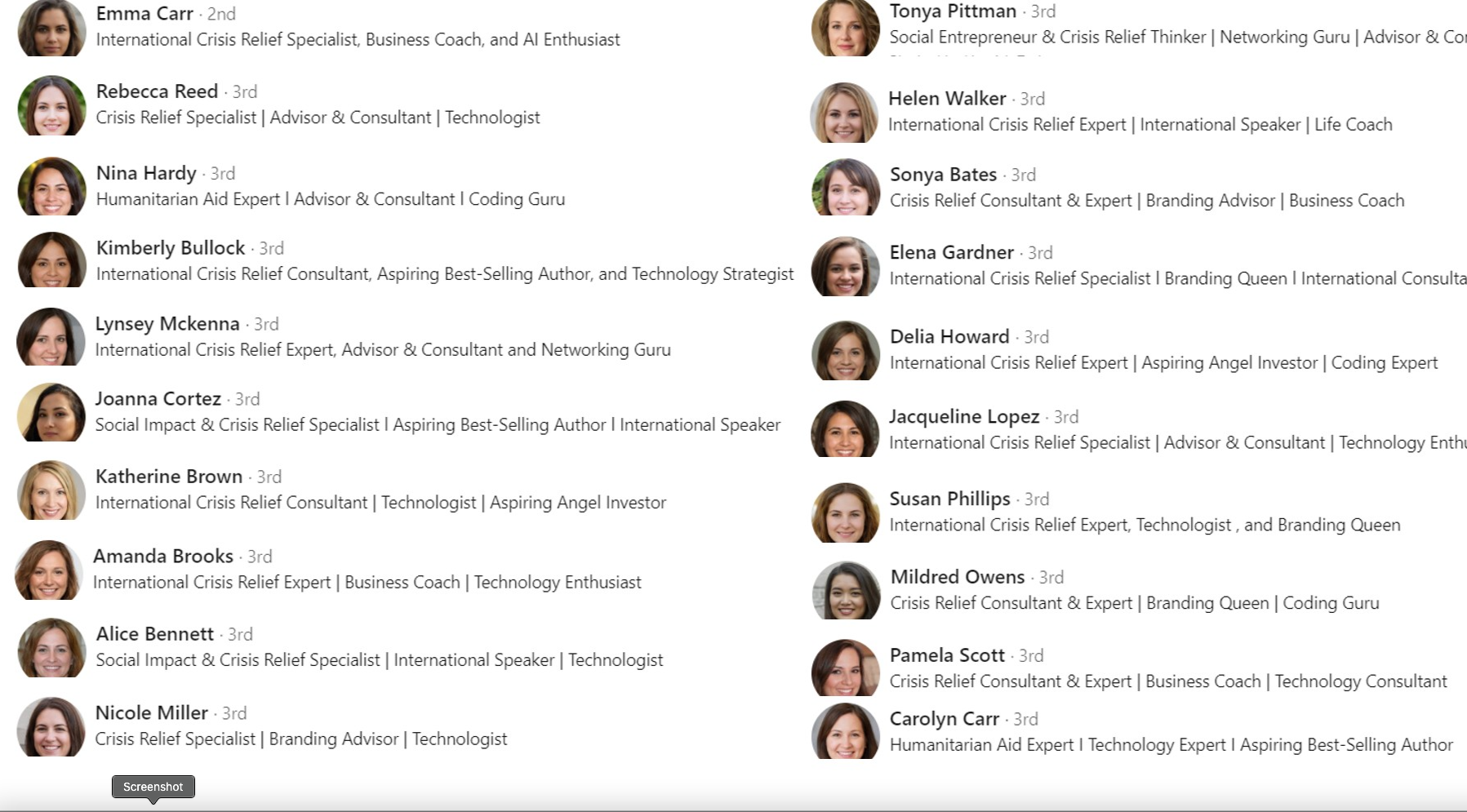
A “swarm” of LinkedIn AI-generated bot accounts flagged by a LinkedIn group administrator recently.
It’s unclear whether LinkedIn is responsible for this latest account purge, or if individually affected companies are starting to take action on their own. The timing, however, argues for the former, as the account purges for Apple and Amazon employees tracked by Pinho appeared to happen within the same 24 hour period. Continue reading
—————
Free Secure Email – Transcom Sigma
Boost Inflight Internet
Transcom Hosting
Transcom Premium Domains