Data samples contain email addresses, hashed passwords and user IDs, other PII
—————
Free Secure Email – Transcom Sigma
Boost Inflight Internet
Transcom Hosting
Transcom Premium Domains
—————
Free Secure Email – Transcom Sigma
Boost Inflight Internet
Transcom Hosting
Transcom Premium Domains
Depending on where you are when you download your Android apps, it might collect more or less data about you.
The apps we downloaded from Google Play also showed differences based on country in their security and privacy capabilities. One hundred twenty-seven apps varied in what the apps were allowed to access on users’ mobile phones, 49 of which had additional permissions deemed “dangerous” by Google. Apps in Bahrain, Tunisia and Canada requested the most additional dangerous permissions.
Three VPN apps enable clear text communication in some countries, which allows unauthorized access to users’ communications. One hundred and eighteen apps varied in the number of ad trackers included in an app in some countries, with the categories Games, Entertainment and Social, with Iran and Ukraine having the most increases in the number of ad trackers compared to the baseline number common to all countries.
One hundred and three apps have differences based on country in their privacy policies. Users in countries not covered by data protection regulations, such as GDPR in the EU and the California Consumer Privacy Act in the U.S., are at higher privacy risk. For instance, 71 apps available from Google Play have clauses to comply with GDPR only in the EU and CCPA only in the U.S. Twenty-eight apps that use dangerous permissions make no mention of it, despite Google’s policy requiring them to do so.
Research paper: “A Large-scale Investigation into Geodifferences in Mobile Apps“:
Abstract: Recent studies on the web ecosystem have been raising alarms on the increasing geodifferences in access to Internet content and services due to Internet censorship and geoblocking. However, geodifferences in the mobile app ecosystem have received limited attention, even though apps are central to how mobile users communicate and consume Internet content. We present the first large-scale measurement study of geodifferences in the mobile app ecosystem. We design a semi-automatic, parallel measurement testbed that we use to collect 5,684 popular apps from Google Play in 26 countries. In all, we collected 117,233 apk files and 112,607 privacy policies for those apps. Our results show high amounts of geoblocking with 3,672 apps geoblocked in at least one of our countries. While our data corroborates anecdotal evidence of takedowns due to government requests, unlike common perception, we find that blocking by developers is significantly higher than takedowns in all our countries, and has the most influence on geoblocking in the mobile app ecosystem. We also find instances of developers releasing different app versions to different countries, some with weaker security settings or privacy disclosures that expose users to higher security and privacy risks. We provide recommendations for app market proprietors to address the issues discovered.
—————
Free Secure Email – Transcom Sigma
Boost Inflight Internet
Transcom Hosting
Transcom Premium Domains
Optus, one of Australia’s largest telecommunications carriers, reported news of a data breach that may have compromised the information of current and former customers.
As of this writing, the company has not stated how many customers may have been affected, citing their ongoing investigation in conjunction with law enforcement and Australian government officials
According to Optus, the breach may have included the following:
“Information which may have been exposed includes customers’ names, dates of birth, phone numbers, email addresses, and, for a subset of customers, addresses, ID document numbers such as driver’s license or passport numbers. Payment detail and account passwords have not been compromised.”
Optus is currently notifying customers who may have been affected by this breach with SMS and email messages. However, the company makes an important distinction here:
“We are not sending links in SMS or emails. If customers receive an email or SMS with a link claiming to be from Optus, they are advised that this is not a communication from Optus. Please do not click on any links.”
Often in the wake of such breaches, cybercriminals will send out phony communications that use the name of the company affected. These can include phishing attacks over email and SMS that solicit personal and account information or other tactics that attempt to capitalize on the announced breach.
Optus continues to keep its customers up to date on the latest developments on its website, which includes a comprehensive FAQ that details what happened, what steps are being taken, and what customers can do in the wake of this announcement.
Any time a data breach occurs, your exposed personal information may be used by those trying to commit identity fraud or theft. Different pieces of personal information can be more useful to them than others.
Some information is directly useful, such as a driver’s license or credit card information because they identify you right away. Others are indirectly helpful, like device IDs, browsing history, geolocation information, and internet protocol addresses. While they don’t identify you on their own, a cybercriminal could piece together your identity if they have enough indirect information about you.
In light of this, there are a few steps you can take to protect yourself in the aftermath of a data breach, which involve a combination of preventative steps and some monitoring on your part.
If you become the victim of fraud or theft after a data breach, a licensed recovery pro can help you restore your credit and identity. If you’ve ever dealt with fraud or theft before, or know someone who has, recovery can be a time-consuming and stressful process if you undertake it alone. With McAfee+ Advanced, you have around-the-clock support from a restoration expert with limited power of attorney who can take the steps that can help restore your credit and identity.
Working with an expert can lend you extra peace of mind, particularly in a time where there’s plenty of uncertainty. First, you’ll know that a professional is working on your case—a person who knows exactly where to start and what needs to happen for the best possible outcome. Second, you’ll get precious time back, time you’d otherwise have to spend if you took on the process yourself.
As mentioned above, with some personal information in hand, cybercriminals may seek out more. They may follow up a breach with rounds of phishing attacks that direct you to bogus sites designed to steal your personal information—either by tricking you into providing it or by stealing it without your knowledge. So, it’s always wise to keep a skeptical eye open for unsolicited messages or phone calls that ask you for information in some form or other, often in ways that urge or pressure you into acting.
An identity monitoring service can monitor your information from email addresses to IDs and phone numbers for signs of breaches so you can take action to secure your accounts before they’re used for identity theft. Personal information harvested from data breaches can end up on dark web marketplaces where it’s bought by other cybercriminals so they can launch their own attacks. McAfee monitors the dark web for your personal info and provides early alerts if your data is found, an average of 10 months ahead of similar services. We also provide guidance to help you act if your information is found.
While it does not appear that login information was affected, a password update is still a strong security move. Strong and unique passwords are best, which means never reusing your passwords across different sites and platforms. Using a password manager will help you keep on top of it all, while also storing your passwords securely. Moreover, changing your passwords regularly may make a stolen password worthless because it’s out of date.
While a strong and unique password is a good first line of defense, enabling two-factor authentication across your accounts will help your cause by providing an added layer of security. It’s increasingly common to see nowadays where banks and all manner of online services will only allow access to your accounts after you’ve provided a one-time passcode sent to your email or smartphone. If your accounts support two-factor authentication, enable it.
Mentioned earlier, information stolen in a data breach may indirectly identify you. Yet when pieced together with other information, it can then directly identify you. One way cybercriminals complete this identity picture puzzle is with information provided by data brokers that buy and sell personal information online. However, you can take some control over this. Our Personal Data Cleanup service scans high-risk data broker sites for your personal information and then helps you remove it—which denies cybercriminals the information they may need to commit identity theft.
When personal information gets released, there’s a chance that a hacker, scammer, or thief will put it to use. This may include committing fraud, where they draw funds from existing accounts, and theft, where they create new accounts in a victim’s name.
Even though it’s believed that no payment information was involved in this breach, customers should still take steps to monitor their statements and their overall credit report so that they can spot and address any unusual activity. Optus has announced that it will offer affected customers 12 months of credit and identity monitoring through Equifax, one of the major global credit agencies, at no cost.
Another step that customers can take is to place a credit freeze on their credit reports with the major credit agencies in Australia— Equifax, illion, and Experian. This will help prevent cybercriminals from opening new lines of credit or taking out loans in a victim’s name by “freezing” their credit report so that potential creditors cannot pull it for reference. Terms of freezing a credit report will vary, so check with each agency for details.
A complete suite of online protection software can offer layers of extra security for future protection. In addition to more private and secure time online with a VPN, identity monitoring, and password management, protection like McAfee+ Advanced includes web browser protection that can block malicious and suspicious links that could lead you down the road to malware or a phishing scam—which antivirus protection can’t do alone.
Per Optus, a subset of those affected may have had their driver’s license and/or passport ID number affected by the breach. Given that license and passport ID numbers are such unique pieces of personally identifiable information, anyone notified by Optus that theirs may have been affected should strongly consider changing them.
The process for replacing either document will vary depending on your state or territory. Given the scope of the attack, some states and territories have proposed making exceptions to the rules for attack victims. As of this writing, that picture continues to evolve, so look to your local government for guidance.
Not all data breaches make the news. Businesses and organizations, large and small, have all fallen victim to them, and with regularity. The measures you can take here are measures you can take even if you don’t believe you were caught up in the Optus breach. As you can see, several of them are preventative, which is important because word of data breaches tend to reach customers days, weeks, or even months after they’ve been discovered—leaving cybercriminals plenty of opportunity to commit all kinds of identity crime in the meantime.
In this case, the breach certainly made the news due to its apparent size and scale. And as Optus works with law enforcement and government officials, more details into the attack and who has been affected will arise.
However, you have every reason to act now rather than wait for additional news. Staying on top of our credit and identity has always been important, but given all the devices, apps, and accounts we keep these days leaves us more exposed than ever, making protecting ourselves a must.
The post The Optus Data Breach – Steps You Can Take to Protect Yourself appeared first on McAfee Blog.
—————
Free Secure Email – Transcom Sigma
Boost Inflight Internet
Transcom Hosting
Transcom Premium Domains
Someone has recently created a large number of fake LinkedIn profiles for Chief Information Security Officer (CISO) roles at some of the world’s largest corporations. It’s not clear who’s behind this network of fake CISOs or what their intentions may be. But the fabricated LinkedIn identities are confusing search engine results for CISO roles at major companies, and they are being indexed as gospel by various downstream data-scraping sources.
If one searches LinkedIn for the CISO of the energy giant Chevron, one might find the profile for a Victor Sites, who says he’s from Westerville, Ohio and is a graduate of Texas A&M University.
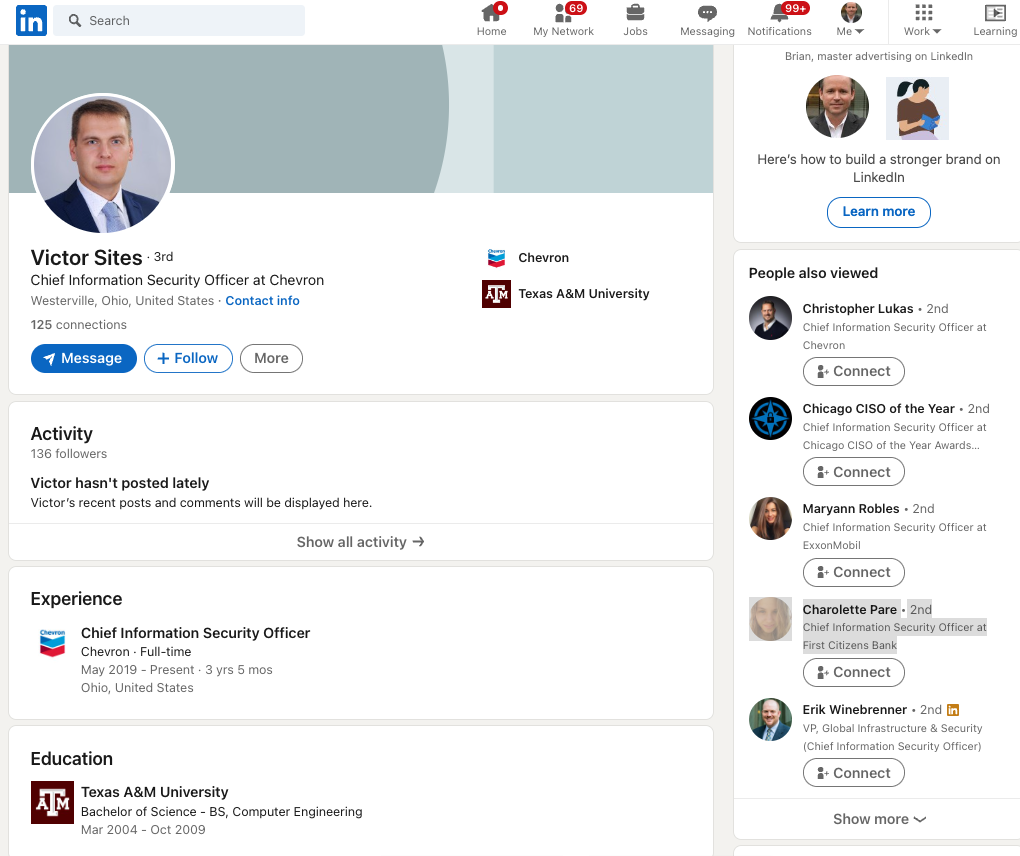
The LinkedIn profile for Victor Sites, who is most certainly NOT the CISO of Chevron.
Of course, Sites is not the real CISO of Chevron. That role is currently occupied by Christopher Lukas of Danville, Calif. If you were confused at this point, you might ask Google who it thinks is the current Chief Information Security Officer of Chevron. When KrebsOnSecurity did that earlier this morning, the fake CISO profile was the very first search result returned (followed by the LinkedIn profile for the real Chevron CISO).
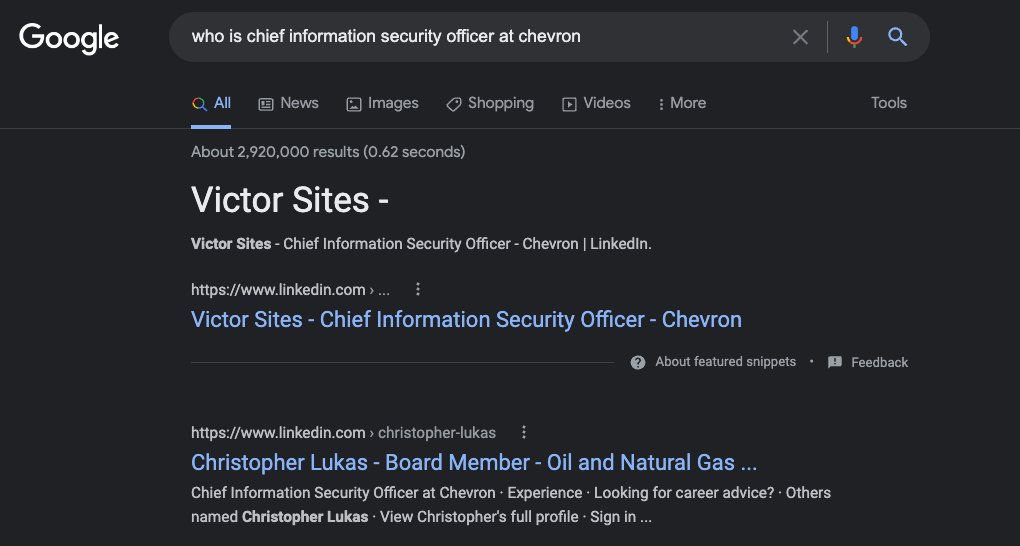
Helpfully, LinkedIn seems to be able to detect something in common about all these fake CISO profiles, because it suggested I view a number of them in the “People Also Viewed” column seen in the image above. There are two fake CISO profiles suggested there, including one for a Maryann Robles, who claims to be the CISO of another energy giant — ExxonMobil.
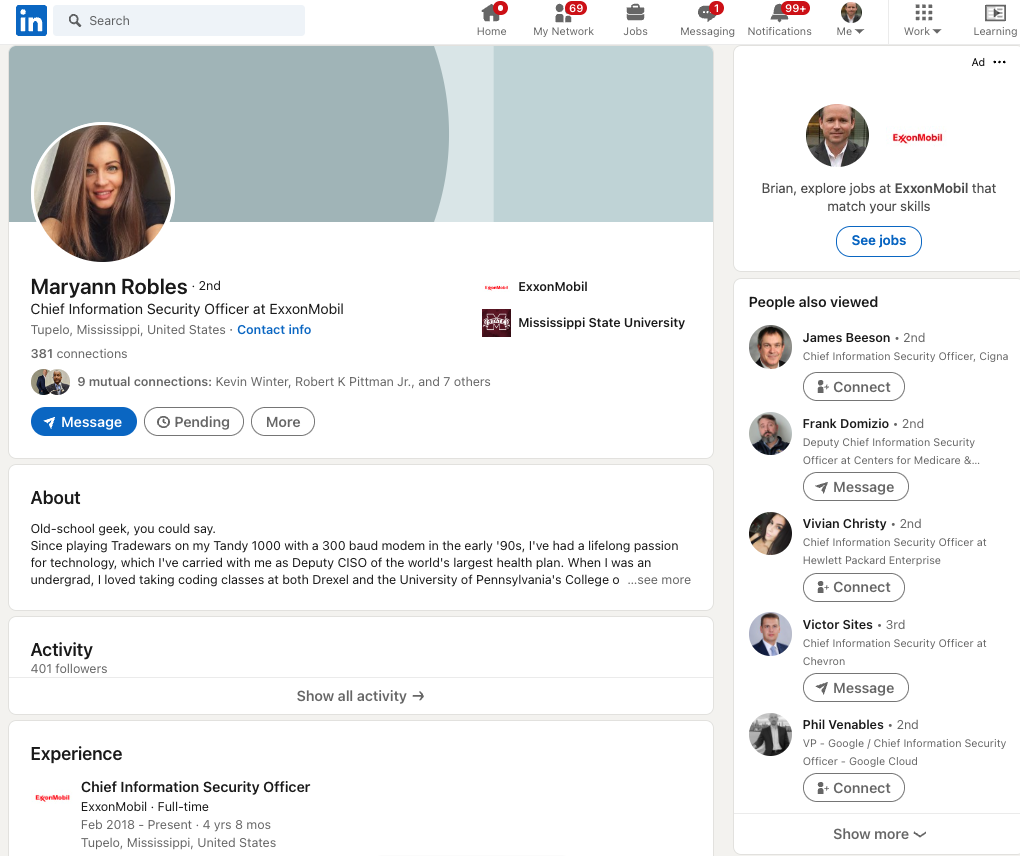
Maryann’s profile says she’s from Tupelo, Miss., and includes this detail about how she became a self-described “old-school geek.”
“Since playing Tradewars on my Tandy 1000 with a 300 baud modem in the early ’90s, I’ve had a lifelong passion for technology, which I’ve carried with me as Deputy CISO of the world’s largest health plan,” her profile reads.
However, this description appears to have been lifted from the profile for the real CISO at the Centers for Medicare & Medicaid Services in Baltimore, Md.
Interestingly, Maryann’s LinkedIn profile was accepted as truth by Cybercrime Magazine’s CISO 500 listing, which claims to maintain a list of the current CISOs at America’s largest companies:
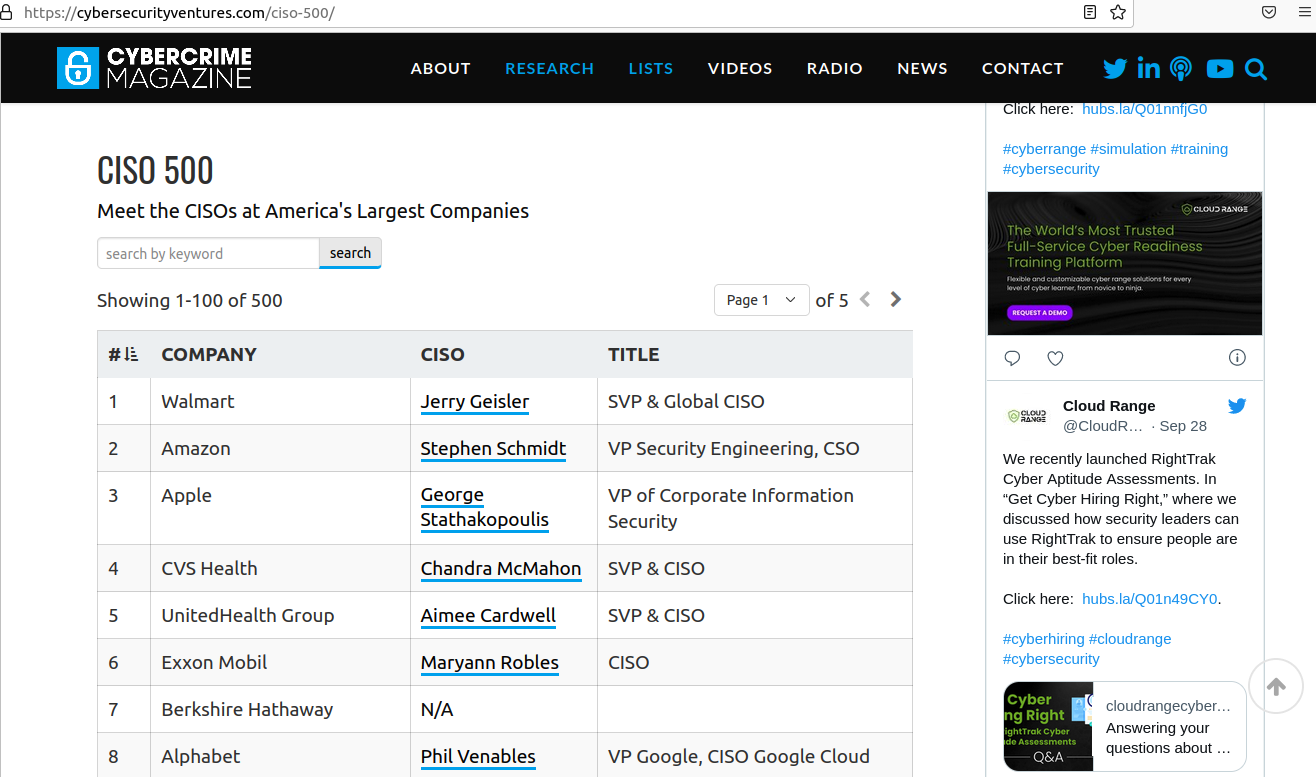
The fake CISO for ExxOnMobil was indexed in Cybercrime Magazine’s CISO 500.
Rich Mason, the former CISO at Fortune 500 firm Honeywell, began warning his colleagues on LinkedIn about the phony profiles earlier this week.
“It’s interesting the downstream sources that repeat LinkedIn bogus content as truth,” Mason said. “This is dangerous, Apollo.io, Signalhire, and Cybersecurity Ventures.”
Google wasn’t fooled by the phony LinkedIn profile for Jennie Biller, who claims to be CISO at biotechnology giant Biogen (the real Biogen CISO is Russell Koste). But Biller’s profile is worth mentioning because it shows how some of these phony profiles appear to be quite hastily assembled. Case in point: Biller’s name and profile photo suggest she is female, however the “About” description of her accomplishments uses male pronouns. Also, it might help that Jennie only has 18 connections on LinkedIn.
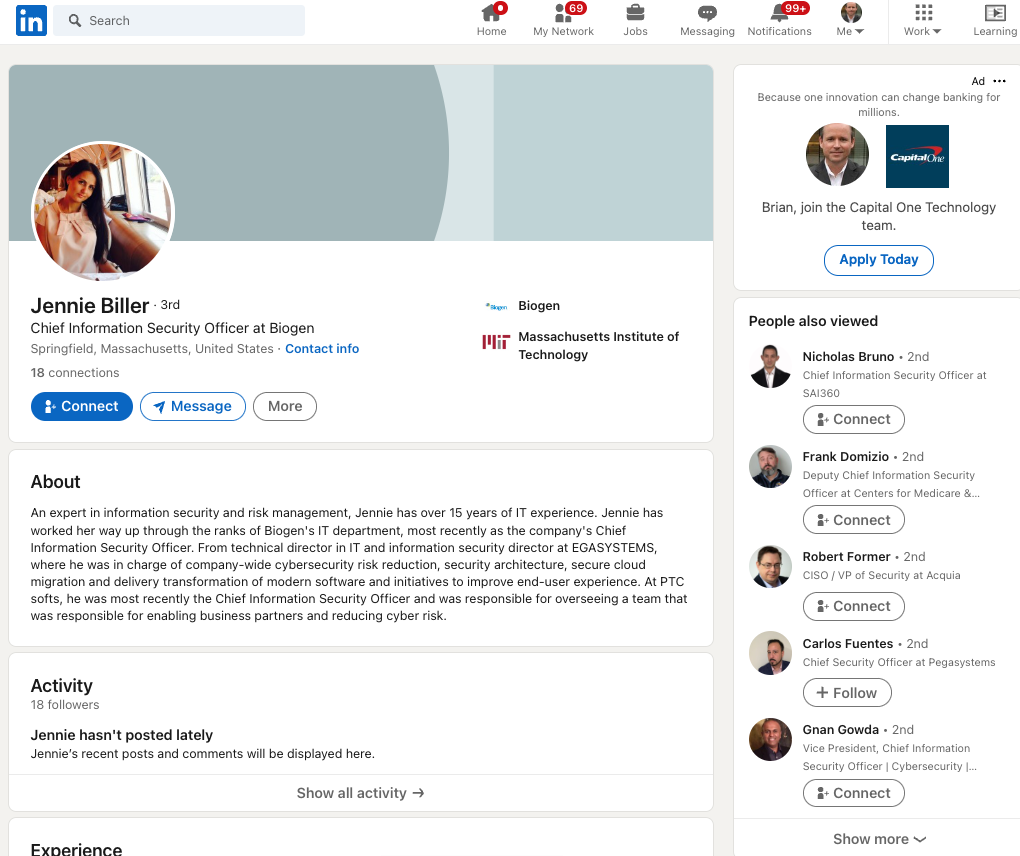
Again, we don’t know much about who or what is behind these profiles, but in August the security firm Mandiant (recently acquired by Google) told Bloomberg that hackers working for the North Korean government have been copying resumes and profiles from leading job listing platforms LinkedIn and Indeed, as part of an elaborate scheme to land jobs at cryptocurrency firms.
None of the profiles listed here responded to requests for comment (or to become a connection).
In a statement provided to KrebsOnSecurity, LinkedIn said its teams were actively working to take these fake accounts down.
“We do have strong human and automated systems in place, and we’re continually improving, as fake account activity becomes more sophisticated,” the statement reads. “In our transparency report we share how our teams plus automated systems are stopping the vast majority of fraudulent activity we detect in our community – around 96% of fake accounts and around 99.1% of spam and scam.”
LinkedIn could take one simple step that would make it far easier for people to make informed decisions about whether to trust a given profile: Add a “created on” date for every profile. Twitter does this, and it’s enormously helpful for filtering out a great deal of noise and unwanted communications.
The former CISO Mason said LinkedIn also could experiment with offering something akin to Twitter’s verified mark to users who chose to validate that they can respond to email at the domain associated with their stated current employer.
“If I saw that a LinkedIn profile had been domain-validated, then my confidence in that profile would go way up,” Mason said, noting that many of the fake profiles had hundreds of followers, including dozens of real CISOs. Maryann’s profile grew by a hundred connections in just the past few days, he said.
“If we have CISOs that are falling for this, what hopes do the masses have?” Mason said.
Mason said LinkedIn also needs a more streamlined process for allowing employers to remove phony employee accounts. He recently tried to get a phony profile removed from LinkedIn for someone who falsely claimed to have worked for his company.
“I shot a note to LinkedIn and said please remove this, and they said, well, we have to contact that person and arbitrate this,” he said. “They gave the guy two weeks and he didn’t respond, so they took it down. But that doesn’t scale, and there needs to be a mechanism where an employer can contact LinkedIn and have these fake profiles taken down in less than two weeks.”
—————
Free Secure Email – Transcom Sigma
Boost Inflight Internet
Transcom Hosting
Transcom Premium Domains
—————
Free Secure Email – Transcom Sigma
Boost Inflight Internet
Transcom Hosting
Transcom Premium Domains
—————
Free Secure Email – Transcom Sigma
Boost Inflight Internet
Transcom Hosting
Transcom Premium Domains
—————
Free Secure Email – Transcom Sigma
Boost Inflight Internet
Transcom Hosting
Transcom Premium Domains
—————
Free Secure Email – Transcom Sigma
Boost Inflight Internet
Transcom Hosting
Transcom Premium Domains
—————
Free Secure Email – Transcom Sigma
Boost Inflight Internet
Transcom Hosting
Transcom Premium Domains
—————
Free Secure Email – Transcom Sigma
Boost Inflight Internet
Transcom Hosting
Transcom Premium Domains