Introducing Personal Data Cleanup

We’re excited to announce the release of McAfee’s Personal Data Cleanup, a new feature that finds and removes your personal info from data brokers and people search sites. Now, you can feel more confident by removing personal info from data broker sites and keeping it from being collected, sold, and used to: advertise products to you, fill your email box with spam, and can even give criminals the info they need to steal your identity. Let’s look at why we’re offering Personal Data Cleanup, how it protects your privacy, and why it’s a great addition to the online protection we already offer. 

Does the cost of a connected life have to be your privacy?

There’s so much to enjoy when you live a connected life – free email, online stores that remember what you like, social media that connects you to friends and influencers. It’s a world of convenience, opportunity, and incredible content. It’s also a world where your data is constantly collected.  

“Wait. Did you say my data?” 

That’s right, companies are collecting your personal data. They’re called data brokers and they make money by selling information that specifically identifies you, like an email address. They sell this information to marketers looking to target you with ads. Criminals can also use it to build profiles in service of stealing your identity and accessing your accounts. This activity takes place behind the scenes and often without consumers’ knowledge.  There are also data brokers known as people search sites that compile and sell info like home addresses, emails, phones, court records, employment info, and more. These websites give identity thieves, hackers, stalkers, and other malicious actors easy access to your info. Regardless of how your data is being used, it’s clear that these days a more connected life often comes at the cost of your privacy.  

Consumers are clamoring for more privacy online 

In a recent survey of McAfee customers, we found that 59% have become more protective of their personal data over the past six months. And it’s no wonder. Over the past two years, trends like telehealth, remote working, and increased usage of online shopping and financial services have meant that more of your time is being spent online. Unsurprisingly, more personal data is being made available in the process. This leads us to the most alarming finding of our survey – 95% of consumers whose personal information ends up on data broker sites had it collected without their consent.  

Free to enjoy privacy online with McAfee’s Personal Data Cleanup 

We created Personal Data Cleanup to make it easy for you to take back your privacy online. McAfee’s Personal Data Cleanup regularly scans the riskiest data broker sites for info like your home address, date of birth, and names of relatives. After showing where we found your data, you can either remove it yourself or we will work on your behalf to remove it. Here’s how it works: 

  • Set upInput your name, date of birth, and home address. 
  • Scan  We scan this against some of the riskiest data broker sites. 
  • ReviewWithin minutes, we’ll show you where we found your personal info, and what info the sites have. 
  • Remove You can manually go to each site and request that your data be removed OR upgrade to have McAfee manage the removal process on your behalf. 
  • Ongoing Your info can reappear as data brokers continually collect data. To ensure ongoing protection, Personal Data Cleanup enables regular scanning so it can be removed. 

Start using McAfee’s Personal Data Cleanup right now 

Ready to take back your personal info online? Personal Data Cleanup is available immediately with most of our online protection plans. If you have an eligible subscription, you can start using this new feature through McAfee Protection Center, or you can get McAfee online protection here.

The post Introducing Personal Data Cleanup appeared first on McAfee Blog.

—————
Free Secure Email – Transcom Sigma
Boost Inflight Internet
Transcom Hosting
Transcom Premium Domains
You Can Now Ask Google to Remove Your Phone Number, Email or Address from Search Results

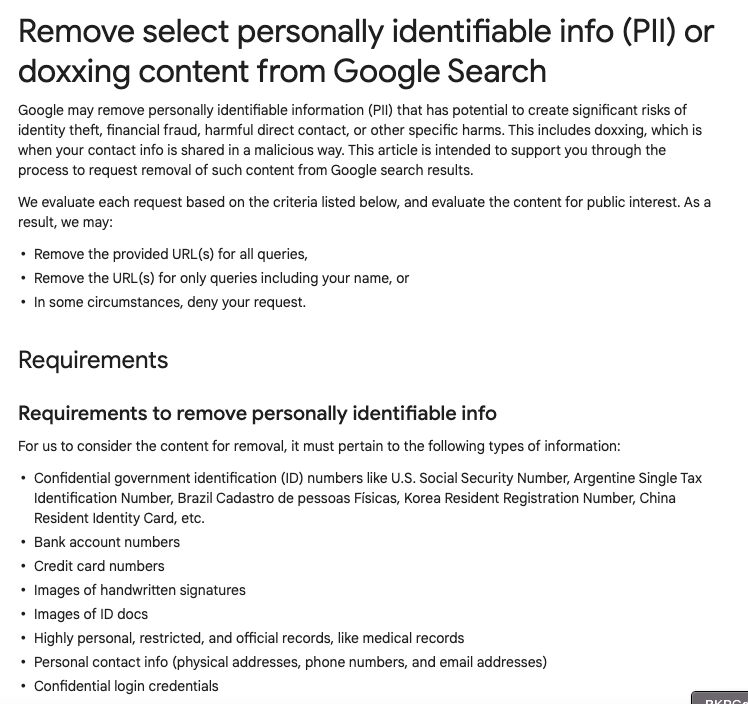
Google said this week it is expanding the types of data people can ask to have removed from search results, to include personal contact information like your phone number, email address or physical address. The move comes just months after Google rolled out a new policy enabling people under the age of 18 (or a parent/guardian) to request removal of their images from Google search results.

Google has for years accepted requests to remove certain sensitive data such as bank account or credit card numbers from search results. In a blog post on Wednesday, Google’s Michelle Chang wrote that the company’s expanded policy now allows for the removal of additional information that may pose a risk for identity theft, such as confidential log-in credentials, email addresses and phone numbers when it appears in Search results.

“When we receive removal requests, we will evaluate all content on the web page to ensure that we’re not limiting the availability of other information that is broadly useful, for instance in news articles,” Chang wrote. “We’ll also evaluate if the content appears as part of the public record on the sites of government or official sources. In such cases, we won’t make removals.”

While Google’s removal of a search result from its index will do nothing to remove the offending content from the site that is hosting it, getting a link decoupled from Google search results is going to make the content at that link far less visible. According to recent estimates, Google enjoys somewhere near 90 percent market share in search engine usage.

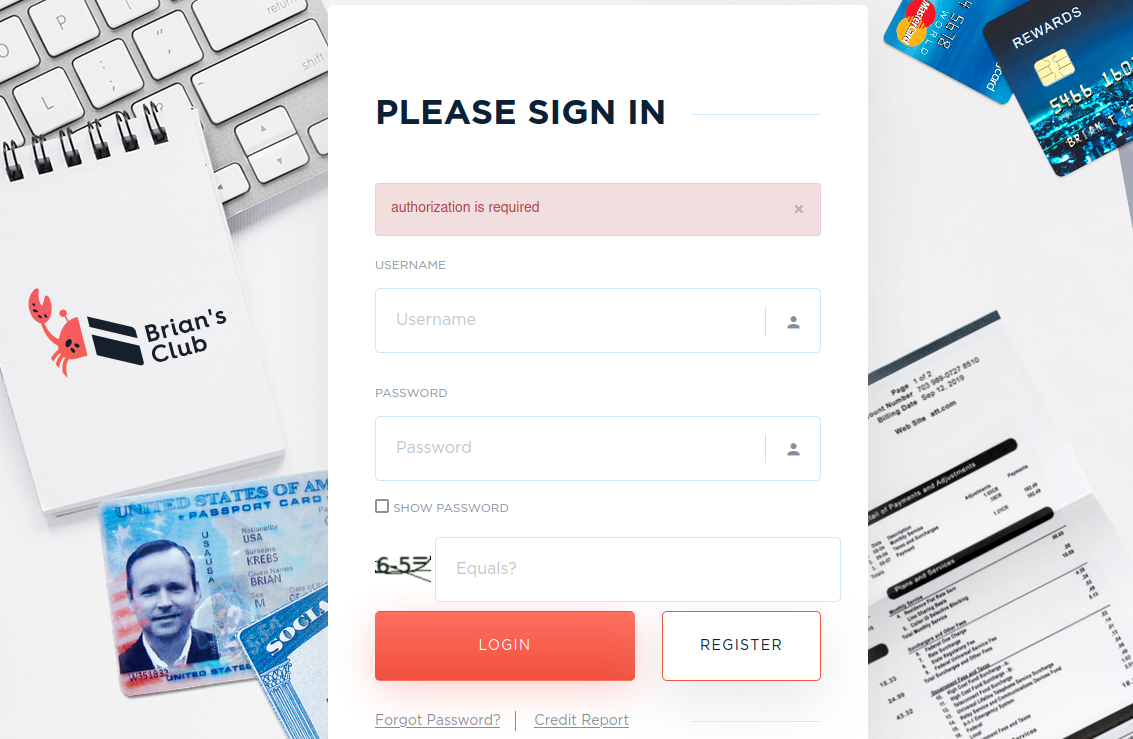
KrebsOnSecurity decided to test this expanded policy with what would appear to be a no-brainer request: I asked Google to remove search result for BriansClub, one of the largest (if not THE largest) cybercrime stores for selling stolen payment card data.

BriansClub has long abused my name and likeness to pimp its wares on the hacking forums. Its homepage includes a copy of my credit report, Social Security card, phone bill, and a fake but otherwise official looking government ID card.

The login page for perhaps the most bustling cybercrime store for stolen payment card data.

Briansclub updated its homepage with this information in 2019, after it got massively hacked and a copy of its customer database was shared with this author. The leaked data — which included 26 million credit and debit card records taken from hacked online and brick-and-mortar retailers — was ultimately shared with dozens of financial institutions.

TechCrunch writes that the policy expansion comes six months after Google started allowing people under 18 or their parents request to delete their photos from search results. To do so, users need to specify that they want Google to remove “Imagery of an individual currently under the age of 18” and provide some personal information, the image URLs and search queries that would surface the results. Google also lets you submit requests to remove non-consensual explicit or intimate personal images from Google, along with involuntary fake pornography, TechCrunch notes.

This post will be updated in the event Google responds one way or the other, but that may take a while: Google’s automated response said: “Due to the preventative measures being taken for our support specialists in light of COVID-19, it may take longer than usual to respond to your support request. We apologize for any inconvenience this may cause, and we’ll send you a reply as soon as we can.”

Update: 10:30 p.m. ET: An earlier version of this story incorrectly stated that people needed to show explicit or implicit threats regarding requests to remove information like one’s phone number, address or email address from a search result. A spokesperson for Google said “there is no requirement that we find the content to be harmful or shared in a malicious way.”

—————
Free Secure Email – Transcom Sigma
Boost Inflight Internet
Transcom Hosting
Transcom Premium Domains