—————
Free Secure Email – Transcom Sigma
Boost Inflight Internet
Transcom Hosting
Transcom Premium Domains
Author: admin
Crime Shop Sells Hacked Logins to Other Crime Shops
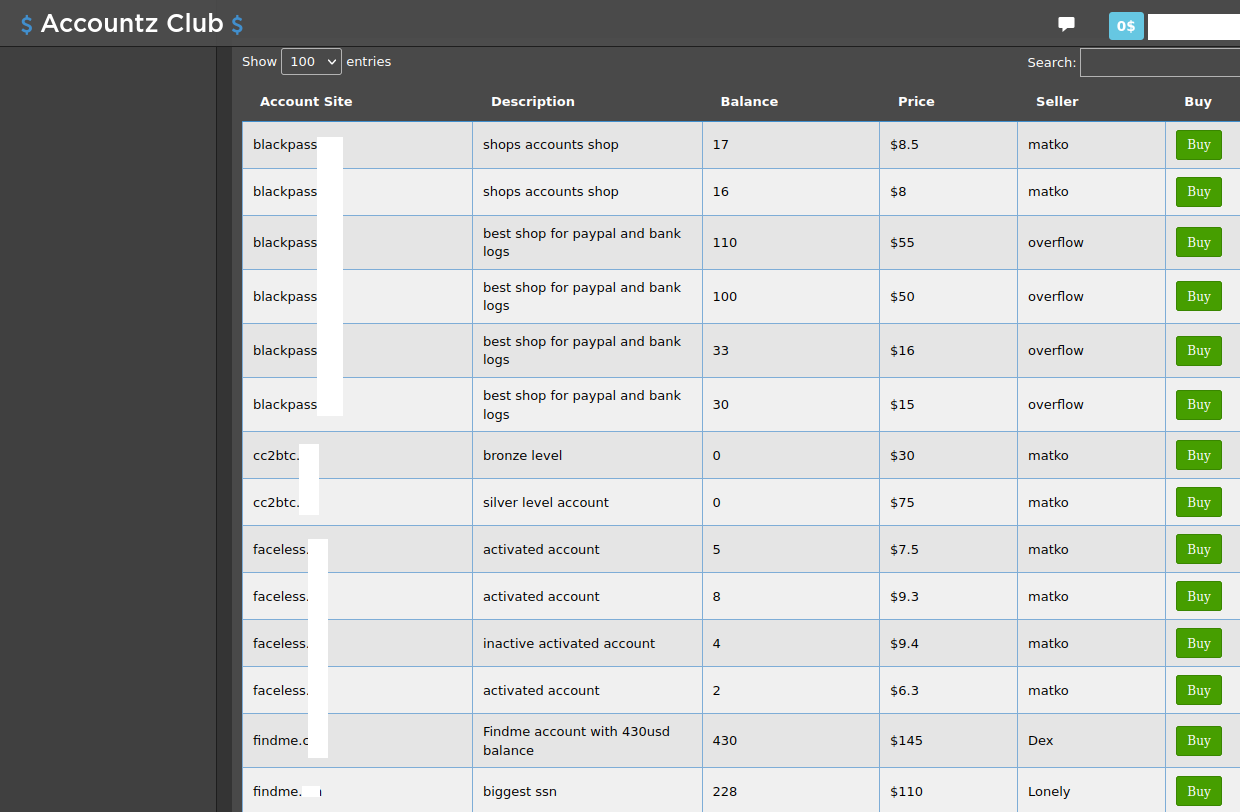
Up for the “Most Meta Cybercrime Offering” award this year is Accountz Club, a new cybercrime store that sells access to purloined accounts at services built for cybercriminals, including shops peddling stolen payment cards and identities, spamming tools, email and phone bombing services, and those selling authentication cookies for a slew of popular websites.
Criminals ripping off other crooks is a constant theme in the cybercrime underworld; Accountz Club’s slogan — “the best autoshop for your favorite shops’ accounts” — just normalizes this activity by making logins stolen from users of various cybercrime shops for sale at a fraction of their account balances.
The site says it sells “cracked” accounts, or those that used passwords which could be easily guessed or enumerated by automated tools. All of the credentials being sold by Accountz provide access to services that in turn sell access to stolen information or hijacked property, as in the case of “bot shops” that resell access to infected computers.
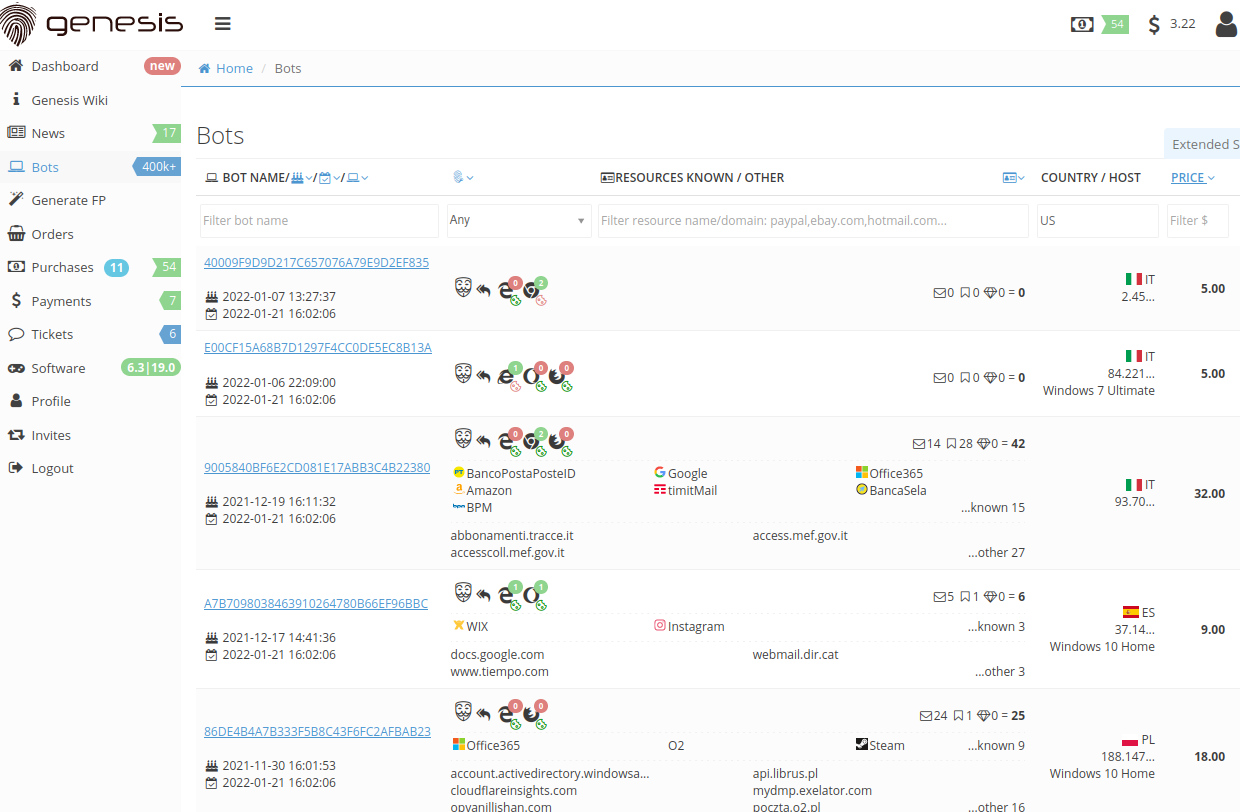
One example is Genesis Market, where customers can search for stolen credentials and authentication cookies from a broad range of popular online destinations. Genesis even offers a custom-made web browser where you can load authentication cookies from botted PCs and waltz right into the account without having to enter a username or password or mess with multi-factor authentication.
Accountz is currently selling four different Genesis logins for about 40-50 percent of their unspent balances. Genesis mostly gets its inventory of botted computers and stolen logins from resellers who specialize in deploying infostealer malware via email and booby-trapped websites. Likewise, it appears Accountz also derives much of its stock from a handful of resellers, who presumably are the same ones doing the cybercrime service account cracking.
In essence, Accountz customers are paying for illicit access to cybercrime services that sell access to compromised resources that can be abused for cybercrime. That’s seriously meta.
Accountz says its inventory is low right now but that it expects to offer a great deal more stock in the coming days. I don’t doubt that’s true, and it’s somewhat remarkable that services like this aren’t more common: From reporting my “Breadcrumbs” series on prominent cybercrime actors, it’s clear that a great many cybercriminals will use the same username and password across multiple services online.
What’s more, relatively few cybercrime shops online offer their users any sort of multi-factor authentication. That’s probably because so few customers supply their real contact information when they sign up. As a result, it is often far easier for customers to simply create a new account than it is to regain control over a hacked one, or to change a forgotten password. On top of that, most shops have only rudimentary tools for blocking automated login attempts and password cracking activity.
It will be interesting to see whether any of the cybercrime shops most heavily represented in the logins for sale at Accountz start to push back. After all, draining customer account balances and locking out users is likely to increase customer support costs for these shops, lower customer satisfaction, and perhaps even damage their reputations on the crime forums where they peddle their wares.
Oh, the horror.
—————
Free Secure Email – Transcom Sigma
Boost Inflight Internet
Transcom Hosting
Transcom Premium Domains
Biden Signs Memo to Boost National Cybersecurity

United States President Joe Biden has signed a National Security Memorandum (NSM) requiring national security systems to implement network cybersecurity measures that are at least as good as those required of federal civilian networks.
The requirements for federal civilian networks were laid out in Biden’s Executive Order 14028 (EO 14028) issued May 12 2021. The new memo, signed Wednesday, specifies how the provisions of EO 14028 apply to national security systems.
The NSM establishes timelines and guidance for how cybersecurity requirements, including multi-factor authentication, encryption, cloud technologies and endpoint detection services, will be implemented.
It also requires agencies to identify their national security systems and report cyber incidents that occur on them to the National Security Agency (NSA).
Commenting on this particular requirement of the NSM, Mark Manglicmot, vice president of security services at Arctic Wolf, said: “To defend something, you need to have an asset inventory to know what your most critical systems and data are. This directive mandates this best practice.”
The NSM further authorizes the NSA to create Binding Operational Directives that require agencies to take specific actions against known or suspected cyber-threats and vulnerabilities. In addition, it requires the NSA and the Department of Homeland Security to share BODs and “learn from each other to determine if any of the requirements from one agency’s directive should be adopted by the other.”
Under the new memo, agencies are required to secure tools known as cross-domain solutions that transfer data between classified and unclassified systems.
In a statement released Wednesday, the White House said: Modernizing our cybersecurity defenses and protecting all federal networks is a priority for the Biden Administration, and this National Security Memorandum raises the bar for the cybersecurity of our most sensitive systems.”
James McQuiggan, security awareness advocate at KnowBe4, noted that the memo omitted any requirements around cybersecurity education or creating a security culture among users.
He said: “When users can spot social engineering attacks, have the necessary training to work in Network or Security Operations Centers and understand the importance of developing secure code, it can strengthen the resiliency of the organization or government systems and significantly reduce the risk of a cyber-attack.”
—————
Free Secure Email – Transcom Sigma
Boost Inflight Internet
Transcom Hosting
Transcom Premium Domains
11:11 Systems Acquires iland

Managed infrastructure solutions company, 11:11 Systems, has acquired Texas-based cloud services provider, iland.
The completion of the acquisition was announced on Thursday. The terms of the deal were not disclosed.
Headquartered in Houston with regional offices in London and Sydney, iland delivers cloud services including Disaster-Recovery-as-a-Service (DRaaS), Infrastructure-as-a-Service (IaaS) and Backup-as-a-Service (BaaS) from its cloud regions throughout North America, Europe, Australia and Asia.
11:11 Systems said it intends to leverage iland’s award-winning Secure Cloud Console, which natively combines deep layered security, predictive analytics and compliance to deliver visibility and easy management for iland’s cloud services.
The deal follows 11:11 Systems’ recent acquisition of Green Cloud Defense, a channel-only, cloud Infrastructure-as-a-Service (IaaS) provider.
“By adding iland’s steady 25% YOY momentum to 11:11 Systems’ expanding national network of MSPs, VARs and IT consultants, a hyper-growth pathway has been created,” said 11:11 Systems in a statement.
Brett Diamond, CEO of 11:11 Systems, said his company’s recent acquisitions were motivated by making cybersecurity more straightforward for its customers.
“CIOs and IT leaders are being pushed to address increasing numbers of security threats, application vulnerabilities and network weaknesses that can leave organizations exposed to data breaches; at the same time, they are tasked with laying the right foundation within their infrastructure to embrace hybrid cloud, navigate sophisticated application requirements, artificial intelligence and more while data and devices continue to multiply exponentially,” said Diamond.
He added: “11:11 Systems is focused on significantly simplifying our customers’ approach to cloud, security and connectivity to drive greater security, innovation, and responsiveness and adding iland and Green Cloud as core ingredient platforms substantively advances this mission.”
For iland, the deal brings an opportunity for expansion and innovation, according to the company’s CTO, Justin Giardina.
“Joining 11:11 Systems, which now includes Green Cloud, will open up the doors of innovation even wider with new opportunities to expand services across the iland platform, which will further enhance our customers’ ability to manage and monitor their hybrid environments,” said Giardina.
—————
Free Secure Email – Transcom Sigma
Boost Inflight Internet
Transcom Hosting
Transcom Premium Domains
Third Firmware Bootkit Discovered

Cybersecurity researchers at Kaspersky have discovered a third known case of a firmware bootkit in the wild.
The kit, which made its first appearance in the wild in the spring of 2021, has been named MoonBounce. Researchers are confident that the campaign is the work of well-known Chinese-speaking advanced persistent threat (APT) actor APT41.
MoonBounce demonstrates a more complicated attack flow and greater technical sophistication than previously discovered bootkits LoJax and MosaicRegressor.
The malicious implant was found hiding inside the CORE_DXE component of the Unified Extensible Firmware Interface (UEFI) firmware. UEFI firmware is critical because its code is responsible for booting up a device and passing control to the software that loads the operating system (OS).
Once MoonBounce’s components have made their way into the operating system, they reach out to a command & control server to retrieve further malicious payloads, which Kaspersky researchers could not retrieve.
The code to boot the device is stored in a non-volatile component external to the hard drive called the Serial Peripheral Interface (SPI) flash.
Researchers said that Bootkits of this kind are extremely hard to detect because the code they target is located outside of the device’s hard drive in an area that most security solutions do not scan as standard.
Firmware bootkits are also difficult to delete. They can’t be removed simply by reformatting a hard drive or reinstalling an OS because the code is launched before the operating system.
“The infection chain itself does not leave any traces on the hard drive, since its components operate in memory only, thus facilitating a fileless attack with a small footprint,” noted researchers.
While investigating MoonBounce, researchers appeared to detect a link between the bootkit and Microcin malware used by the SixLittleMonkeys threat actor.
“While we can’t definitely connect the additional malware implants found during our research to MoonBounce specifically, it does appear as if some Chinese-speaking threat actors are sharing tools with one another to aid in their various campaigns; there especially seems to be a low confidence connection between MoonBounce and Microcin,” said Denis Legezo, senior security researcher with GReAT (Kaspersky’s Global Research and Analysis Team).
—————
Free Secure Email – Transcom Sigma
Boost Inflight Internet
Transcom Hosting
Transcom Premium Domains
Applications Open for Next NCSC for Startups Cohort

Applications have opened for the latest NCSC for Startups program, which is focusing on companies developing products to protect SMEs from ransomware.
The program, designed to help the growth and development of the UK’s most promising cybersecurity startup firms, was launched last June. It is run by the National Cyber Security Centre (NCSC) and Plexal, and is a successor to the successful NCSC Cyber Accelerator program.
The first companies to participate in this new program were announced in August.
For its next cohort, NCSC for Startups is inviting applications from startups creating products designed to protect SMEs from surging ransomware attacks. Specifically, these are companies that:
- Can defend SMEs from ransomware by providing accessible, low-cost protection
- Encourage firms to implement secure backups to minimize the impact of an attack
- Address risks posed by remote desktop protocol (RDP) as more businesses and individuals implement home and remote working
Cyber-criminals have dramatically increased their targeting of SMEs during the pandemic, with many of these businesses having to undertake rapid digital transformation projects. Yet many of these firms do not have the necessary cybersecurity skills or tools to protect themselves.
Successful applicants will receive continuous onboarding for 12 months, working with leading cybersecurity experts to develop, adapt and test their products.
Chris Ensor, deputy director for cyber growth at the NCSC, commented: “Ransomware presents the most serious cyber security threat to the UK, and it is vital that organizations protect themselves.
“Our latest NCSC for Startups challenge provides a great opportunity for innovative companies to collaborate with us in the fight against ransomware and strengthen the UK’s defenses.”
Saj Huq, director of innovation at Plexal, said: “Ransomware doesn’t just affect large, established companies: there is a growing risk to SMEs that make up the backbone of our economy, and anyone who lives and works online are potential victims.
“This is a unique and game-changing opportunity for startups to work on the biggest cyber-threat around alongside experts from the NCSC and industry who are working day in, day out, to keep the UK safe – and I hope they respond to this call with a sense of urgency and mission.”
Interested companies can submit their applications at: https://www.ncsc.gov.uk/section/ncsc-for-startups/join-the-ncsc-for-start-ups.
The NCSC for Startups program forms part of the UK’s National Cyber Strategy, unveiled in December.
—————
Free Secure Email – Transcom Sigma
Boost Inflight Internet
Transcom Hosting
Transcom Premium Domains
Twitter Mentions More Effective Than CVSS at Reducing Exploitability

Monitoring Twitter mentions of vulnerabilities may be twice as effective as CVSS scores at helping organizations prioritize which bugs to patch first, according to new research.
Kenna Security’s latest report, Prioritization to Prediction, Volume 8: Measuring and Minimizing Exploitability, was compiled with help from the Cyentia Institute.
It confirmed what many security experts have been saying for some time: the sheer volume of CVEs discovered today means organizations must get better at prioritizing which vulnerabilities to fix.
Although an average of 55 bugs were discovered every day in 2021, the good news is that only 4% posed a high risk to organizations, according to the research. It went further, claiming that 62% of the vulnerabilities studied had a less than a 1% chance of exploitation, while only 5% exceeded a 10% probability.
To arrive at its findings, Kenna Security used an industry-devised Exploit Prediction Scoring System (EPSS), which uses CVE information and real-world exploit data to predict “whether and when” vulnerabilities will be exploited in the wild.
Not all vulnerability management strategies are created equal, argued Kenna Security co-founder and CTO, Ed Bellis.
“Prioritizing vulnerabilities with exploit code is 11 times more effective than CVSS scores in minimizing exploitability. Mentions on Twitter, surprisingly, also have a much better signal-to-noise ratio than CVSS (about two times better),” he wrote.
“We also learned that, given the choice, it’s far more effective to improve vulnerability prioritization than increase remediation capacity … but doing both can achieve a 29-times reduction in exploitability.”
Bellis concluded that prioritizing bugs via exploitability rather than technical CVSS scores is “the strategy of the future” and one that US government security experts appear to be taking.
“The data shows that taking this more measured approach of prioritizing exploitability over CVSS scores is the way to go and the recent Cybersecurity and Infrastructure Security Agency (CISA) directive agrees,” he argued.
—————
Free Secure Email – Transcom Sigma
Boost Inflight Internet
Transcom Hosting
Transcom Premium Domains
Eleven Arrested in Bust of Prolific Nigerian BEC Gang

Nigerian police have arrested 11 more suspected members of a prolific business email compromise (BEC) gang that may have targeted hundreds of thousands of organizations.
Interpol coordinated Operation Falcon II with the Nigerian Police Force (NPF) over 10 days in December 2021, having sought input from other police forces across the globe investigating BEC attacks via its I-24/7 communications network.
Those arrested are thought to be part of the Silver Terrier (aka TMT) group. One individual had the domain credentials of 800,000 potential victims on his laptop, while another was monitoring online conversations between 16 companies and their clients and diverting funds to TMT, Interpol claimed.
A third is suspected of BEC attacks across West Africa, including Nigeria, Gambia and Ghana.
Any intelligence and evidence gleaned from the operation will be fed into Interpol’s Global Financial Crime Taskforce (IGFCTF) to help prevent further fraud.
“Operation Falcon II sends a clear message that cybercrime will have serious repercussions for those involved in business email compromise fraud, particularly as we continue our onslaught against the threat actors, identifying and analyzing every cyber trace they leave,” said Interpol director of cybercrime, Craig Jones.
“Interpol is closing ranks on gangs like SilverTerrier. As investigations continue to unfold, we are building a very clear picture of how such groups function and corrupt for financial gain. Thanks to Operation Falcon II we know where and whom to target next.”
The first iteration of this anti-BEC campaign was run in 2020 and resulted in the arrest of three TMT suspects. The gang was thought to have compromised as many as 500,000 victim organizations by that time, according to Group-IB, which was involved in both operations.
“Group-IB’s APAC Cyber Investigations Team has contributed to the current operation by sharing information on the threat actors, having identified the attackers’ infrastructure, collected their digital traces and assembled data on their identities,” it explained in a statement.
“Group-IB has also expanded the investigation’s evidence base by reverse-engineering the samples of malware used by the cyber-criminals and conducting the digital forensics analysis of the files contained on the devices seized from the suspects.”
—————
Free Secure Email – Transcom Sigma
Boost Inflight Internet
Transcom Hosting
Transcom Premium Domains
Red Cross: Supply Chain Data Breach Hit 500K People

The International Committee of the Red Cross (ICRC) has revealed a major data breach that compromised the personal details of over 515,000 “highly vulnerable” victims.
It was stolen from a Swiss contractor that stores the data on behalf of the global humanitarian organization headquartered in Geneva.
The ICRC claimed it originated from at least 60 Red Cross and Red Crescent National Societies worldwide.
Some of the most vulnerable members of society are affected, including individuals separated from their families due to conflict, migration and disaster, missing persons and their families and people in detention, it added.
“An attack on the data of people who are missing makes the anguish and suffering for families even more difficult to endure. We are all appalled and perplexed that this humanitarian information would be targeted and compromised,” said Robert Mardini, the ICRC’s director-general.
“This cyber-attack puts vulnerable people, those already in need of humanitarian services, at further risk.”
There’s no indication the information has been shared publicly yet, but that’s no guarantee it won’t be in the future. That’s why Mardini pleaded with the threat actors not to leak or sell the spoils of its attack.
“Your actions could potentially cause yet more harm and pain to those who have already endured untold suffering,” he said.
“The real people, the real families behind the information you now have are among the world’s least powerful. Please do the right thing. Do not share, sell, leak or otherwise use this data.”
Given financially motivated cyber-criminals have targeted hospitals with ransomware in the past, there’s certainly no guarantee that Mardini’s words will be heard. Nor is it clear whether it was a criminal rather than a state-sponsored attack.
As a result of the attack, the ICRC said it had been forced to shut down its Restoring Family Links service, which it claims reunites 12 missing people on average with their families every day.
—————
Free Secure Email – Transcom Sigma
Boost Inflight Internet
Transcom Hosting
Transcom Premium Domains
S3 Ep66: Cybercrime busts, wormable Windows, and the crisis of featuritis [Podcast + Transcript]
—————
Free Secure Email – Transcom Sigma
Boost Inflight Internet
Transcom Hosting
Transcom Premium Domains