Conti Group Leak Celebs’ Data After Ransom Attack on Jeweller

Conti Group Leak Celebs’ Data After Ransom Attack on Jeweller

Data on countless celebrities, politicians and heads of state appear to be in the hands of ransomware actors after a group using the Conti variant compromised a high-end jeweler over the weekend.

London-based Graff, which sells diamond jewelry to the super-rich, confirmed the news in a statement sent to Sky News.

“Regrettably we, in common with a number of other businesses, have recently been the target of a sophisticated – though limited – cyber-attack by professional and determined criminals,” it read.

“We were alerted to their intrusive activity by our security systems, allowing us to react swiftly and shut down our network. We notified, and have been working with, the relevant law enforcement agencies and the ICO.”

The group reportedly released tens of thousands of documents, including customer invoices and receipts, on its dark web leak site. Although there’s said to be plenty more in reserve, used as leverage to force a ransom payment, the data currently exposed is not thought to be a serious privacy risk to the victims.

What’s more, researchers at Digital Shadows confirmed to Infosecurity that, when they checked, there was no mention of the breach on the Conti site.

“Although unconfirmed it is possible either that Graff has paid the ransom, or is currently in negotiations with the ransomware group,” the firm noted.

Big names from Hollywood, sport and business were reportedly impacted, including former footballers David Beckham and Frank Lampard, Donald Trump, Hollywood actors Alec Baldwin and Samuel L Jackson, and retail boss Philip Green.

“We have informed those individuals whose personal data was affected and have advised them on the appropriate steps to take,” the Graff statement concluded.

According to an analysis from Group-IB, Conti attacks accounted for 15% of the total last year. The group, which only appeared on the ransomware scene in 2020, is known for issuing high ransom demands to organizations it thinks can pay.

In April this year, one attack on a Florida school district led to a $40m demand.

In September, an alert posted by US security agencies warned that Conti had been used in more than 400 attacks globally

—————
Boost Internet Speed
Free Business Hosting
Free Email Account
Dropcatch
Free Secure Email
Secure Email
Cheap VOIP Calls
Free Hosting
Boost Inflight Wifi
Premium Domains
Free Domains

Euro Police Swoop on 12 Suspected Ransomware Gang Members

Euro Police Swoop on 12 Suspected Ransomware Gang Members

Twelve threat actors were singled out by Europol last week in a major ransomware operation targeting multiple organized crime groups.

The unnamed suspected are believed to have been involved in deploying the LockerGoga, MegaCortex and Dharma variants or laundering the proceeds, the trans-national policing group claimed.

Focusing their efforts mainly on large organizations, the suspects impacted over 1800 victims in 71 countries, it added.

Individual players had specific roles, such as: gaining initial network access via phishing or brute-forcing credentials and SQL injection; lateral movement using Trickbot, Cobalt Strike or PowerShell Empire; and sending ransom demands for Bitcoin payment.

A joint investigation team (JIT) was first set up to tackle the threat in September 2019 – comprising police in Norway, France, the UK and Ukraine.

Last Wednesday, an action day in Ukraine and Switzerland led to the seizure of over $52,000 in cash, five luxury vehicles, and several electronic devices. However, it’s not clear whether the 12 have been arrested or charged.

Europol would only say that they are “high-value targets” under investigation in multiple high-profile cases in different jurisdictions.

Police from Norway, France, the Netherlands, UK, Ukraine, Germany, Switzerland and the US took part last week, alongside Europol and Eurojust.

More than 50 investigators were present, while a Ukrainian cyber specialist was seconded to Europol for two months to prepare for the action day.

According to SonicWall data released last week, the number of ransomware attacks in the first three quarters of 2021 surged 148% year-on-year to reach 470 million.

That makes 2021 already the worst year on record for attacks, the vendor claimed. Q3 2021 alone saw SonicWall customers hit with 190.4 million attempts, nearly as much as the total for 2020: 195.6 million.

—————
Boost Internet Speed
Free Business Hosting
Free Email Account
Dropcatch
Free Secure Email
Secure Email
Cheap VOIP Calls
Free Hosting
Boost Inflight Wifi
Premium Domains
Free Domains

Hiding Vulnerabilities in Source Code

Really interesting research demonstrating how to hide vulnerabilities in source code by manipulating how Unicode text is displayed. It’s really clever, and not the sort of attack one would normally think about.

From Ross Anderson’s blog:

We have discovered ways of manipulating the encoding of source code files so that human viewers and compilers see different logic. One particularly pernicious method uses Unicode directionality override characters to display code as an anagram of its true logic. We’ve verified that this attack works against C, C++, C#, JavaScript, Java, Rust, Go, and Python, and suspect that it will work against most other modern languages.

This potentially devastating attack is tracked as CVE-2021-42574, while a related attack that uses homoglyphs –- visually similar characters –- is tracked as CVE-2021-42694. This work has been under embargo for a 99-day period, giving time for a major coordinated disclosure effort in which many compilers, interpreters, code editors, and repositories have implemented defenses.

Website for the attack. Rust security advisory.

Brian Krebs has a blog post.

—————
Boost Internet Speed
Free Business Hosting
Free Email Account
Dropcatch
Free Secure Email
Secure Email
Cheap VOIP Calls
Free Hosting
Boost Inflight Wifi
Premium Domains
Free Domains

Nation States Will Weaponize Social and Recruit Bad Guys with Benefits in 2022

McAfee Enterprise and FireEye recently released its 2022 Threat Predictions. In this blog, we take a deeper dive into the continuingly aggressive role Nation States will play in 2022.

Prediction: Lazarus Wants to Add You as a Friend

By Raj Samani

We love our social media. From beefs between popstars and professional pundits, to an open channel to the best jobs in the industry.

But guess what?

The threat actors know this, and our appetite toward accepting connections from people we have never met are all part of our relentless pursuit of the next 1,000 followers.

A result of this has seen the targeting of executives with promises of job offers from specific threat groups; and why not? After all, it is the most efficient method to bypass traditional security controls and directly communicate with targets at companies that are of interest to threat groups. Equally, direct messages have been used by groups to take control over influencer accounts to promote messaging of their own.

While this approach is not new, it is nearly as ubiquitous as alternate channels. After all, it does demand a level of research to “hook” the target into interactions and establishing fake profiles are more work than simply finding an open relay somewhere on the internet. That being said, targeting individuals has proven a very successful channel, and we predict the use of this vector could grow not only through espionage groups, but other threat actors looking to infiltrate organizations for their own criminal gain.

Potential Impacts & Implications
The potential impacts and implications for an executive or company that had their social media channels targeted by threat actors are endless. We began to see some nation state groups using platforms like LinkedIn to target executives, more specifically targeting the defense and aerospace industry. For years we’ve been accepting connections on LinkedIn to expand our network and threat actors are using this to their advantage with job adverts. Threat actors will find the executive they want to target in the company they want to go after and develop profiles that look like legitimate recruiters. By getting an executive on the hook, they could potentially convince them to download a job spec that is malware. These types of espionage campaigns can be carried out by other social networks as well, including Twitter, Instagram, Reddit, etc.

Techniques & Tactics
In the past, fake social profiles were relatively easy to spot, however in the case of DPRK, the cybercriminals spent time to setting up a profile, get hooked up into the infosec scene, gain followers and connections through LinkedIn, making it more difficult than before to detect a fraudulent account. When threat actors weaponize social media, they use techniques and tactics you see in the legitimate world. They diligently do their research into what types of jobs would be of interest to you and share an offer that will require you to open a document and trick you to carry out some type of action that will have you download malicious content onto your device.

Who Can Regulate?
We live in a world where we are governed by rules, territories, and jurisdictions; to hold a threat actor accountable, we would need digital evidence. We need to use regulations for digital investigations, and the bad guys don’t. While in territories where there isn’t an extradition treaty, threat actors can continue their malicious behaviors without any consequences. Unfortunately, cybercrime has nonrepudiation and threat actors can deny all knowledge and get away with it.

Prevention
Cybercrime will always be an issue and we need to be more aware of what threat actors are doing and what they’re after. It’s important to understand the threat and what is happening. At McAfee Enterprise and FireEye we work to track malicious actors and integrate intelligence into our products and make content available for CISO, CEO etc. to know what to do and what to look for in the event they are targeted.

Prediction: Help Wanted: Bad Guys with Benefits

By Christiaan Beek

With a focus on strategic intelligence, our team is not only monitoring activity, but also investigating and monitoring open-source-intelligence from a diversity of sources to gain more insights into threat-activities around the globe – and these include an increase in the blending of cybercrime and nation-state operations.

In many cases, a start-up company is formed, and a web of front companies or existing “technology” companies are involved in operations that are directed and controlled by the countries’ intelligence ministries.

In May 2021 for example, the U.S. government charged four Chinese nationals who were working for state-owned front companies. The front-companies facilitated hackers to create malware, attack targets of interest to gain business intelligence, trade-secrets, and information about sensitive technologies.

Not only China but also other nations such as Russia, North Korea, and Iran have applied these tactics. Hire hackers for operations, do not ask questions about their other operations if they do not harm the interests of their own country.

Where in the past specific malware families were tied to nation-state groups, the blurring starts to happen when hackers are hired to write code and conduct these operations.

The initial breach with tactics and tools could be similar as “regular” cybercrime operations, however it is important to monitor what is happening next and act fast. With the predicted increase of blurring between cybercrime and nation-state actors in 2022, companies should audit their visibility and learn from tactics and operations conducted by actors targeting their sector.

Potential Impacts & Implications
With more tools at their disposal, nation state actors are reshaping the cyberthreat landscape leaving destruction and disrupted operations in their wake. There have been many accusations of “spying” which poses as a major threat to economic and national security. The main aim of these attacks is to obtain intellectual property or business intelligence. We are seeing nation states devoting a significant number of resources, time and energy toward achieving strategic cyber advantages, resulting in the implications of divulging national interests, intelligence-gathering capabilities, and military strength through espionage, disruption and theft.

Techniques & Tactics
In May 2021 incident where four Chinese nationals were charged in a global hacking campaign; the indictment stated the threat actors used a front company to hide the Chinese government’s role in the information theft. We anticipate nation states will continue to team up with cybercriminals and create front companies to hide involvement and gain access to private information, military tactics, trade secrets and more. Adversaries will leverage techniques like phishing, known vulnerabilities, malware, crimeware and more to attain their goal.

On the blending of cybercrime/nation-state; understanding the functionalities of malware becomes more important than ever. Let me give an example, when you get a Trickbot infection, a part of the code will steal credentials, they could be sold to a ransomware crew with a possible ransomware attack as result, a complete cybercrime operation. But what if the Trickbot infection was ordered by a Nation State, the credentials are used for a long time operation; started as a crime, ends as a long APT.

Who Can Regulate?
It’s important for governments to hold actors accountable for cyber incidents. Government entities and researchers can likely assist public and private sector organizations in navigating this new cyber landscape by developing standards and/or template processes to drive cyber defense and maintaining operational resiliency.

Prevention
A threat actor’s goal is to gain access to data they can sell, leverage for ransom, or gain critical knowledge so it is important to properly encrypt critical data, rendering it unusable to unauthorized users. You should also maintain regular, offline backups and have an incident response plan ready. Maintaining and testing offline backups can similarly mitigate the impact of destructive malware.

MVISION Insights Preview

Explore a preview of the only proactive solution to stay ahead of emerging threats.

Start Now

The post Nation States Will Weaponize Social and Recruit Bad Guys with Benefits in 2022 appeared first on McAfee Blogs.

—————
Boost Internet Speed
Free Business Hosting
Free Email Account
Dropcatch
Free Secure Email
Secure Email
Cheap VOIP Calls
Free Hosting
Boost Inflight Wifi
Premium Domains
Free Domains

‘Trojan Source’ Bug Threatens the Security of All Code

Virtually all compilers — programs that transform human-readable source code into computer-executable machine code — are vulnerable to an insidious attack in which an adversary can introduce targeted vulnerabilities into any software without being detected, new research released today warns. The vulnerability disclosure was coordinated with multiple organizations, some of whom are now releasing updates to address the security weakness.

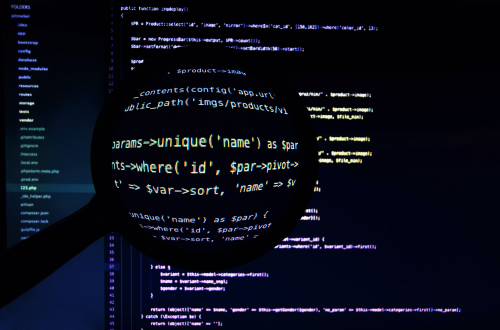
Researchers with the University of Cambridge discovered a bug that affects most computer code compilers and many software development environments. At issue is a component of the digital text encoding standard Unicode, which allows computers to exchange information regardless of the language used. Unicode currently defines more than 143,000 characters across 154 different language scripts (in addition to many non-script character sets, such as emojis).

Specifically, the weakness involves Unicode’s bi-directional or “Bidi” algorithm, which handles displaying text that includes mixed scripts with different display orders, such as Arabic — which is read right to left — and English (left to right).

But computer systems need to have a deterministic way of resolving conflicting directionality in text. Enter the “Bidi override,” which can be used to make left-to-right text read right-to-left, and vice versa.

“In some scenarios, the default ordering set by the Bidi Algorithm may not be sufficient,” the Cambridge researchers wrote. “For these cases, Bidi override control characters enable switching the display ordering of groups of characters.”

Bidi overrides enable even single-script characters to be displayed in an order different from their logical encoding. As the researchers point out, this fact has previously been exploited to disguise the file extensions of malware disseminated via email.

Here’s the problem: Most programming languages let you put these Bidi overrides in comments and strings. This is bad because most programming languages allow comments within which all text — including control characters — is ignored by compilers and interpreters. Also, it’s bad because most programming languages allow string literals that may contain arbitrary characters, including control characters.

“So you can use them in source code that appears innocuous to a human reviewer [that] can actually do something nasty,” said Ross Anderson, a professor of computer security at Cambridge and co-author of the research. “That’s bad news for projects like Linux and Webkit that accept contributions from random people, subject them to manual review, then incorporate them into critical code. This vulnerability is, as far as I know, the first one to affect almost everything.”

The research paper, which dubbed the vulnerability “Trojan Source,” notes that while both comments and strings will have syntax-specific semantics indicating their start and end, these bounds are not respected by Bidi overrides. From the paper:

“Therefore, by placing Bidi override characters exclusively within comments and strings, we can smuggle them into source code in a manner that most compilers will accept. Our key insight is that we can reorder source code characters in such a way that the resulting display order also represents syntactically valid source code.”

“Bringing all this together, we arrive at a novel supply-chain attack on source code. By injecting Unicode Bidi override characters into comments and strings, an adversary can produce syntactically-valid source code in most modern languages for which the display order of characters presents logic that diverges from the real logic. In effect, we anagram program A into program B.”

Anderson said such an attack could be challenging for a human code reviewer to detect, as the rendered source code looks perfectly acceptable.

“If the change in logic is subtle enough to go undetected in subsequent testing, an adversary could introduce targeted vulnerabilities without being detected,” he said.

Equally concerning is that Bidi override characters persist through the copy-and-paste functions on most modern browsers, editors, and operating systems.

“Any developer who copies code from an untrusted source into a protected code base may inadvertently introduce an invisible vulnerability,” Anderson told KrebsOnSecurity. “Such code copying is a significant source of real-world security exploits.”
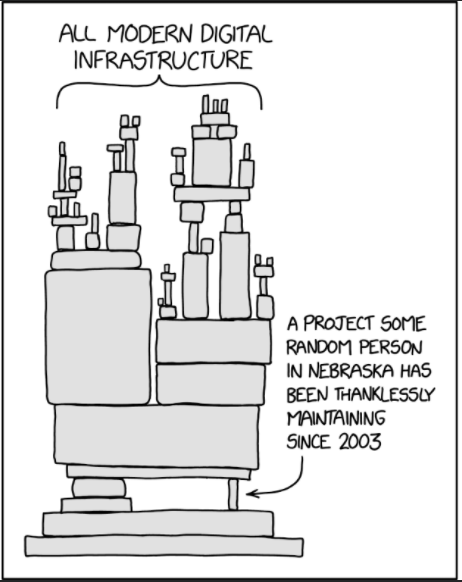
Image: XKCD.com/2347/

Matthew Green, an associate professor at the Johns Hopkins Information Security Institute, said the Cambridge research clearly shows that most compilers can be tricked with Unicode into processing code in a different way than a reader would expect it to be processed.

“Before reading this paper, the idea that Unicode could be exploited in some way wouldn’t have surprised me,” Green told KrebsOnSecurity. “What does surprise me is how many compilers will happily parse Unicode without any defenses, and how effective their right-to-left encoding technique is at sneaking code into codebases. That’s a really clever trick I didn’t even know was possible. Yikes.”

Green said the good news is that the researchers conducted a widespread vulnerability scan, but were unable to find evidence that anyone was exploiting this. Yet.

“The bad news is that there were no defenses to it, and now that people know about it they might start exploiting it,” Green said. “Hopefully compiler and code editor developers will patch this quickly! But since some people don’t update their development tools regularly there will be some risk for a while at least.”

Nicholas Weaver, a lecturer at the computer science department at University of California, Berkeley, said the Cambridge research presents “a very simple, elegant set of attacks that could make supply chain attacks much, much worse.”

“It is already hard for humans to tell ‘this is OK’ from ‘this is evil’ in source code,” Weaver said. “With this attack, you can use the shift in directionality to change how things render with comments and strings so that, for example ‘This is okay” is how it renders, but ‘This is’ okay is how it exists in the code. This fortunately has a very easy signature to scan for, so compilers can [detect] it if they encounter it in the future.”

The latter half of the Cambridge paper is a fascinating case study on the complexities of orchestrating vulnerability disclosure with so many affected programming languages and software firms. The researchers said they offered a 99-day embargo period following their initial disclosure to allow affected products to be repaired with software updates.

“We met a variety of responses ranging from patching commitments and bug bounties to quick dismissal and references to legal policies,” the researchers wrote. “Of the nineteen software suppliers with whom we engaged, seven used an outsourced platform for receiving vulnerability disclosures, six had dedicated web portals for vulnerability disclosures, four accepted disclosures via PGP-encrypted email, and two accepted disclosures only via non-PGP email. They all confirmed receipt of our disclosure, and ultimately nine of them committed to releasing a patch.”

Eleven of the recipients had bug bounty programs offering payment for vulnerability disclosures. But of these, only five paid bounties, with an average payment of $2,246 and a range of $4,475, the researchers reported.
Anderson said so far about half of the organizations maintaining the affected computer programming languages contacted have promised patches. Others are dragging their feet.

“We’ll monitor their deployment over the next few days,” Anderson said. “We also expect action from Github, Gitlab and Atlassian, so their tools should detect attacks on code in languages that still lack bidi character filtering.”

As for what needs to be done about Trojan Source, the researchers urge governments and firms that rely on critical software to identify their suppliers’ posture, exert pressure on them to implement adequate defenses, and ensure that any gaps are covered by controls elsewhere in their toolchain.

“The fact that the Trojan Source vulnerability affects almost all computer languages makes it a rare opportunity for a system-wide and ecologically valid cross-platform and cross-vendor comparison of responses,” the paper concludes. “As powerful supply-chain attacks can be launched easily using these techniques, it is essential for organizations that participate in a software supply chain to implement defenses.”

Weaver called the research “really good work at stopping something before it becomes a problem.”

“The coordinated disclosure lessons are an excellent study in what it takes to fix these problems,” he said. “The vulnerability is real but also highlights the even larger vulnerability of the shifting stand of dependencies and packages that our modern code relies on.”

Rust has released a security advisory for this security weakness, which is being tracked as CVE-2021-42574 and CVE-2021-42694. Additional security advisories from other affected languages will be added as updates here.

The Trojan Source research paper is available here (PDF).

—————
Boost Internet Speed
Free Business Hosting
Free Email Account
Dropcatch
Free Secure Email
Secure Email
Cheap VOIP Calls
Free Hosting
Boost Inflight Wifi
Premium Domains
Free Domains

Minnesotan Charged with Hacking Pro Sports Leagues

Minnesotan Charged with Hacking Pro Sports Leagues

A man from Minnesota has been charged with hacking four major American professional sports leagues and defrauding them of millions of dollars by illegally streaming copyrighted live games.

St. Louis Park resident Joshua Streit, who is also known as Josh Brody, allegedly intruded into the computer systems of the National Basketball Association (NBA), the National Football League (NFL), the National Hockey League (NHL), and Major League Baseball (MLB) using login credentials misappropriated from legitimate users.

The 30-year-old Streit then allegedly used his unauthorized access to livestream games via a pay-to-view website that he operated from around 2017 to August 2021. 

Streit is further accused of threatening to expose cybersecurity flaws in the computer system of one of the leagues unless he received a hefty payment.

US Attorney Damian Williams said: “Joshua Streit is alleged to have illegally streamed sports content online from MLB, the NHL, the NBA, and the NFL for his own personal profit. 

“Furthermore, Streit allegedly hacked MLB’s computer systems and attempted to extort $150,000 from the league.” 

According to the complaint unsealed Thursday in Manhattan Federal Court, Streit’s alleged illegal conduct caused one of the victim sports leagues to sustain financial losses of approximately $3m.

Streit is charged with one count of knowingly accessing a protected computer in furtherance of a criminal act and for purposes of commercial advantage and private financial gain, one count of knowingly accessing a protected computer in furtherance of fraud, one count of wire fraud, one count of illicit digital transmission, and one count of sending interstate threats with the intent to extort.

If convicted on all counts, Streit faces a maximum custodial sentence of 37 years.

“Instead of quitting while he [Streit] was ahead, he allegedly decided to continue the game by extorting one of the leagues, threatening to expose the very vulnerability he used to hack them,” said FBI Assistant Director Michael Driscoll.

“Now instead of scoring a payday, Mr. Brody faces the possibility of a federal prison sentence as a penalty.”

—————
Boost Internet Speed
Free Business Hosting
Free Email Account
Dropcatch
Free Secure Email
Secure Email
Cheap VOIP Calls
Free Hosting
Boost Inflight Wifi
Premium Domains
Free Domains

Cerberus Sentinel Acquires RED74

Cerberus Sentinel Acquires RED74

RED74, a managed security services provider based in New Jersey, has been acquired by cybersecurity consulting and managed services firm Cerberus Cyber Sentinel Corporation.

The financial terms of the acquisition were not disclosed when the deal was announced on Thursday.

RED74 is a privately held company whose clientele are primarily in the financial services and distribution/warehouse management sectors. It was launched in the summer of 2009 and operates from an office in Pennington.

The company’s team provides information technology managed services and key IT security management expertise to small and medium-sized businesses (SMBs) in New Jersey, Manhattan, and Eastern Pennsylvania.

Under the terms of the agreement, RED74 will continue to be based in New Jersey but will become a wholly owned subsidiary of Cerberus Sentinel, which is sited in Scottsdale, Arizona.

“A strong cybersecurity stance is crucial not only to IT resource management, but to the core business functions of all organizations,” said Tim Coleman, president of RED74. 

“We are thrilled to be a part of the Cerberus Sentinel team and contribute to the mission of ensuring the protection and continued success of our customers.”

David Jemmett, CEO and founder of Cerberus Sentinel, said Coleman’s enthusiasm for the deal was catching. 

“RED74 is an excellent addition for the Cerberus portfolio of companies,” said Jemmett. “Tim has built a strong team, and we know his continued support in the Cerberus Sentinel family will have a great impact.”

Jemmett added: “Tim’s excitement to join a national firm is contagious. Working with him and his team has been and will continue to be a pleasure.”

RED74 isn’t the only security acquisition to be made by Cerberus Sentinel. In August, Cerberus snapped up VelocIT, a managed security services provider, also based in New Jersey.

That deal followed Cerberus Sentinel’s December 2020 acquisition of Alpine Security, a St. Louis, Missouri–based cybersecurity services provider. 

A spokesperson for Cerberus Sentinel said: “The company is rapidly expanding by acquiring world-class cybersecurity, secured managed services, and compliance companies with top-tier talent that utilize the latest technology to create innovative solutions to protect the most demanding businesses and government organizations against continuing and emerging security threats and compliance obligations.”

—————
Boost Internet Speed
Free Business Hosting
Free Email Account
Dropcatch
Free Secure Email
Secure Email
Cheap VOIP Calls
Free Hosting
Boost Inflight Wifi
Premium Domains
Free Domains