McAfee Enterprise Defender Blog | MSHTML CVE-2021-40444

Threat Summary

Microsoft is warning its users of a zero-day vulnerability in Windows 10 and versions of Windows Server that is being leveraged by remote, unauthenticated attackers to execute code on the target system using specifically crafted office documents. Tracked as CVE-2021-40444 (CVSS score: 8.8), the remote code execution flaw is rooted in MSHTML (aka Trident), a proprietary browser engine for the now-discontinued Internet Explorer and which is used in Microsoft Office to render web content inside Word, Excel, and PowerPoint documents. This vulnerability is being actively exploited and protections should be put into place to prevent that. Microsoft has released guidance on a workaround, as well as updates to prevent exploitation, but below are additional McAfee Enterprise countermeasures you can use to protect your business.

MVISION Insights Campaign – “CVE-2021-40444 – Microsoft MSHTML Remote Code Execution Vulnerability”

Since originally reported, vulnerability exploitation has grown worldwide.

Figure 1. Latest MITRE ATT&CK framework for Exploitation of CVE-2021-40444. Source: MVISION Insights

Additional MITRE ATT&CK techniques have been identified since our original report. MVISION Insights will be regularly updated with the latest IOCs and hunting rules for proactive detection in your environment.

Figure 2. Latest MITRE ATT&CK framework for Exploitation of CVE-2021-40444. Source: MVISION Insights

McAfee Enterprise Product Protections

The following McAfee Enterprise products can protect you against this threat.

Figure 3. Protection by ENS Module

For ENS, it’s important to have both Threat Protection (TP) and Adaptive Threat Protection (ATP) with GTI enabled. We are seeing 50% of detections based on ATP behavior analysis rules.

Figure 4. Protection by ENS Module

More details on Endpoint protection including MVISION EDR are included below.

Preventing Exploit with McAfee ENS

McAfee Global Threat Intelligence (GTI) is currently detecting the analyzed IOCs for this exploitation. GTI will be continually updated as new indicators are observed in the wild.

ENS Threat Prevention module can provide added protections against exploitation of CVE-2021-40444 until a patch is deployed. The following signature in Exploit Prevention has shown coverage in testing of observed exploits; this signature could cause false positives, so it is highly advised to test in Report Mode or in sandbox environments before blocking in production environments.

Signature 2844: Microsoft Word WordPerfect5 Converter Module Buffer Overflow Vulnerability

Several custom Expert Rules can be implemented to prevent or detect potential exploitation attempts. As with all Expert Rules, please test them in your environment before deploying widely to all endpoints. Recommended to implement this rule in a log only mode to start.

Figure 5. Expert Rule to block or log exploitation attempts

Figure 6. Expert Rule to block or log exploitation attempts

ATP Rules

Adaptive Threat Protection module provides behavior-blocking capability through threat intelligence, rules destined to detect abnormal application activity or system changes and cloud-based machine-learning. To exploit this vulnerability, the attacker must gain access to a vulnerable system, most likely through Spearphishing with malicious attachments. These rules may also be effective in preventing initial access and execution. It is recommended to have the following rules in Observe mode at least and monitor for threat events in ePO.

  • Rule 2: Use Enterprise Reputations to identify malicious files.
  • Rule 4: Use GTI file reputation to identify trusted or malicious files
  • Rule 5: Use GTI file reputation to identify trusted or malicious URLs
  • Rule 300: Prevent office applications from being abused to deliver malicious payloads
  • Rule 309: Prevent office applications from being abused to deliver malicious payloads
  • Rule 312: Prevent email applications from spawning potentially malicious tools

As with all ATP Rules, please test them in your environment before deploying widely to all endpoints or turning on blocking mode.

Utilizing MVISION EDR for Hunting of Threat Activity

The Real-Time Search feature in MVISION EDR provides the ability to search across your environment for behavior associated with the exploitation of this Microsoft vulnerability. Please see the queries to locate the “mshtml” loaded module associated with various application processes.

EDR Query One

Processes where Processes parentimagepath matches “winword|excel|powerpnt” and Processes cmdline matches “AppData/Local/Temp/|.inf|.dll” and Processes imagepath ends with “control.exe”

EDR Query Two

HostInfo hostname and LoadedModules where LoadedModules process_name matches “winword|excel|powerpnt” and LoadedModules module_name contains “mshtml” and LoadedModules module_name contains “urlmon” and LoadedModules module_name contains “wininet

Additionally, the Historical Search feature within MVISION EDR will allow for the searching of IOCs even if a system is currently offline.

Figure 7. Using Historical Search to locate IOCs across all devices. Source: MVISION EDR

McAfee Enterprise has published the following KB article that will be updated as more information and coverage is released.

McAfee Enterprise coverage for CVE-2021-40444 – MSHTML Remote Code Execution

Further Protection for Threat Actor Behavior After Exploitation

Since public disclosure of the vulnerability, it has been observed from successful exploitation of CVE-2021-40444 in the wild that threat actors are utilizing a Cobalt Strike payload to then drop ransomware later in the compromised environment. The association between this vulnerability and ransomware point to the possibility that the exploit has been added to the tools utilized in the ransomware-as-a-service (RaaS) ecosystem.

Figure 8. CVE-2021-40444-attack-chain (Microsoft)​​

The Ransomware Gangs that have been observed in these attacks have in the past been known to utilize the Ryuk and Conti variants of ransomware.

Please see below additional mitigations that can be utilized in the event your environment is compromised and added protections are needed to prevent further TTPs.

Cobalt Strike BEACON

MVISION Insights Campaign – Threat Profile: CobaltStrike C2s


Endpoint Security – Advanced Threat Protection:

Rule 2: Use Enterprise Reputations to identify malicious files.

Rule 4: Use GTI file reputation to identify trusted or malicious files

Rule 517: Prevent actor process with unknown reputations from launching processes in common system folders


Ryuk Ransomware Protection

MVISION Insights Campaign – Threat Profile: Ryuk Ransomware


Endpoint Security – Advanced Threat Protection:

Rule 2: Use Enterprise Reputations to identify malicious files.

Rule 4: Use GTI file reputation to identify trusted or malicious files

Rule 5: Use GTI file reputation to identify trusted or malicious URLs


Endpoint Security – Access Protection:

Rule: 1

Executables (Include):

*

Subrules:

Subrule Type: Files

Operations:

Create

Targets (Include):

*.ryk


Endpoint Security – Exploit Prevention

Signature 6153: Malware Behavior: Ryuk Ransomware activity detected


Conti Ransomware Protection

MVISION Insights Campaign – Threat Profile: Conti Ransomware


Endpoint Security – Advanced Threat Protection:

Rule 2: Use Enterprise Reputations to identify malicious files.

Rule 4: Use GTI file reputation to identify trusted or malicious files

Rule 5: Use GTI file reputation to identify trusted or malicious URLs


Endpoint Security – Access Protection Custom Rules:

Rule: 1

Executables (Include):

*

Subrules:

Subrule Type: Files

Operations:

create

Targets (Include):

*conti_readme.txt


Endpoint Security – Exploit Prevention

Signature 344: New Startup Program Creation

The post McAfee Enterprise Defender Blog | MSHTML CVE-2021-40444 appeared first on McAfee Blogs.

—————
Boost Internet Speed
Free Business Hosting
Free Email Account
Dropcatch
Free Secure Email
Secure Email
Cheap VOIP Calls
Free Hosting
Boost Inflight Wifi
Premium Domains
Free Domains

Does Your Organization Have a Security.txt File?

It happens all the time: Organizations get hacked because there isn’t an obvious way for security researchers to let them know about security vulnerabilities or data leaks. Or maybe it isn’t entirely clear who should get the report when remote access to an organization’s internal network is being sold in the cybercrime underground.

In a bid to minimize these scenarios, a growing number of major companies are adopting “Security.txt,” a proposed new Internet standard that helps organizations describe their vulnerability disclosure practices and preferences.

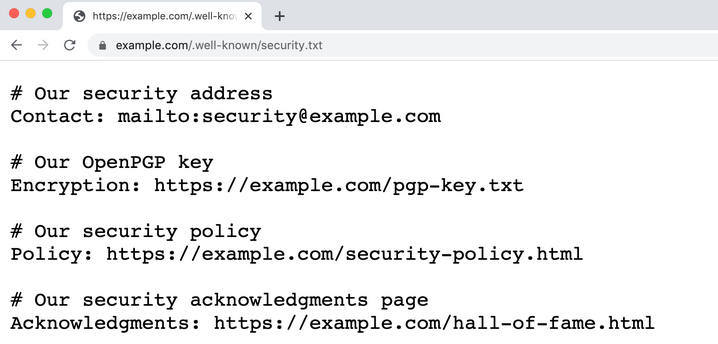
An example of a security.txt file. Image: Securitytxt.org.

The idea behind Security.txt is straightforward: The organization places a file called security.txt in a predictable place — such as example.com/security.txt, or example.com/.well-known/security.txt. What’s in the security.txt file varies somewhat, but most include links to information about the entity’s vulnerability disclosure policies and a contact email address.

The security.txt file made available by USAA, for example, includes links to its bug bounty program; an email address for disclosing security related matters; its public encryption key and vulnerability disclosure policy; and even a link to a page where USAA thanks researchers who have reported important cybersecurity issues.

Other security.txt disclosures are less verbose, as in the case of HCA Healthcare, which lists a contact email address, and a link to HCA’s “responsible disclosure” policies. Like USAA and many other organizations that have published security.txt files, HCA Healthcare also includes a link to information about IT security job openings at the company.

Having a security.txt file can make it easier for organizations to respond to active security threats. For example, just this morning a trusted source forwarded me the VPN credentials for a major clothing retailer that were stolen by malware and made available to cybercriminals. Finding no security.txt file at the retailer’s site using gotsecuritytxt.com (which checks a domain for the presence of this contact file), KrebsonSecurity sent an alert to its “security@” email address for the retailer’s domain.

Many organizations have long unofficially used (if not advertised) the email address security@[companydomain] to accept reports about security incidents or vulnerabilities. Perhaps this particular retailer also did so at one point, however my message was returned with a note saying the email had been blocked. KrebsOnSecurity also sent a message to the retailer’s chief information officer (CIO) — the only person in a C-level position at the retailer who was in my immediate LinkedIn network. I still have no idea if anyone has read it.

Although security.txt is not yet an official Internet standard as approved by the Internet Engineering Task Force (IETF), its basic principles have so far been adopted by at least eight percent of the Fortune 100 companies. According to a review of the domain names for the latest Fortune 100 firms via gotsecuritytxt.com, those include Alphabet, Amazon, Facebook, HCA Healthcare, Kroger, Procter & Gamble, USAA and Walmart.

There may be another good reason for consolidating security contact and vulnerability reporting information in one, predictable place. Alex Holden, founder of the Milwaukee-based consulting firm Hold Security, said it’s not uncommon for malicious hackers to experience problems getting the attention of the proper people within the very same organization they have just hacked.

“In cases of ransom, the bad guys try to contact the company with their demands,” Holden said. “You have no idea how often their messages get caught in filters, get deleted, blocked or ignored.”

GET READY TO BE DELUGED

So if security.txt is so great, why haven’t more organizations adopted it yet? It seems that setting up a security.txt file tends to invite a rather high volume of spam. Most of these junk emails come from self-appointed penetration testers who — without any invitation to do so — run automated vulnerability discovery tools and then submit the resulting reports in hopes of securing a consulting engagement or a bug bounty fee.

This dynamic was a major topic of discussion in these Hacker News threads on security.txt, wherein a number of readers related their experience of being so flooded with low-quality vulnerability scan reports that it became difficult to spot the reports truly worth pursuing further.

Edwin “EdOverflow” Foudil, the co-author of the proposed notification standard, acknowledged that junk reports are a major downside for organizations that offer up a security.txt file.

“This is actually stated in the specification itself, and it’s incredibly important to highlight that organizations that implement this are going to get flooded,” Foudil told KrebsOnSecurity. “One reason bug bounty programs succeed is that they are basically a glorified spam filter. But regardless of what approach you use, you’re going to get inundated with these crappy, sub-par reports.”

Often these sub-par vulnerability reports come from individuals who have scanned the entire Internet for one or two security vulnerabilities, and then attempted to contact all vulnerable organizations at once in some semi-automated fashion. Happily, Foudil said, many of these nuisance reports can be ignored or grouped by creating filters that look for messages containing keywords commonly found in automated vulnerability scans.

Foudil said despite the spam challenges, he’s heard tremendous feedback from a number of universities that have implemented security.txt.

“It’s been an incredible success with universities, which tend to have lots of older, legacy systems,” he said. “In that context, we’ve seen a ton of valuable reports.”

Foudil says he’s delighted that eight of the Fortune 100 firms have already implemented security.txt, even though it has not yet been approved as an IETF standard. When and if security.txt is approved, he hopes to spend more time promoting its benefits.

“I’m not trying to make money off this thing, which came about after chatting with quite a few people at DEFCON [the annual security conference in Las Vegas] who were struggling to report security issues to vendors,” Foudil said. “The main reason I don’t go out of my way to promote it now is because it’s not yet an official standard.”

Has your organization considered or implemented security.txt? Why or why not? Sound off in the comments below.

—————
Boost Internet Speed
Free Business Hosting
Free Email Account
Dropcatch
Free Secure Email
Secure Email
Cheap VOIP Calls
Free Hosting
Boost Inflight Wifi
Premium Domains
Free Domains

Romance Scammers Make $133m in First Half of 2021

Romance Scammers Make $133m in First Half of 2021

Over $133m has already been lost this year to romance scams, with victims increasingly urged to invest in fraudulent cryptocurrency opportunities, according to the FBI.

A new Public Service Announcement was published yesterday revealing that the FBI Internet Crime Complaint Center (IC3) received over 1,800 complaints from January 1 to June 31 this year, resulting in soaring losses for victims.

Victims are typically approached on dating and social media sites, where the scammer establishes a relationship with them designed to build confidence. In time, the scammer will share information on a new cryptocurrency investment or trading opportunity, which is claimed to generate significant profits, according to the FBI.

The victim is then directed to a scam website where they hand over some money for the investment. To add legitimacy to the scheme, the fraudsters purportedly make it appear as if the victim has made a profit and allow them to withdraw a small amount of money.

“After the successful withdrawal, the scammer instructs the victim to invest larger amounts of money and often expresses the need to ‘act fast.’ When the victim is ready to withdraw funds again, the scammers create reasons why this cannot happen,” the Public Service Announcement continued.

“The victim is informed additional taxes or fees need paid, or the minimum account balance has not been met to allow a withdrawal. This entices the victim to provide additional funds. Sometimes, a ‘customer service group’ gets involved, which is also part of the scam. Victims are not able to withdraw any money, and the scammers most often stop communicating with the victim after they cease to send additional funds.”

Romance scams are a perennial money-maker for fraudsters. In fact, they collectively accounted for over $600m in losses last year, second only to Business Email Compromise, according to official FBI figures.

The addition of a cryptocurrency element taps into a growing parallel trend of scammers making money from eager investors looking to get rich quickly.

According to the FBI, investment scams are the third-highest earner for cyber-criminals, bringing in over $336m last year.

—————
Boost Internet Speed
Free Business Hosting
Free Email Account
Dropcatch
Free Secure Email
Secure Email
Cheap VOIP Calls
Free Hosting
Boost Inflight Wifi
Premium Domains
Free Domains

Free REvil Decryptor Launched

Free REvil Decryptor Launched

Antivirus vendor Bitdefender has launched a free universal decryption tool to help victims of REvil ransomware, also known as Sodinokibi.

The new tool, which was made available on Thursday, can restore many files impacted by the crypto-locking malware before July 13, 2021. However, the tool’s instructions include the warning that “some versions” of REvil “are not yet decryptable.”

REvil victims can download the tool and a step-by-step tutorial on how to use it via the Bitdefender website. The free decryptor is also from the No More Ransomware project, a public-private collaboration involving Europol, Dutch cybercrime law enforcement, and multiple private security firms.

Bitdefender said that the decryption tool was created in collaboration with “a trusted law enforcement partner” while the investigation into REvil’s criminal activities continues.

“Please note this is an ongoing investigation and we can’t comment on details related to this case until authorized by the lead investigating law enforcement partner,” Bitdefender said in a statement released September 16. 

“Both parties believe it is important to release the universal decryptor before the investigation is completed to help as many victims as possible.”

REvil first came on the cybercrime radar as a Ransomware-as-a-Service (RaaS) operator in April 2019 and grew to become one of the most prolific ransomware gangs on the dark web. 

After successfully extorting millions of dollars from thousands of technology companies, retailers, and managed services providers around the world, REvil’s website went down earlier this year following a major supply-chain attack on IT software provider Kaseya.

“On July 13 of this year, parts of REvil’s infrastructure went offline, leaving infected victims who had not paid the ransom unable to recover their encrypted data,” said Bitdefender.

“This decryption tool will now offer those victims the ability to take back control of their data and assets.”

Bitdefender and its unnamed law enforcement partner suspect that more attacks from REvil could be about to occur. 

“We believe new REvil attacks are imminent after the ransomware gang’s servers and supporting infrastructure recently came back online after a two-month hiatus,” said Bitdefender. “We urge organizations to be on high alert and to take necessary precautions.”

—————
Boost Internet Speed
Free Business Hosting
Free Email Account
Dropcatch
Free Secure Email
Secure Email
Cheap VOIP Calls
Free Hosting
Boost Inflight Wifi
Premium Domains
Free Domains

Prison for AT&T Phone-Unlocking Fraudster

Prison for AT&T Phone-Unlocking Fraudster

A cyber-criminal who defrauded American telecommunications giant AT&T out of more than $200m through a phone-unlocking bribery scheme has been sentenced to prison.

Muhammad Fahd, a 35-year-old citizen of Pakistan and Grenada, led a seven-year conspiracy in which AT&T employees were bribed to unlawfully unlock nearly two million customers’ cell phones for profit.

The plot began in 2012 when Fahd colluded with others to recruit AT&T staff working at a call center in Bothell, Washington. The employees were bribed to use their AT&T credentials to unlock cell phones for ineligible customers.

“Unlocking a phone effectively removes it from AT&T’s network, thereby allowing the account holder to avoid having to pay AT&T for service or to make any payments for purchase of the phone,” said the Department of Justice’s Office of Public Affairs in a statement released September 16.

Fahd used the alias Frank Zhang to contact an AT&T employee through Facebook and offer them large sums of money to secretly unlock phones’ International Mobile Equipment Identity numbers (IMEIs). Fahd also asked the employee to enlist other AT&T staff in the scheme. 

The recruited employees were instructed by Fahd to establish fake businesses and set up bank accounts for those businesses. These accounts were used to give the illusion that the fraudulent payments and fictitious invoices that formed part of the scheme were genuine.

“AT&T’s forensic analysis shows the total number of cellular telephones fraudulently unlocked by members of the scheme was 1,900,033 phones,” said the Office of Public Affairs. 

“AT&T has further determined that the loss it suffered because customers, whose cellular phones were illegally unlocked, failed to complete payments for their cellular telephones was $201,497,430.94.”

When AT&T implemented a new unlocking system in 2013 that made unlocking the IMEIs harder, Fahd hired a software developer to design malware to unlock phones more efficiently and in larger numbers. Fahd then had AT&T employees install the malware on AT&T’s computer system.

Fahd was indicted in 2017 and arrested in Hong Kong in 2018. After being extradited to the US in 2019, in September 2020 Fahd pleaded guilty to conspiracy to commit wire fraud. On September 16, he was sentenced to 12 years in prison and ordered to pay restitution of $200,620,698.

—————
Boost Internet Speed
Free Business Hosting
Free Email Account
Dropcatch
Free Secure Email
Secure Email
Cheap VOIP Calls
Free Hosting
Boost Inflight Wifi
Premium Domains
Free Domains

More Tribes Given Enhanced Access to US Crime Data

More Tribes Given Enhanced Access to US Crime Data

More Native American tribes are going to be given enhanced access to critical databases containing national crime information for the United States.

In an announcement made September 16, the Department of Justice said that 12 tribes have been newly selected to participate in the Tribal Access Program for National Crime Information (TAP), bringing the total number of federally recognized participating tribes to 108.

TAP was set up in 2015 after tribal leaders raised concerns about not being able to directly access crime data held in federal systems. Using the program, tribes can view shared information for non-criminal justice purposes such as screening employees or volunteers who work with children. 

Information accessible to tribes via TAP includes data on missing persons; registered convicted sex offenders; entered domestic violence orders of protection for nationwide enforcement; criminal history checks; identified and arrested fugitives; entered bookings and convictions; and completed fingerprint-based record checks.

In 2019, the Department of Justice announced that tribal governments already participating in TAP could directly input data and gain access to the FBI’s National Sex Offender Registry (NSOR) using the Tribe and Territory Sex Offender Registry System (TTSORS).

The twelve tribes joining the program are the Confederated Tribes of the Warm Springs Reservation; Cow Creek Band of Umpqua; Fort Belknap Indian Community; Grand Traverse Band of Ottawa and Chippewa; Havasupai Tribe; Lower Brule Sioux Tribe; Menominee Tribe; Mille Lacs Band of Ojibwe; Muckleshoot Tribe; Passamaquoddy Tribe; Shingle Springs Band of Miwok; and United Keetoowah Band of Cherokee.

Under the program, the tribes will be given training as well as software and biometric/biographic kiosk workstations to take mugshots, process fingerprints, and submit information to FBI Criminal Justice Information Services (CJIS) systems.

“Timely access to federal criminal information can help protect domestic violence victims, place foster children in safe conditions, solve crimes and apprehend fugitives on tribal land, among other important uses,” said Deputy Attorney General Lisa Monaco. 

“Increasing tribal access to criminal databases is a priority of the Justice Department and this administration, and essential to many tribal government efforts to strengthen public safety in their communities.”

—————
Boost Internet Speed
Free Business Hosting
Free Email Account
Dropcatch
Free Secure Email
Secure Email
Cheap VOIP Calls
Free Hosting
Boost Inflight Wifi
Premium Domains
Free Domains

CISA: Patch Zoho Bug Being Exploited by APT Groups

CISA: Patch Zoho Bug Being Exploited by APT Groups

The US government is urging organizations to patch a newly identified Zoho vulnerability since state-sponsored attackers are actively exploiting it.

CVE-2021-4053 is a critical authentication bypass vulnerability affecting REST-based API URLs which could enable remote code execution if exploited, according to the Cybersecurity and Infrastructure Security Agency (CISA).

It affects ManageEngine ADSelfService Plus — a self-service password management and single sign-on solution from the online productivity vendor.

Zoho released a patch for this bug on September 6, but CISA claimed that malicious actors might have been exploiting it as far back as August, using various tools and techniques.

“The exploitation of ManageEngine ADSelfService Plus poses a serious risk to critical infrastructure companies, US-cleared defense contractors, academic institutions, and other entities that use the software,” it warned.

“Successful exploitation of the vulnerability allows an attacker to place webshells, which enable the adversary to conduct post-exploitation activities, such as compromising administrator credentials, conducting lateral movement, and exfiltrating registry hives and Active Directory files.”

CISA claimed that threat actors might be looking for “US research” in multiple sectors.

Sean Nikkel, a senior cyber threat intel analyst at Digital Shadows, claimed that this is the fifth critical bug to be found in ManageEngine this year.

“Since the service interacts with Active Directory, giving attackers access can only lead to bad things, such as controlling domain controllers or other services. Attackers can then take advantage of ‘blending in with the noise’ of everyday system activity. It’s reasonable to assume that there will be more widespread exploitation of this and previous vulnerabilities given the interactivity with Microsoft system processes,” he argued.

“The observation that APT groups are actively exploiting CVE-2021-40539 should highlight the potential exposure it might cause. If trends are consistent, extortion groups will likely seek exploitation for ransomware activity in the not-so-distant future. Users of Zoho’s software should apply patches immediately to avoid the types of compromise described in the CISA bulletin.”

—————
Boost Internet Speed
Free Business Hosting
Free Email Account
Dropcatch
Free Secure Email
Secure Email
Cheap VOIP Calls
Free Hosting
Boost Inflight Wifi
Premium Domains
Free Domains

Experts Concerned Over New Digital Secretary’s Lack of Cyber Knowledge

Experts Concerned Over New Digital Secretary’s Lack of Cyber Knowledge

Privacy and security experts have signaled their concern over the appointment of Nadine Dorries to the post of digital and culture secretary.

This week, Boris Johnson announced the move as part of a major Cabinet reshuffle designed to stamp his authority on government and drive momentum into the next General Election campaign.

However, while most of the appointments were well received, question marks have been raised over Dorries’ tech credentials. As secretary of state for digital, culture, media and sport, she will be expected to master the detail of complex regulatory issues and sell Britain’s growing prowess in digital and cyber abroad.

However, in 2017 she invited widespread criticism from security experts after publicly admitting that her staff logged into her work computer using her credentials “every day.”

“Dorries spent much of her parliamentary career as a backbencher — and didn’t attend a single session when appointed to the Science and Technology Committee in 2010,” argued ProPrivacy digital privacy expert Hannah Hart.

“This is even more alarming when you weigh her seemingly lack of digital knowledge against the fact that the UK is facing an increasing amount of high-profile cybersecurity attacks. The education sector has faced a flurry of ransomware attacks, 2020 was a landmark year for hacking attempts, and the pandemic has seen opportunities for phishing scams soar as we do most of our banking and shopping online.”

Others raised concerns about the potential regulatory impact of the appointment.

“Given the government is currently pondering whether we should ‘relax’ data protection regulation and move away from the GDPR, it would be great to have the confidence that our parliamentarians had the technical and legal understanding of this complex issue,” Bournemouth University professor of IT ethics, Andy Phippen, told the newspaper.

 “Equally, observing the Online Safety Bill as it moves through parliament, one would hope those debating greater regulation of big tech understand both what technology is capable of in terms of content monitoring and filtering, and the implications of legislation on everyone’s online experiences. Sadly, with a few exceptions, I do not have that confidence.”

—————
Boost Internet Speed
Free Business Hosting
Free Email Account
Dropcatch
Free Secure Email
Secure Email
Cheap VOIP Calls
Free Hosting
Boost Inflight Wifi
Premium Domains
Free Domains

US Imprisons World’s Largest Facilitator of CSAM

US Imprisons World’s Largest Facilitator of CSAM

A dual Irish-American citizen has been sentenced to 27 years in US federal prison for sharing on the dark web millions of images depicting the sexual abuse of children, toddlers and infants. 

Dublin resident Eric Eoin Marques was extradited to the United States on March 23, 2019, to face federal criminal charges filed in Maryland on August 8, 2013. On February 6, 2020, 36-year-old Marques pleaded guilty to conspiracy to advertise child pornography on the dark web. 

According to his plea agreement, between July 24, 2008, and July 29, 2013, Marques operated a free, anonymous web-hosting service (AHS) called Freedom Hosting that hosted more than 200 child exploitation websites on the darknet. The websites hosted by Marques housed millions of images of child exploitation material, including over 1.97 million videos and images featuring victims not previously known to law enforcement. 

“Many of these images involved sadistic abuse of infants and toddlers to include bondage, bestiality and humiliation to include urination, defecation and vomit,” said the US Attorney’s Office for the District of Maryland in a statement published Wednesday.

In his guilty plea, Marques admitted distributing child sexual abuse material (CSAM) involving children under twelve and sadistic or masochistic material or depictions of violence.  

According to Acting United States Attorney for the District of Maryland Jonathan F. Lenzner, “Eric Marques was one of the largest facilitators of child pornography in the world.” 

On September 15, US District Judge Theodore D. Chuang sentenced Marques to 27 years in federal prison, followed by lifetime supervised release.

The Marques prosecution was part of a global investigation targeting thousands of users of more than 200 websites operating on the Tor network edicated to trading in CSAM. This investigation led to the disruption of the activities of tens of thousands of online child sexual abuse material creators and the seizure of over four million images and videos of child sexual abuse.

“Today’s sentencing of Eric Marques sends a clear message to perpetrators of this egregious crime that no matter where you are in the world, law enforcement will hold you accountable and bring you to justice,” said FBI Assistant Director Calvin Shivers.

—————
Boost Internet Speed
Free Business Hosting
Free Email Account
Dropcatch
Free Secure Email
Secure Email
Cheap VOIP Calls
Free Hosting
Boost Inflight Wifi
Premium Domains
Free Domains

Porn Problem: Adult Ads Persist on US Gov’t, Military Sites

Cities, states, federal and military agencies should patch the Laserfiche CMS post-haste, said the security researcher whose jaw dropped at 50 sites hosting porn and Viagra spam.

—————
Boost Internet Speed
Free Business Hosting
Free Email Account
Dropcatch
Free Secure Email
Secure Email
Cheap VOIP Calls
Free Hosting
Boost Inflight Wifi
Premium Domains
Free Domains