Top 10 COVID-19 Scams: How to Stay Protected

The COVID-19 pandemic flipped the world on its head in so many ways. Offices and schools stood empty while living rooms were transformed into classrooms and workspaces. Misinformation ran rampant and made people unsure of what to believe. Cybercriminals took advantage of the confusion and new way of daily life, giving rise to many COVID-19 scams. 

Luckily, when armed with the facts, you can sidestep scams and keep your personal information safe from cybercriminals. Here’s a list of the top 10 COVID-19 scams you should keep an eye on plus tips on how to avoid each and help you navigate the current landscape and the future with confidence. 

1. Vaccination Card Counterfeiting

Finally getting your COVID-19 vaccine is an exciting occasion. Many people’s first reaction to exciting news is to share it with their extended networks on social media. There was a trend going around where people were posting pictures of their vaccination cards. Little did they know, vaccination cards hold a trove of valuable information (name, birth dates, vaccination location, and dates) that can be used to create counterfeit vaccination cards.  

Additionally, the information on vaccination cards can be paired together with other details from your social media profile to steal your identity. Consider altering the privacy settings on your social media profiles so it is only visible to people you know. If you’d like additional peace of mind that your identity is safe, McAfee Identity Theft Protection Plus provides up to $1 million in identity theft insurance and restoration assistance.

2. General Misinformation Spreading

Some of the false claims about COVID-19 circulating on social media are outrageous, such as 5G aiding the spread of the virus and eating garlic as a preventive measure. Cybercriminals might not have been the origin of false claims, but they certainly benefit from the chaos created by misinformation. They capitalize on commonly held fears by swooping in with cure-alls that swindle money from concerned people. 

Be a source of truth for your social media following. The Centers for Disease Control and Prevention, the National Health Service, and the World Health Organization can be trusted for up-to-date resources concerning COVID-19, the vaccine, and how to remain healthy. 

3. Hazardous Online Miracle Cures 

To firmly and quickly debunk this myth right now: There are no COVID-19 miracle cures. The best way to protect your and your loved one’s health is to receive a CDC-approved vaccination from a medical institution. Any homemade online treatment claiming to cure the disease is a hoax to steal money. Also, healing potions purchased online could be hazardous to your health, as in the case of one fraudulent operation in Florida. A Florida family sold a bleach solution that swindled $1 million and left many people hospitalized. 

For the latest news about COVID-19 treatment, preventive measures, and the vaccine, refer to the CDC or WHO.

4. Stimulus CheckScams

Various stimulus check scams were swirling around in early 2021. Scammers impersonating government workers contacted citizens by phone, text, and email asking them to verify personal information or to pay fees to receive their checks. 

As with other IRS scams, the best way to avoid them is to know how the IRS typically communicates. The IRS will never ask for private personal information over email or over the phone. Never share your Social Security Number over email or the phone. The IRS only gets in touch with people through postal mail or in person.

5. Proof of Vaccination Phishing Scheme

A new COVID-19 phishing scam is on the rise: proof of vaccination scam. Cybercriminals are sending phishing emails posing as healthcare institutions asking for urgent confirmation of vaccine status. The emails ask for full names, birth dates, Social Security Numbers, and photos of vaccine cards. This scam is dangerous, not only because it asks for sensitive information, but because the request is a believable one. Employers and various other institutions are on the fence about asking people for their vaccine status, and people are unsure to whom they should divulge this information. 

Like with other phishing scams, pay close attention to the message and how it’s written. Does it convey urgency and penalties for ignoring it? Phishing emails often use language that causes readers to panic and give up their information quickly without taking the time to determine if the message is real or not. Also, does the email or text have typos and is it poorly written? Never click on links or respond to suspicious emails. Instead, contact the supposed sender through the phone number or email address listed on their official website.

6. Video Conferencing Eavesdropping

Video conferencing popularity soared as businesses and schools conducted work and learning online. Cybercriminals capitalized on the surge by forcing their way into video conferencing software and spying on meetings and classrooms. 

The key to protecting the privacy of your teleconference calls is to always have the most up-to-date software installed. Software upgrades often include security patches. One way to ensure you always have the latest, most secure version installed is to enable automatic updates. Also, be careful about what you share over teleconference. Just in case a cybercriminal is eavesdropping, never say aloud or instant message your Social Security Number or other sensitive personal information. Finally, follow your workplace’s IT team’s cybersecurity policies and use only your company-issued device for work purposes. Company-issued devices often have additional security protections to keep your personal and company information safe from prying eyes.

7. Job Scams

Unfortunately, many people lost their jobs during the pandemic. Cybercriminals, aware that people without jobs were likely to jump on an employment opportunity due to economic uncertainty, flooded job boards with fake employment ads and sent fraudulent job offer emails. These job scams turned out to be phishing attempts to extract personal and banking details. In some cases, the scammers asked job seekers to wire money for pre-employment training. 

If you receive a job offer, make sure that it is for a company you actually applied to. Even though companies are looking to hire people quickly, a reputable institution likely won’t offer a job without interviewing candidates first. Most interviews are happening online, so request a video conference to make sure that the person on the other end of the line is real and has honest intentions. Research the interviewer on professional networking sites to make sure they are who they say they are. 

8. Real Estate Scams

Similar to job scams, the urgency of the real estate market during the pandemic may make people act more impulsively than they would under normal circumstances. The rental and housing markets have been extremely competitive, which is causing people to put deposits down for residences that weren’t even real. Since home tours were moved online due to social distancing requirements, buyers and renters were OK with making a decision based on pictures. 

Real estate scams play up the urgency of acting quickly. In their hurry to claim a real estate gem, homebuyers and renters may overlook the most glaring red flag of real estate scams during the pandemic: not viewing the property in person. Additionally, never share your banking information or wire money to someone you have never met in person or cannot verify the accredited real estate agency for which they work.     

9. FakeHealth Alerts 

When a cybercriminal poses as a legitimate organization, it’s more difficult to determine what information to trust. For example, criminals circulated a scam impersonating the CDC that downloaded malware onto users’ devices. 

A great tip to thwart cybercriminals hiding behind the name of a credible organization is to always hover your cursor over links in emails and texts. If a link redirects to a URL that looks suspicious, immediately delete the message. A suspicious URL could contain a typo, a variant spelling of the organization its impersonating, or be a string of jumbled letters and numbers. Emails that claim to be from official organizations will often have the organization’s logo somewhere on the message. Check the clarity of the logo and compare it to the organization’s official site. If the logo is blurry or the coloring seems off, that’s a sign that the message is fake. 

10. Fake Delivery Notices

COVID-19 led to a boom in e-commerce. Shopping that was normally conducted in person moved online, and a pile of packages on the front stoop was a common occurrence. There was a fake delivery notice scam where cybercriminals posed as UPS and Amazon to phish for personal details in order to release a hold on deliveries. 

One final phishing avoidance tip is: Consider what the message is asking. Has UPS ever asked for your Social Security Number before? If they had it, what would they use it for? And there’s no reason for Amazon to have your banking information. Don’t let the urgency of the scammer’s message stress you out. A quick phone call with the delivery service in question should solve the problem. 

The post Top 10 COVID-19 Scams: How to Stay Protected appeared first on McAfee Blogs.

—————
Boost Internet Speed
Free Business Hosting
Free Email Account
Dropcatch
Free Secure Email
Secure Email
Cheap VOIP Calls
Free Hosting
Boost Inflight Wifi
Premium Domains
Free Domains

Trial Ends in Guilty Verdict for DDoS-for-Hire Boss

A jury in California today reached a guilty verdict in the trial of Matthew Gatrel, a St. Charles, Ill. man charged in 2018 with operating two online services that allowed paying customers to launch powerful distributed denial-of-service (DDoS) attacks against Internet users and websites. Gatrel’s conviction comes roughly two weeks after his co-conspirator pleaded guilty to criminal charges related to running the services.

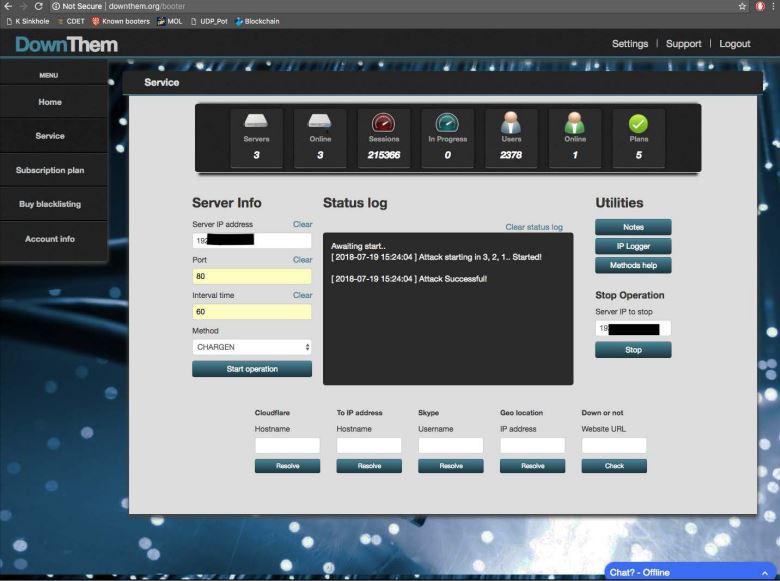
The user interface for Downthem[.]org.

Prosecutors for the Central District of California charged Gatrel, 32, and his business partner Juan “Severon” Martinez of Pasadena, Calif. with operating two DDoS-for-hire or “booter” services — downthem[.]org and ampnode[.]com.

Despite admitting to FBI agents that he ran these booter services (and turning over plenty of incriminating evidence in the process), Gatrel opted to take his case to trial, defended the entire time by public defenders. Facing the prospect of a hefty sentence if found guilty at trial, Martinez pleaded guilty on Aug. 26 to one count of unauthorized impairment of a protected computer.

Gatrel was convicted on all three charges of violating the Computer Fraud and Abuse Act, including conspiracy to commit unauthorized impairment of a protected computer, conspiracy to commit wire fraud, and unauthorized impairment of a protected computer.

Investigators say Downthem helped some 2,000 customers launch debilitating digital assaults at more than 200,000 targets, including many government, banking, university and gaming Web sites.

Prosecutors alleged that in addition to running and marketing Downthem, the defendants sold huge, continuously updated lists of Internet addresses tied to devices that could be used by other booter services to make attacks far more powerful and effective. In addition, other booter services also drew firepower and other resources from Ampnode.

Booter and stresser services let customers pick from among a variety of attack methods, but almost universally the most powerful of these methods involves what’s known as a “reflective amplification attack.” In such assaults, the perpetrators leverage unmanaged Domain Name Servers (DNS) or other devices on the Web to create huge traffic floods.

Ideally, DNS servers only provide services to machines within a trusted domain — such as translating an Internet address from a series of numbers into a domain name, like example.com. But DNS reflection attacks rely on consumer and business routers and other devices equipped with DNS servers that are (mis)configured to accept queries from anywhere on the Web.

Attackers can send spoofed DNS queries to these DNS servers, forging the request so that it appears to come from the target’s network. That way, when the DNS servers respond, they reply to the spoofed (target) address.

The bad guys also can amplify a reflective attack by crafting DNS queries so that the responses are much bigger than the requests. For example, an attacker could compose a DNS request of less than 100 bytes, prompting a response that is 60-70 times as large. This “amplification” effect is especially pronounced if the perpetrators query dozens of DNS servers with these spoofed requests simultaneously.

The government charged that Gatrel and Martinez constantly scanned the Internet for these misconfigured devices, and then sold lists of Internet addresses tied to these devices to other booter service operators.

Gatrel’s sentencing is scheduled for January 27, 2022. He faces a statutory maximum sentence of 35 years in federal prison. However, given the outcome of past prosecutions against other booter service operators, it seems unlikely that Gatrel will spend much time in jail.

The case against Gatrel and Martinez was brought as part of a widespread crackdown on booter services in Dec. 2018, when the FBI joined with law enforcement partners overseas to seize 15 different booter service domains.

Federal prosecutors and DDoS experts interviewed at the time said the operation had three main goals: To educate people that hiring DDoS attacks is illegal, to destabilize the flourishing booter industry, and to ultimately reduce demand for booter services.

The jury is still out on whether any of those goals have been achieved with lasting effect.

The original complaint against Gatrel and Martinez is here (PDF).

—————
Boost Internet Speed
Free Business Hosting
Free Email Account
Dropcatch
Free Secure Email
Secure Email
Cheap VOIP Calls
Free Hosting
Boost Inflight Wifi
Premium Domains
Free Domains

Customer Care Giant TTEC Hit By Ransomware

TTEC, [NASDAQ: TTEC], a company used by some of the world’s largest brands to help manage customer support and sales online and over the phone, is dealing with disruptions from a network security incident resulting from a ransomware attack, KrebsOnSecurity has learned.

While many companies have been laying off or furloughing workers in response to the Coronavirus pandemic, TTEC has been massively hiring. Formerly TeleTech Holdings Inc., Englewood, Co.-based TTEC now has nearly 60,000 employees, most of whom work from home and answer customer support calls on behalf of a large number of name-brand companies, like Bank of America, Best Buy, Credit Karma, Dish Network, Kaiser Permanente, USAA and Verizon.

On Sept. 14, KrebsOnSecurity heard from a reader who passed on an internal message apparently sent by TTEC to certain employees regarding the status of a widespread system outage that began on Sunday, Sept. 12.

“We’re continuing to address the system outage impacting access to the network, applications and customer support,” reads an internal message sent by TTEC to certain employees.

TTEC has not responded to requests for comment. A phone call placed to the media contact number listed on an August 2021 TTEC earnings release produced a message saying it was a non-working number.

[Update, 6:20 p.m. ET: TTEC confirmed a ransomware attack. See the update at the end of this piece for their statement]

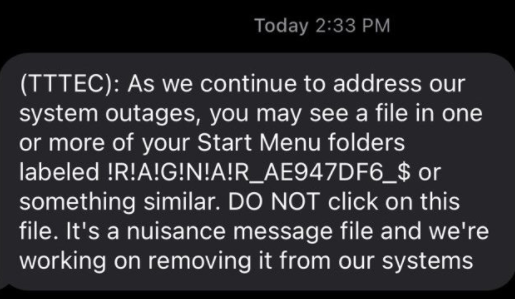
TTEC’s own message to employees suggests the company’s network may have been hit by the ransomware group “Ragnar Locker,” (or else by a rival ransomware gang pretending to be Ragnar). The message urged employees to avoid clicking on a file that suddenly may have appeared in their Windows start menu called “!RA!G!N!A!R!”

“DO NOT click on this file,” the notice read. “It’s a nuisance message file and we’re working on removing it from our systems.”

Ragnar Locker is an aggressive ransomware group that typically demands millions of dollars worth of cryptocurrency in ransom payments. In an announcement published on the group’s darknet leak site this week, the group threatened to publish the full data of victims who seek help from law enforcement and investigative agencies following a ransomware attack.

One of the messages texted to TTEC employees included a link to a Zoom videoconference line at ttec.zoom.us. Clicking that link opened a Zoom session in which multiple TTEC employees who were sharing their screens took turns using the company’s Global Service Desk, an internal TTEC system for tracking customer support tickets.

The TTEC employees appear to be using the Zoom conference line to report the status of various customer support teams, most of which are reporting “unable to work” at the moment.

For example, TTEC’s Service Desk reports that hundreds of TTEC employees assigned to work with Bank of America’s prepaid services are unable to work because they can’t remotely connect to TTEC’s customer service tools. More than 1,000 TTEC employees are currently unable to do their normal customer support work for Verizon, according to the Service Desk data. Hundreds of employees assigned to handle calls for Kaiser Permanente also are unable to work.

“They’ve been radio silent all week except to notify employees to take another day off,” said the source who passed on the TTEC messages, who spoke to KrebsOnSecurity on condition of anonymity. “As far as I know, all low-level employees have another day off today.”

The extent and severity of the incident at TTEC remains unknown. It is common for companies to disconnect critical systems in the event of a network intrusion, as part of a larger effort to stop the badness from spreading elsewhere. Sometimes disconnecting everything actually does help, or at least helps to keep the attack from spreading to partner networks. But it is those same connections to partner companies that raises concern in the case of TTEC’s ongoing outage.

In the meantime, if you’re unlucky enough to need to make a customer service call today, there’s a better-than-even chance you will experience….wait for it…longer-than-usual hold times.

This is a developing story. Further details or updates will be noted here with a date and time stamp.

Update, 5:37 p.m. ET: TTEC responded with the following statement:

TTEC is committed to cyber security, and to protecting the integrity of our clients’ systems and data. We recently became aware of a cybersecurity incident that has affected certain TTEC systems.  Although as a result of the  incident, some of our data was encrypted and business activities at several facilities have been temporarily disrupted, the company continuous to serve its global clients. TTEC immediately activated its information security incident response business continuity protocols, isolated the systems involved, and took other appropriate measures to contain the incident. We are now in the process of  carefully and deliberately restoring the systems that have been involved.

We also launched an investigation, typical under the circumstances, to determine the potential impacts.  In serving our clients TTEC, generally, does not maintain our clients’ data, and the investigation to date has not identified compromise to clients’ data. That investigation is on-going and we will take additional action, as appropriate, based on the investigation’s results. This is all the information we have to share until our investigation is complete.

—————
Boost Internet Speed
Free Business Hosting
Free Email Account
Dropcatch
Free Secure Email
Secure Email
Cheap VOIP Calls
Free Hosting
Boost Inflight Wifi
Premium Domains
Free Domains

Serious Flaw Found in HP OMEN Driver

Serious Flaw Found in HP OMEN Driver

A serious flaw has been found in the driver of a popular PC gaming software used by millions. 

Researchers from SentinelLabs published details of the vulnerability in the HP Omen Gaming Hub on September 14. They said that attackers could exploit the flaw to locally escalate to kernel-mode privileges.

“With this level of access, attackers can disable security products, overwrite system components, corrupt the OS, or perform any malicious operations unimpeded,” wrote researchers. 

Omen comes preinstalled on all HP OMEN desktops and laptops and can be used to control and optimize settings such as device GPU, fan speeds, CPU overclocking, memory and more. 

The vulnerability was reported to HP on February 17, 2021, and was later given a Common Vulnerability Scoring System (CVSS) score of 7.8, making it a high-severity flaw. 

No evidence of the flaw’s being exploited in the wild was discovered by SentinelOne. 

“While we haven’t seen any indicators that these vulnerabilities have been exploited in the wild up till now, using any OMEN-branded PC with the vulnerable driver utilized by OMEN Gaming Hub makes the user potentially vulnerable,” noted researchers. “Therefore, we urge users of OMEN PCs to ensure they take appropriate mitigating measures without delay.”

Commenting on the newly unearthed flaw, Jamie Boote, security consultant at the Synopsys Software Integrity Group, said, “With the rise of remote workers during the Covid-19 Pandemic, the collision between corporate IT environments and personal hardware will only rise as employees supply more of their own hardware to continue to customize and equip their home offices. 

“It is impossible to anticipate all potential driver and hardware vulnerabilities that can arise from these situations, so it is important for IT departments to recognize and react to threats such as these when they’re made public.”

Boote added that the enforcement of proactive security measures such as keeping up with threat intelligence feeds, limiting software installations to only approved software sources and maintaining approved workstation images can limit the impact of threats such as this gaming hub privilege escalation bug. 

“Perhaps this vulnerability is a reminder of why it’s called ‘The Bleeding Edge,’” said Boote.

—————
Boost Internet Speed
Free Business Hosting
Free Email Account
Dropcatch
Free Secure Email
Secure Email
Cheap VOIP Calls
Free Hosting
Boost Inflight Wifi
Premium Domains
Free Domains

Arizona Medical Practice Permanently Loses EHR Data

Arizona Medical Practice Permanently Loses EHR Data

A medical practice in Arizona has lost nearly all the data entered into its electronic health record (EHR) system due to a cyber-attack. 

Desert Wells Family Medicine, which has been serving patients in Queens Creek for 20 years, was attacked by cyber-criminals on May 21. The practice had backed up all its EHR data before the attack took place, but the attackers managed to encrypt both the original files and the backup files using ransomware.

The practice has begun notifying 35,000 patients that their protected health information has been compromised. Information that may have been accessed by the attackers during the security incident included patient names, dates of birth, addresses, billing account numbers, medical record numbers, treatment information, and Social Security numbers. 

Desert Wells said it had done everything that it could to retrieve the encrypted data, including engaging external specialists, but their efforts had proved fruitless.

All EHR information added into Desert Wells’ system prior to the date of the attack has been lost forever, and the practice is currently in the process of constructing an entirely new EHR system.  

“Upon discovering the extent of the damage, we engaged additional forensics and recovery services as part of our exhaustive efforts to do everything we could to try and recover the data,” said Daniel Hoag, MD, a family medicine physician at Desert Wells. 

“Unfortunately, these efforts to date have been unsuccessful and patient electronic records before May 21, 2021, are unrecoverable.”

The practice said that no evidence has been found to suggest that any of the compromised patient data has been misused. Third-party computer forensics experts hired to investigate the incident found no evidence that any patient data had been exfiltrated from Desert Wells before the files were encrypted. 

“We recognize this is an upsetting situation and, from my family to yours, sincerely apologize for any concern this may cause,” said Hoag. “I’m sure many of you have been reading about other healthcare providers in the community, and around the country, that have been impacted by cybersecurity events.”

Hoag added that Desert Wells is continuing to take steps to enhance the security of its systems, including improving its endpoint detection, implementing 24/7 threat monitoring, and providing additional training and education to staff.

—————
Boost Internet Speed
Free Business Hosting
Free Email Account
Dropcatch
Free Secure Email
Secure Email
Cheap VOIP Calls
Free Hosting
Boost Inflight Wifi
Premium Domains
Free Domains

Americans Fined After Hacking for Foreign Government

Americans Fined After Hacking for Foreign Government

Three former members of the United States military or United States Intelligence Community (USIC) have been fined for providing hacking-related services to a foreign government. 

United States citizens, 49-year-old Marc Baier and 34-year-old Ryan Adams, and 40-year-old former US citizen Daniel Gericke were investigated by the Department of Justice (DOJ) over claims that they had violated U.S. export control, computer fraud, and access device fraud laws. 

On September 7, the three men entered into a deferred prosecution agreement (DPA) with the DOJ that requires them to pay $1,685,000 in penalties. The agreement also places restrictions on the future activities and employment of the three men.

According to court documents, between 2016 and 2019, all three defendants worked as senior managers at a company based in the United Arab Emirates (UAE) that performed and supported hacking for the benefit of the UAE government. 

Services carried out by the defendants included the provision of support, direction and supervision in the creation of sophisticated “zero-click” computer-hacking and intelligence-gathering systems capable of compromising a device without any action being taken by the target.

The zero-click exploits were later deployed by other employees at the UAE-based company to illegally obtain and use access credentials for online accounts issued by companies in the United States. The exploits were further used to obtain unauthorized access to mobile phones and computers in the United States and around the world. 

The State Department’s Directorate of Defense Trade Controls (DDTC) informed the defendants on multiple occasions that the work they were doing was a “defense service” as defined under the International Traffic in Arms Regulations (ITAR) and that they needed a license from the State to provide the services they were carrying out.

“This agreement is the first-of-its-kind resolution of an investigation into two distinct types of criminal activity: providing unlicensed export-controlled defense services in support of computer network exploitation, and a commercial company creating, supporting and operating systems specifically designed to allow others to access data without authorization from computers worldwide, including in the United States,” said Acting Assistant Attorney General Mark J. Lesko for the Justice Department’s National Security Division.

—————
Boost Internet Speed
Free Business Hosting
Free Email Account
Dropcatch
Free Secure Email
Secure Email
Cheap VOIP Calls
Free Hosting
Boost Inflight Wifi
Premium Domains
Free Domains

Software Supply Chain Attacks Surge 650% in a Year

Software Supply Chain Attacks Surge 650% in a Year

The insatiable global demand for open source code packages has led to a triple-digit year-on-year surge in upstream software supply chain attacks, according to Sonatype.

The supply chain management specialist compiled its 2021 State of the Software Supply Chain report from publicly available and proprietary data.

It claimed that global developers would borrow over 2.2 trillion open-source packages or components from third-party ecosystems to accelerate time-to-market. This includes Java downloaded from the Maven Central Repository, Python packages downloaded from PyPi, JavaScript from npmjs and .NET NuGet packages.

These shared code packages often contain publicly disclosed vulnerabilities that threat actors can exploit. However, increasingly cyber-criminals are getting more proactive, Sonatype warned.

“Next-generation software supply chain attacks are far more sinister, because bad actors are no longer waiting for public vulnerability disclosures to pursue an exploit. Instead, they are taking the initiative and injecting new vulnerabilities into open source projects that feed the global supply chain, and then exploiting those vulnerabilities before they are discovered,” the report noted.

“By shifting their attacks ‘upstream,’ bad actors can gain leverage and the crucial benefit of time that that enables malware to propagate throughout the supply chain, enabling far more scalable attacks on ‘downstream’ users.”

Such attacks have increased by a staggering 650% year-on-year, versus a figure of 430% last year, Sonatype said.

There were 216 such attacks detected over four years between February 2015 and June 2019. However, this figure rose to 929 during just a year (July 2019–May 2020). That number surged to a staggering 12,000 over the past year.

“We now know that popular projects contain disproportionately more vulnerabilities,” argued Sonatype EVP, Matt Howard.

“This stark reality highlights both a critical responsibility, and opportunity, for engineering leaders to embrace intelligent automation so they can standardize on the best open source suppliers and simultaneously help developers keep third-party libraries fresh and up-to-date with optimal versions.”

Major cyber-threat campaigns, including the attacks on SolarWinds and Codecov, highlight the potentially severe repercussions of code supply-chain compromises.

—————
Boost Internet Speed
Free Business Hosting
Free Email Account
Dropcatch
Free Secure Email
Secure Email
Cheap VOIP Calls
Free Hosting
Boost Inflight Wifi
Premium Domains
Free Domains

Nearly a Third of Brits Say They Feel Unsafe Online

Nearly a Third of Brits Say They Feel Unsafe Online

Nearly a third (29%) of Brits feel unsafe while using the internet, according to a new report by Veriff.

The survey of 2000 UK citizens revealed a range of factors that have caused this sentiment. One of these is rising scam attempts, with over two-fifths (42%) of those surveyed experiencing a package delivery scam during the past three months. The next most common type of scam is those relating to tax rebates (25%) followed by TV licenses (19%).

Veriff also found that 13% of Brits have received a COVID-19 vaccine scam during this period, further highlighting how fraudsters have leveraged the circumstances of the pandemic to target people in the past 18 months.

The potential impact of ‘digital trails’ being left on the internet was also a significant concern for people. Almost half (48%) of millennials expressed fears that old posts online will come back to haunt them, while more than two-thirds (37%) of all those surveyed said they regretted sharing personal details online.

Additionally, more than half (52%) of Brits were worried that their images may be used online without their permission. More than two-thirds (68%) agreed that social media companies should require users to show ID when signing up to their site in order to help combat issues like identity fraud and online abuse.

Surprisingly, Generation Z (16-24-year-olds) were more likely to feel unsafe online than any other age group (41%). This compared to just 18% of those aged 55 and older feeling unsafe.

In terms of internet usage, people who spend more than 30 hours online per week were least likely to feel unsafe online (21%). In contrast, almost half (48%) of people who spend just one or two hours online per week were most likely to feel safe online.

Janer Gorohhov, co-founder and CPO at Veriff, commented: “Cyber-criminals are continuously thinking of new ways to commit fraud, with the pandemic sadly providing them with more opportunities than ever — from COVID-19 vaccination scams to fake delivery texts — which is why we wanted to uncover how the nation really feels online and how the future of identity verification can help people feel safer.

“With the common misconception being that the older generation is most susceptible to online fraud, we were interested to find that the younger generations were the most likely to feel unsafe online. With the internet playing such a vital role in the lives of many young Brits, unfortunately, their hours spent online does not make them any less of a target of online fraud, if anything, it heightens the risk.”

—————
Boost Internet Speed
Free Business Hosting
Free Email Account
Dropcatch
Free Secure Email
Secure Email
Cheap VOIP Calls
Free Hosting
Boost Inflight Wifi
Premium Domains
Free Domains

Quarter of Fortune 500’s External IT Assets Are a Cyber Risk

Quarter of Fortune 500’s External IT Assets Are a Cyber Risk

The external attack surface of Fortune 500 companies contains known, exploitable vulnerabilities and security issues, according to new research from Cyberpion.

The Israeli startup compiled its findings from a “single-pass scan” of the public and internet-facing assets of every Fortune 500 company in the first half of 2021.

Nearly three-quarters (73%) of these organizations’ IT infrastructure is now located externally, but this outsourcing trend appears to have created a significant visibility gap. Some 24% of these assets are considered risky or have a known vulnerability, Cyberpion claimed.

This includes a quarter (25%) of externally hosted cloud-based assets that failed at least one security test, such as misconfigured storage.

The report also claimed that the average Fortune 500 firm has 126 different login pages for customers and employees — but 10% of these allow data transmission over unencrypted HTTP or have invalid certificates.

Fortune 500 firms also connect to an average of 951 cloud assets, but almost 5% of these are vulnerable to severe abuse, Cyberpion claimed. This includes AWS buckets misconfigured, which could allow hackers to read or overwrite customer data or code.

The vendor warned that attackers could take advantage of these gaps in visibility and protection to launch Magecart-style attacks, DNS hijacks or brand abuse — resulting in financial and reputational damage.

“Security teams often can’t effectively defend against attacks stemming from third parties because they lack visibility into the total inventory and volume of assets they are connected to,” said Cyberpion CEO Nethanel Gelertner.

“They are unaware of the exposure to these external vulnerabilities and can’t identify and mitigate against these risks. In addition, the growth of these interconnected assets continues to explode due to trends in cloud-first architectures and digital transformation initiatives, meaning that assessing and protecting the attack surface has become even more challenging over time.”

—————
Boost Internet Speed
Free Business Hosting
Free Email Account
Dropcatch
Free Secure Email
Secure Email
Cheap VOIP Calls
Free Hosting
Boost Inflight Wifi
Premium Domains
Free Domains

Microsoft Patches OMIGOD, MSHTML and PrintNightmare Bugs

Microsoft Patches OMIGOD, MSHTML and PrintNightmare Bugs

Microsoft fixed over 60 CVEs in this month’s Patch Tuesday update round, including a zero-day being actively exploited in the wild.

First made public last week, CVE-2021-40444 is a remote code execution vulnerability in Microsoft’s MSHTML engine.

A second zero-day, which was publicly disclosed but not actively exploited, is CVE-2021-36968, an elevation of privilege vulnerability in Windows DNS. It is labeled “important” by Microsoft and only impacts Windows 7 and Windows Server 2008.

However, these vulnerable legacy systems could appeal to threat actors as targets, according to Ivanti VP of product management, Chris Goettl.

“In this case, they could find the fact that this only affects legacy OSs as attractive, banking on the fact that companies are still running these systems but not continuing with extended security updates (ESU) from Microsoft,” he explained.

“If you fall into this group, there is yet more reason to either subscribe to Microsoft’s ESU for Windows 7 and Server 2008/2008 R2 or migrate off of these platforms, as the risk of running these end-of-life systems continues to grow.”

Elsewhere there was also an updated patch for one of the print spooler bugs known as PrintNightmare, to fix new issues discovered by researchers beyond the original fix. With exploit code available for this CVE, it’s also a matter of urgency to patch, said Goettl.

Other noteworthy CVEs that got the patch treatment this month were CVE-2021-38647, CVE-2021-38648, CVE-2021-38645, and CVE-2021-38649 — affecting Microsoft’s Open Management Infrastructure (OMI) agent.

Dubbed “OMIGOD” by researchers at Wiz.io, the bugs could enable a remote attacker to gain root access to Linux virtual machines running on Azure.

“We conservatively estimate that thousands of Azure customers and millions of endpoints are affected. In a small sample of Azure tenants we analyzed, over 65% were unknowingly at risk,” the firm warned.

—————
Boost Internet Speed
Free Business Hosting
Free Email Account
Dropcatch
Free Secure Email
Secure Email
Cheap VOIP Calls
Free Hosting
Boost Inflight Wifi
Premium Domains
Free Domains