How Fraudsters Are Fooling Users With This Proof of Vaccination Phishing Scam

You open your laptop and see an email from a healthcare organization that you don’t recognize. The subject line reads “URGENT – PROOF OF VACCINATION NEEDED.” Impulsively, you open the email and click on the link. You’re redirected to a website that asks you to enter your name, date of birth, Social Security Number, and a photo of your vaccine card. Scrambling, you enter the information and click “Submit.”  

As you continue to adapt your lifestyle to the ongoing public health precautions, it’s important to consider how these precautions can affect your digital health as well. According to the Washington Post, pandemic-related email scams are on the rise, especially with the delta variant surging. McAfee Labs’ April 2021 Threats Report found that COVID-19-themed cyber-attack detections increased 114% in Q3 and Q4 of 2020. Research also shows that COVID-19 phishing attempts in June 2021 increased 33%. With confusion around proof of vaccination and booster shots emerging, it’s likely that cybercriminals will take advantage.   

Phishing Scams Asking for Proof of Vaccination 

As employers re-evaluate their return-to-office plans, some are requiring proof of vaccination or negative COVID-19 test results. This creates a new opportunity for cybercriminals to exploit. Researchers have uncovered phishing emails disguised as human resources departments asking recipients to submit personally identifiable information about their vaccination status. Many of these types of emails contain links to fake login pages. If the recipient proceeds with entering their credentials and personal data, cybercriminals can use the consumer’s data to conduct credential stuffing attacks and hack their online profiles. This could lead to credit card fraud, data extraction, wire transfers, identity theft, and more.  

Phishing Scams Posing as Healthcare Organizations 

 With various organizations contacting individuals about potential virus exposure, testing and vaccination information, and other public health news, it’s important to remember that some of these organizations may not be what they say they are. That email from the healthcare company you’ve never heard of? It’s probably a cybercriminal in disguise. Some hackers are impersonating public health and government organizations, sending phishing emails in the hopes of collecting users’ names, Social Security Numbers, birthdates, and other valuable data. Criminals tend to sell this information on the dark web, making a profit while the recipients’ online safety is put in jeopardy.  

Guard Yourself Against Phishing  

As more news and recommendations for dealing with the pandemic continues to emerge, it’s important that you stay vigilant when it comes to protecting your digital wellness. After all, it’s just as important as your physical wellness! In addition to staying updated on the latest COVID-19-related scams, follow these tips to keep yourself secure from online threats like phishing scams:  

1. Verify the sender  

If you receive an email or text message from an organization that you’re unfamiliar with, do some sleuthing. Verify that the organization is legitimate. The same goes if you receive a message from an entity that you recognize. If your “HR department” or a “doctor’s office” contacts you and asks for personal information, reach out to them directly instead of replying directly or clicking on any links in the message. This can prevent you from interacting with a hacker in disguise.  

2. Look for misspellings or grammatical errors   

Oftentimes, hackers will use a URL for their spoofed website that is just one character off from the legitimate site. Before clicking on any website from an email asking you to act, hover over the link with your cursor. This will allow you to preview the URL and identify any suspicious misspellings or grammatical errors before navigating to a potentially dangerous website.  

3. Enable multi-factor authentication   

Multi-factor authentication requires that users confirm a collection of things to verify their identity—usually something they have, and a factor unique to their physical being—such as a retina or fingerprint scan. This can prevent a cybercriminal from using credential-stuffing tactics (where they will use email and password combinations to hack into online profiles) to access your network or account if your login details were ever exposed during a data breach and sold on the dark web.  

4. Sign up for an identity theft alert service  

An identity theft alert service warns you about suspicious activity surrounding your personal information, allowing you to jump to action before irreparable damage is done. McAfee Total Protection not only keeps your devices safe from viruses but gives you the added peace of mind that your identity is secure, as well.  

The post How Fraudsters Are Fooling Users With This Proof of Vaccination Phishing Scam appeared first on McAfee Blogs.

—————
Boost Internet Speed
Free Business Hosting
Free Email Account
Dropcatch
Free Secure Email
Secure Email
Cheap VOIP Calls
Free Hosting
Boost Inflight Wifi
Premium Domains
Free Domains

Phishing Android Malware Targets Taxpayers in India

Authored by ChanUng Pak  

McAfee’s Mobile Research team recently found a new Android malware, Elibomi, targeting taxpayers in India. The malware steals sensitive financial and private information via phishing by pretending to be a tax-filing application. We have identified two main campaigns that used different fake app themes to lure in taxpayers. The first campaign from November 2020 pretended to be a fake IT certificate application while the second campaign, first seen in May 2021, used the fake tax-filing theme. With this discovery, the McAfee Mobile Research team has been able to update McAfee Mobile Security so that it detects this threat as Android/Elibomi and alerts mobile users if this malware is present in their devices. 

During our investigation, we found that in the latest campaign the malware is delivered using an SMS text phishing attack. The SMS message pretends to be from the Income Tax Department in India and uses the name of the targeted user to make the SMS phishing attack more credible and increase the chances of infecting the device. The fake app used in this campaign is designed to capture and steal the victim’s sensitive personal and financial information by tricking the user into believing that it is a legitimate tax-filing app. 

We also found that Elibomi exposes the stolen sensitive information to anyone on the Internet. The stolen data includes e-mail addresses, phone numbers, SMS/MMS messages among other financial and personal identifiable information. McAfee has reported the servers exposing the data and at the time of publication of this blog the exposed information is no longer available. 

Pretending to be an app from the Income Tax Department in India 

The latest and most recent Elibomi campaign uses a fake tax-filing app theme and pretends to be from the Income Tax Department from the Indian government. They even use the original logo to trick the users into installing the app. The package names (unique app identifiers) of these fake apps consist of a random word + another random string + imobile (e.g. “direct.uujgiq.imobile” and “olayan.aznohomqlq.imobile”). As mentioned before this campaign has been active since at least May 2021. 

Figure 1. Fake iMobile app pretending to be from the Income Tax Department and asking SMS permissions 

After all the required permissions are granted, Elibomi attempts to collect personal information like e-mail address, phone number and SMS/MMS messages stored in the infected device: 

Figure 2. Elibomi stealing SMS messages 

Prevention and defense 

Here are our recommendations to avoid being affected by this and other Android threats that use social engineering to convince users to install malware disguised as legitimate apps: 

  • Have a reliable and updated security application like McAfee Mobile Security installed in your mobile devices to protect you against this and other malicious applications. 
  • Do not click on suspicious links received from text messages or social media, particularly from unknown sources. Always double check by other means if a contact that sends a link without context was really sent by that person because it could lead to the download of a malicious application. 

Conclusion 

Android/Elibomi is just another example of the effectiveness of personalized phishing attacks to trick users into installing a malicious application even when Android itself prevents that from happening. By pretending to be an “Income Tax” app from the Indian government, Android/Elibomi has been able to gather very sensitive and private personal and financial information from affected users which could be used to perform identify and/or financial fraud. Even more worryingly, the information was not only in cybercriminals’ hands, but it was also unexpectedly exposed on the Internet which could have a greater impact on the victims. As long as social engineering attacks remain effective, we expect that cybercriminals will continue to evolve their campaigns to trick even more users with different fake apps including ones related to financial and tax services. 

McAfee Mobile Security detects this threat as Android/Elibomi and alerts mobile users if it is present. For more information about McAfee Mobile Security, visit https://www.mcafeemobilesecurity.com 

For those interested in a deeper dive into our research… 

Distribution method and stolen data exposed on the Internet 

During our investigation, we found the main distribution method of the latest campaign in one of the stolen SMS messages exposed in one of the C2 servers. The SMS body field in the screenshot below shows the Smishing attack used to deliver the malware. Interestingly, the message includes the victim’s name in order to make the message more personal and therefore more credible. It also urges the user to click on a suspicious link with the excuse of checking an urgent update regarding the victim’s Income Tax return: 

Figure 3. Exposed information includes the SMS phishing attack used to originally deliver the malware 

Elibomi not only exposes stolen SMS messages, but it also captures and exposes the list of all accounts logged in the infected devices: 

Figure 4. Example of account information exposed in one of the C2 servers

If the targeted user clicks on the link in the text message, a phishing page will be shown pretending to be from the Income Tax Department from the Indian government which addresses the user by its name to make the phishing attack more credible: 

Figure 5. Fake e-Filing phishing page pretending to be from the Income Tax Department in India 

Each targeted user has a different application. For example in the screenshot below we have the app “cisco.uemoveqlg.imobile” on the left and “komatsu.mjeqls.imobile” on the right: 

Figure 6. Different malicious applications for different users

During our investigation, we found that there are several variants of Elibomi for the same iMobile fake Income tax app. For example, some iMobile apps only have the login page while in others have the option to “register” and request a fake tax refund: 

Figure 7. Fake iMobile screens designed to capture personal and financial information 

The sensitive financial information provided by the tricked user is also exposed on the Internet: 

Figure 8. Example of exposed financial information stolen by Elibomi using a fake tax filling app 

Related Fake IT Certificate applications 

The first Elibomi campaign pretended to be a fake “IT Certificate” app was found to be distributed in November 2020.  In the following figure we can see the similarities in the code between the two malware campaigns: 

Figure 9. Code similarity between Elibomi campaigns 

The malicious application impersonated an IT certificate management module that is purposedly used to validate the device in a non-existent verification server. Just like the most recent version of Elibomi, this fake ITCertificate app requests SMS permissions but it also requests device administrator privileges, probably to make more difficult its removal. The malicious application also simulates a “Security Scan” but in reality what it is doing in the background is stealing personal information like e-mail, phone number and SMS/MMS messages stored in the infected device: 

Figure 10. Fake ITCertificate app pretending to do a security scan while it steals personal data in the background 

Just like with the most recent “iMobile” campaign, this fake “ITCertificate” also exposes the stolen data in one of the C2 servers. Here’s an example of a stolen SMS message that uses the same log fields and structure as the “iMobile” campaign: 

Figure 11. SMS message is stolen by the fake “ITCertificate” using the same log structure as “iMobile” 

Interesting string obfuscation technique 

The cybercriminals behind these two pieces of malware designed a simple but interesting string obfuscation technique. All strings are decoded by calling different classes and each class has a completely different table value

Figure 12. Calling the de-obfuscation method with different parameters 

Figure 13. String de-obfuscation method 

Figure 14. String de-obfuscation table 

The algorithm is a simple substitution cipher. For example, 35 is replaced with ‘h’ and 80 is replaced with ‘t’ to obfuscate the string. 

Appendix – Technical Data and IOCs 

Hash  Package name 
1e8fba3c530c3cd7d72e208e25fbf704ad7699c0a6728ab1b290c645995ddd56  direct.uujgiq.imobile 
7f7b0555563e08e0763fe52f1790c86033dab8004aa540903782957d0116b87f  ferrero.uabxzraglk.imobile 


120a51611a02d1d8bd404bb426e07959ef79e808f1a55ce5bff33f04de1784ac  erni.zbvbqlk.imobile 


ecbd905c44b1519590df5465ea8acee9d3c155334b497fd86f6599b1c16345ef  olayan.bxynrqlq.imobile 


da900a00150fcd608a09dab8a8ccdcf33e9efc089269f9e0e6b3daadb9126231  foundation.aznohomqlq.imobile 
795425dfc701463f1b55da0fa4e7c9bb714f99fecf7b7cdb6f91303e50d1efc0  fresenius.bowqpd.immobile 
b41c9f27c49386e61d87e7fc429b930f5e01038d17ff3840d7a3598292c935d7  cisco.uemoveqlg.immobile 
8de8c8c95fecd0b1d7b1f352cbaf839cba1c3b847997c804dfa2d5e3c0c87dfe  komatsu.mjeqls.imobile 
ecbd905c44b1519590df5465ea8acee9d3c155334b497fd86f6599b1c16345ef  olayan.bxynrqlq.imobile 
326d81ba7a715a57ba7aa2398824b420fff84cda85c0dd143462300af4e0a37a  alstom.zjeubopqf.certificate 
154cfd0dbb7eb2a4f4e5193849d314fa70dcc3caebfb9ab11b4ee26e98cb08f7  alstom.zjeubopqf.certificate 
c59ecd344729dac99d9402609e248c80e10d39c4d4d712edef0df9ee460fbd7b  alstom.zjeubopqf.certificate 
16284cad1b5a36e2d2ea9f67f5c772af01b64d785f181fd31d2e2bec2d98ce98  alstom.zjeubopqf.certificate 
98fc0d5f914ae47b61bc7b54986295d86b502a9264d7f74739ca452fac65a179  alstom.zjeubopqf.certificate 
32724a3d2a3543cc982c7632f40f9e831b16d3f88025348d9eda0d2dfbb75dfe 


computer.yvyjmbtlk.transferInstant 


The post Phishing Android Malware Targets Taxpayers in India appeared first on McAfee Blogs.

—————
Boost Internet Speed
Free Business Hosting
Free Email Account
Dropcatch
Free Secure Email
Secure Email
Cheap VOIP Calls
Free Hosting
Boost Inflight Wifi
Premium Domains
Free Domains

Executive Spotlight: Q&A with EMEA Senior Vice President, Adam Philpott

Welcome back to our executive blog series, where we’re sitting down with some of the pivotal players behind McAfee Enterprise to hear their takes on today’s security trends, challenges, and opportunities for enterprises across the globe.

Q: Do you have a role model? If so, who is it?

Well, there are work and there are more personal role models. At work, I have several past and present role models I’ve met across my career that share the same traits. They’re typically great leaders who lead authentically and with a strong sense of purpose and values. For these, I often think when facing a challenge, “What would he or she do?”

Personally, I have many people who have inspired me. A current, topical favorite is Gareth Southgate – manager of the England national football team. He’s not only achieved great success in getting the team to their first final in over 50 years but has challenged the status quo by focusing on young talent and has played a pivotal role as a visible leader in support of diversity.

Q: What’s the most important thing happening in your field at the moment? 

The pandemic, coupled with the ongoing digitization of society, are probably the two most dominant topics in the cyber domain. Ransomware and cyber threats continue to rise in profile, as does cyber security and information assurance in the macro, geo-political sphere. Our purpose has never been greater as leaders in this field.

Q: Will zero trust be a requirement for agencies?

Yes. Organizations deliver outcomes through partnerships, both at a human and systems level. Implementing mechanisms to ensure trust is increasingly important as these partnerships increasingly digitize in operation. Thinking of zero trust as an architecture and framework matters. Many suppliers articulate zero trust as a feature. It is not. As a true partner, it’s important to consider its role more broadly, to not trust and always verify, not just a virtual choke point (remember, there is no perimeter), but throughout the data journey.

Q: What was your mindset to build your team and establish the right culture to drive success for the new company and continue to strive for new goals in the future?

In building a team with the culture to drive growth, the most fundamental attributes I seek in every team member is attitude and energy. Those are the power and velocity needed as a foundation. It’s amazing what people can achieve, and how they find ways to do so, with those fundamental ingredients.

When you combine a group of those people with a common goal and assign each a clear role to play, you end up with a phenomenal team. Rather than offering either no parameters, or parameters that are too narrow, you must empower them with a framework in which they can innovate and find ways to win. This is critical – giving them the scope to use their talent for a positive outcome. Listen to them. Hiring great people who push boundaries brings a lot of intellect and creativity. It’s a waste of intelligence if you don’t take the time to learn from them to continuously improve the business.


The post Executive Spotlight: Q&A with EMEA Senior Vice President, Adam Philpott appeared first on McAfee Blogs.

—————
Boost Internet Speed
Free Business Hosting
Free Email Account
Dropcatch
Free Secure Email
Secure Email
Cheap VOIP Calls
Free Hosting
Boost Inflight Wifi
Premium Domains
Free Domains

Gift Card Gang Extracts Cash From 100k Inboxes Daily

Some of the most successful and lucrative online scams employ a “low-and-slow” approach — avoiding detection or interference from researchers and law enforcement agencies by stealing small bits of cash from many people over an extended period. Here’s the story of a cybercrime group that compromises up to 100,000 email inboxes per day, and apparently does little else with this access except siphon gift card and customer loyalty program data that can be resold online.

The data in this story come from a trusted source in the security industry who has visibility into a network of hacked machines that fraudsters in just about every corner of the Internet are using to anonymize their malicious Web traffic. For the past three years, the source — we’ll call him “Bill” to preserve his requested anonymity — has been watching one group of threat actors that is mass-testing millions of usernames and passwords against the world’s major email providers each day.

Bill said he’s not sure where the passwords are coming from, but he assumes they are tied to various databases for compromised websites that get posted to password cracking and hacking forums on a regular basis. Bill said this criminal group averages between five and ten million email authentication attempts daily, and comes away with anywhere from 50,000 to 100,000 of working inbox credentials.

In about half the cases the credentials are being checked via “IMAP,” which is an email standard used by email software clients like Mozilla’s Thunderbird and Microsoft Outlook. With his visibility into the proxy network, Bill can see whether or not an authentication attempt succeeds based on the network response from the email provider (e.g. mail server responds “OK” = successful access).

You might think that whoever is behind such a sprawling crime machine would use their access to blast out spam, or conduct targeted phishing attacks against each victim’s contacts. But based on interactions that Bill has had with several large email providers so far, this crime gang merely uses custom, automated scripts that periodically log in and search each inbox for digital items of value that can easily be resold.

And they seem particularly focused on stealing gift card data.

“Sometimes they’ll log in as much as two to three times a week for months at a time,” Bill said. “These guys are looking for low-hanging fruit — basically cash in your inbox. Whether it’s related to hotel or airline rewards or just Amazon gift cards, after they successfully log in to the account their scripts start pilfering inboxes looking for things that could be of value.”
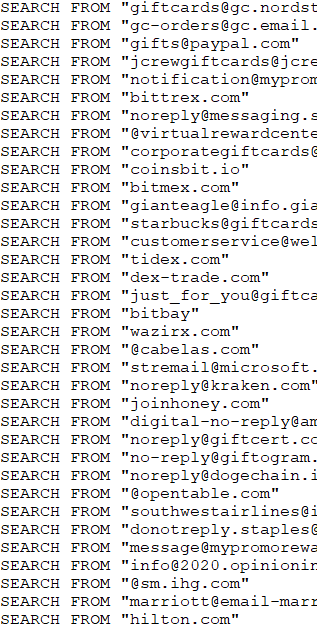
A sample of some of the most frequent search queries made in a single day by the gift card gang against more than 50,000 hacked inboxes.

According to Bill, the fraudsters aren’t downloading all of their victims’ emails: That would quickly add up to a monstrous amount of data. Rather, they’re using automated systems to log in to each inbox and search for a variety of domains and other terms related to companies that maintain loyalty and points programs, and/or issue gift cards and handle their fulfillment.

Why go after hotel or airline rewards? Because these accounts can all be cleaned out and deposited onto a gift card number that can be resold quickly online for 80 percent of its value.

“These guys want that hard digital asset — the cash that is sitting there in your inbox,” Bill said. “You literally just pull cash out of peoples’ inboxes, and then you have all these secondary markets where you can sell this stuff.”

Bill’s data also shows that this gang is so aggressively going after gift card data that it will routinely seek new gift card benefits on behalf of victims, when that option is available.  For example, many companies now offer employees a “wellness benefit” if they can demonstrate they’re keeping up with some kind of healthy new habit, such as daily gym visits, yoga, or quitting smoking.

Bill said these crooks have figured out a way to tap into those benefits as well.

“A number of health insurance companies have wellness programs to encourage employees to exercise more, where if you sign up and pledge to 30 push-ups a day for the next few months or something you’ll get five wellness points towards a $10 Starbucks gift card, which requires 1000 wellness points,” Bill explained. “They’re actually automating the process of replying saying you completed this activity so they can bump up your point balance and get your gift card.”

The Gift Card Gang’s Footprint

How do the compromised email credentials break down in terms of ISPs and email providers? There are victims on nearly all major email networks, but Bill said several large Internet service providers (ISPs) in Germany and France are heavily represented in the compromised email account data.

“With some of these international email providers we’re seeing something like 25,000 to 50,000 email accounts a day get hacked,” Bill said.  “I don’t know why they’re getting popped so heavily.”

That may sound like a lot of hacked inboxes, but Bill said some of the bigger ISPs represented in his data have tens or hundreds of millions of customers.

Measuring which ISPs and email providers have the biggest numbers of compromised customers is not so simple in many cases, nor is identifying companies with employees whose email accounts have been hacked.

This kind of mapping is often more difficult than it used to be because so many organizations have now outsourced their email to cloud services like Gmail and Microsoft Office365 — where users can access their email, files and chat records all in one place.

“It’s a little complicated with Office 365 because it’s one thing to say okay how many Hotmail connections are you seeing per day in all this credential-stuffing activity, and you can see the testing against Hotmail’s site,” Bill said. “But with the IMAP traffic we’re looking at, the usernames being logged into are any of the million or so domains hosted on Office365, many of which will tell you very little about the victim organization itself.”

On top of that, it’s also difficult to know how much activity you’re not seeing.

Looking at the small set of Internet address blocks he knows are associated with Microsoft 365 email infrastructure, Bill examined the IMAP traffic flowing from this group to those blocks. Bill said that in the first week of April 2021, he identified 15,000 compromised Office365 accounts being accessed by this group, spread over 6,500 different organizations that use Office365.

“So I’m seeing this traffic to just like 10 net blocks tied to Microsoft, which means I’m only looking at maybe 25 percent of Microsoft’s infrastructure,” Bill explained. “And with our puny visibility into probably less than one percent of overall password stuffing traffic aimed at Microsoft, we’re seeing 600 Office accounts being breached a day. So if I’m only seeing one percent, that means we’re likely talking about tens of thousands of Office365 accounts compromised daily worldwide.”

In a December 2020 blog post about how Microsoft is moving away from passwords to more robust authentication approaches, the software giant said an average of one in every 250 corporate accounts is compromised each month. As of last year, Microsoft had nearly 240 million active users, according to this analysis.

“To me, this is an important story because for years people have been like, yeah we know email isn’t very secure, but this generic statement doesn’t have any teeth to it,” Bill said. “I don’t feel like anyone has been able to call attention to the numbers that show why email is so insecure.”

Bill says that in general companies have a great many more tools available for securing and analyzing employee email traffic when that access is funneled through a Web page or VPN, versus when that access happens via IMAP.

“It’s just more difficult to get through the Web interface because on a website you have a plethora of advanced authentication controls at your fingertips, including things like device fingerprinting, scanning for http header anomalies, and so on,” Bill said. “But what are the detection signatures you have available for detecting malicious logins via IMAP?”

Microsoft declined to comment specifically on Bill’s research, but said customers can block the overwhelming majority of account takeover efforts by enabling multi-factor authentication.

“For context, our research indicates that multi-factor authentication prevents more than 99.9% of account compromises,” reads a statement from Microsoft. “Moreover, for enterprise customers, innovations like Security Defaults, which disables basic authentication and requires users to enroll a second factor, have already significantly decreased the proportion of compromised accounts. In addition, for consumer accounts, adding a second authentication factor is required on all accounts.”

A Mess That’s Likely to Stay That Way

Bill said he’s frustrated by having such visibility into this credential testing botnet while being unable to do much about it. He’s shared his data with some of the bigger ISPs in Europe, but says months later he’s still seeing those same inboxes being accessed by the gift card gang.

The problem, Bill says, is that many large ISPs lack any sort of baseline knowledge of or useful data about customers who access their email via IMAP. That is, they lack any sort of instrumentation to be able to tell the difference between legitimate and suspicious logins for their customers who read their messages using an email client.

“My guess is in a lot of cases the IMAP servers by default aren’t logging every search request, so [the ISP] can’t go back and see this happening,” Bill said.

Confounding the challenge, there isn’t much of an upside for ISPs interested in voluntarily monitoring their IMAP traffic for hacked accounts.

“Let’s say you’re an ISP that does have the instrumentation to find this activity and you’ve just identified 10,000 of your customers who are hacked. But you also know they are accessing their email exclusively through an email client. What do you do? You can’t flag their account for a password reset, because there’s no mechanism in the email client to affect a password change.”

Which means those 10,000 customers are then going to start receiving error messages whenever they try to access their email.

“Those customers are likely going to get super pissed off and call up the ISP mad as hell,” Bill said. “And that customer service person is then going to have to spend a bunch of time explaining how to use the webmail service. As a result, very few ISPs are going to do anything about this.”

Indictators of Compromise (IoCs)

It’s not often KrebsOnSecurity has occasion to publish so-called “indicators of compromise” (IoC)s, but hopefully some ISPs may find the information here useful. This group automates the searching of inboxes for specific domains and trademarks associated with gift card activity and other accounts with stored electronic value, such as rewards points and mileage programs.

This file includes the top inbox search terms used in a single 24 hour period by the gift card gang. The numbers on the left in the spreadsheet represent the number of times during that 24 hour period where the gift card gang ran a search for that term in a compromised inbox.

Some of the search terms are focused on specific brands — such as Amazon gift cards or Hilton Honors points; others are for major gift card networks like CashStar, which issues cards that are white-labeled by dozens of brands like Target and Nordstrom. Inboxes hacked by this gang will likely be searched on many of these terms over the span of just a few days.

—————
Boost Internet Speed
Free Business Hosting
Free Email Account
Dropcatch
Free Secure Email
Secure Email
Cheap VOIP Calls
Free Hosting
Boost Inflight Wifi
Premium Domains
Free Domains

SEC Sanctions Eight Firms Over Deficient Cybersecurity Procedures

SEC Sanctions Eight Firms Over Deficient Cybersecurity Procedures

The United States Securities and Exchange Commission (SEC) has charged eight companies with cybersecurity failures that led to the exposure of personal information. 

Sanctions against the firms were announced on Monday in the form of three actions against Cetera Advisor Networks LLC, Cetera Investment Services LLC, Cetera Financial Specialists LLC, Cetera Advisors LLC, and Cetera Investment Advisers LLC (collectively, the Cetera Entities); Cambridge Investment Research Inc. and Cambridge Investment Research Advisors Inc. (collectively, Cambridge); and KMS Financial Services Inc. (KMS). 

In a statement released August 30, the SEC said: “The Securities and Exchange Commission today sanctioned eight firms in three actions for failures in their cybersecurity policies and procedures that resulted in email account takeovers exposing the personal information of thousands of customers and clients at each firm.”

All the accused firms were Commission-registered as investment advisory firms, broker dealers, or both. They have all entered into agreements with the SEC to settle the charges laid against them.

An SEC investigation into the cybersecurity of Cetera Entities found that between November 2017 and June 2020, the personally identifying information (PII) of at least 4,388 customers and clients was exposed after the cloud-based email accounts of more than 60 personnel of Cetera Entities were taken over by unauthorized third parties.

Between January 2018 and July 2021, email account takeovers of 121 email accounts belong to Cambridge representatives caused the PII of at least 2,177 Cambridge customers and clients to be exposed. At KMS, between September 2018 and December 2019, 15 financial advisers or their assistants had their email accounts taken over by unauthorized third parties, resulting in the PII exposure of approximately 4,900 KMS customers and clients.

The SEC found that KMS and Cambridge “failed to adopt written policies and procedures requiring additional firm-wide security measures” until August 2020 and 2021, respectively. 

“It is not enough to write a policy requiring enhanced security measures if those requirements are not implemented or are only partially implemented, especially in the face of known attacks,” said Kristina Littman, chief of the SEC Enforcement Division’s Cyber Unit.

Cetera Entities will pay a $300,000 penalty, KMS will pay $200,000, and Cambridge will pay $250,000.

—————
Boost Internet Speed
Free Business Hosting
Free Email Account
Dropcatch
Free Secure Email
Secure Email
Cheap VOIP Calls
Free Hosting
Boost Inflight Wifi
Premium Domains
Free Domains

UK Cyber Security Council Appoints New Chief Executive

UK Cyber Security Council Appoints New Chief Executive

The UK Cyber Security Council has appointed Simon Hepburn as its permanent chief executive.

Hepburn will succeed Don MacIntyre, who was appointed interim CEO of the Council in January 2021, shortly before it launched as an independent organization.

He is tasked with driving forward the remit of the self-regulatory body for the cybersecurity education and skills sector, whose activities are funded by the UK government. This is primarily to represent the cybersecurity profession, drive awareness and excellence across the industry and help close the UK’s cyber skills gap by providing a clear roadmap for those entering or progressing through roles in the sector.

Hepburn has a wealth of experience in developing skills and educational programs across various organizations, including leadership roles at a number of charities. Among his experiences, he founded Black Star Inc., where he advised on diversity and inclusion, leadership and management, people and change, strategy and organization development, careers and employability. He was also UK Director at the international social action charity City Year UK, where he oversaw school partnerships, program design and delivery, leadership program development and mentor experience.  

Commenting on the appointment, Dr. Claudia Natanson, chair of the Board of Trustees of the UK Cyber Security Council, said: “Simon Hepburn’s record is one of delivering at the sharp end of education and careers, for charitable organizations like the Council.

“The Council may well be the voice for the profession, but it is absolutely intended to be a ‘doing’ organization rather than just a ‘talking’ organization, so this attribute made him an excellent candidate for CEO; we welcome his passion and energy and look forward to him driving the organization forwards.”

Hepburn outlined: “I make no secret of my passion for supporting people and organizations to reach their full potential and make a positive contribution to society — it has been at the heart of my career to date. I intend to bring the full weight of that knowledge and experience to bear on the activities of the Council, benefiting the cybersecurity profession.

“I’m excited by the opportunity to work with one of the most critical sectors in our country, delivering education and skills support and resources to organizations and the professionals that are essential to the safe, secure and prosperous operation of the UK economy.”

Last week, the Council announced it had opened its membership application process.

—————
Boost Internet Speed
Free Business Hosting
Free Email Account
Dropcatch
Free Secure Email
Secure Email
Cheap VOIP Calls
Free Hosting
Boost Inflight Wifi
Premium Domains
Free Domains

91% of Industrial Organizations Can Be Penetrated by Hackers

91% of Industrial Organizations Can Be Penetrated by Hackers

More than nine in 10 (91%) industrial organizations are vulnerable to cyber-attacks, according to a new report by Positive Technologies.

The study found that external attackers can penetrate the corporate network in all these organizations, and once inside, can obtain user credentials and complete control over the infrastructure in 100% of cases. In over two-thirds (69%) of these cases, external attackers can steal sensitive data from the organization, including information about partners and company employees and internal documentation.

In addition, penetration testers from Positive Technologies gained access to the technological segment of the network of 75% of organizations. This then enabled them to access industrial control systems (ICS) in 56% of cases.

Once malicious actors gain access to ICS components, they have the opportunity to cause severe damage and even fatalities — this includes shutting down entire productions, causing equipment to fail and triggering industrial accidents.

Positive Technologies said there is a range of factors that are making these organizations vulnerable to hackers. For example, during recent PT NAD pilot projects, its experts uncovered numerous suspicious events in the internal network of each industrial company. In one case, PT NAD registered an RDP connection to an external cloud storage, enabling 23 GB of data to be transferred to the address of this storage via RDP and HTTPS.

The vendor also noted that industrial companies often use outdated software and commonly save connection parameters (username and password) in a remote access authentication form, allowing attackers to connect to the resources of an isolated segment without credentials when they obtain control over such a computer.

The potential impact of an attack on an industrial organization was demonstrated during a virtual cyber-range at The Standoff 2021. In one scenario, within two days, attackers gained control of the gas station, halting the gas supply and causing an explosion.

Olga Zinenko, senior analyst at Positive Technologies, commented: “Today, the level of cybersecurity at most industrial companies is too low for comfort. In most cases, internet-accessible external network perimeters contain weak protection, device configurations contain flaws, and we find a low level of ICS network security and the use of dictionary passwords and outdated software versions present risks.”

—————
Boost Internet Speed
Free Business Hosting
Free Email Account
Dropcatch
Free Secure Email
Secure Email
Cheap VOIP Calls
Free Hosting
Boost Inflight Wifi
Premium Domains
Free Domains

Ransomware Attacks Soar 288% in First Half of 2021

Ransomware Attacks Soar 288% in First Half of 2021

The number of ransomware attacks surged by 288% between the first and second quarters of 2021 as double extortion attempts grew, according to the latest data from NCC Group.

Analyzing incidents dealt with by its own Research Intelligence and Fusion Team (RIFT) throughout 2021, the firm claimed nearly a quarter (22%) of data leaks in the second quarter came from the Conti group.

Conti typically gains initial network access to victim organizations via phishing emails, it claimed.

Next came Avaddon, which accounted for 17% of incidents, although this variant is now thought to be inactive.

Unsurprisingly, nearly half (49%) of victims with known locations in Q2 were based in the US, followed by 7% in France and 4% in Germany.

Christo Butcher, global lead for threat intelligence at NCC Group, argued that no organization in any sector is safe from ransomware today.

“We’ve seen targets range from IT companies and suppliers to financial institutions and critical national infrastructure providers, with ransomware-as-a-service increasingly being sold by ransomware gangs in a subscription model,” he added.

“It’s therefore crucial for organizations to be proactive about their resilience. This should include proactive remediation of security issues, and operating a least-privilege model, which means that if a user’s account is compromised, the attacker will only be able to access and/or destroy a limited amount of information.”

According to separate data from Group-IB, ransomware attacks grew by 150% year-on-year in 2020, with the average extortion amount doubling.

However, it’s difficult to get an accurate vendor-neutral picture of how threats are developing over time. Coveware, for example, maintains that despite the ramping up of media coverage since the Colonial Pipeline incident, “in reality, the volume and severity of ransomware attacks have been extreme but relatively stable for at least 18 months.”

This week, the FBI and Cybersecurity and Infrastructure Security Agency (CISA) released an alert warning organizations to plan for possible threat activity ahead of weekends and holidays.

—————
Boost Internet Speed
Free Business Hosting
Free Email Account
Dropcatch
Free Secure Email
Secure Email
Cheap VOIP Calls
Free Hosting
Boost Inflight Wifi
Premium Domains
Free Domains

CISA: Plan Now to Avoid Labor Day Breach

CISA: Plan Now to Avoid Labor Day Breach

The US authorities have used the week before Labor Day to warn organizations about the risk of cyber-threats timed to coincide with holidays and weekends.

The FBI and Cybersecurity and Infrastructure Security Agency (CISA) alert noted that ransomware attacks in particular are more likely to hit home on these days, when offices are closed and IT incident responders will not be at their desks.

Most recently, the major Kaseya supply chain attack on MSPs and their downstream customers occurred over the July 4 weekend in the US. On Memorial Day weekend, there was an attack on meat processing giant JBS USA, while the infamous Colonial Pipeline outage began on the Mother’s Day weekend in the US.

Although the agencies don’t have any intelligence suggesting a similar attack this coming weekend, it urged public and private sector organizations to be alert in the days preceding.

They flagged the following as among the main tactics for ransomware threat actors: phishing and brute forcing unsecured remote desktop protocol (RDP) endpoints; deploying dropper malware for reconnaissance and other tasks; exploitation of vulnerabilities and MSPs; and use of credentials purchased on the dark web.

The alert suggests a number of mitigations for organizations, including offline backups, securing RDP, vulnerability scans and patching, multi-factor authentication, network segmentation, and user training on phishing awareness.

It also suggested organizations engage in “pre-emptive” threat-hunting on their networks to spot the signs of suspicious activity and mitigate attacks before they cause any damage.

“Threat actors can be present on a victim network long before they lock down a system, alerting the victim to the ransomware attack,” it said. “Threat actors often search through a network to find and compromise the most critical or lucrative targets. Many will exfiltrate large amounts of data.”

Jake Williams, co-founder and CTO at incident response specialist, BreachQuest, argued that most ransomware attacks could be thwarted by following CISA’s advice.

“This is especially true for reviewing logs. Threat actors could certainly perform lateral movement while staying out of logs, but with the plethora of potential victims with horrible cyber-hygiene there’s currently no need to do so,” he added.

“Extremely basic levels of cybersecurity hygiene and monitoring are enough to achieve early detection of today’s ransomware adversaries.”

—————
Boost Internet Speed
Free Business Hosting
Free Email Account
Dropcatch
Free Secure Email
Secure Email
Cheap VOIP Calls
Free Hosting
Boost Inflight Wifi
Premium Domains
Free Domains