Law enforcers have arrested nine suspected members of a prolific cyber-fraud gang
—————
Free Secure Email – Transcom Sigma
Boost Inflight Internet
Transcom Hosting
Transcom Premium Domains
—————
Free Secure Email – Transcom Sigma
Boost Inflight Internet
Transcom Hosting
Transcom Premium Domains
—————
Free Secure Email – Transcom Sigma
Boost Inflight Internet
Transcom Hosting
Transcom Premium Domains
The debate over professionalizing software engineers is decades old. (The basic idea is that, like lawyers and architects, there should be some professional licensing requirement for software engineers.) Here’s a law journal article recommending the same idea for AI engineers.
This Article proposes another way: professionalizing AI engineering. Require AI engineers to obtain licenses to build commercial AI products, push them to collaborate on scientifically-supported, domain-specific technical standards, and charge them with policing themselves. This Article’s proposal addresses AI harms at their inception, influencing the very engineering decisions that give rise to them in the first place. By wresting control over information and system design away from companies and handing it to AI engineers, professionalization engenders trustworthy AI by design. Beyond recommending the specific policy solution of professionalization, this Article seeks to shift the discourse on AI away from an emphasis on light-touch, ex post solutions that address already-created products to a greater focus on ex ante controls that precede AI development. We’ve used this playbook before in fields requiring a high level of expertise where a duty to the public welfare must trump business motivations. What if, like doctors, AI engineers also vowed to do no harm?
I have mixed feelings about the idea. I can see the appeal, but it never seemed feasible. I’m not sure it’s feasible today.
—————
Free Secure Email – Transcom Sigma
Boost Inflight Internet
Transcom Hosting
Transcom Premium Domains
As the tax season draws near, the incidence of cybercrime, particularly phishing for W-2s, tends to increase dramatically. Cybercriminals are aware that this is the time of year when many unsuspecting individuals are completing their tax returns, and they design schemes to exploit this vulnerability. This blog raises awareness about this growing problem and offers practical advice for keeping your financial data safe during tax season.
W-2 phishing scams often involve emails that appear to be from the IRS or another official source, requesting personal information. These phishing emails can be highly sophisticated, often mimicking the look and feel of legitimate communications. The goal is to trick the recipient into revealing confidential data, such as social security numbers and financial information, which the perpetrator can then use for fraudulent purposes. The first step in protecting against such scams is understanding how they work and being able to recognize the red flags.
Phishing scams are fundamentally deception tactics—disguised as legitimate correspondence, they aim to trick the recipient into parting with sensitive information. In the case of W-2 phishing scams, the perpetrator often poses as an employer, government agency, or financial institution. The message may request that the recipient update their personal information, verify their identity, or provide their W-2 form. Typically, these emails have a sense of urgency, indicating that failure to comply will result in adverse consequences.
The contents of a phishing email are often compelling and appear to be authentic. They may contain official logos, legal disclaimers, and even legitimate contact details. However, closer examination often reveals telltale signs of phishing. For example, the email address of the sender may not match the organization they claim to represent, or the message may contain poor grammar and spelling. Additionally, phishing emails often require the recipient to click a link or open an attachment—actions that could potentially install malware on the victim’s device or redirect them to a fraudulent website.
McAfee Pro Tip: Nowadays, those sneaky social engineering tricks look a lot like legit messages from well-known folks. They’re super well-crafted, with proper grammar, and seamlessly fit into everyday situations. But don’t be fooled by their slick appearance – underneath it all, they’re still after your sensitive info. Keep your personal stuff safe and sound with McAfee+ to dodge the headaches that come with social engineering.
Recent years have seen a significant increase in the number of reported W-2 phishing scams. According to the FBI’s Internet Crime Complaint Center (IC3), thousands of these scams occur every tax season, leading to substantial financial losses and ID theft. Not only does this affect individuals, but businesses too. In fact, some companies have reported instances where their entire workforce was targeted, resulting in massive data breaches.
The impact of falling for a W-2 phishing scam can be devastating. Once cybercriminals have gained access to your financial data, they can use it in a variety of malicious ways. This may include filing fraudulent tax returns, opening new credit accounts, or even selling the information on the black market. The recovery process from such scams can be lengthy and stressful, as victims have to prove their identity to the IRS, their bank, and credit reporting agencies. Additionally, they need to monitor their financial activity closely for signs of any further unauthorized transactions or fraudulent activities.
→ Dig Deeper: Watch Out For IRS Scams and Avoid Identity Theft
Given the prevalence and potential impact of W-2 phishing scams, it’s crucial to take steps to protect yourself. One of the most effective strategies is to improve your digital literacy, namely your ability to identify and respond appropriately to phishing attempts. This includes being skeptical of unsolicited emails, especially those that ask for personal or financial information. Always verify the sender’s identity before responding or clicking any links. Remember, legitimate organizations rarely request sensitive information via email.
Another important safeguard is to ensure your computer and mobile devices are protected with up-to-date security software. This can help identify and block potential phishing emails and malicious links. Further, regularly backing up data can help mitigate the potential damage caused by a successful breach. Consider using a secure cloud service or an external storage device for this purpose.
Next is to file your tax returns as early as possible. By doing so, you can beat the scammers who might make an attempt to file a fraudulent tax return in your name. Additionally, if you receive an email that appears suspicious, do not click on the links or download the attachments included in that email. Instead, forward the suspicious email to phishing@irs.gov.
Finally, two-factor authentication (2FA) is another excellent way to safeguard your data. By enabling 2FA, you are adding an extra layer of security that makes it harder for cybercriminals to access your data even if they get your password. Additionally, always be cautious about sharing your personal and financial information online. Make sure that you only enter such information on secure websites – those with ‘https://’ in the URL. Regularly check your financial accounts for any suspicious activity and report immediately to your bank if you notice anything unusual.
If you believe you have fallen victim to a W-2 phishing scam, it is crucial to act quickly. If you have divulged your social security number, contact the IRS immediately. They can aid you in taking steps to prevent potential tax fraud. Additionally, it would be wise to file an identity theft affidavit (Form 14039) with the IRS. This form alerts the IRS to the theft of your identity and allows them to secure your tax account.
Additionally, you should report the phishing scam to the Federal Trade Commission (FTC) using the FTC Complaint Assistant at FTC.gov. If you have clicked on a link or downloaded a suspicious attachment, run a full antivirus scan to check for malware. You should also consider placing a fraud alert or a credit freeze on your credit reports, which makes it harder for someone to open a new account in your name. Finally, you should check your credit reports frequently for any signs of fraudulent activity.
→Dig Deeper: Credit Lock and Credit Freeze: Which Service Is Best for You? Both!
Protecting your financial data during tax season is crucial, and being aware of phishing scams can save you from a world of trouble. By understanding the nature of W-2 phishing scams and implementing the above-mentioned best practices, you can keep your sensitive information safe. Remember to always be skeptical of unsolicited emails and never share personal or financial information unless you can confirm the legitimacy of the request. By doing so, you will not only protect yourself but also contribute to the collective fight against cybercrime.
Protecting your W-2 information during tax season is not a one-time effort but a continuous process. Always stay vigilant, and remember that it’s better to be safe than sorry. If you ever suspect that you have become a victim of a W-2 phishing scam, take prompt action by reporting it to the relevant authorities and taking necessary measures to mitigate possible damages. The key to staying safe is staying informed, vigilant, and prepared.
The post Phishing for W-2s: Keeping Your Financial Data Safe During Tax Season appeared first on McAfee Blog.
—————
Free Secure Email – Transcom Sigma
Boost Inflight Internet
Transcom Hosting
Transcom Premium Domains
—————
Free Secure Email – Transcom Sigma
Boost Inflight Internet
Transcom Hosting
Transcom Premium Domains
—————
Free Secure Email – Transcom Sigma
Boost Inflight Internet
Transcom Hosting
Transcom Premium Domains
A new species of squid was discovered, along with about a hundred other species.
As usual, you can also use this squid post to talk about the security stories in the news that I haven’t covered.
Read my blog posting guidelines here.
—————
Free Secure Email – Transcom Sigma
Boost Inflight Internet
Transcom Hosting
Transcom Premium Domains
BleepingComputer has the details. It’s $2M less than in 2022, but it’s still a lot.
The highest reward for a vulnerability report in 2023 was $113,337, while the total tally since the program’s launch in 2010 has reached $59 million.
For Android, the world’s most popular and widely used mobile operating system, the program awarded over $3.4 million.
Google also increased the maximum reward amount for critical vulnerabilities concerning Android to $15,000, driving increased community reports.
During security conferences like ESCAL8 and hardwea.io, Google awarded $70,000 for 20 critical discoveries in Wear OS and Android Automotive OS and another $116,000 for 50 reports concerning issues in Nest, Fitbit, and Wearables.
Google’s other big software project, the Chrome browser, was the subject of 359 security bug reports that paid out a total of $2.1 million.
Slashdot thread.
—————
Free Secure Email – Transcom Sigma
Boost Inflight Internet
Transcom Hosting
Transcom Premium Domains
The nonprofit organization that supports the Firefox web browser said today it is winding down its new partnership with Onerep, an identity protection service recently bundled with Firefox that offers to remove users from hundreds of people-search sites. The move comes just days after a report by KrebsOnSecurity forced Onerep’s CEO to admit that he has founded dozens of people-search networks over the years.
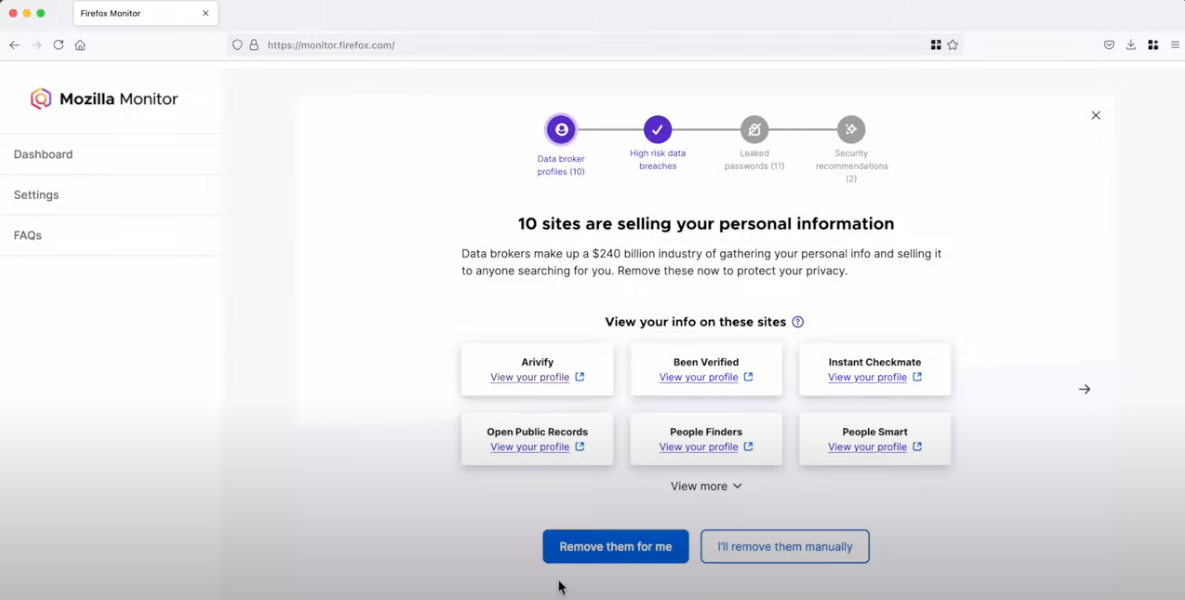
Mozilla Monitor. Image Mozilla Monitor Plus video on Youtube.
Mozilla only began bundling Onerep in Firefox last month, when it announced the reputation service would be offered on a subscription basis as part of Mozilla Monitor Plus. Launched in 2018 under the name Firefox Monitor, Mozilla Monitor also checks data from the website Have I Been Pwned? to let users know when their email addresses or password are leaked in data breaches.
On March 14, KrebsOnSecurity published a story showing that Onerep’s Belarusian CEO and founder Dimitiri Shelest launched dozens of people-search services since 2010, including a still-active data broker called Nuwber that sells background reports on people. Onerep and Shelest did not respond to requests for comment on that story.
But on March 21, Shelest released a lengthy statement wherein he admitted to maintaining an ownership stake in Nuwber, a consumer data broker he founded in 2015 — around the same time he launched Onerep.
Shelest maintained that Nuwber has “zero cross-over or information-sharing with Onerep,” and said any other old domains that may be found and associated with his name are no longer being operated by him.
“I get it,” Shelest wrote. “My affiliation with a people search business may look odd from the outside. In truth, if I hadn’t taken that initial path with a deep dive into how people search sites work, Onerep wouldn’t have the best tech and team in the space. Still, I now appreciate that we did not make this more clear in the past and I’m aiming to do better in the future.” The full statement is available here (PDF).
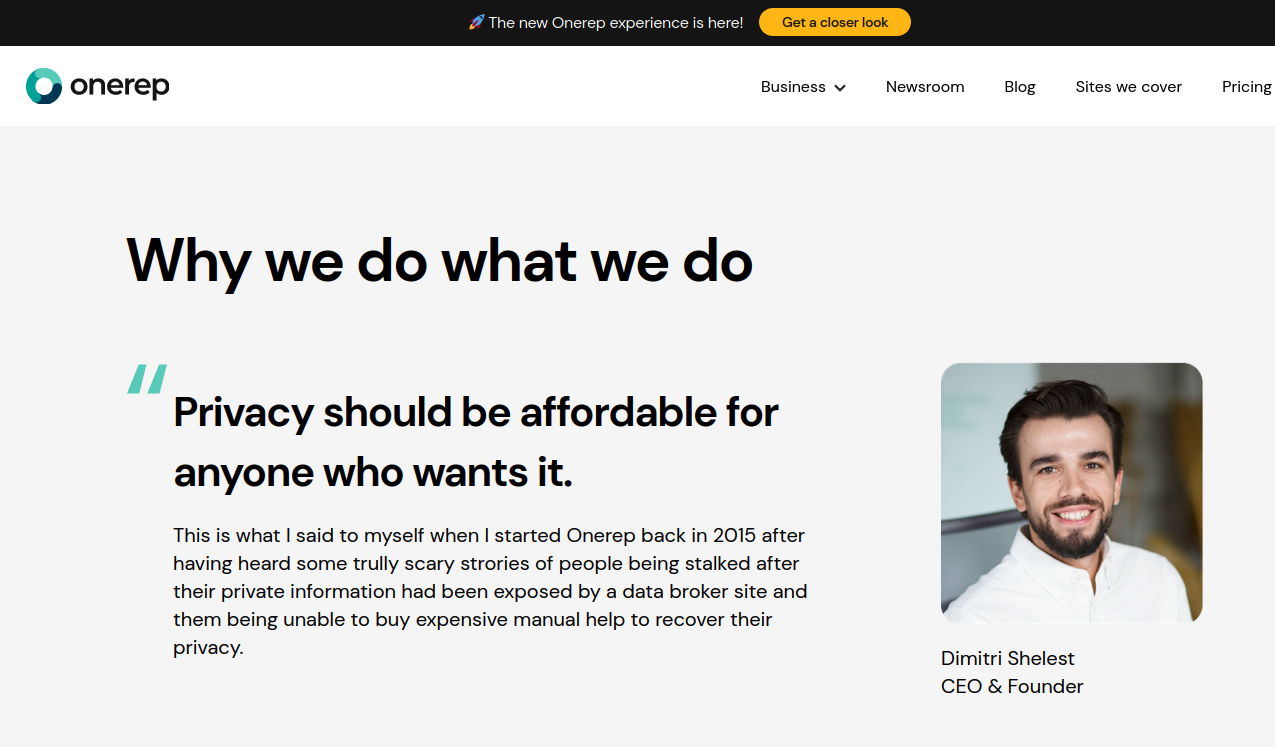
Onerep CEO and founder Dimitri Shelest.
In a statement released today, a spokesperson for Mozilla said it was moving away from Onerep as a service provider in its Monitor Plus product.
“Though customer data was never at risk, the outside financial interests and activities of Onerep’s CEO do not align with our values,” Mozilla wrote. “We’re working now to solidify a transition plan that will provide customers with a seamless experience and will continue to put their interests first.”
KrebsOnSecurity also reported that Shelest’s email address was used circa 2010 by an affiliate of Spamit, a Russian-language organization that paid people to aggressively promote websites hawking male enhancement drugs and generic pharmaceuticals. As noted in the March 14 story, this connection was confirmed by research from multiple graduate students at my alma mater George Mason University.
Shelest denied ever being associated with Spamit. “Between 2010 and 2014, we put up some web pages and optimize them — a widely used SEO practice — and then ran AdSense banners on them,” Shelest said, presumably referring to the dozens of people-search domains KrebsOnSecurity found were connected to his email addresses (dmitrcox@gmail.com and dmitrcox2@gmail.com). “As we progressed and learned more, we saw that a lot of the inquiries coming in were for people.”
Shelest also acknowledged that Onerep pays to run ads on “on a handful of data broker sites in very specific circumstances.”
“Our ad is served once someone has manually completed an opt-out form on their own,” Shelest wrote. “The goal is to let them know that if they were exposed on that site, there may be others, and bring awareness to there being a more automated opt-out option, such as Onerep.”
Reached via Twitter/X, HaveIBeenPwned founder Troy Hunt said he knew Mozilla was considering a partnership with Onerep, but that he was previously unaware of the Onerep CEO’s many conflicts of interest.
“I knew Mozilla had this in the works and we’d casually discussed it when talking about Firefox monitor,” Hunt told KrebsOnSecurity. “The point I made to them was the same as I’ve made to various companies wanting to put data broker removal ads on HIBP: removing your data from legally operating services has minimal impact, and you can’t remove it from the outright illegal ones who are doing the genuine damage.”
Playing both sides — creating and spreading the same digital disease that your medicine is designed to treat — may be highly unethical and wrong. But in the United States it’s not against the law. Nor is collecting and selling data on Americans. Privacy experts say the problem is that data brokers, people-search services like Nuwber and Onerep, and online reputation management firms exist because virtually all U.S. states exempt so-called “public” or “government” records from consumer privacy laws.
Those include voting registries, property filings, marriage certificates, motor vehicle records, criminal records, court documents, death records, professional licenses, and bankruptcy filings. Data brokers also can enrich consumer records with additional information, by adding social media data and known associates.
The March 14 story on Onerep was the second in a series of three investigative reports published here this month that examined the data broker and people-search industries, and highlighted the need for more congressional oversight — if not regulation — on consumer data protection and privacy.
On March 8, KrebsOnSecurity published A Close Up Look at the Consumer Data Broker Radaris, which showed that the co-founders of Radaris operate multiple Russian-language dating services and affiliate programs. It also appears many of their businesses have ties to a California marketing firm that works with a Russian state-run media conglomerate currently sanctioned by the U.S. government.
On March 20, KrebsOnSecurity published The Not-So-True People-Search Network from China, which revealed an elaborate web of phony people-search companies and executives designed to conceal the location of people-search affiliates in China who are earning money promoting U.S. based data brokers that sell personal information on Americans.
—————
Free Secure Email – Transcom Sigma
Boost Inflight Internet
Transcom Hosting
Transcom Premium Domains
—————
Free Secure Email – Transcom Sigma
Boost Inflight Internet
Transcom Hosting
Transcom Premium Domains