“Up to $10 million for information that leads to the arrest and/or conviction of this defendant.”
—————
Free Secure Email – Transcom Sigma
Boost Inflight Internet
Transcom Hosting
Transcom Premium Domains
—————
Free Secure Email – Transcom Sigma
Boost Inflight Internet
Transcom Hosting
Transcom Premium Domains
Microsoft is currently patching a zero-day Secure-Boot bug.
The BlackLotus bootkit is the first-known real-world malware that can bypass Secure Boot protections, allowing for the execution of malicious code before your PC begins loading Windows and its many security protections. Secure Boot has been enabled by default for over a decade on most Windows PCs sold by companies like Dell, Lenovo, HP, Acer, and others. PCs running Windows 11 must have it enabled to meet the software’s system requirements.
Microsoft says that the vulnerability can be exploited by an attacker with either physical access to a system or administrator rights on a system. It can affect physical PCs and virtual machines with Secure Boot enabled.
That’s important. This is a nasty vulnerability, but it takes some work to exploit it.
The problem with the patch is that it breaks backwards compatibility: “…once the fixes have been enabled, your PC will no longer be able to boot from older bootable media that doesn’t include the fixes.”
And:
Not wanting to suddenly render any users’ systems unbootable, Microsoft will be rolling the update out in phases over the next few months. The initial version of the patch requires substantial user intervention to enable—you first need to install May’s security updates, then use a five-step process to manually apply and verify a pair of “revocation files” that update your system’s hidden EFI boot partition and your registry. These will make it so that older, vulnerable versions of the bootloader will no longer be trusted by PCs.
A second update will follow in July that won’t enable the patch by default but will make it easier to enable. A third update in “first quarter 2024” will enable the fix by default and render older boot media unbootable on all patched Windows PCs. Microsoft says it is “looking for opportunities to accelerate this schedule,” though it’s unclear what that would entail.
So it’ll be almost a year before this is completely fixed.
—————
Free Secure Email – Transcom Sigma
Boost Inflight Internet
Transcom Hosting
Transcom Premium Domains
—————
Free Secure Email – Transcom Sigma
Boost Inflight Internet
Transcom Hosting
Transcom Premium Domains
—————
Free Secure Email – Transcom Sigma
Boost Inflight Internet
Transcom Hosting
Transcom Premium Domains
—————
Free Secure Email – Transcom Sigma
Boost Inflight Internet
Transcom Hosting
Transcom Premium Domains
—————
Free Secure Email – Transcom Sigma
Boost Inflight Internet
Transcom Hosting
Transcom Premium Domains
—————
Free Secure Email – Transcom Sigma
Boost Inflight Internet
Transcom Hosting
Transcom Premium Domains
—————
Free Secure Email – Transcom Sigma
Boost Inflight Internet
Transcom Hosting
Transcom Premium Domains
—————
Free Secure Email – Transcom Sigma
Boost Inflight Internet
Transcom Hosting
Transcom Premium Domains
A Russian man identified by KrebsOnSecurity in January 2022 as a prolific and vocal member of several top ransomware groups was the subject of two indictments unsealed by the Justice Department today. U.S. prosecutors say Mikhail Pavolovich Matveev, a.k.a. “Wazawaka” and “Boriselcin” worked with three different ransomware gangs that extorted hundreds of millions of dollars from companies, schools, hospitals and government agencies.
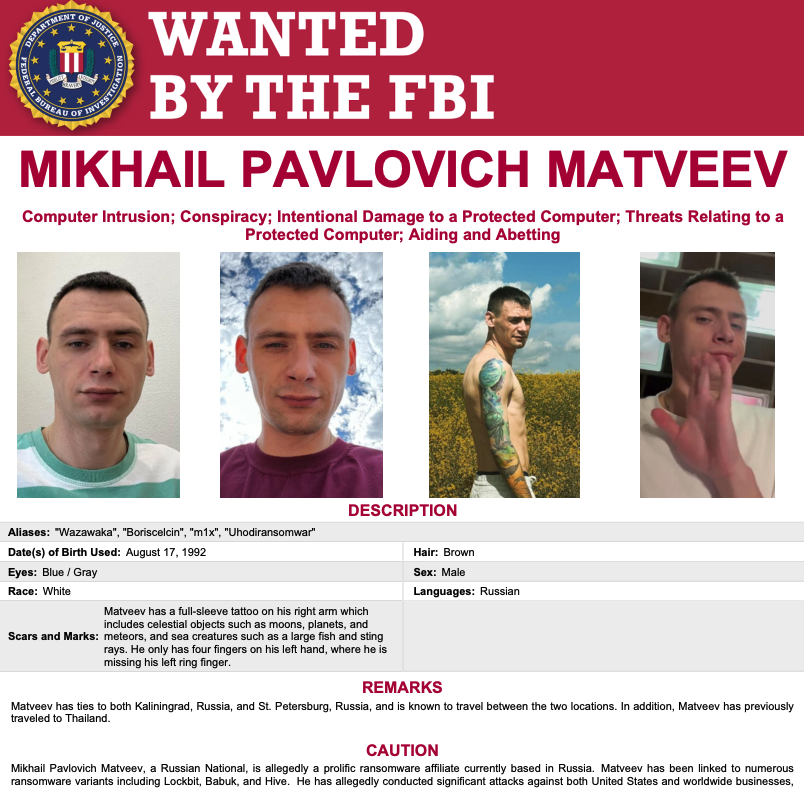
An FBI wanted poster for Matveev.
Indictments returned in New Jersey and the District of Columbia allege that Matveev was involved in a conspiracy to distribute ransomware from three different strains or affiliate groups, including Babuk, Hive and LockBit.
The indictments allege that on June 25, 2020, Matveev and his LockBit co-conspirators deployed LockBit ransomware against a law enforcement agency in Passaic County, New Jersey. Prosecutors say that on May 27, 2022, Matveev conspired with Hive to ransom a nonprofit behavioral healthcare organization headquartered in Mercer County, New Jersey. And on April 26, 2021, Matveev and his Babuk gang allegedly deployed ransomware against the Metropolitan Police Department in Washington, D.C.
Meanwhile, the U.S. Department of Treasury has added Matveev to its list of persons with whom it is illegal to transact financially. Also, the U.S. State Department is offering a $10 million reward for the capture and/or prosecution of Matveev, although he is unlikely to face either as long as he continues to reside in Russia.
In a January 2021 discussion on a top Russian cybercrime forum, Matveev’s alleged alter ego Wazawaka said he had no plans to leave the protection of “Mother Russia,” and that traveling abroad was not an option for him.
“Mother Russia will help you,” Wazawaka concluded. “Love your country, and you will always get away with everything.”
In January 2022, KrebsOnSecurity published Who is the Network Access Broker ‘Wazawaka,’ which followed clues from Wazawaka’s many pseudonyms and contact details on the Russian-language cybercrime forums back to a 33-year-old Mikhail Matveev from Abaza, RU (the FBI says his date of birth is Aug. 17, 1992).
A month after that story ran, a man who appeared identical to the social media photos for Matveev began posting on Twitter a series of bizarre selfie videos in which he lashed out at security journalists and researchers (including this author), while using the same Twitter account to drop exploit code for a widely-used virtual private networking (VPN) appliance.
“Hello Brian Krebs! You did a really great job actually, really well, fucking great — it’s great that journalism works so well in the US,” Matveev said in one of the videos. “By the way, it is my voice in the background, I just love myself a lot.”
Prosecutors allege Matveev used a dizzying stream of monikers on the cybercrime forums, including “Boriselcin,” a talkative and brash personality who was simultaneously the public persona of Babuk, a ransomware affiliate program that surfaced on New Year’s Eve 2020.
Previous reporting here revealed that Matveev’s alter egos included “Orange,” the founder of the RAMP ransomware forum. RAMP stands for “Ransom Anon Market Place, and analysts at the security firm Flashpoint say the forum was created “directly in response to several large Dark Web forums banning ransomware collectives on their site following the Colonial Pipeline attack by ransomware group ‘DarkSide.”
As noted in last year’s investigations into Matveev, his alleged cybercriminal handles all were driven by a uniquely communitarian view that when organizations being held for ransom decline to cooperate or pay up, any data stolen from the victim should be published on the Russian cybercrime forums for all to plunder — not privately sold to the highest bidder.
In thread after thread on the crime forum XSS, Matveev’s alleged alias “Uhodiransomwar” could be seen posting download links to databases from companies that have refused to negotiate after five days.
Matveev is charged with conspiring to transmit ransom demands, conspiring to damage protected computers, and intentionally damaging protected computers. If convicted, he faces more than 20 years in prison.
Further reading:
Who is the Network Access Broker “Wazawaka?”
The New Jersey indictment against Matveev (PDF)
The indictment from the U.S. attorney’s office in Washington, D.C. (PDF)
—————
Free Secure Email – Transcom Sigma
Boost Inflight Internet
Transcom Hosting
Transcom Premium Domains