Kaspersky also observed an increase in the number of programs that can steal secrets
—————
Free Secure Email – Transcom Sigma
Boost Inflight Internet
Transcom Hosting
Transcom Premium Domains
—————
Free Secure Email – Transcom Sigma
Boost Inflight Internet
Transcom Hosting
Transcom Premium Domains
Most every parent loves a new school year. Most likely because the beloved milestone offers us a clean slate and a chance to do things better, shape new habits, and close those digital safety gaps.
The hope that fuels change is a powerful thing. However, if you want to ensure your new habits stick, there’s some science you might consider. Psychologists suggest that to make a new change permanent, you should start with smaller, micro-size choices that will lead to sustainable patterns and habits. Micro habits allow you to take safe steps that are too small to fail but effective enough to generate long-term change.
Breaking down the task online safety into bite-sized pieces is a great approach for parents eager to put better habits into play this year. Establishing new ground rules doesn’t have to include restrictions, tantrums, or tears. You can start small, commit to work together, and build your new habits over time.
So often in this blog we offer a combination of practical digital tips proven to work such as robust password protocols, privacy settings, parental controls, smart phone protection, and social network/app safety.
Today, however, we will flip that approach and give you some foundations that will no doubt support and amplify your family’s daily online safety efforts. Ready? Here we go!
We’re all connected 24/7 but to what? Equipping kids to make wise decisions online begins with intentional, face-to-face connection at home with a parent or caregiver. When the parent-child relationship is strong, trust grows, and conversation flows. If and when a challenge arises, your child is more likely to turn to you.
Micro-habit: If your family doesn’t eat dinner together, start with one night a week (stay consistent with the day). Make the dinner table a no-phone zone and spend that time together listening and connecting. Build from there.
The new school year is a chance to get more involved with your child’s day-to-day communities (on and offline), including their teachers, friend groups, or hobbies. If you’ve been on the sidelines in the past, taking a few steps into their world can give you an exceptional understanding of their online life. Knowing where they go and who they know online has never been more critical, as outlined in our recent Connected Family Report.
Micro-habit: Does your child have a favorite app? Download it, look around, and understand the culture.
Summer—coupled with extra time online (often unmonitored)—can wreak havoc on a child’s sleep patterns, which, in turn, wreaks havoc on a family. If you have a tween or teen, ensuring they get the required hours of sleep is a significant way to keep them safe online. Think about it. Fatigue can impair judgment, increase anxiety, impact grades, and magnify moodiness, putting a child’s physical and emotional wellbeing at risk online and off.
Micro-habit: Think about setting a phone curfew that everyone agrees on. Giving your child input into the curfew makes it less of a restriction and more of a health or lifestyle shift. Remember, your child’s device is their lifeline to their peers so cutting them off isn’t a long-term solution.
With kids spending so much time on apps like TikTok, Instagram, Snapchat, and YouTube, those platforms inevitably influence your child more than just about anyone. Be on the lookout for behavior changes in your child that may be connected to digital risks such as cyberbullying, sextortion, gaming addiction, inappropriate content, or connecting with strangers.
Micro-habit: Consider setting time limits that allow your child to enjoy their online hangouts without being consumed or overly influenced by the wrong voices. Apply limits in small blocks at first and grow from there.
Balancing your online life with face-to-face activities and relationships is a must for your child’s physical and emotional wellbeing. But sometimes, striving for that balance can feel overwhelming. Being too stringent can cause big plans to collapse, sending our behaviors in the opposite direction. Balance requires constant re-calibration and pausing to take those small bites.
Micro-habit: Commit to one family outdoor activity together a month. Take a hike, learn to fish, take up tennis. Make the outings phone-free zones. Be consistent with your monthly micro-habit and build from there.
It’s been proven that any change you attempt to make ignites a degree of friction. And prolonged friction can discourage your efforts to stick to new habits. Ignore that noise and keep moving forward. Stay the course parents because this is the year your best intentions take shape.
The post Kicking Off a New School Year with New Online Habits appeared first on McAfee Blog.
—————
Free Secure Email – Transcom Sigma
Boost Inflight Internet
Transcom Hosting
Transcom Premium Domains
—————
Free Secure Email – Transcom Sigma
Boost Inflight Internet
Transcom Hosting
Transcom Premium Domains
—————
Free Secure Email – Transcom Sigma
Boost Inflight Internet
Transcom Hosting
Transcom Premium Domains
—————
Free Secure Email – Transcom Sigma
Boost Inflight Internet
Transcom Hosting
Transcom Premium Domains
—————
Free Secure Email – Transcom Sigma
Boost Inflight Internet
Transcom Hosting
Transcom Premium Domains
—————
Free Secure Email – Transcom Sigma
Boost Inflight Internet
Transcom Hosting
Transcom Premium Domains
—————
Free Secure Email – Transcom Sigma
Boost Inflight Internet
Transcom Hosting
Transcom Premium Domains
—————
Free Secure Email – Transcom Sigma
Boost Inflight Internet
Transcom Hosting
Transcom Premium Domains
A 21-year-old New Jersey man has been arrested and charged with stalking in connection with a federal investigation into groups of cybercriminals who are settling scores by hiring people to carry out physical attacks on their rivals. Prosecutors say the defendant recently participated in several of these schemes — including firing a handgun into a Pennsylvania home and torching a residence in another part of the state with a Molotov Cocktail.
Patrick McGovern-Allen of Egg Harbor Township, N.J. was arrested on Aug. 12 on a warrant from the U.S. Federal Bureau of Investigation. An FBI complaint alleges McGovern-Allen was part of a group of co-conspirators who are at the forefront of a dangerous escalation in coercion and intimidation tactics increasingly used by competing cybercriminal groups.
Prosecutors say that around 2 a.m. on Jan 2, 2022, McGovern-Allen and an unidentified co-conspirator fired multiple handgun rounds into a residence in West Chester, Pa. Fortunately, none of the residents inside the home at the time were injured. But prosecutors say the assailants actually recorded video of the attack as “proof” that the shooting had been carried out.
A copy of that video was obtained by KrebsOnSecurity. According to investigators, McGovern-Allen was one of the shooters, who yelled “Justin Active was here” as they haphazardly fired at least eight rounds into the lower story of the West Chester residence.
On Dec. 18, 2021, police in Abington Township, Pa., responded to reports of a house fire from homeowners who said it sounded like something was thrown at their residence just prior to the fire.
Weeks later, on the day of the shooting in West Chester, a detective with the Westtown East Goshen Police Department contacted the Abington police and shared another video that was circulating on several online message boards that appeared to show two individuals setting fire to the Abington Township residence. The criminal complaint said the two police officers agreed the same suspect was present in both videos.
A copy of that video also was obtained by KrebsOnSecurity, and it shows at least two individuals smashing a window, then lighting a rag-soaked Mad Dog 20/20 grape wine bottle and hurling it at the side of the home [Update: My apologies for the file download link, but YouTube just deleted both of the videos included in this story — for allegedly violating their community standards].
“The Molotov cocktail caused the immediate surrounding area to ignite, including the siding of the house, grass, and the wooden chair,” the government’s complaint against McGovern-Allen states. “The two suspects then fled on foot toward the street and begin yelling something when the video stops.”
The government mentions the victims only by their initials — “K.M.” in the shooting and “A.R.” in the firebombing — but said both had been the target of previous harassment by rival cybercriminal groups that included swatting attacks, wherein the perpetrators spoof a distress call to the police about a hostage situation, suicide or bomb threat with the goal of sending a heavily-armed police response to a targeted address.
A number of previous swatting incidents have turned deadly. But these more “hands-on” and first person attacks are becoming increasingly common within certain cybercriminal communities, particularly those engaged in SIM swapping, a crime in which identity thieves hijack a target’s mobile phone number and use that to wrest control over the victim’s various online accounts and identities.
The complaint mentions a handle and user ID allegedly used by McGovern-Allen’s online persona “Tongue” on the Discord chat service, (user: “Tongue#0001”).
“In the chats, [Tongue] tells other Discord users that he was the person who shot K.M.’s house and that he was willing to commit firebombings using Molotov Cocktails,” the complaint alleges. “For example, in one Discord chat from March 2022, [the defendant] states ‘if you need anything done for $ lmk [“let me know”]/I did a shooting/Molotov/but I can also do things for ur entertainment.”
KrebsOnsecurity reviewed hundreds of chat records tied to this Tongue alias, and it appears both attacks were motivated by a desire to get back at a rival cybercriminal by attacking the female friends of that rival.
Recall that the shooters in the West Chester, Pa. incident shouted “Justin Active was here.” Justin Active is the nickname of an individual who is just as active in the same cybercriminal channels, but who has vehemently denied knowledge of or participation in the shooting. Justin Active said on Telegram that the person targeted in the shooting was his ex-girlfriend, and that the firebombing targeted another friend of his.
Justin Active has claimed for months that McGovern-Allen was responsible for both attacks, saying they were intended as an intimidation tactic against him. “DO THE PATRICK MCGOVERN ALLEN RAID DANCE!,” Justin Active’s alias “Nutcase68” shouted on Telegram on Aug. 12, the same day McGovern-Allen was arrested by authorities.
Justin Active’s version of events seems to be supported by a reference in the criminal complaint to an April 2, 2022 chat in which Tongue explained the reason for the shooting.
“The video/is [K]’s house/getting shit/shot/justin active/ was her current bf/ the reason it happened,” Tongue explained. “So that’s why Justin active was there.”
The Telegram chat channels that Justin Active and Tongue both frequented have hundreds to thousands of members each, and some of the more interesting solicitations on these communities are job offers for in-person assignments and tasks that can be found if one searches for posts titled, “If you live near,” or “IRL job” — short for “in real life” job.
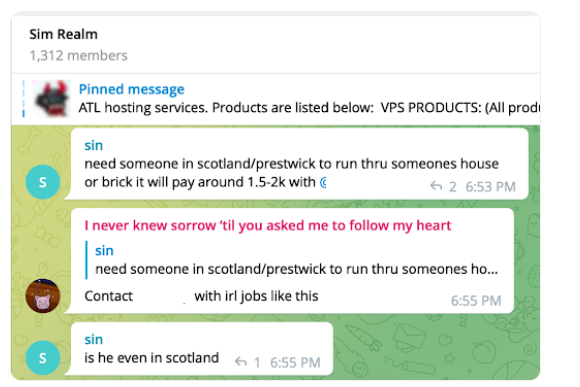
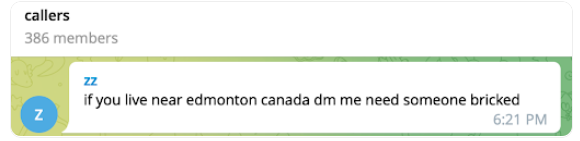
A number of these classified ads are in service of performing “brickings,” where someone is hired to visit a specific address and toss a brick through the target’s window.
“If you live near Edmonton Canada dm me need someone bricked,” reads on Telegram message on May 31, 2022.
“If you live near [address redacted] Lakewood, CA, dm [redacted] Paying 3k to slash the tires,” reads another help wanted ad in the same channel on Feb. 24, 2022. “If you live near here and can brick them, dm [address omitted] Richland, WA,” reads another from that same day.
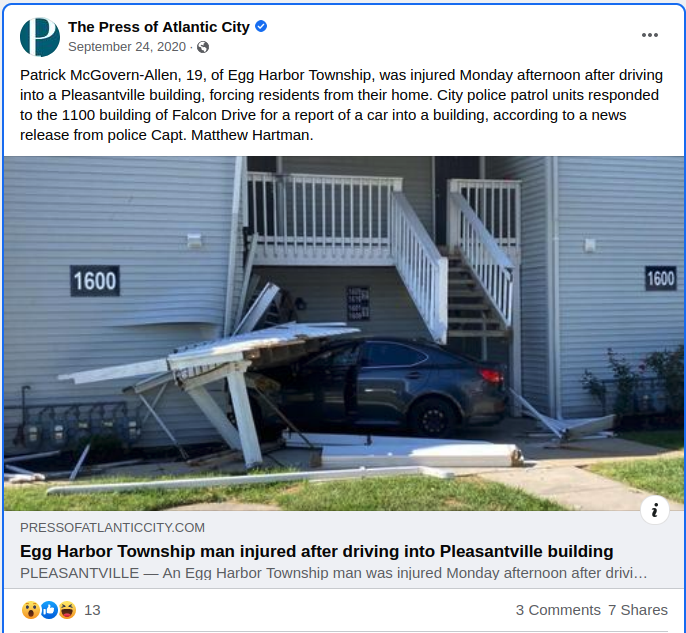
McGovern-Allen was in the news not long ago. According to a Sept. 2020 story from The Press of Atlantic City, a then 19-year-old Patrick McGovern Allen was injured after driving into a building and forcing residents from their home.
“Police found a 2007 Lexus, driven by Patrick McGovern-Allen, 19, that had lost control and left the road, crashing into the eastern end of the 1600 building,” the story recounted. “The car was driven through the steps that provide access to the second-floor apartments, destroying them, and also caused damage to the outer wall.”
A search on the Inmate Locator of the U.S. Bureau of Prisons website shows that McGovern-Allen remains in federal custody at a detention facility in Philadelphia. He’s currently represented by a public defender who has not responded to requests for comment.
A copy of the criminal complaint against McGovern-Allen is available here (PDF).
Many of the individuals involved in paying others to commit these physical attacks are also frequent participants in several Telegram channels focused singularly on SIM swapping activity. As a result, the vast majority of the people being targeted for brickings and other real-life physical assaults tend to be other cybercriminals involved in SIM swapping crimes (or individuals on the periphery of that scene).
There are dozens of SIM swappers who are now teenage or 20-something millionaires, by virtue of having stolen vast sums of cryptocurrencies from SIM swapping victims. And now many of these same individuals are finding that communities like Telegram can be leveraged to hire physical harassment and intimidation of their rivals and competitors.
The primary barrier to hiring someone to brick a home or slash some tires seems to be the costs involved: A number of solicitations for these services advertised payment of $3,000 or more upon proof of successful completion, which usually involves recording the attack and hiring a getaway driver in the town where the crime is to take place (calling a cab or hailing an Uber from the scene of a bricking isn’t the brightest idea).
My fear is these violence-as-a-service offerings will at some point migrate outside of the SIM swapping communities. This is precisely what happened with swatting, which for years was a crime perpetrated almost exclusively against online gamers and people streaming their games online. These days, swatting attacks are commonly used by SIM swapping groups as a way to harass and extort regular Internet users into giving up prized social media account names that can be resold for thousands of dollars.
—————
Free Secure Email – Transcom Sigma
Boost Inflight Internet
Transcom Hosting
Transcom Premium Domains