One bug in the January 2022 Patch Tuesday list is getting lots of attention: “HTTP Protocol Stack Remote Code Execution Vulnerability”.
—————
Free Secure Email – Transcom Sigma
Boost Inflight Internet
Transcom Hosting
Transcom Premium Domains
—————
Free Secure Email – Transcom Sigma
Boost Inflight Internet
Transcom Hosting
Transcom Premium Domains
—————
Free Secure Email – Transcom Sigma
Boost Inflight Internet
Transcom Hosting
Transcom Premium Domains
—————
Free Secure Email – Transcom Sigma
Boost Inflight Internet
Transcom Hosting
Transcom Premium Domains
—————
Free Secure Email – Transcom Sigma
Boost Inflight Internet
Transcom Hosting
Transcom Premium Domains
—————
Free Secure Email – Transcom Sigma
Boost Inflight Internet
Transcom Hosting
Transcom Premium Domains
—————
Free Secure Email – Transcom Sigma
Boost Inflight Internet
Transcom Hosting
Transcom Premium Domains
Researchers have figured how how to intercept and fake an iPhone reboot:
We’ll dissect the iOS system and show how it’s possible to alter a shutdown event, tricking a user that got infected into thinking that the phone has been powered off, but in fact, it’s still running. The “NoReboot” approach simulates a real shutdown. The user cannot feel a difference between a real shutdown and a “fake shutdown.” There is no user-interface or any button feedback until the user turns the phone back “on.”
It’s a complicated hack, but it works.
Uses are obvious:
Historically, when malware infects an iOS device, it can be removed simply by restarting the device, which clears the malware from memory.
However, this technique hooks the shutdown and reboot routines to prevent them from ever happening, allowing malware to achieve persistence as the device is never actually turned off.
I see this as another manifestation of the security problems that stem from all controls becoming software controls. Back when the physical buttons actually did things — like turn the power, the Wi-Fi, or the camera on and off — you could actually know that something was on or off. Now that software controls those functions, you can never be sure.
—————
Free Secure Email – Transcom Sigma
Boost Inflight Internet
Transcom Hosting
Transcom Premium Domains
In a great many ransomware attacks, the criminals who pillage the victim’s network are not the same crooks who gained the initial access to the victim organization. More commonly, the infected PC or stolen VPN credentials the gang used to break in were purchased from a cybercriminal middleman known as an initial access broker. This post examines some of the clues left behind by “Wazawaka,” the hacker handle chosen by a major access broker in the Russian-speaking cybercrime scene.

Wazawaka has been a highly active member of multiple cybercrime forums over the past decade, but his favorite is the Russian-language community Exploit. Wazawaka spent his early days on Exploit and other forums selling distributed denial-of-service (DDoS) attacks that could knock websites offline for about USD $80 a day. But in more recent years, Wazawaka has focused on peddling access to organizations and to databases stolen from hacked companies.
“Come, rob, and get dough!,” reads a thread started by Wazawaka on Exploit in March 2020, in which he sold access to a Chinese company with more than $10 billion in annual revenues. “Show them who is boss.”
According to their posts on Exploit, Wazawaka has worked with at least two different ransomware affiliate programs, including LockBit. Wazawaka said LockBit had paid him roughly $500,000 in commissions for the six months leading up to September 2020.
Wazawaka also said he’d teamed up with DarkSide, the ransomware affiliate group responsible for the six-day outage at Colonial Pipeline last year that caused nationwide fuel shortages and price spikes. The U.S. Department of State has since offered a $5 million reward for information leading to the arrest and conviction of any DarkSide affiliates.
Wazawaka seems to have adopted the uniquely communitarian view that when organizations being held for ransom decline to cooperate or pay up, any data stolen from the victim should be published on the Russian cybercrime forums for all to plunder — not privately sold to the highest bidder. In thread after thread on the crime forum XSS, Wazawaka’s alias “Uhodiransomwar” can be seen posting download links to databases from companies that have refused to negotiate after five days.
“The only and the main principle of ransomware is: the information that you steal should never be sold,” Uhodiransomwar wrote in August 2020. “The community needs to receive it absolutely free of charge if the ransom isn’t paid by the side that this information is stolen from.”
Wazawaka hasn’t always been so friendly to other cybercrooks. Over the past ten years, his contact information has been used to register numerous phishing domains intended to siphon credentials from people trying to transact on various dark web marketplaces. In 2018, Wazawaka registered a slew of domains spoofing the real domain for the Hydra dark web market. In 2014, Wazawaka confided to another crime forum member via private message that he made good money stealing accounts from drug dealers on these marketplaces.
“I used to steal their QIWI accounts with up to $500k in them,” Wazawaka recalled. “A dealer would never go to the cops and tell them he was selling stuff online and someone stole his money.”
Wazawaka used multiple email addresses and nicknames on several Russian crime forums, but data collected by cybersecurity firm Constella Intelligence show that Wazawaka’s alter egos always used one of three fairly unique passwords: 2k3x8x57, 2k3X8X57, and 00virtual.
Those three passwords were used by one or all of Wazawaka’s email addresses on the crime forums over the years, including wazawaka@yandex.ru, mixseo@mail.ru, mixseo@yandex.ru, mixfb@yandex.ru.
That last email address was used almost a decade ago to register a Vkontakte (Russian version of Facebook) account under the name Mikhail “Mix” Matveev. The phone number tied to that Vkontakte account — 7617467845 — was assigned by the Russian telephony provider MegaFon to a resident in Khakassia, situated in the southwestern part of Eastern Siberia.
DomainTools.com [an advertiser on this site] reports mixfb@yandex.ru was used to register three domains between 2008 and 2010: ddosis.ru, best-stalker.com, and cs-arena.org. That last domain was originally registered in 2009 to a Mikhail P. Matveyev, in Abakan, Khakassia.
Mikhail Matveev is not the most unusual name in Russia, but other clues help narrow things down quite a bit. For example, early in his postings to Exploit, Wazawaka can be seen telling members that he can be contacted via the ICQ instant message account 902228.
An Internet search for Wazawaka’s ICQ number brings up a 2009 account for a Wazawaka on a now defunct discussion forum about Kopyovo-a, a town of roughly 4,400 souls in the Russian republic of Khakassia:
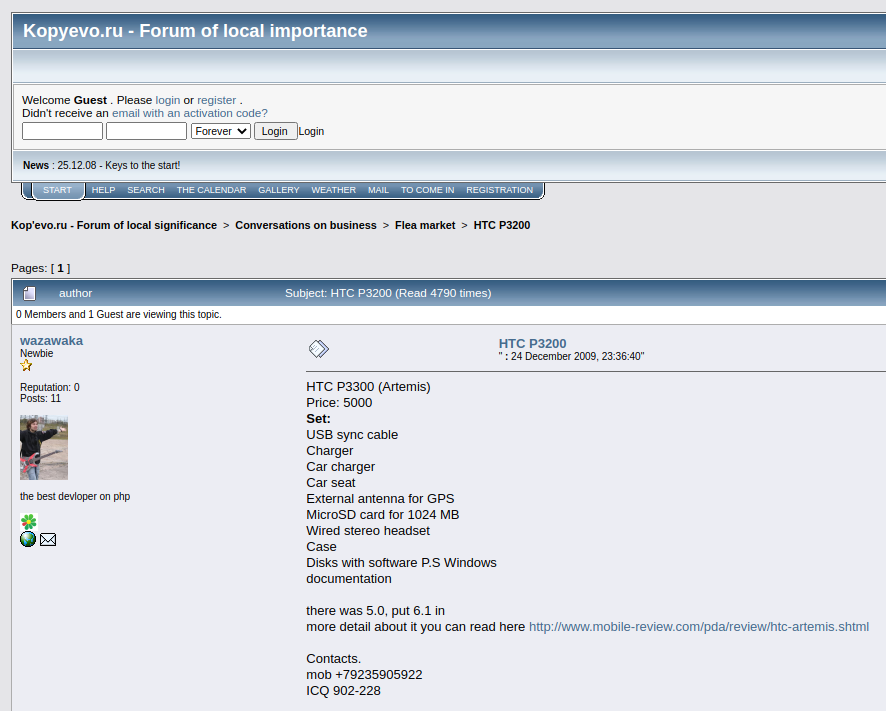
Also around 2009, someone using the nickname Wazawaka and the 902228 ICQ address started posting to Russian social media networks trying to convince locals to frequent the website “fureha.ru,” which was billed as another website catering to residents of Khakassia.
According to the Russian domain watcher 1stat.ru, fureha.ru was registered in January 2009 to the email address mix@devilart.net and the phone number +79617467845, which is the same number tied to the Mikhail “Mix” Matveev Vkontakte account.
DomainTools.com says the mix@devilart.net address was used to register two domains: one called badamania[.]ru, and a defunct porn site called tvporka[.]ru. The phone number tied to that porn site registration back in 2010 was 79235810401, also issued by MegaFon in Khakassia.
A search in Skype for that number shows that it was associated more than a decade ago with the username “matveevatanya1.” It was registered to a now 29-year-old Tatayana Matveeva Deryabina, whose Vkontakte profile says she currently resides in Krasnoyarsk, the largest city that is closest to Abakan and Abaza.
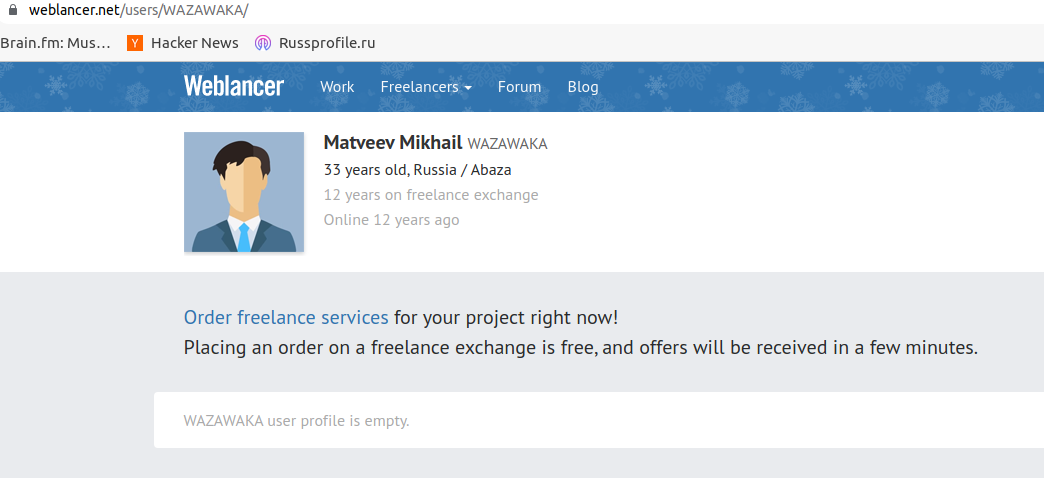
It seems likely that Tatayana is a relative of Mikhail Matveev, perhaps even his sister. Neither responded to requests for comment. In 2009, a Mikhail Matveev from Abaza, Khakassia registered the username Wazawaka on weblancer.net, a freelance job exchange for Russian IT professionals. The Weblancer account says Wazawaka is currently 33 years old.
In March 2019, Wazawaka explained a lengthy absence on Exploit by saying he’d fathered a child. “I will answer everyone in a week or two,” the crime actor wrote. “Became a dad — went on vacation for a couple of weeks.”
One of the many email addresses Wazawaka used was devdelphi@yandex.ru, which is tied to a more recent but since-deleted Vkontakte account for a Mikhail Matveev and used the password 2k3X8X57. As per usual, I put together a mind map showing the connections referenced in this story:
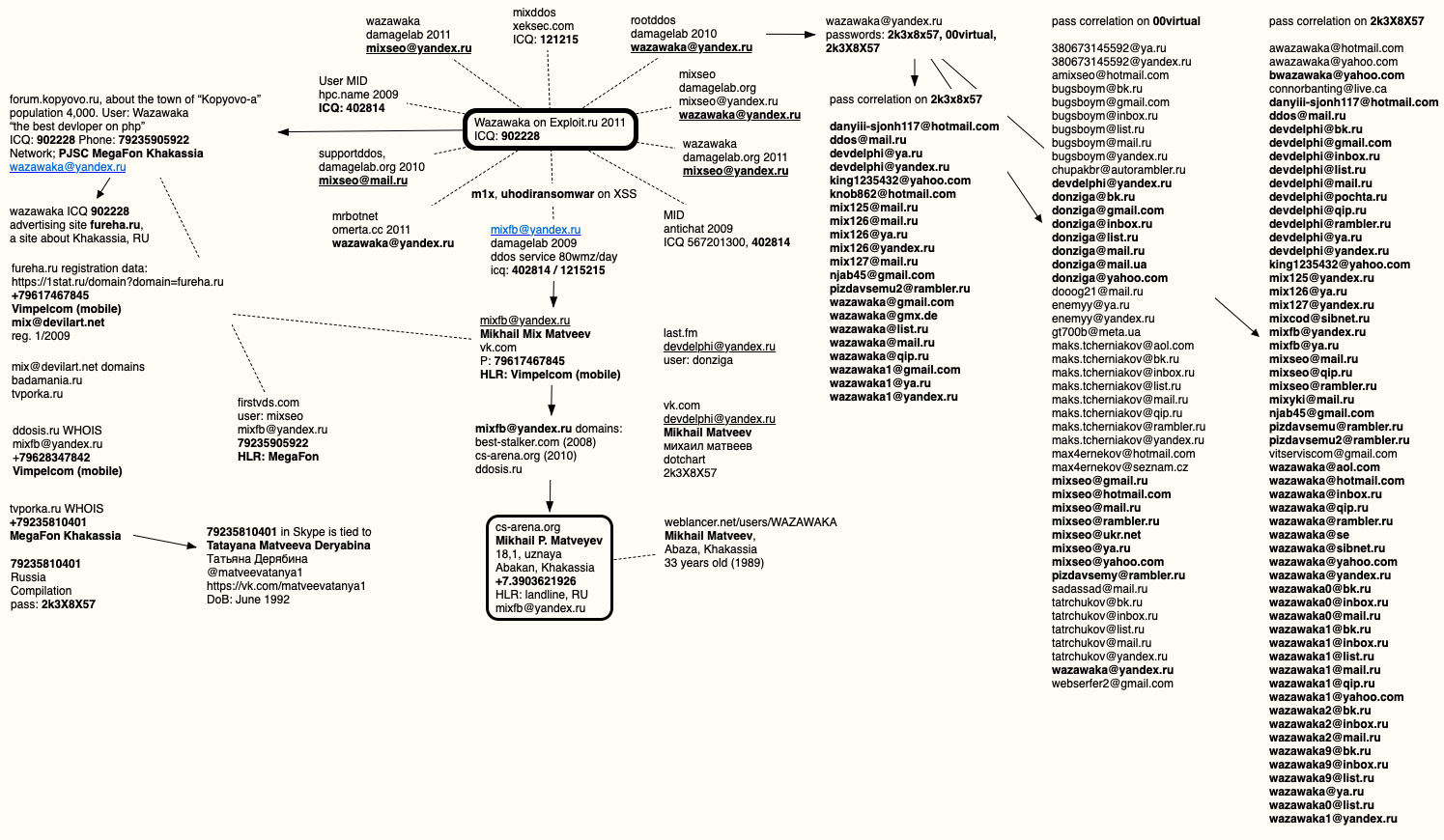
A rough mind map of the connections mentioned in this story.
Analysts with cyber intelligence firm Flashpoint say Wazawaka’s postings on various Russian crime forums show he is proficient in many specializations, including botnet operations, keylogger malware, spam botnets, credential harvesting, Google Analytics manipulation, selling databases for spam operations, and launching DDoS attacks.
Flashpoint says it is likely Wazawaka/Mix/M1x has shared cybercriminal identities and accounts with multiple other forum members, most of whom appear to have been partners in his DDoS-for-hire business a decade ago. For example, Flashpoint points to an Antichat forum thread from 2009 where members said M1x worked on his DDoS service with a hacker by the nickname “Vedd,” who was reputedly also a resident of Abakan.
All of this is academic, of course, provided Mr. Wazawaka chooses to a) never leave Russia and b) avoid cybercrime activities that target Russian citizens. In a January 2021 thread on Exploit regarding the arrest of an affiliate for the NetWalker ransomware program and its subsequent demise, Wazawaka seems already resigned those limitations.
“Don’t shit where you live, travel local, and don’t go abroad,” Wazawaka said of his own personal mantra.
Which might explain why Wazawaka is so lackadaisical about hiding and protecting his cybercriminal identities: Incredibly, Wazawaka’s alter ego on the forum XSS — Uhodiransomware — still uses the same password on the forum that he used for his Vkontakte account 10 years ago. Lucky for him, XSS also demands a one-time code from his mobile authentication app.
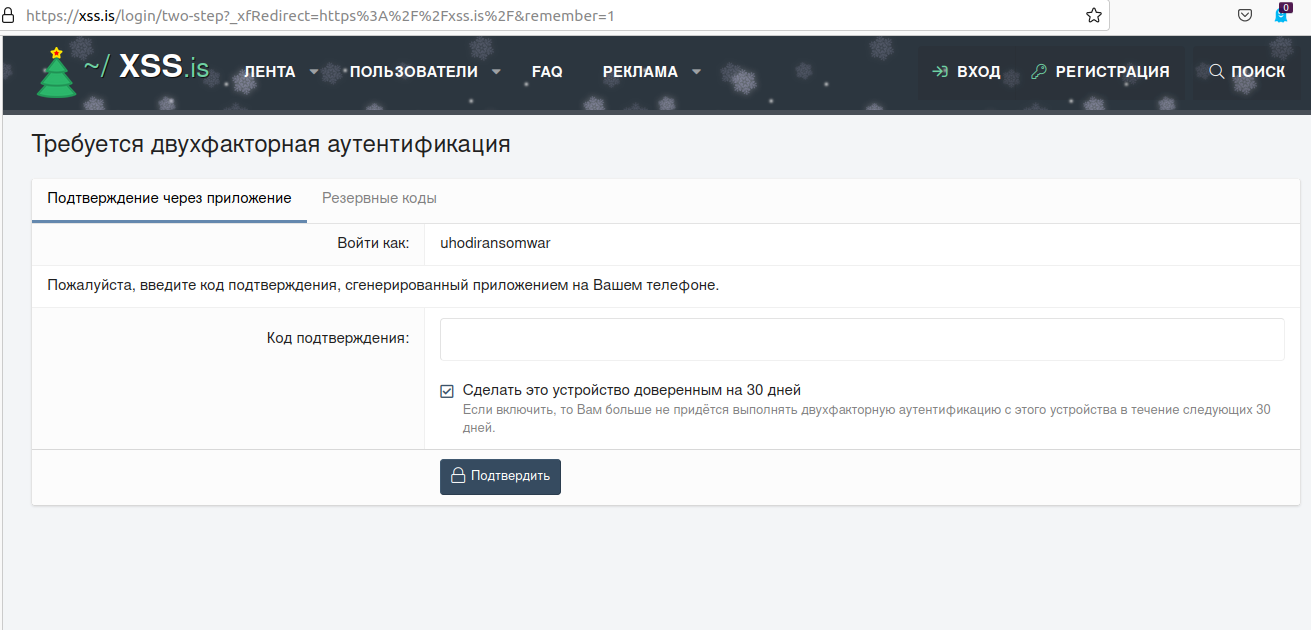
The second step of logging into Wazawaka’s account on XSS (Uhodiransomwar).
Wazawaka said NetWalker’s closure was the result of its administrator (a.k.a. “Bugatti”) getting greedy, and then he proceeds to preach about the need to periodically re-brand one’s cybercriminal identity.
“I’ve had some business with Bugatti,” Wazawaka said. “The guy got too rich and began recruiting Americans as affiliate partners. What happened now is the result. That’s okay, though. I wish Bugatti to do some rebranding and start from the beginning  As for the servers that were seized, they should’ve hosted their admin panels in Russia to avoid getting their servers seized by INTERPOL, the FBI, or whatever.”
“Mother Russia will help you,” Wazawaka concluded. “Love your country, and you will always get away with everything.”
If you liked this post, you may also enjoy Who Is the Network Access Broker “Babam”?
—————
Free Secure Email – Transcom Sigma
Boost Inflight Internet
Transcom Hosting
Transcom Premium Domains

Cyber-physical systems (CPS) security company Claroty has announced the acquisition of healthcare IoT security business Medigate.
In a statement released January 10, Claroty said the deal would allow it to secure the Extended Internet of Things (XIoT) “by delivering unmatched visibility, protection, and threat detection for all connected organizations via one comprehensive solution.”
Medigate, which is headquartered in New York’s Brooklyn borough, is known for creating the first security platform dedicated to healthcare IoT.
The company was founded in the summer of 2017 by Jonathan Langer, Itay Kirshenbaum, and Pini Pinhasov. Langer serves as the company’s CEO, while Israel-based Kirshenbaum and Pinhasov fulfill the roles of vice president of research and development and vice president of product, respectively.
Since its creation, Medigate has scooped more than 40 industry awards, including the 2021 Best in KLAS for Healthcare IoT Security, the SINET Innovator Award, and Fast Company’s Most Innovative Company Award. It has also been listed in Forbes’ Top 20 IoT Start-Ups to Watch.
“By joining forces between Medigate and Claroty, we are forming the only cybersecurity company that can deliver a best-of-breed solution for all the critical assets across healthcare, industrial, and enterprise environments that comprise the XIoT,” said Langer.
He added: “Our combined talent, technology, and IP empowers us to truly change the way organizations identify, secure, and manage these connected assets on a massive scale, thereby delivering even greater value for our customers.”
Yaniv Vardi, CEO of Claroty, said that Medigate’s team and capabilities would play a key role in Claroty’s vision of a future “where cyber and physical worlds safely connect to support our lives.”
“Highly interconnected CPS have become pervasive in industrial and healthcare environments in recent years in order to drive innovation, resilience, sustainability, and better health outcomes. However, greater connectivity begets greater exposure to risks, with serious consequences for patient safety, public safety, and the environment,” said Vardi.
He added: “Together, Claroty and Medigate will combine our deep domain expertise and specialized technologies into a comprehensive platform that will extend across all types of CPS and connected devices to secure the XIoT.”
—————
Free Secure Email – Transcom Sigma
Boost Inflight Internet
Transcom Hosting
Transcom Premium Domains

The protected health information (PHI) of thousands of individuals may have been exposed in a hacking incident at a healthcare information management company based in Georgia.
Clinical or treatment information and Social Security numbers were among the sensitive data compromised during a successful cyber-attack on Ciox Health that took place last summer.
Ciox Health, which is headquartered in Alpharetta, provides a variety of services, including information release, medical record retrieval, and health information management to more than 30 healthcare providers.
According to a notice recently issued by Ciox Health, an unauthorized person accessed the email account of a Ciox employee between June 24, 2021, and July 2, 2021.
The company warned that the threat actor may have used that access to download emails and attachments associated with the compromised account.
“Ciox reviewed the account’s contents to determine whether sensitive information was contained in the account,” said the notice.
“On September 24, 2021, Ciox learned that some emails and attachments in the employee’s email account contained limited patient information related to Ciox billing inquiries and/or other customer service requests.”
Information that the attacker may have accessed included patient names, provider names, dates of birth, and/or dates of service. Social Security numbers or driver’s license numbers, health insurance information, and/or clinical or treatment information was also exposed in what Ciox described as “very limited instances.”
The data breach was reported to the US Department of Health and Human Services’ Office for Civil Rights on December 30 as a hacking/IT incident impacting 12,493 individuals.
Ciox Health said it began notifying its healthcare provider customers of the security incident on November 23. The security notice published on Ciox Health’s website was issued on behalf of 32 different healthcare providers, including Children’s Healthcare of Atlanta, Indiana University Health, Niagara Falls Memorial Medical Center Health System, and Sarasota County Public Hospital District d/b/a Sarasota Memorial Health Care System.
“To help prevent something like this from happening again, we have and will continue to identify opportunities to implement additional procedures to further strengthen our email security, including by providing enhanced cybersecurity training to our employees,” stated Ciox Health.
—————
Free Secure Email – Transcom Sigma
Boost Inflight Internet
Transcom Hosting
Transcom Premium Domains