Premium Domain Names – transcom.uk
Transcom ISP – The UK’s Best Business ISP
DoubleCheck any website at doublecheck.uk
Author: admin
Telegram Triangulation Pinpoints Users’ Exact Locations
Premium Domain Names – transcom.uk
Transcom ISP – The UK’s Best Business ISP
DoubleCheck any website at doublecheck.uk
Google Warns of Critical Android Remote Code Execution Bug
Premium Domain Names – transcom.uk
Transcom ISP – The UK’s Best Business ISP
DoubleCheck any website at doublecheck.uk
Major Gaming Companies Hit with Ransomware Linked to APT27
Premium Domain Names – transcom.uk
Transcom ISP – The UK’s Best Business ISP
DoubleCheck any website at doublecheck.uk
ElectroRAT Drains Cryptocurrency Wallet Funds of Thousands
Premium Domain Names – transcom.uk
Transcom ISP – The UK’s Best Business ISP
DoubleCheck any website at doublecheck.uk
Data from August Breach of Amazon Partner Juspay Dumped Online
Premium Domain Names – transcom.uk
Transcom ISP – The UK’s Best Business ISP
DoubleCheck any website at doublecheck.uk
Ransomware Gang Collects Data from Blood Testing Lab
Premium Domain Names – transcom.uk
Transcom ISP – The UK’s Best Business ISP
DoubleCheck any website at doublecheck.uk
Latest on the SVR’s SolarWinds Hack
The New York Times has an in-depth article on the latest information about the SolarWinds hack (not a great name, since it’s much more far-reaching than that).
Interviews with key players investigating what intelligence agencies believe to be an operation by Russia’s S.V.R. intelligence service revealed these points:
- The breach is far broader than first believed. Initial estimates were that Russia sent its probes only into a few dozen of the 18,000 government and private networks they gained access to when they inserted code into network management software made by a Texas company named SolarWinds. But as businesses like Amazon and Microsoft that provide cloud services dig deeper for evidence, it now appears Russia exploited multiple layers of the supply chain to gain access to as many as 250 networks.
- The hackers managed their intrusion from servers inside the United States, exploiting legal prohibitions on the National Security Agency from engaging in domestic surveillance and eluding cyberdefenses deployed by the Department of Homeland Security.
- “Early warning” sensors placed by Cyber Command and the National Security Agency deep inside foreign networks to detect brewing attacks clearly failed. There is also no indication yet that any human intelligence alerted the United States to the hacking.
- The government’s emphasis on election defense, while critical in 2020, may have diverted resources and attention from long-brewing problems like protecting the “supply chain” of software. In the private sector, too, companies that were focused on election security, like FireEye and Microsoft, are now revealing that they were breached as part of the larger supply chain attack.
- SolarWinds, the company that the hackers used as a conduit for their attacks, had a history of lackluster security for its products, making it an easy target, according to current and former employees and government investigators. Its chief executive, Kevin B. Thompson, who is leaving his job after 11 years, has sidestepped the question of whether his company should have detected the intrusion.
- Some of the compromised SolarWinds software was engineered in Eastern Europe, and American investigators are now examining whether the incursion originated there, where Russian intelligence operatives are deeply rooted.
Separately, it seems that the SVR conducted a dry run of the attack five months before the actual attack:
The hackers distributed malicious files from the SolarWinds network in October 2019, five months before previously reported files were sent to victims through the company’s software update servers. The October files, distributed to customers on Oct. 10, did not have a backdoor embedded in them, however, in the way that subsequent malicious files that victims downloaded in the spring of 2020 did, and these files went undetected until this month.
[…]
“This tells us the actor had access to SolarWinds’ environment much earlier than this year. We know at minimum they had access Oct. 10, 2019. But they would certainly have had to have access longer than that,” says the source. “So that intrusion [into SolarWinds] has to originate probably at least a couple of months before that - probably at least mid-2019 [if not earlier].”
The files distributed to victims in October 2019 were signed with a legitimate SolarWinds certificate to make them appear to be authentic code for the company’s Orion Platform software, a tool used by system administrators to monitor and configure servers and other computer hardware on their network.
Premium Domain Names – transcom.uk
Transcom ISP – The UK’s Best Business ISP
DoubleCheck any website at doublecheck.uk
Hamas May Be Threat to 8chan, QAnon Online
In October 2020, KrebsOnSecurity looked at how a web of sites connected to conspiracy theory movements QAnon and 8chan were being kept online by DDoS-Guard, a dodgy Russian firm that also hosts the official site for the terrorist group Hamas. New research shows DDoS-Guard relies on data centers provided by a U.S.-based publicly traded company, which experts say could be exposed to civil and criminal liabilities as a result of DDoS-Guard’s business with Hamas.
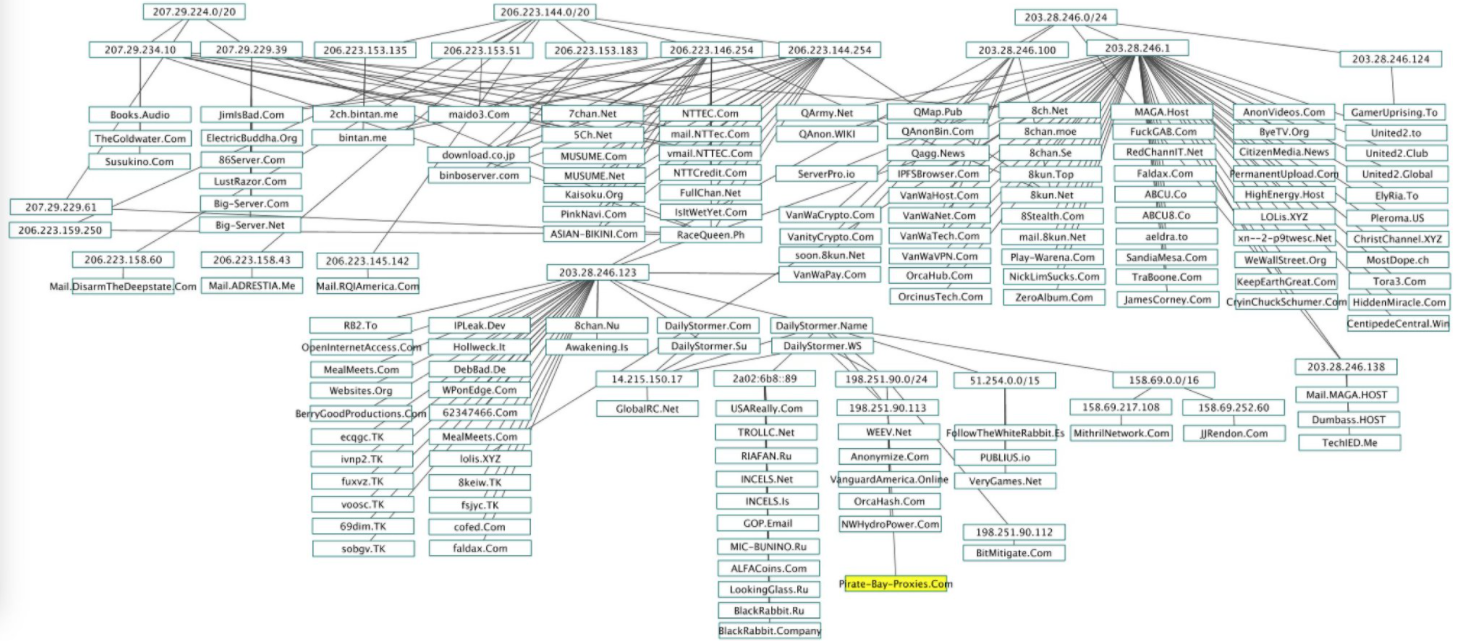
Many of the IP address ranges in in this map of QAnon and 8Chan-related sites — are assigned to VanwaTech. Source: twitter.com/Redrum_of_Crows
Last year’s story examined how a phone call to Oregon-based CNServers was all it took to briefly sideline multiple websites related to 8chan/8kun — a controversial online image board linked to several mass shootings — and QAnon, the far-right conspiracy theory which holds that a cabal of Satanic pedophiles is running a global child sex-trafficking ring and plotting against President Donald Trump.
From that piece:
A large number of 8kun and QAnon-related sites (see map above) are connected to the Web via a single Internet provider in Vancouver, Wash. called VanwaTech (a.k.a. “OrcaTech“). Previous appeals to VanwaTech to disconnect these sites have fallen on deaf ears, as the company’s owner Nick Lim reportedly has been working with 8kun’s administrators to keep the sites online in the name of protecting free speech.
After that story, CNServers and a U.K.-based hosting firm called SpartanHost both cut ties with VanwaTech. Following a brief disconnection, the sites came back online with the help of DDoS-Guard, an Internet company based in Russia. DDoS-Guard is now VanwaTech’s sole connection to the larger Internet.
A review of the several thousand websites hosted by DDoS-Guard is revelatory, as it includes a vast number of phishing sites and domains tied to cybercrime services or forums online.
Replying to requests for comment from a CBSNews reporter following up on my Oct. 2020 story, DDoS-Guard issued a statement saying, “We observe network neutrality and are convinced that any activity not prohibited by law in our country has the right to exist.”
But experts say DDoS-Guard’s business arrangement with a Denver-based publicly traded data center firm could create legal headaches for the latter thanks to the Russian company’s support of Hamas.
In a press release issued in late 2019, DDoS-Guard said its services rely in part on a traffic-scrubbing facility in Los Angeles owned by CoreSite [NYSE:COR], a real estate investment trust which invests in “carrier-neutral data centers and provides colocation and peering services.”
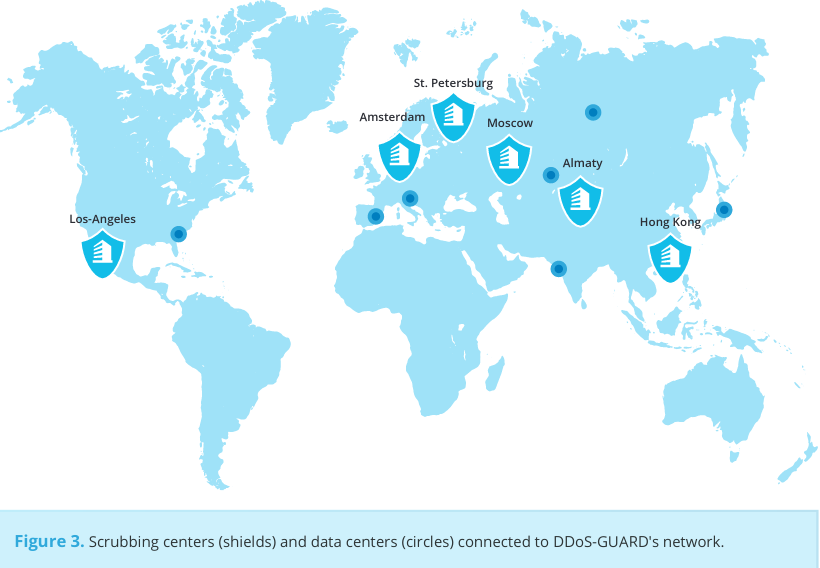
This facilities map published by DDoS-Guard suggests the company’s network actually has at least two points of presence in the United States.
Hamas has long been named by the U.S. Treasury and State departments as a Specially Designated Global Terrorist (SDGT) organization. Under such a designation, any U.S. person or organization that provides money, goods or services to an SDGT entity could face civil and/or criminal prosecution and hefty fines ranging from $250,000 to $1 million per violation.
Sean Buckley, a former Justice Department prosecutor with the law firm Kobre & Kim, said U.S. persons and companies within the United States “are prohibited from any transaction or dealing in property or interests in property blocked pursuant to an entity’s designation as a SDGT, including but not limited to the making or receiving of any contribution of funds, goods, or services to or for the benefit of individuals or entities so designated.”
CoreSite did not respond to multiple requests for comment. But Buckley said companies can incur fines and prosecution for violating SDGT sanctions even when they don’t know that they are doing so.
In 2019, for example, a U.S. based cosmetics company was fined $1 million after investigators determined its eyelash kits were sourcing materials from North Korea, even though the supplier in that case told the cosmetics firm the materials had come from China.
“U.S. persons or companies found to willfully violate these regulations can be subject to criminal penalties under the International Emergency Economic Powers Act,” Buckley said. “However, even in the case that they are unaware they’re violating these regulations, or if the transaction isn’t directly with the sanctioned entity, these companies still run a risk of facing substantial civil and monetary penalties by the Department of Treasury’s Office of Foreign Asset Control if the sanctioned entity stands to benefit from such a transaction.”
DDoS-Guard said its partnership with CoreSite will help its stable of websites load more quickly and reliably for people visiting them from the United States. It is possible that when and if CoreSite decides it’s too risky to continue doing business with DDoS-Guard, sites like those affiliated with Hamas, QAnon and 8Chan may become more difficult to reach.
Meanwhile, DDoS-Guard customer VanwaTech continues to host a slew of sites promoting the conspiracy theory that the U.S. 2020 presidential election was stolen from President Donald Trump via widespread voting fraud and hacked voting machines, including maga[.]host, donaldsarmy[.]us, and donaldwon[.]com.
These sites are being used to help coordinate a protest rally in Washington, D.C. on January 6, 2021, the same day the U.S. Congress is slated to count electoral votes certified by the Electoral College, which in December elected Joseph R. Biden as the 46th president of The United States.
In a tweet late last year, President Trump urged his supporters to attend the Jan. 6 protest, saying the event “will be wild.”
8chan, which has rebranded as 8kun, has been linked to white supremacism, neo-Nazism, antisemitism, multiple mass shootings, and child pornography. The FBI in 2019 identified QAnon as a potential domestic terror threat, noting that some of its followers have been linked to violent incidents motivated by fringe beliefs.

Premium Domain Names – transcom.uk
Transcom ISP – The UK’s Best Business ISP
DoubleCheck any website at doublecheck.uk
Cyber-Attack on US Laboratory

An American laboratory specializing in home phlebotomy has disclosed a cyber-attack that occurred five months ago after data stolen in the attack turned up online.
Apex Laboratory opened in 1997 and is based in Farmingdale, New York. The company has provided medical testing services to hundreds of home health agencies and thousands of physicians in New York and South Florida.
On July 25, 2020, Apex learned that it had become the victim of a cyber-attack that rendered certain files and systems inaccessible. Network access was restored along with the impacted data, and the company resumed normal operations on July 27.
A third-party cyber forensic analyst was hired by Apex to investigate the attack. The investigation found no evidence of unauthorized access or acquisition of patient information, and Apex did not disclose the incident.
However, Apex discovered last month that the cyber-criminals behind the attack had stolen “personal and health information for some patients” and posted it online on their blog. Information believed to have been taken includes patient names, dates of birth, test results, and, for some individuals, Social Security numbers and phone numbers.
Apex is yet to reveal how many patients were impacted by the incident, but the laboratory did say that the information stolen by the threat actors could have been pinched over a four-day period.
“It is believed that this information may have been acquired from Apex’s systems between July 21, 2020 and July 25, 2020,” stated Apex.
From a notice of data event posted by Apex on December 31, the attack sounds like it might have involved ransomware.
The notice states: “On July 25, 2020, Apex Laboratory of Farmingdale, NY (‘Apex’) discovered that it was the victim of a cyber-attack and that certain systems in its environment were encrypted and inaccessible.”
Apex didn’t say that it paid a ransom to the cyber-attackers; however, the speedy restoration of the impacted data and the removal of the stolen data from the hacker’s blog might suggest some communication between the criminals and their victim has occurred.
The company said that it is “unaware of any actual or attempted misuse of any information other than the extracting of this data as part of the cyber-attack.”
Premium Domain Names – transcom.uk
Transcom ISP – The UK’s Best Business ISP
DoubleCheck any website at doublecheck.uk