COVID-19 and Acedia

Note: This isn’t my usual essay topic. Still, I want to put it on my blog.

Six months into the pandemic with no end in sight, many of us have been feeling a sense of unease that goes beyond anxiety or distress. It’s a nameless feeling that somehow makes it hard to go on with even the nice things we regularly do.

What’s blocking our everyday routines is not the anxiety of lockdown adjustments, or the worries about ourselves and our loved ones — real though those worries are. It isn’t even the sense that, if we’re really honest with ourselves, much of what we do is pretty self-indulgent when held up against the urgency of a global pandemic.

It is something more troubling and harder to name: an uncertainty about why we would go on doing much of what for years we’d taken for granted as inherently valuable.

What we are confronting is something many writers in the pandemic have approached from varying angles: a restless distraction that stems not just from not knowing when it will all end, but also from not knowing what that end will look like. Perhaps the sharpest insight into this feeling has come from Jonathan Zecher, a historian of religion, who linked it to the forgotten Christian term: acedia.

Acedia was a malady that apparently plagued many medieval monks. It’s a sense of no longer caring about caring, not because one had become apathetic, but because somehow the whole structure of care had become jammed up.

What could this particular form of melancholy mean in an urgent global crisis? On the face of it, all of us care very much about the health risks to those we know and don’t know. Yet lurking alongside such immediate cares is a sense of dislocation that somehow interferes with how we care.

The answer can be found in an extreme thought experiment about death. In 2013, philosopher Samuel Scheffler explored a core assumption about death. We all assume that there will be a future world that survives our particular life, a world populated by people roughly like us, including some who are related to us or known to us. Though we rarely or acknowledge it, this presumed future world is the horizon towards which everything we do in the present is oriented.

But what, Scheffler asked, if we lose that assumed future world — because, say, we are told that human life will end on a fixed date not far after our own death? Then the things we value would start to lose their value. Our sense of why things matter today is built on the presumption that they will continue to matter in the future, even when we ourselves are no longer around to value them.

Our present relations to people and things are, in this deep way, future-oriented. Symphonies are written, buildings built, children conceived in the present, but always with a future in mind. What happens to our ethical bearings when we start to lose our grip on that future?

It’s here, moving back to the particular features of the global pandemic, that we see more clearly what drives the restlessness and dislocation so many have been feeling. The source of our current acedia is not the literal loss of a future; even the most pessimistic scenarios surrounding COVID-19 have our species surviving. The dislocation is more subtle: a disruption in pretty much every future frame of reference on which just going on in the present relies.

Moving around is what we do as creatures, and for that we need horizons. COVID-19 has erased many of the spatial and temporal horizons we rely on, even if we don’t notice them very often. We don’t know how the economy will look, how social life will go on, how our home routines will be changed, how work will be organized, how universities or the arts or local commerce will survive.

What unsettles us is not only fear of change. It’s that, if we can no longer trust in the future, many things become irrelevant, retrospectively pointless. And by that we mean from the perspective of a future whose basic shape we can no longer take for granted. This fundamentally disrupts how we weigh the value of what we are doing right now. It becomes especially hard under these conditions to hold on to the value in activities that, by their very nature, are future-directed, such as education or institution-building.

That’s what many of us are feeling. That’s today’s acedia.

Naming this malaise may seem more trouble than its worth, but the opposite is true. Perhaps the worst thing about medieval acedia was that monks struggled with its dislocation in isolation. But today’s disruption of our sense of a future must be a shared challenge. Because what’s disrupted is the structure of care that sustains why we go on doing things together, and this can only be repaired through renewed solidarity.

Such solidarity, however, has one precondition: that we openly discuss the problem of acedia, and how it prevents us from facing our deepest future uncertainties. Once we have done that, we can recognize it as a problem we choose to face together — across political and cultural lines — as families, communities, nations and a global humanity. Which means doing so in acceptance of our shared vulnerability, rather than suffering each on our own.

This essay was written with Nick Couldry, and previously appeared on CNN.com.

Premium Domain Names – transcom.uk
Transcom ISP – The UK’s Best Business ISP
DoubleCheck any website at doublecheck.uk

Attacks Aimed at Disrupting the Trickbot Botnet

Over the past 10 days, someone has been launching a series of coordinated attacks designed to disrupt Trickbot, an enormous collection of more than two million malware-infected Windows PCs that are constantly being harvested for financial data and are often used as the entry point for deploying ransomware within compromised organizations.
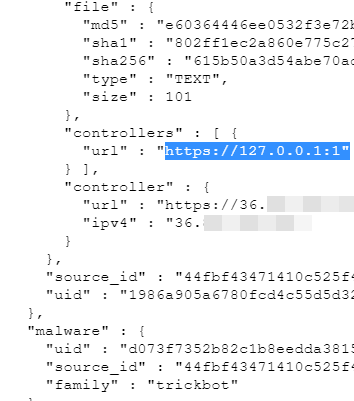
A text snippet from one of the bogus Trickbot configuration updates. Source: Intel 471

On Sept. 22, someone pushed out a new configuration file to Windows computers currently infected with Trickbot. The crooks running the Trickbot botnet typically use these config files to pass new instructions to their fleet of infected PCs, such as the Internet address where hacked systems should download new updates to the malware.

But the new configuration file pushed on Sept. 22 told all systems infected with Trickbot that their new malware control server had the address 127.0.0.1, which is a “localhost” address that is not reachable over the public Internet, according to an analysis by cyber intelligence firm Intel 471.

It’s not known how many Trickbot-infected systems received the phony update, but it seems clear this wasn’t just a mistake by Trickbot’s overlords. Intel 471 found that it happened yet again on Oct. 1, suggesting someone with access to the inner workings of the botnet was trying to disrupt its operations.

“Shortly after the bogus configs were pushed out, all Trickbot controllers stopped responding correctly to bot requests,” Intel 471 wrote in a note to its customers. “This possibly means central Trickbot controller infrastructure was disrupted. The close timing of both events suggested an intentional disruption of Trickbot botnet operations.”

Intel 471 CEO Mark Arena said it’s anyone’s guess at this point who is responsible.

“Obviously, someone is trying to attack Trickbot,” Arena said. “It could be someone in the security research community, a government, a disgruntled insider, or a rival cybercrime group. We just don’t know at this point.

Arena said it’s unclear how successful these bogus configuration file updates will be given that the Trickbot authors built a fail-safe recovery system into their malware. Specifically, Trickbot has a backup control mechanism: A domain name registered on EmerDNS, a decentralized domain name system.

“This domain should still be in control of the Trickbot operators and could potentially be used to recover bots,” Intel 471 wrote.

But whoever is screwing with the Trickbot purveyors appears to have adopted a multi-pronged approach: Around the same time as the second bogus configuration file update was pushed on Oct. 1, someone stuffed the control networks that the Trickbot operators use to keep track of data on infected systems with millions of new records.

Alex Holden is chief technology officer and founder of Hold Security, a Milwaukee-based cyber intelligence firm that helps recover stolen data. Holden said at the end of September Trickbot held passwords and financial data stolen from more than 2.7 million Windows PCs.

By October 1, Holden said, that number had magically grown to more than seven million.

“Someone is flooding the Trickbot system with fake data,” Holden said. “Whoever is doing this is generating records that include machine names indicating these are infected systems in a broad range of organizations, including the Department of Defense, U.S. Bank, JP Morgan Chase, PNC and Citigroup, to name a few.”

Holden said the flood of new, apparently bogus, records appears to be an attempt by someone to dilute the Trickbot database and confuse or stymie the Trickbot operators. But so far, Holden said, the impact has been mainly to annoy and aggravate the criminals in charge of Trickbot.

“Our monitoring found at least one statement from one of the ransomware groups that relies on Trickbot saying this pisses them off, and they’re going to double the ransom they’re asking for from a victim,” Holden said. “We haven’t been able to confirm whether they actually followed through with that, but these attacks are definitely interfering with their business.”

Intel 471’s Arena said this could be part of an ongoing campaign to dismantle or wrest control over the Trickbot botnet. Such an effort would hardly be unprecedented. In 2014, for example, U.S. and international law enforcement agencies teamed up with multiple security firms and private researchers to commandeer the Gameover Zeus Botnet, a particularly aggressive and sophisticated malware strain that had enslaved up to 1 million Windows PCs globally.

Trickbot would be an attractive target for such a takeover effort because it is widely viewed as a platform used to find potential ransomware victims. Intel 471 describes Trickbot as “a malware-as-a-service platform that caters to a relatively small number of top-tier cybercriminals.”

One of the top ransomware gangs in operation today — which deploys ransomware strains known variously as “Ryuk” and “Conti,” is known to be closely associated with Trickbot infections. Both ransomware families have been used in some of the most damaging and costly malware incidents to date.

The latest Ryuk victim is Universal Health Services (UHS), a Fortune 500 hospital and healthcare services provider that operates more than 400 facilities in the U.S. and U.K.

On Sunday, Sept. 27, UHS shut down its computer systems at healthcare facilities across the United States in a bid to stop the spread of the malware. The disruption has reportedly caused the affected hospitals to redirect ambulances and relocate patients in need of surgery to other nearby hospitals.

Premium Domain Names – transcom.uk
Transcom ISP – The UK’s Best Business ISP
DoubleCheck any website at doublecheck.uk

H&M Fined €35.2m for GDPR Violations

H&M Fined €35.2m for GDPR Violations

The world’s second-biggest fashion retailer was today handed a monumental fine for violating the European Union’s General Data Protection Regulation (GDPR). 

A German subsidiary of Hennes & Mauritz AB (H&M) was fined €35,258,707.95 by regulatory body the Hamburg Data Protection Authority (HmbBfDI) for excessive use of employee data. H&M employs around 126,000 people globally.

The fine imposed on H&M Hennes & Mauritz Online Shop A.B. & Co KG is the largest to be levied so far against a company for GDPR violations involving how employee data is handled. 

“We are likely to see more pressure on employers to justify the handling of employee data as a result of today’s fine,” commented a spokesperson for Cordery Legal Compliance.

HmbBfDI launched an investigation into H&M’s Service Center in Nuremberg after a 2019 data breach caused by a configuration error revealed how much data H&M Germany was collecting about the private lives of its employees. 

The authority found that since at least 2014, H&M had been collecting and storing on its company network copious amounts of data concerning their employees’ holiday experiences, family issues, religious beliefs, and symptoms of illness and diagnoses.

The data was collected during one-to-one conversations between employees and their supervisors and during “welcome back talks” held between employees and team leaders after an absence from work. Some of the data was accessible by up to 50 other managers. 

After evaluating 60GB of H&M data and reviewing witness evidence and the company’s internal procedures, HmbBfDI ruled that “the combination of collecting details about their private lives and the recording of their activities led to a particularly intensive encroachment on employees’ civil rights.”

H&M subsequently apologized to its employees. Today the company confirmed that financial compensation would be given to everyone employed at the impacted entity since May 2018, when GDPR became law.

News of the financial penalty comes as the Swedish multinational clothing company announced plans to close 250 of its stores globally. The company said the closures, scheduled to take place in 2021, are driven by customers’ showing a marked preference for shopping online.

The firm has 5,000 stores worldwide, 166 of which are currently closed due to restrictions put in place to slow the spread of COVID-19. 

Premium Domain Names – transcom.uk
Transcom ISP – The UK’s Best Business ISP
DoubleCheck any website at doublecheck.uk