Google Cloud Hires Goldman Sachs Man as First CISO

Google Cloud Hires Goldman Sachs Man as First CISO

Google has hired the first security boss for its cloud business in the form of British-born Phil Venables.

A 25+ year veteran of the industry with experience in CISO roles in some of the world’s biggest banks, Venables officially joined Google Cloud this month, according to his LinkedIn profile.

After graduating from the University of York with a BSc in Computer Science, Venables went on to gain a Masters in computation at Oxford University before starting his career at a range of petrochemical, defense and finance companies.

This led to a stint as information security manager at Barclays, before CISO roles at Standard Chartered, Deutsche Bank and eventually Goldman Sachs, where he remained for two decades, moving into the private equity part of the business recently.

His role as VP at Google will involve not only a focus on inward-facing security but also helping to solve customer challenges.

According to the latest figures from October, Google remains in third place in the global cloud infrastructure market with a share of 7%, some way behind Microsoft Azure (19%) and AWS (32%). It’s also coming under strong pressure from Alibaba Cloud (6%).

All four are battling to secure new business customers attracted to the cloud as they look for ways to streamline business processes, drive innovation and improve IT efficiency amidst a pandemic-fuelled recession.

At Google Cloud, Venables will continue to work on best practices for cloud migration and security standards, according to reports. The platform has a good reputation in security circles: although it is in some ways less mature than the likes of AWS, that has meant security could be baked into more services from the start.

“Cloud becomes almost like a digital immune system, in that it’s detecting issues and then rapidly providing support for all of their customers to help defend themselves,” Venables is quoted as saying.

Premium Domain Names – transcom.uk
Transcom ISP – The UK’s Best Business ISP
DoubleCheck any website at doublecheck.uk

Former Cisco Engineer Gets Two Years for $2.4M WebEx Attack

Former Cisco Engineer Gets Two Years for $2.4M WebEx Attack

A former Cisco engineer has been sentenced to 24 months behind bars after causing millions of dollars in damages and losses for his former employer.

Sudhish Kasaba Ramesh, 31, of San Jose, pleaded guilty back in August to one count of intentionally accessing a protected computer without authorization and recklessly causing damage to Cisco.

Ramesh resigned his job at the networking giant in April 2018 after working there for nearly two years.

However, for a reason not explained in the court documents, he unlawfully accessed Cisco cloud infrastructure in September 2018, deploying code which deleted 456 virtual machines supporting the WebEx Teams application for clients.

In fact, over 16,000 customer WebEx Teams accounts were shut down for two weeks as a result of his actions. Although no data was compromised in the operation, it is said to have resulted in Cisco spending $1.4 million on extra staff costs to remediate the issue and a further $1 million in compensation for customers.

Ramesh will also be forced to serve a one-year period of supervised release following his two year stint in prison and to pay a $15,000 fine.

According to Verizon, 30% of the breaches it analyzed earlier this year were linked to insider actions. However, most of these are thought to be the result of human error rather than malicious intent.

While malicious insider threats are relatively rare, they can be difficult to detect and prevent.

Back in 2018, it emerged that a disgruntled Tesla employee passed over for promotion caused “quite extensive and damaging sabotage” to the company’s systems.

According to an Accenture report last year, the cost of malicious insider threats jumped 15% from 2017 to reach $1.6 million.

Premium Domain Names – transcom.uk
Transcom ISP – The UK’s Best Business ISP
DoubleCheck any website at doublecheck.uk

Russian Hackers Steal Data for Months in Global Supply Chain Attacks

Russian Hackers Steal Data for Months in Global Supply Chain Attacks

Russian hackers who stole red team tools from FireEye may have been in action on a much broader scale, operating a sophisticated supply chain campaign targeting multiple global organizations and governments.

FireEye revealed in an update on Sunday that nation state attackers inserted malicious code into legitimate software for SolarWinds’ popular Orion product to gain remote access into victim environments.

Although it didn’t name any victims or the identity of the group, a Reuters report on Sunday citing “people familiar with the matter” pointed the finger at Moscow and claimed that the US Treasury and Commerce departments were both hit.

It’s claimed the attackers may have had access to staff emails since spring.

SolarWinds also confirmed the attack in an advisory over the weekend, and urged users to upgrade as soon as possible. Its software was seeded with a malicious backdoor dubbed “Sunburst” by FireEye.

“The malware masquerades its network traffic as the Orion Improvement Program (OIP) protocol and stores reconnaissance results within legitimate plugin configuration files allowing it to blend in with legitimate SolarWinds activity,” the security vendor explained in a technical blog.

“The backdoor uses multiple obfuscated blocklists to identify forensic and anti-virus tools running as processes, services, and drivers.”

The attackers conducted a carefully planned, patient and highly sophisticated campaign based around a light malware footprint, prioritization of stealth and advanced OpSec to cover their tracks and use difficult-to-attribute tools, it added.

“The victims have included government, consulting, technology, telecom and extractive entities in North America, Europe, Asia and the Middle East,” said FireEye. “We anticipate there are additional victims in other countries and verticals.”

It’s unclear what the end goal of the group was, although a New York Times story named it as APT29, or Cozy Bear, which has been associated with previous attacks on the Democratic National Committee in 2016 and COVID-19 vaccine data earlier this year.

The Commerce Department’s National Telecommunications and Information Administration (NTIA), which decides which tech imports and exports to block on national security grounds, was reportedly one of the targets.

Premium Domain Names – transcom.uk
Transcom ISP – The UK’s Best Business ISP
DoubleCheck any website at doublecheck.uk

Should There Be Limits on Persuasive Technologies?

Persuasion is as old as our species. Both democracy and the market economy depend on it. Politicians persuade citizens to vote for them, or to support different policy positions. Businesses persuade consumers to buy their products or services. We all persuade our friends to accept our choice of restaurant, movie, and so on. It’s essential to society; we couldn’t get large groups of people to work together without it. But as with many things, technology is fundamentally changing the nature of persuasion. And society needs to adapt its rules of persuasion or suffer the consequences.

Democratic societies, in particular, are in dire need of a frank conversation about the role persuasion plays in them and how technologies are enabling powerful interests to target audiences. In a society where public opinion is a ruling force, there is always a risk of it being mobilized for ill purposes — ­such as provoking fear to encourage one group to hate another in a bid to win office, or targeting personal vulnerabilities to push products that might not benefit the consumer.

In this regard, the United States, already extremely polarized, sits on a precipice.

There have long been rules around persuasion. The US Federal Trade Commission enforces laws that claims about products “must be truthful, not misleading, and, when appropriate, backed by scientific evidence.” Political advertisers must identify themselves in television ads. If someone abuses a position of power to force another person into a contract, undue influence can be argued to nullify that agreement. Yet there is more to persuasion than the truth, transparency, or simply applying pressure.

Persuasion also involves psychology, and that has been far harder to regulate. Using psychology to persuade people is not new. Edward Bernays, a pioneer of public relations and nephew to Sigmund Freud, made a marketing practice of appealing to the ego. His approach was to tie consumption to a person’s sense of self. In his 1928 book Propaganda, Bernays advocated engineering events to persuade target audiences as desired. In one famous stunt, he hired women to smoke cigarettes while taking part in the 1929 New York City Easter Sunday parade, causing a scandal while linking smoking with the emancipation of women. The tobacco industry would continue to market lifestyle in selling cigarettes into the 1960s.

Emotional appeals have likewise long been a facet of political campaigns. In the 1860 US presidential election, Southern politicians and newspaper editors spread fears of what a “Black Republican” win would mean, painting horrific pictures of what the emancipation of slaves would do to the country. In the 2020 US presidential election, modern-day Republicans used Cuban Americans’ fears of socialism in ads on Spanish-language radio and messaging on social media. Because of the emotions involved, many voters believed the campaigns enough to let them influence their decisions.

The Internet has enabled new technologies of persuasion to go even further. Those seeking to influence others can collect and use data about targeted audiences to create personalized messaging. Tracking the websites a person visits, the searches they make online, and what they engage with on social media, persuasion technologies enable those who have access to such tools to better understand audiences and deliver more tailored messaging where audiences are likely to see it most. This information can be combined with data about other activities, such as offline shopping habits, the places a person visits, and the insurance they buy, to create a profile of them that can be used to develop persuasive messaging that is aimed at provoking a specific response.

Our senses of self, meanwhile, are increasingly shaped by our interaction with technology. The same digital environment where we read, search, and converse with our intimates enables marketers to take that data and turn it back on us. A modern day Bernays no longer needs to ferret out the social causes that might inspire you or entice you­ — you’ve likely already shared that by your online behavior.

Some marketers posit that women feel less attractive on Mondays, particularly first thing in the morning — ­and therefore that’s the best time to advertise cosmetics to them. The New York Times once experimented by predicting the moods of readers based on article content to better target ads, enabling marketers to find audiences when they were sad or fearful. Some music streaming platforms encourage users to disclose their current moods, which helps advertisers target subscribers based on their emotional states.

The phones in our pockets provide marketers with our location in real time, helping deliver geographically relevant ads, such as propaganda to those attending a political rally. This always-on digital experience enables marketers to know what we are doing­ — and when, where, and how we might be feeling at that moment.

All of this is not intended to be alarmist. It is important not to overstate the effectiveness of persuasive technologies. But while many of them are more smoke and mirrors than reality, it is likely that they will only improve over time. The technology already exists to help predict moods of some target audiences, pinpoint their location at any given time, and deliver fairly tailored and timely messaging. How far does that ability need to go before it erodes the autonomy of those targeted to make decisions of their own free will?

Right now, there are few legal or even moral limits on persuasion­ — and few answers regarding the effectiveness of such technologies. Before it is too late, the world needs to consider what is acceptable and what is over the line.

For example, it’s been long known that people are more receptive to advertisements made with people who look like them: in race, ethnicity, age, gender. Ads have long been modified to suit the general demographic of the television show or magazine they appear in. But we can take this further. The technology exists to take your likeness and morph it with a face that is demographically similar to you. The result is a face that looks like you, but that you don’t recognize. If that turns out to be more persuasive than coarse demographic targeting, is that okay?

Another example: Instead of just advertising to you when they detect that you are vulnerable, what if advertisers craft advertisements that deliberately manipulate your mood? In some ways, being able to place ads alongside content that is likely to provoke a certain emotional response enables advertisers to do this already. The only difference is that the media outlet claims it isn’t crafting the content to deliberately achieve this. But is it acceptable to actively prime a target audience and then to deliver persuasive messaging that fits the mood?

Further, emotion-based decision-making is not the rational type of slow thinking that ought to inform important civic choices such as voting. In fact, emotional thinking threatens to undermine the very legitimacy of the system, as voters are essentially provoked to move in whatever direction someone with power and money wants. Given the pervasiveness of digital technologies, and the often instant, reactive responses people have to them, how much emotion ought to be allowed in persuasive technologies? Is there a line that shouldn’t be crossed?

Finally, for most people today, exposure to information and technology is pervasive. The average US adult spends more than eleven hours a day interacting with media. Such levels of engagement lead to huge amounts of personal data generated and aggregated about you­ — your preferences, interests, and state of mind. The more those who control persuasive technologies know about us, what we are doing, how we are feeling, when we feel it, and where we are, the better they can tailor messaging that provokes us into action. The unsuspecting target is grossly disadvantaged. Is it acceptable for the same services to both mediate our digital experience and to target us? Is there ever such thing as too much targeting?

The power dynamics of persuasive technologies are changing. Access to tools and technologies of persuasion is not egalitarian. Many require large amounts of both personal data and computation power, turning modern persuasion into an arms race where the better resourced will be better placed to influence audiences.

At the same time, the average person has very little information about how these persuasion technologies work, and is thus unlikely to understand how their beliefs and opinions might be manipulated by them. What’s more, there are few rules in place to protect people from abuse of persuasion technologies, much less even a clear articulation of what constitutes a level of manipulation so great it effectively takes agency away from those targeted. This creates a positive feedback loop that is dangerous for society.

In the 1970s, there was widespread fear about so-called subliminal messaging, which claimed that images of sex and death were hidden in the details of print advertisements, as in the curls of smoke in cigarette ads and the ice cubes of liquor ads. It was pretty much all a hoax, but that didn’t stop the Federal Trade Commission and the Federal Communications Commission from declaring it an illegal persuasive technology. That’s how worried people were about being manipulated without their knowledge and consent.

It is time to have a serious conversation about limiting the technologies of persuasion. This must begin by articulating what is permitted and what is not. If we don’t, the powerful persuaders will become even more powerful.

This essay was written with Alicia Wanless, and previously appeared in Foreign Policy.

Premium Domain Names – transcom.uk
Transcom ISP – The UK’s Best Business ISP
DoubleCheck any website at doublecheck.uk

U.S. Treasury, Commerce Depts. Hacked Through SolarWinds Compromise

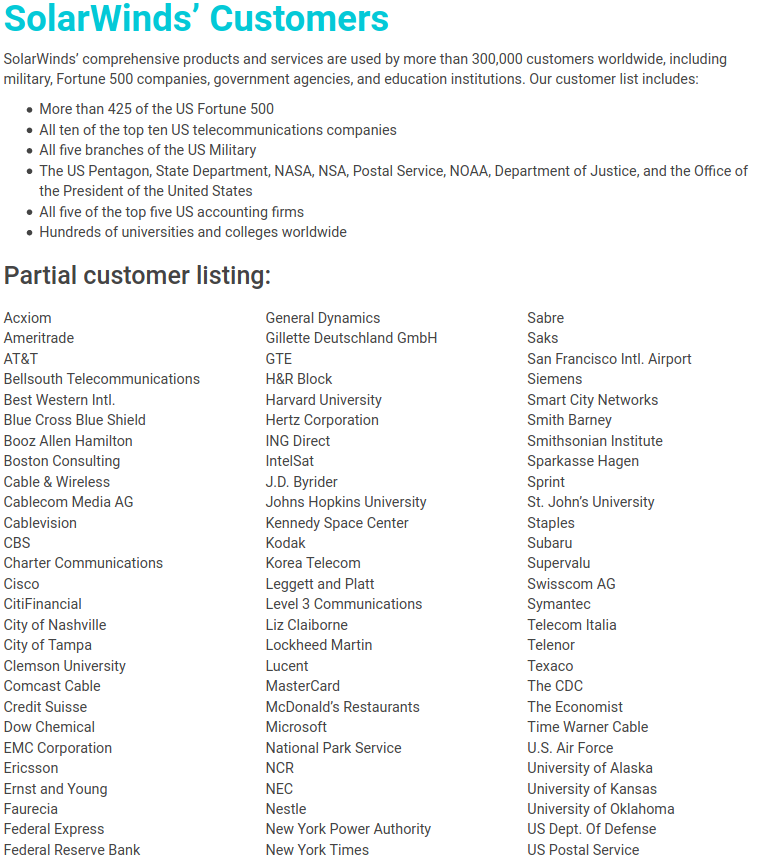
Communications at the U.S. Treasury and Commerce Departments were reportedly compromised by a supply chain attack on SolarWinds, a security vendor that helps the federal government and a range of Fortune 500 companies monitor the health of their IT networks. Given the breadth of the company’s customer base, experts say the incident may be just the first of many such disclosures.

Some of SolarWinds’ customers. Source: solarwinds.com

According to a Reuters story, hackers believed to be working for Russia have been monitoring internal email traffic at the U.S. Treasury and Commerce departments. Reuters reports the attackers were able to surreptitiously tamper with updates released by SolarWinds for its Orion platform, a suite of network management tools.

In a security advisory, Austin, Texas based SolarWinds acknowledged its systems “experienced a highly sophisticated, manual supply chain attack on SolarWinds Orion Platform software builds for versions 2019.4 HF 5 through 2020.2.1, released between March 2020 and June 2020.”

In response to the intrusions at Treasury and Commerce, the Department of Homeland Security’s Cybersecurity and Infrastructure Security Agency (CISA) took the unusual step of issuing an emergency directive ordering all federal agencies to immediately disconnect the affected Orion products from their networks.

“Treat all hosts monitored by the SolarWinds Orion monitoring software as compromised by threat actors and assume that further persistence mechanisms have been deployed,” CISA advised.

A blog post by Microsoft says the attackers were able to add malicious code to software updates provided by SolarWinds for Orion users. “This results in the attacker gaining a foothold in the network, which the attacker can use to gain elevated credentials,” Microsoft wrote.

From there, the attackers would be able to forge single sign-on tokens that impersonate any of the organization’s existing users and accounts, including highly privileged accounts on the network.

“Using highly privileged accounts acquired through the technique above or other means, attackers may add their own credentials to existing application service principals, enabling them to call APIs with the permission assigned to that application,” Microsoft explained.

Malicious code added to an Orion software update may have gone undetected by antivirus software and other security tools on host systems thanks in part to guidance from SolarWinds itself. In this support advisory, SolarWinds says its products may not work properly unless their file directories are exempted from antivirus scans and group policy object restrictions.

The Reuters story quotes several anonymous sources saying the intrusions at the Commerce and Treasury departments could be just the tip of the iceberg. That seems like a fair bet.

SolarWinds says it has over 300,000 customers including:

-more than 425 of the U.S. Fortune 500
-all ten of the top ten US telecommunications companies
-all five branches of the U.S. military
-all five of the top five U.S. accounting firms
-the Pentagon
-the State Department
-the National Security Agency
-the Department of Justice
-The White House.

It’s unclear how many of the customers listed on SolarWinds’ website are users of the affected Orion products. But Reuters reports the supply chain attack on SolarWinds is connected to a broad campaign that also involved the recently disclosed hack at FireEye, wherein hackers gained access to a slew of proprietary tools the company uses to help customers find security weaknesses in their computers and networks.

The compromises at the U.S. federal agencies are thought to date back to earlier this summer, and are being blamed on hackers working for the Russian government.

In its own advisory, FireEye said multiple updates poisoned with a malicious backdoor program were digitally signed with a SolarWinds certificate from March through May 2020, and posted to the SolarWindws update website.

FireEye posits the impact of the hack on SolarWinds is widespread, affecting public and private organizations around the world.

“The victims have included government, consulting, technology, telecom and extractive entities in North America, Europe, Asia and the Middle East,” the company’s analysts wrote. “We anticipate there are additional victims in other countries and verticals.”

Update, 8:30 p.m. ET: An earlier version of this story incorrectly stated that FireEye attributed the SolarWinds attack to APT29. That information has been removed from the story.

Premium Domain Names – transcom.uk
Transcom ISP – The UK’s Best Business ISP
DoubleCheck any website at doublecheck.uk